
In the heart of America’s industrial revival - or what some call its “sluggish renaissance” lies a tale of resilience, rivalry and reinvention.
As we hit October 2025, the manufacturing sector stands at a crossroads. Once the undisputed king of global production, the United States now grapples with a shifting landscape dominated by Asia’s scale and Europe’s precision.
Yet, amid escalating trade tensions and labor crunches, a beacon of hope emerges: Robotics and AI-driven Automation.
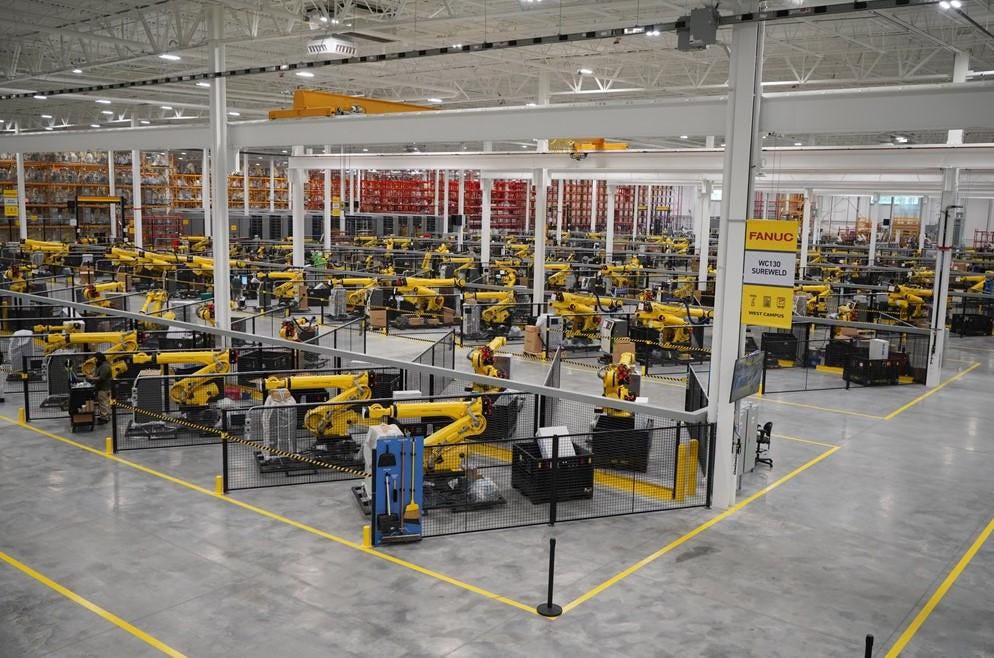
Image: FANUC America’s robotics and automation campus
Picture this: In 1980, the US commanded nearly 30% of the world’s manufacturing output, a testament to post-WWII industrial might. Fast forward to 2025, and that share has dwindled to about 15.9%, while China surges ahead at 31.6% - more than double the American footprint.
According to the latest UNIDO (United Nations Industrial Development Organisation) data, global manufacturing output grew a robust 1.3% in Q1 2025, but the US contribution feels like a shadow of its former self.
China leads global manufacturing by a wide margin, with roughly a third of world output, while the US holds a slot No. 2 position around the mid-teens (see chart below). That gap masks a crucial nuance:
The US over-indexes in high-value and hard-to-replicate niches (semiconductors, aerospace, bioprocessing) even as it lags in sheer volume.
Statista’s breakdown shows China at ~31% and the US at ~16% of global manufacturing share, Japan and Germany trail in the mid-single digits.
China’s manufacturing value added was about $4.66T in 2023. The US remains a distant second by volume, but much closer in value-added where our play is the complex, certified, digitally-threaded build: chips, avionics, medtech, defense. That's exactly very modern robotics + AI thrive.
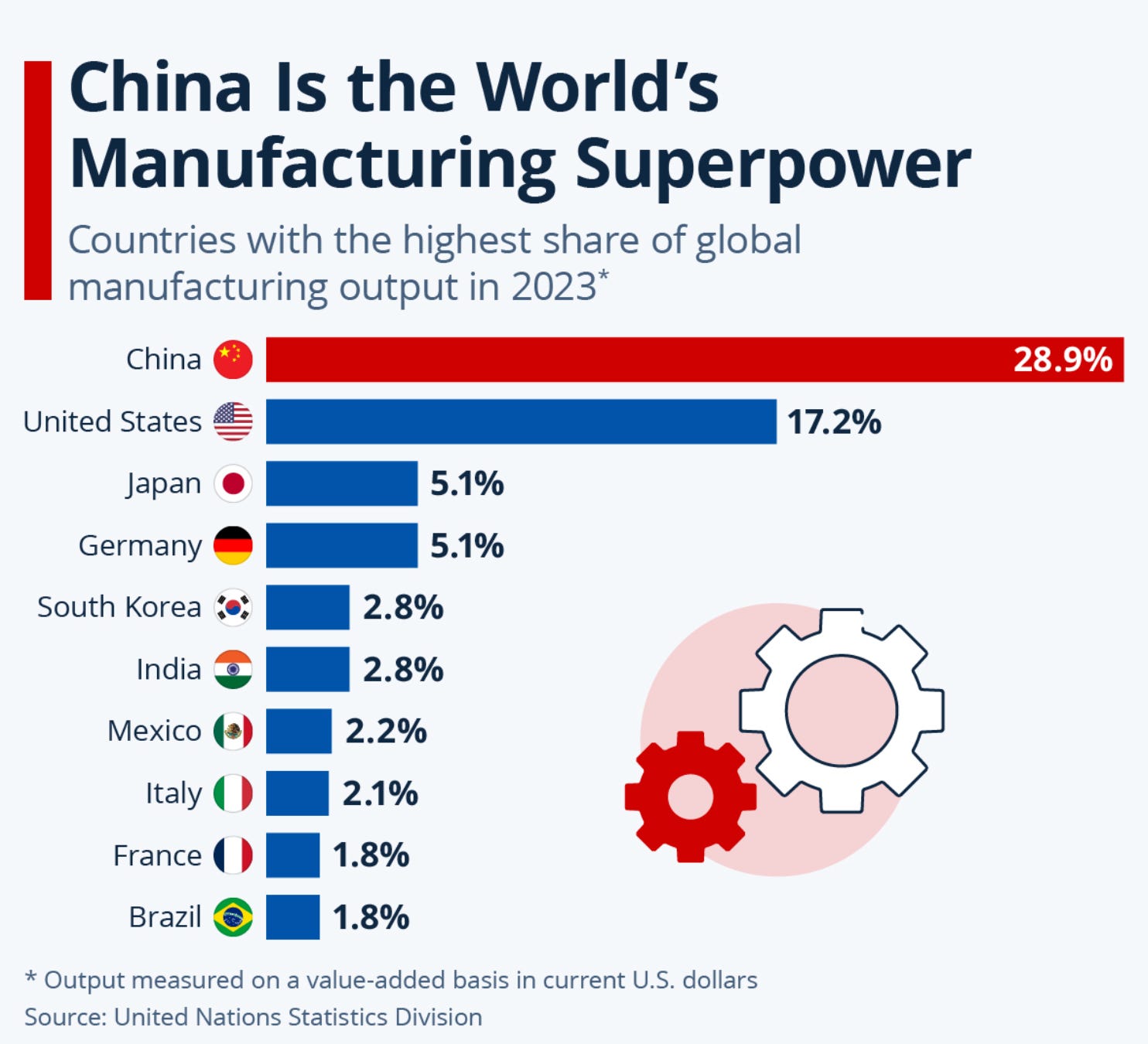
Top 10 countries by share go global manufacturing, 2023 (Statista)
By mid-2025, the US economy still leads in nominal GDP at $30.5 trillion versus China’s $19.2 trillion, but when it comes to factories humming with activity, the narrative flips. Employment tells a starker tale: Only 12.7 million Americans work in factories, a fraction of the 100 million-plus in China, where scale breeds efficiency.
To dominate manufacturing, nations need more than cheap labor. They require a symphony of enablers: a skilled workforce, cutting-edge infrastructure, bold policies, and relentless tech adoption.
The US excels in innovation (think SpaceX’s reusable rockets), but volume production? That’s China’s domain, where vast ecosystems churn out everything from EVs to iPhones at unmatched speeds. Leaders like China orchestrate this through state-backed “Made in China 2025” initiatives, funnelling billions into R&D for AI, robotics, and green tech. Germany’s “Industry 4.0” blueprint integrates digital twins and IoT for “smart factories”, while South Korea boasts the world’s highest robot density at 1,000 per 10,000 workers, feeding electronics giants like Samsung.
American consumers pay premiums for “Made in USA” goods, while supply chain snarls from pandemics and geopolitics expose vulnerabilities. Despite top STEM talent and private investments topping $100B+ annually into various industries, US faces multiple challenges:
Skills gap: Only 30% of manufacturers report adequate training for workers which hampers adoption. The US has the pieces but struggles with assembly.
Infrastructure creaks: Aging ports and grids bottleneck logistics with 40% firms citing supply chain fragility as a top risk.
Policy-wise: Incentives like tax credits exist, but they are patchwork compared to China’s subsidies.
Sustainability: US trails in green manufacturing, where Europe leads with circular economy mandates.
Labor Costs: US wages average $30/hour versus China’s $6, making low-margin goods non competitive without automation. Without addressing these through upskilling and infrastructure bills, the gap widens.
Enter the US-China trade war - the geopolitical accelerant further attenuating these challenges. Ignited in 2018, it’s far from over in 2025. And the fallout? Disrupted supply chains that once relied on China’s “world factories” efficiency.
US faces 20-30% higher input costs for electronics and rare earth materials, forcing rushed restoring that is often incomplete. And then China retaliates with export curbs on critical minerals, hitting US EV and Defense sectors hard.
While CHIPS Act pours $52B into semis, broader manufacturing aid lags. And when geopolitics breeds uncertainty, executives delay Capex amid tariffs whiplash, hence stalling innovation. The trade war doesn’t just hurt US, but it exposes its over reliance on adversaries, demanding urgent and unified action.
Technology - robotics and automation is the “leverage” that can turn scarce talent and tariff noise into durable cost advantage, faster cycles and better quality.
US manufacturers don’t need to out-scale China on headcount; they need to out-automate on precision and uptime.
Let’s look at the numbers below:
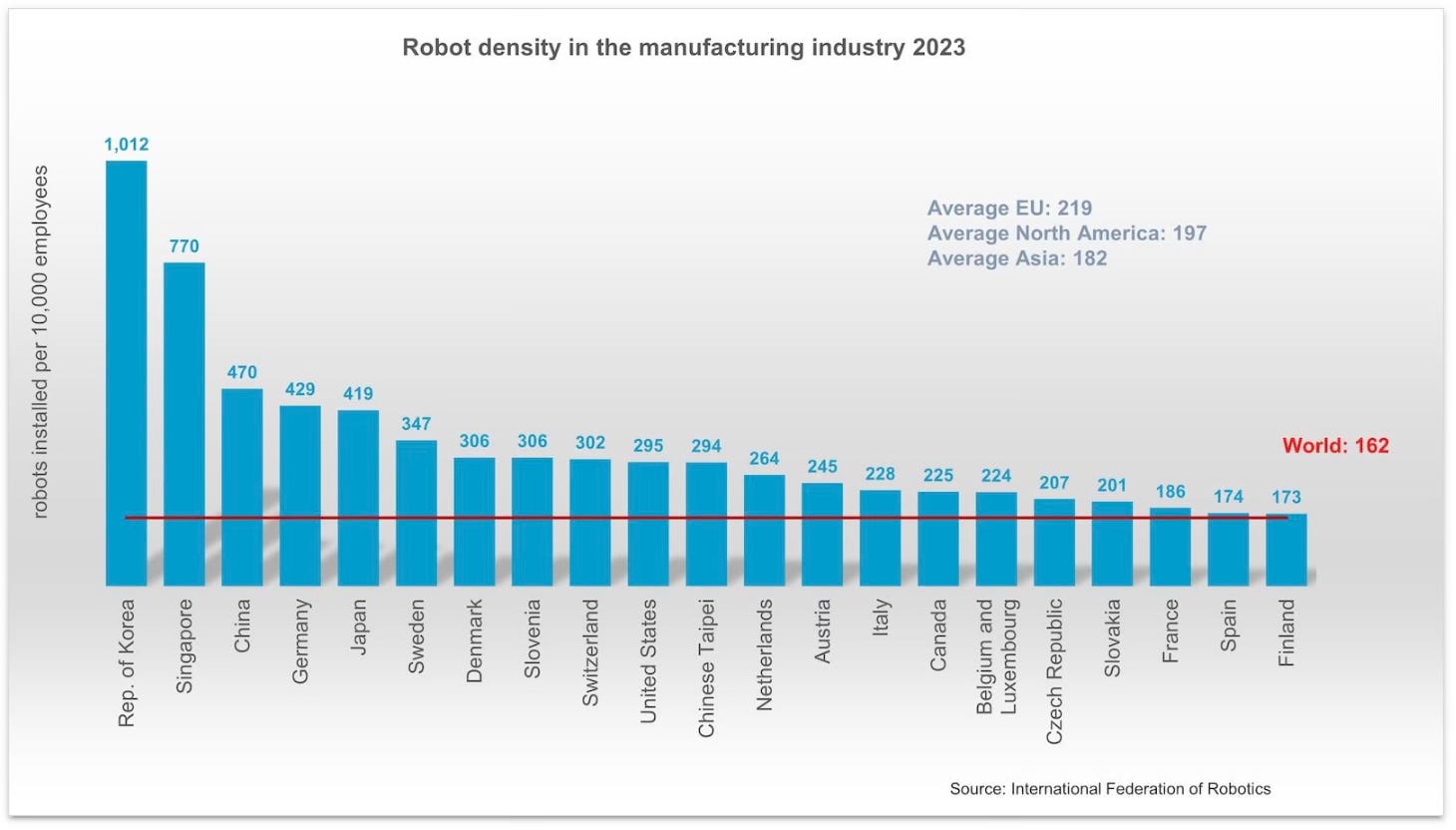
The global factory robot density (number of operational industrial robots relative to the number of employees) reached 162 per 10,000 workers in 2023 (more than double of 2016). The US sits around 295; China is 470, behind Korea and Singapore. In other words, the gap is about deployment, not capability - and closing it is the fastest path to better unit economics at home.
The market?
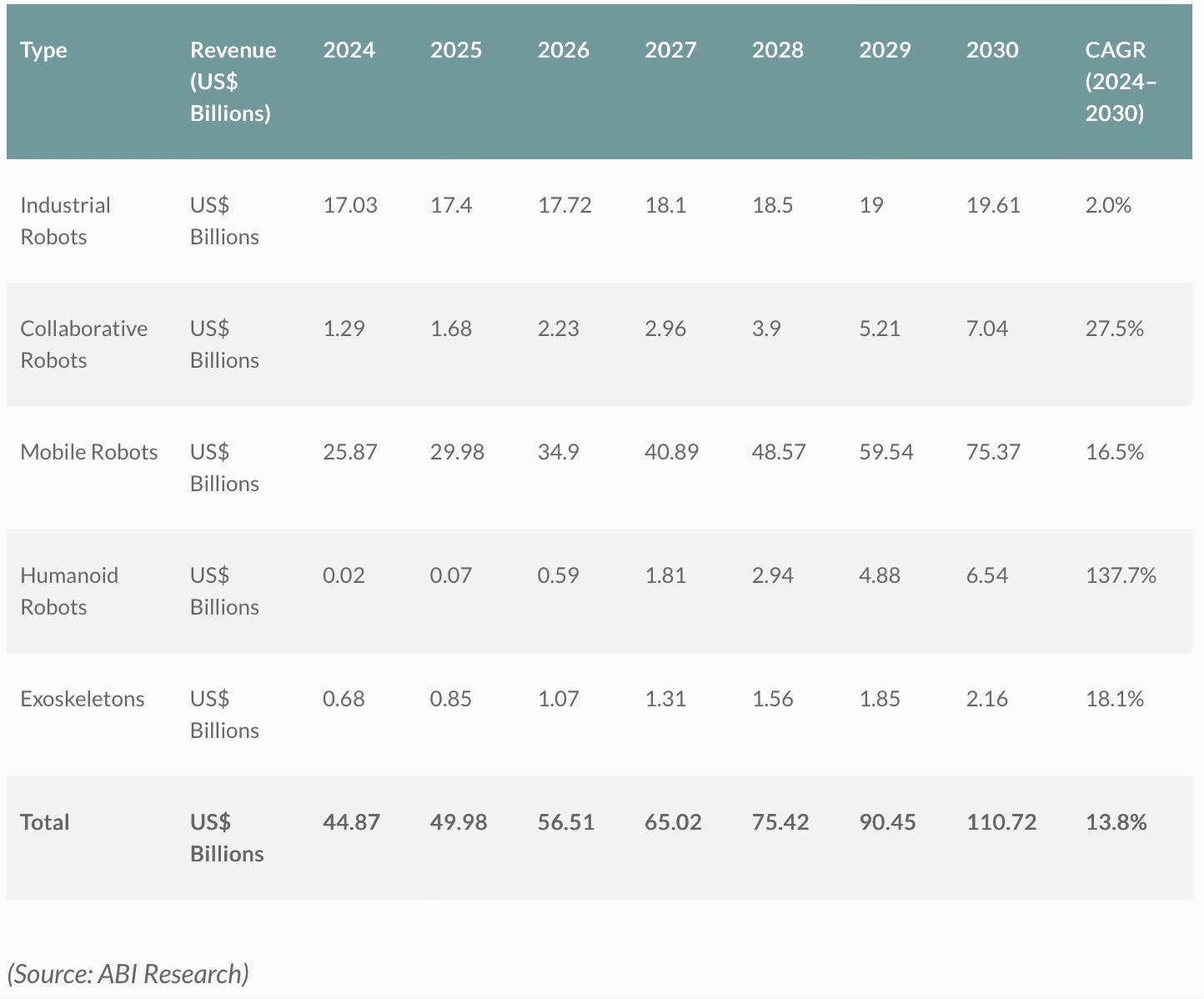
The global robotics market size will reach $110.7B by 2030, a 2.5x increase over 2024’s $45B size. Asia owns 74% of installations, but the US is catching up - robot shipments rose 12% in 2024, fuelled by AI integrations.
Also the adoption momentum is real. Q1 2025 North American orders were flat on units but up 15% on value, with activity spreading beyond auto into food, life sciences, plastics and logistics - the kind of diversification that makes capex resilient across cycles. Amazon now says it operates more than 1 million robots across 300+ facilities worldwide, and public reporting earlier this year still had them at 750,000+ touching roughly three-quarters of orders.
Of the five types of robots: Industrial, Collaborative (cobots), Mobile, Humanoids and Exoskeletons, mobile robots generate the most shipments and revenue, followed by industrial robots.
AI is integrating with robotics through Physical AI and closed-loop automation and significantly enhancing cobot capabilities. Yaskawa, KUKA, FANUC, ACC and Palladyne AI are notable robotics vendors innovating in the AI space.
Humanoid robots are the fastest growing segment, while the Exoskeleton segments are fuelled by safety augmentation in industrial organisations and demand by healthcare providers for rehab.
What does it look like on the ground?
Some real-world examples:
Welding & Fabrication: Path Robotics ships autonomous welding cells that see parts and program themselves
Surface finishing: GrayMatter Robotics automates sanding, grinding, and polishing for aerospace and specialty metals - work that is ergonomically tough for humans and painful to staff. The company raised a $45M Series B (2024) to scale these AI cells, a sign customers are seeing real ROI.
Dock and End-of-line: Dexterity’s dual-arm Mech mobile manipulator unloads trailers and handles pallet work, and the company is scaling manufacturing with Sanmina after a $95M 2025 raise.
Piece-picking: RightHand Robotics’ RightPick 4 widens the pick envelope and autonomy for item handling - useful in kitting, ecom buffers, and line-side replenishment. Rockwell Automation’s strategic investment signals the tech is maturing into mainstream industrial stacks.
At the frontier, humanoids are still early but noteworthy:
Figure AI raised $675M from Microsoft, the OpenAI Fund, NVIDIA, Bezos Expeditions, Intel Capital, and others to accelerate development, while Agility Robotics raised $150M led by DCVC and Playground Global, with Amazon’s innovation fund participating.
Venture capital is leaning in across the stack. Beyond the humanoid headlines, Hadrian, which builds highly automated CNC factories for aerospace and defence parts, closed $260M (led by Founders Fund and Lux Capital plus a loan facility) to stand up a new 270,000 ft.² robotic plant in Arizona. Eclipse Ventures continues to back software-defined manufacturing plays like Bright Machines, which operates “AI factory” assembly for hyperscaler hardware.
This is “thesis-driven” capital targeting domestic capacity, not hype cycles.
Robotics and AI-driven automation are no longer fringe tools for mega factories - they are the foundation for the next chapter of American manufacturing. They don’t just make the factories faster; they make them smarter and more resilient - exactly what you need when wages are higher and policy winds keep shifting.
Automation neutralises the labor-cost gap:
Adaptive systems from collaborative arms to early humanoids let high-wage teams outproduce low-wage labor by raising output per worker and tightening quality. Pilots from Figure AI and Agility Robotics show robots tackling picking, welding, and light assembly with faster lead times and lower operating costs when paired with human oversight. In “lights-out” or near-lights-out cells, AI-driven maintenance cuts unplanned downtime, keeping throughput steady and predictable.
Reshoring is becoming viable again:
The US play isn't mass or cheap labor; it's leveraged labor - one skilled tech supervising multiple cells, tuning paths, clearing exceptions, and improving processes. That shifts the comparison with China from hourly wages to OEE, yield, and changeover - areas where software, vision, and robotics shine.
Innovation is local and fast:
Startups are compressing time-to-first-part and making high-mix feasible at home. Hadrian Automation runs fully automatic CNC plants for aerospace/defense, shrinking prototyping cycles from weeks two hours. Path Robotics turns high-mix welding into a self programming workcell; GrayMatter Robotics automates sanding/grinding/polishing for consistent finish.
Accessibility for everyone, not just OEMs:
Cobots lower the barrier to entry. But friendlier software and faster installs, platforms from Universal Robots, ABB, FANUC, Yaskawa, KUKA, Doosan, Techman, Kassow, and others drop into existing lines for machine tending, palletizing, inspection, and kitting, often without tearing up your floor plan. That's why smaller and mid-sized plants are finally adopting automation at scale.
And why this adds up to a durable bull case?
Unit economics without wage arbitrage: Robots raise output per labor hour and compress changeovers. Net: Lower material and labor per unit - the exact battleground where US manufacturing can win.
Resilience to policy whiplash: Tariffs will ebb and flow but when more value-add happens locally, automated cells stabilize the cost and shrink lead times. Hence, trade turbulence ceases to become an existential threat.
Talent multiplier: Since the goal isn’t cheap labor, it’s leveraged labor. One technician can supervise multiple cells, while apprenticeships and short courses can turn operators into cell techs. Robots can take the dull, dirty, dangerous work and people can move up to troubleshooting and continuous improvement.
The data flywheel: Standardizing on OPC UA and MTConnect lets robots, CNCs, vision, and MES speak the same language. With a shared data layer, you get predictive maintenance that actually predicts, faster changeovers informed by real cycle data, and a continuous-improvement loop that compounds every quarter.
In practice: Put adaptive automation in the loop, upskill for leverage, and wire the factory with interoperable data. That combination turns “Made in USA” into a real operating model - delivering lower costs, faster turns, better quality and stronger resilience.

Comments
Nothing yet. Say the first thing.
Sign in to join the conversation.