
Each year comes with a story we like to tell ourselves. In the context of startups and the tech ecosystem:
2021 was about abundance.
2022-2023 was about shock.
2024-2025 were about AI discovery and acceleration.
2026 feels different. It feels consequential.
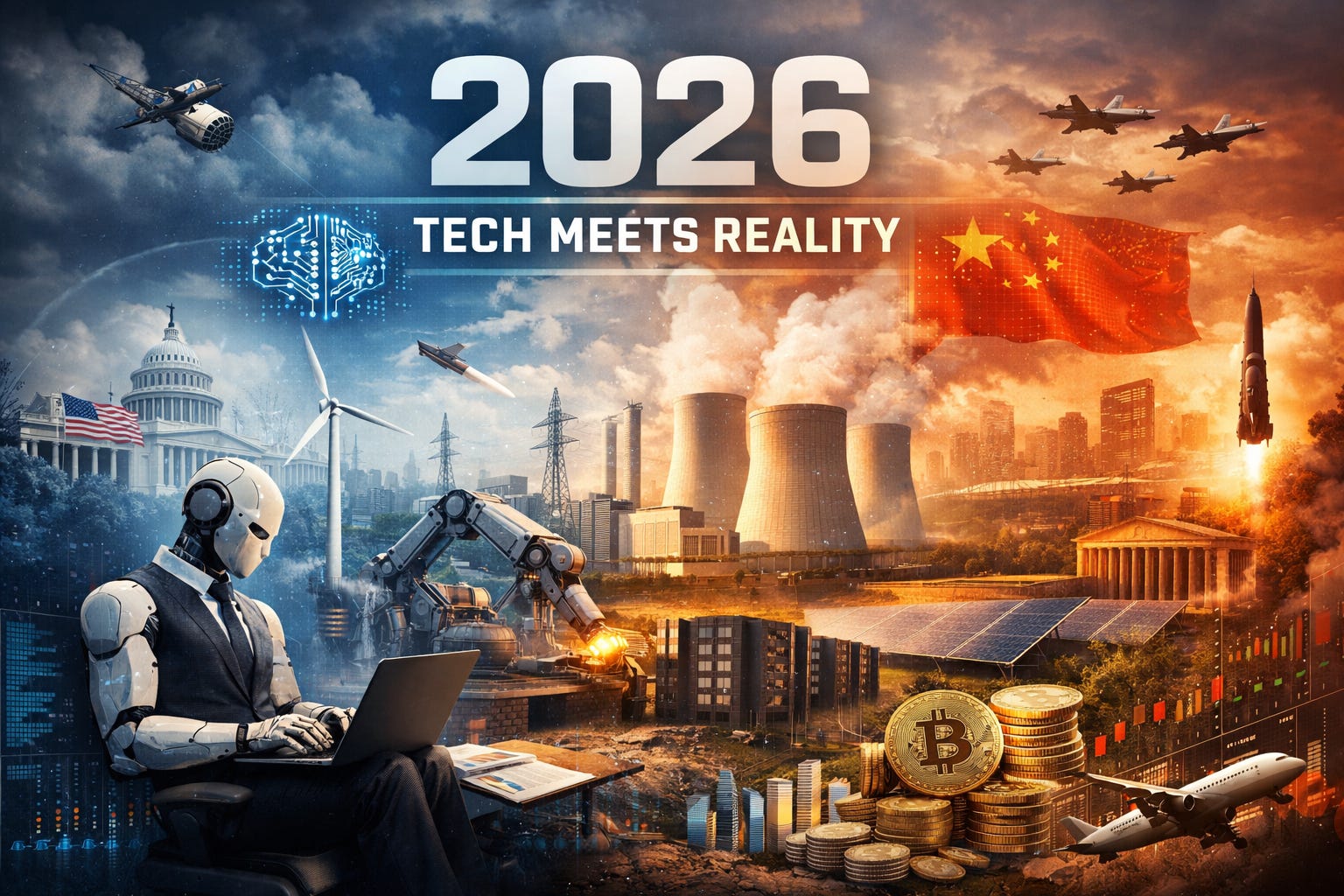
Here’s how I see it unfolding across AI, deep and frontier tech, and markets more broadly (overview first and details to follow):
I. AI: From Magic to Machinery
From Agents to Context and Adoption
The AI Model World Is About to Get Weird Again
AI Wearables & Physical AI Are No Longer Science Fiction
AI Security Has Its “Oops” Year
II. Deep and Frontier Tech
Energy Becomes a First-Class Constraint
Crypto Continues Quietly
Biotech Moves Faster Than Policy
SpaceTech Becomes Strategic Again
III. Markets
More M&A, Fewer IPOs
Private Credit Steps in Where Venture Pulls Back
Private Equity Uses AI Where It Actually Pays
Government, Regulation, and Tech Nationalism
Diving in…
I: AI: From Magic to Machinery
AI: From Agents to Context and Adoption
As predicted in 2025, AI agents are real now. The open question in 2026 though is whether they can live inside real companies without breaking them? Can they be trusted with company knowledge and whether the systems are built to help them do their best work? While the plumbing is ongoing, think of agents this year as junior employees. Useful, productive, and occasionally dangerous if left unsupervised. They need context: company history, permissions, tooling, constraints, and accountability. The companies that make agents work will focus less on “autonomy” and more on plumbing:
Persistent memory
Clear workflow ownership
Human-in-the loop escalation
Distribution inside real systems, not side dashboards
The AI Model World Is About to Get Weird Again
LLMs aren’t going away, but they are also not the end state. We are entering a phase where:
New model architectures start to matter again
Efficiency and reasoning matter more than raw scale
The US-China model race is very real
I’m watching for a third path - neither US nor China, but another DeepSeek-style breakthrough where constraints spark genuine innovation. Smaller, cheaper, specialized models that win on what actually matters. The future isn’t just large LLMs - it’s the task-specific SLMs for edge computing, privacy, and efficiency. And it requires compute architectures that challenge NVIDIA’s stranglehold, whether through novel chip designs, custom accelerators, or entirely new paradigms.
AI Wearables and Physical AI Is No Longer Fiction
AI is breaking free from screens on two fronts: ambient wearables and physical robotics. Both are crossing from demo to deployment.
On the wearable front, the race just intensified. OpenAI confirmed at Davos this month that their Jony Ive-designed device - codenamed “Sweetpea” - will debut in late 2026. Early leaks suggest earbud-style wearables that sit behind the ear, targeting 40-50 million units and taking aim directly at AirPods. Also, Apple countered, with reports of their own AirTag-size AI pin in early development - dual cameras, three microphones, screen less design running the new Gemini-powered Siri. Expected 2027, though the project could still be cancelled. The pattern matters more than any single product: AI moving from tool to companion, from software to persistent hardware.
Meanwhile, physical AI - robotics, world models and simulation-trained systems - are finally crossing the threshold from impressive demos to actual deployment - in warehouses, factories, logistics hubs, inspection sites, and maintenance facilities. But physical AI is not a robotics problem: it’s data, reliability and energy problem. Anyone can build a robot that works once in a controlled environment. The challenge is making it work every day, safely, at scale in the messy real world.
Experts at IBM and Capgemini see robotics funding potentially doubling, with partnerships turning demos into market-ready solutions in logistics and healthcare. Meanwhile, world models - AI systems learning physics and causality through 3D simulation are exploding. Runway’s GWM-1 release signals this technology is reaching mainstream viability, first in gaming and digital twins, then inevitably in robotics. The infrastructure will be finally catching up to the vision in 2026.
AI Security Has Its “Oops” Year
Every platform shift has a public failure moment (or two or more). AI is approaching it. In November 2025, Anthropic disclosed GTG-1002, the first AI-orchestrated cyber espionage campaign where autonomous agents executed most operational steps. As the agents gain autonomy, the attack surface explodes. Data leakage, model misuse, agent-to-agent failures, compliance nightmares. Shadow AI deployments inside companies that don’t even realize what they are running - costing an average of $670,000 more per breach than traditional incidents.
Security is shifting from an add-on to a core architectural concern. Some of the fastest-growing AI startups right now are not flashy at all - they are defensive and that’s usually a signal. Torq hit unicorn status with 300% revenue growth. Cyera raised $940M. Saviynt closed $700M. The sector pulled in $18B in 2025, up 26% YoY.
In 2026, AI security becomes a defensible IT spend category with board-level oversight. Major challenges intensify: advanced threats like deepfake fraud ($200M+ in losses), prompt injection attacks (succeeding in 42 seconds), and AI-orchestrated campaigns like Anthropic's GTG-1002 case. Regulatory tug-of-war escalates—state versus federal fights, lobbying to crush patchwork laws, fragmented global privacy enforcement covering 82% of the world's population. Governance, transparency, and verification tools emerge as category winners as autonomy scales.
II: Deep and Frontier Tech
Energy Becomes a First-Class Constraint
Energy Becomes AI’s Defining Constraint
AI’s power consumption is no longer a footnote—it’s reshaping the entire industry’s economics and geography. The IEA projects global data center electricity demand will more than double to 945-1,050 TWh by 2030 (from ~415 TWh in 2024), with AI driving 30% annual growth in accelerated servers. In Ireland, data centers could consume 32% of national electricity by 2026. This isn’t abstract anymore.
In 2026, energy constraints dictate strategy: where data centers get built, which models are economically viable, how inference gets priced, and what architectures survive at scale. Big tech is increasingly thinking like utilities—negotiating directly with power providers, building on-site generation, and treating energy access as a moat. Meanwhile, startups are emerging around energy-aware compute, grid optimization, dynamic load balancing, and inference routing based on real-time power costs.
Energy is now part of the AI stack, not infrastructure it sits on top of. AI’s thirst for power is turning data centers into geopolitical assets—and liabilities. States are eyeing barriers on power access for foreign-owned compute. Regions with abundant energy (Texas, Middle East, Nordics) gain leverage. And technologies that seemed decades away—fusion, small modular reactors, advanced grid tech—resurface as serious near-term themes with real capital behind them. The AI race is becoming an energy race.
Crypto continues quietly
Crypto isn’t gone. It’s just less loud. The parts that are working are pure infrastructure: stablecoins as settlement rails, tokenization of real world assets, on-chain payments beneath normal UX. It’s less about ideology and more about plumbing - and that’s usually where the real value accrues. The shift is telling: AI agents can’t use cash, but they can transact with stable coins. Non-human identities now outnumber human financial services workers 96-to-1, yet remain “unbanked ghosts”. a16z predicts 2026 introduces Know Your Agent (KYA) - cryptographic identity systems linking agents to human principals, constraints, and liabilities. This isn’t speculative; major wallets are already implementing intent-driven transactions where you say “find me the best yield for my USDC on an L2” and the agent handles bridge, swap and deposit.
In 2026, the interesting overlap is Crypto X AI Infra. Agents managing small slices of DeFi. Autonomous yield optimization. Smart contract generation and monitoring. Prediction markets like Polymarket demonstrating real liquidity, with weekly volumes topping meaningful scale. Nonpayment systems enabling usage-based AI compensation at scale - solving the problem where AI agents extract value from ad-supported sites while bypassing revenue streams. This convergence isn’t about tokens pumping; it’s about crypto becoming essential plumbing for autonomous economies.
Biotech Moves Faster Than Policy
AI-enabled biotech is accelerating dramatically. Drug timelines are compressing - what took 2.5-4 years now takes 12-18 months. Early clinical data suggests AI-native biotechs are achieving significantly higher Phase I success rates than traditional approaches. Self-driving labs with robotics-integrated AI are turning design-make-test-learn cycles from quarterly processes to weekly ones. Foundation models for protein structure prediction and molecular synthesis are reaching expert-level performance, with major pharmaceutical treating AI as core infrastructure rather than experimental add-on.
The core tension in 2026: science moves faster than the systems designed to govern it. The FDA and EU are scrambling to establish frameworks for AI-generated insights in regulatory submissions, but guidance lags innovation by years. Reimbursement models don't yet account for computationally-designed therapeutics. Liability questions remain unresolved when AI makes critical discovery decisions. Adoption is bifurcating—breakthrough use cases with clean, verifiable data (protein prediction, target identification) are scaling fast, while areas with messy, incomplete data (generative design, biomarker analysis) still struggle. The winners won't just be the best computational biologists—they'll be teams that can navigate both cutting-edge biology and Byzantine bureaucracy, building AI systems that are regulatory-ready from day one. Speed versus safety. Innovation versus approval. 2026 is where that collision accelerates.
SpaceTech Becomes Strategic Again
Space is no longer science fiction or billionaire vanity projects—it’s critical infrastructure. Private investment surged 48% to $12.4 billion in 2025, driven by defense-linked satellites, AI integration, and launch capacity expansion. The sector is shifting from exploration narrative to strategic asset, with geopolitical tensions accelerating military and intelligence satellite deployments. A potential SpaceX IPO in 2026 could value the company at unprecedented levels and legitimize space as a mainstream investment category, pulling institutional capital into the broader ecosystem. What changed: reusable rockets made the economics work, and suddenly orbital infrastructure isn’t aspirational—it’s viable.
The most interesting bets for 2026 aren’t Moon colonies—they’re orbital AI data centers and space-based solar power (SBSP). Unlimited solar energy and natural cooling make orbit attractive for compute-intensive AI workloads that are constrained by power and heat on Earth. SBSP, estimated at $3.3 billion in 2025 and forecast to reach $7.2 billion by 2035, is moving from concept to demonstration as clean energy demand intensifies and beaming technology matures. Meanwhile, defense and intelligence agencies are treating space superiority as non-negotiable, with satellite constellations for communications, surveillance, and potential anti-satellite capabilities becoming standard procurement. Space is becoming strategic infrastructure—energy, compute, and defense converging in orbit. The companies building reusable launch capacity, AI-orbit integration, and SBSP capture are positioning for a trillion-dollar frontier that’s no longer decades away.
III: Markets:
More M&A, Fewer IPOs
Liquidity isn’t dead - it’s just selective. In 2026, strategic M&A will outpace IPOs as large companies buy capabilities they can’t build fast enough internally, particularly in AI infrastructure, security, and vertical SaaS. Strong but non-category-defining startups increasingly choose acquisition over the brutal scrutiny of public markets. The math is simple: public markets demand durability, profitability, and scale at IPO; private markets demand optionality and growth. ServiceNow’s $11.6B security acquisition spree in 2025 set the template - platform companies consolidating point solutions before they become competitive threats. Meanwhile, the IPO window remains narrow, reserved for true category leaders with clear paths to sustained profitability. Founders need to plan exits like adults again: if you're not building a generational company that can withstand public market discipline, a strategic exit at the right valuation beats a mediocre IPO followed by years of underperformance. Fewer unicorn debuts, more intelligent acquisitions, and a healthier ecosystem where strong players get scooped up by buyers who can actually scale them.
Private credit steps in venture falls back
As venture capital becomes more disciplined and traditional banks stay cautious post-SVB, private credit is filling the gap—and becoming normalized. Revenue-based financing, structured debt, and hybrid equity instruments are no longer exotic capital structures reserved for struggling companies. They're standard tools for scaling businesses that have revenue but don't fit the traditional VC power-law profile. This shift ties directly into broader 2026 themes: companies need flexible capital to navigate energy constraints, regulatory complexity, and longer paths to profitability. Structure knowledge is no longer optional for founders. Understanding waterfalls, liquidation preferences, PIK interest, and warrant coverage is as essential as understanding CAC and LTV. The winners will be founders who can evaluate a term sheet from a credit fund with the same sophistication they bring to equity rounds, and credit providers who can move at venture speed with discipline that banks require.
Private Equity Uses AI Where It Actually Pays
Private equity deploys AI where it can cut costs, improve pricing, and optimize operations across portfolio companies. This isn't glamorous, but it's profitable. Jared Kushner's Affinity Partners co-founded Brain Co. with prolific investor Elad Gil, raising $30M to help Fortune 100s and governments implement AI at scale—not building foundation models, but bridging the gap between cutting-edge capabilities and institutional operations. The company already works with auction houses, PE giants like Warburg Pincus, healthcare systems, energy providers, hotels, and restaurant chains, automating everything from booking workflows to construction permit processing to insurance claims. This is the pattern: operational AI, vertical-specific tooling, and AI-driven roll-ups quietly creating real economic value. PE firms view AI as an enabler in portfolios rather than standalone investment—using it to compress EBITDA improvement timelines, identify acquisition targets, optimize pricing dynamically, and automate back-office functions at scale. Much of AI's actual value creation in 2026 happens here—not on stage at conferences, but in spreadsheets, workflow automation, and margin expansion across thousands of legacy businesses getting incrementally smarter.
Government, Regulation, and Tech Nationalism
Governments are no longer neutral observers—they care deeply about data sovereignty, defense relevance, and technological autonomy. AI is increasingly treated like critical infrastructure, closer to telecom or energy than software, triggering sovereign cloud requirements, national AI strategies, and localized compliance frameworks. The EU AI Act phases in throughout 2026. China's data localization laws tighten. The U.S. tightens export controls on AI chips and models. Startups now build compliance-by-design and region-specific deployment strategies whether they admit it publicly or not. Some companies will be global; others will be strategically local—and both can win, but the playbook diverges sharply. Tech nationalism isn't a headline anymore; it's a structural reality shaping capital allocation, hiring, data residency, and partnership strategies. The CFIUS review process becomes routine for any meaningful foreign investment in AI or infrastructure. Trade restrictions fragment the global AI ecosystem. Countries compete not just for AI talent but for compute capacity, energy access, and model sovereignty. The companies that win long-term will be those that plan for a fragmented regulatory landscape from day one, treating geopolitical risk as a first-order design constraint rather than an afterthought.
If you’re building in 2026, there’s one question I keep coming back to: What breaks first if this actually scales?
The answer usually tells you where the real work is. And where the opportunity lives.
The hard part isn't the technology anymore. It's everything else.
The views expressed are those of the author and do not necessarily reflect the views of any investment firm or portfolio company.
Comments
Nothing yet. Say the first thing.
Sign in to join the conversation.