

Imagine you take your 10-year-old Golden Retriever “Molly” to your vet Dr. Jones for her annual wellness visit. Molly’s been healthy overall, but you mention she has been slowing down a little lately—maybe it’s just old age? Nothing too concerning pops up on the physical exam, and routine labwork is pretty boring, other than a mildly increased calcium.
Dr. Jones explains that while there are many causes for that abnormality, one of them is cancer such as lymphoma, which Golden Retrievers are unfortunately predisposed to.
“There is a new blood test1 that can screen for lymphoma and other cancers, is that something you’d be interested in submitting?” Dr. Jones asks. “I learned about it at the last conference I attended, the sales rep made it sound great!” she adds. After thinking about it, you decide yes and send off more blood.
A few days later, Dr. Jones calls with bad news: The test was positive.
That result triggers an extensive (and expensive) work-up. However, Molly continues to feel well and none of the other diagnostics confirmed lymphoma or other tumors. Because we couldn’t prove that Molly even has cancer, let alone where or what kind it is, all you can do is watch and wait…
10 weeks later, Molly’s lymph nodes massively increase in size 😟 When Dr. Jones aspirates them, the pathologist sees this under the microscope:
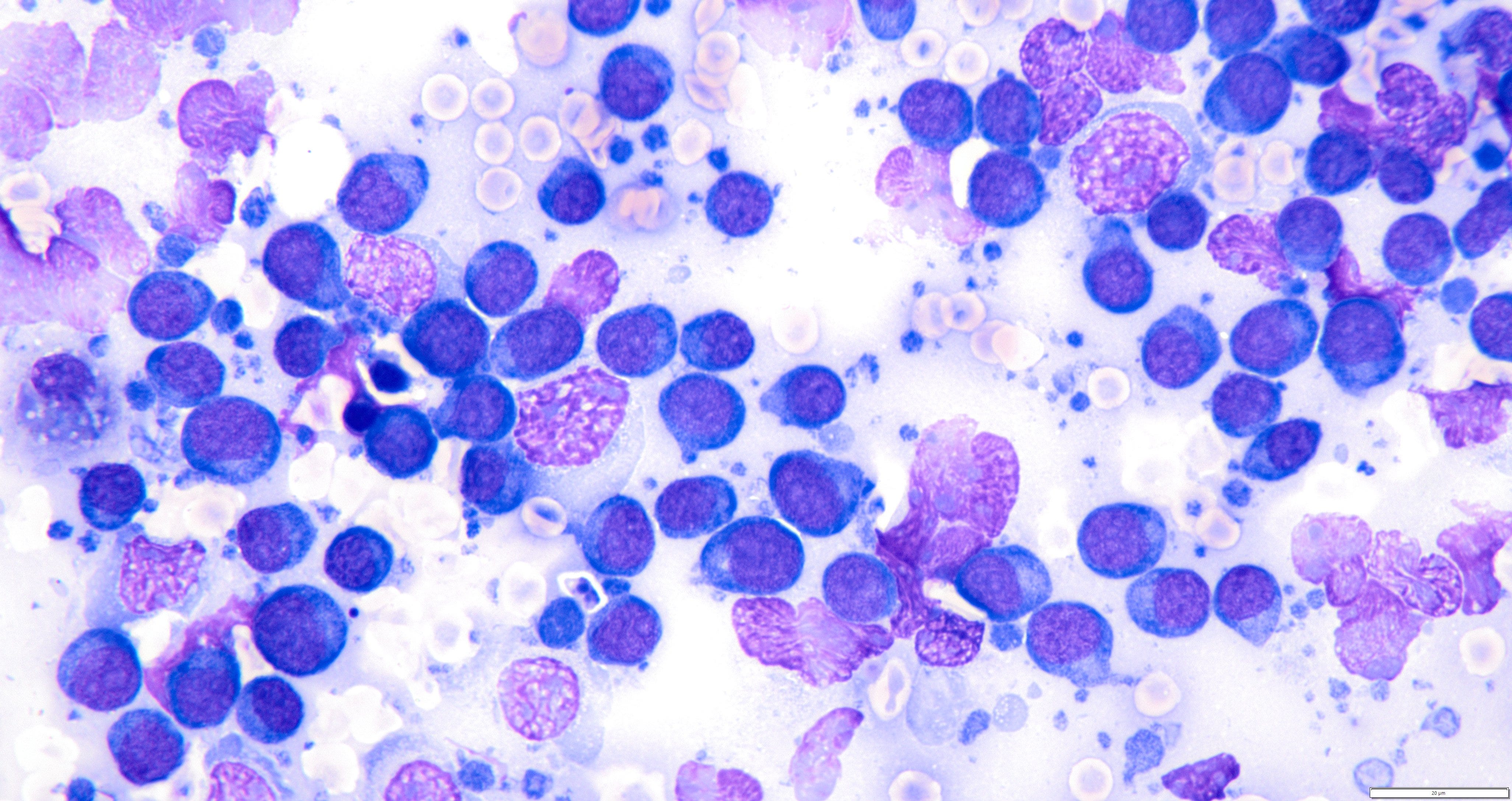
All of the slides contain a uniform expansion of large, immature lymphocytes, consistent with a diagnosis of high-grade lymphoma. After two and a half months of stress and worry, Molly finally begins receiving multi-agent chemotherapy2.

Let’s unpack what happened with a few questions:
Was the original positive result an early true positive, or a false positive?
In light of the case outcome, it’s highly likely that the original result was indeed a true warning sign, but there were too few cancer cells to locate or sample them.
Did that presumptive early cancer diagnosis provide any benefit to Molly?
For this one, I would argue NO.
The whole concept behind these cancer screening blood tests is that if you can detect tumors at a lower stage (when they are smaller and localized), you could potentially remove or otherwise treat them before they spread throughout the body and become impossible to cure. However, central to this theory is that the diagnostic information has to be actionable.
What do I mean by “actionable”? Even if these tests had perfect accuracy (and spoiler alert, they don’t)…
If you don’t know the location of the tumor, you can’t do surgery or radiation
If you don’t know the precise type of cancer, you can’t administer chemotherapy or immunotherapy3
In this hypothetical example, you paid money (probably several hundred dollars) for an initial screening test that caused a lot of anxiety and stress. Cancer was already on your vet’s radar from the high blood calcium, so it wasn’t adding a new concern. This in turn led to following up with a bunch of extra imaging and pathology diagnostics that cost even more money—full bloodwork, X-rays, abdominal ultrasound and cytology would likely be several thousand dollars—and wound up inconclusive. In the end, Molly got a concrete diagnosis months later when she became symptomatic and began treatment at likely the same time as she would have without doing any of that other stuff.
Net added survival time: likely close to zero.
Do these veterinary multi-cancer screening tests perform worse than the ones in human medicine?
No!
Over the past decade there have been many minimally invasive multi-cancer screening tests developed and several are now being sold to the public. The best known is probably the Galleri test offered by a company called GRAIL. Galleri looks at cell-free DNA and methylation patterns in blood, and the company claims it can detect 50+ kinds of cancer with high accuracy. GRAIL marketing pushes annual screening for at risk patients, and it’s not cheap at almost $1,000 out of pocket.
A number of small pilot studies using Galleri showed promise, but we were lacking a large population study over a long period of time to see if it caught a lot of early stage cancers—until now. Results from the first large scale randomized clinical trial of Galleri were published at the end of May this year.
GRAIL’s clinical trial was pre-registered and started in 2021. The National Health System (NHS) in the UK recruited 142,942 patients aged 50-77 without evidence of cancer and drew blood annually for 3 years.4 Participants were randomized to either receive the additional Galleri assay or not (the control group). The study looked for 12 different cancers, but specifically excluded breast and cervical cancer (due to established routine screening processes). Patients in the Galleri group that received positive results were referred and worked up according to the appropriate NHS oncology protocols.
The top-line results were disappointing:
“While the Galleri-NHS study results show some encouraging trends toward tumor downstaging, it is important to recognize that the trial did not statistically reduce late-stage cancers by its predefined primary endpoint.”
Brown University radiation oncologist Dr. Sana Raoof provides some nuanced thoughts about these results in an op-ed for the medical news site STAT. While the GRAIL arm of the trial did result in fewer stage IV cancer diagnoses, there was an increase in Stage III diagnoses, which essentially cancelled each other out. Would that result be clinically meaningful? Possibly, with some caveats: Dr. Raoof points out that for some tumors, treatment options and prognosis are better at Stage III than IV. However, surviving other common killers like liver and pancreatic cancer depends on achieving complete surgical removal early, and the distinction between Stage III and IV may be small. She also makes a few other points, such as the 3-year duration of the study, which was far shorter than other screening trials like low-dose CT scans for smokers to catch lung cancer (6.5 years)5.
I want to be clear that I am NOT against any and all forms of cancer screening! I previously wrote about the trend of increasing colon cancer diagnoses in young people, and as a result many oncologists are pushing to lower the age for colonoscopies. What sets colonoscopies apart from these blood tests for cancer?
First, it’s a limited search: You are looking for a specific type of cancer in one part of the body. There is no risk of going on a “fishing expedition” looking for cancer anywhere from the liver, brain, or lungs, which drastically increases both the costs of testing and risk of false positive results.
Second, the information you get is “multimodal.” Rather than a binary “cancer” or “no cancer” result, the doctor performing the colonoscopy can visualize the lesions directly, measure the size, describe their appearance, and sample them with a biopsy. Other underlying intestinal diseases like ulcerative colitis can be diagnosed at the same time.
Third, you can surgically remove suspicious polyps during the procedure, so this is potentially a test + treatment at the same time!
Other similarly robust screening tests include Pap smears for cervical cancer, mammograms for breast cancer, and the previously mentioned CT scans for lung cancer in smokers. While new data has resulted in tweaks to the recommended ages and intervals between these screening events, they have stood the test of time and contributed to improving survival for those specific diseases.
I want to believe that someday we will have better options for minimally invasive cancer screening in both people and animals. Today, that goal remains elusive because we’re still sorting out the science of these molecular cancer biomarkers. In my professional opinion as a veterinarian, you should never run a test unless (1) you know how to interpret the results and (2) that it could change your clinical plan. So unless and until robust data shows that these multi-cancer screening blood tests can generate truly actionable information that leads to improved survival times, I personally would not run them on myself or my pets.
—Eric
Thanks for reading All Science Great & Small! This post is public so feel free to share it 👇
Author’s Note: This article is for educational purposes only and does not constitute medical advice. Nor does it necessarily reflect the viewpoints of any current or previous employers.
There are several of these tests on the market, but I am deliberately not naming the exact product for several reasons. For one, whenever possible I avoid “name and shame” articles on this site and try to stick to core scientific principles. For another, many of these companies don’t publish information on their methods or validation, which makes it difficult if not impossible to verify any specific claims they make.
While some details have been changed for privacy, this hypothetical patient is actually quite close to a real case I saw recently
There is unfortunately no universal chemotherapy protocol for cancer in human or vet med; giving the wrong drug(s) can be costly and ineffective, to say nothing of the harmful side effects, so you don’t want to blindly guess without a diagnosis!
This is a fairly massive screening trial over multiple years. I am skeptical that if there was no statistically significant benefit to Galleri in this huge population, we are likely to do better in veterinary studies which are shorter in duration and much smaller in size
Comments
Nothing yet. Say the first thing.
Sign in to join the conversation.