
Dear Readers,
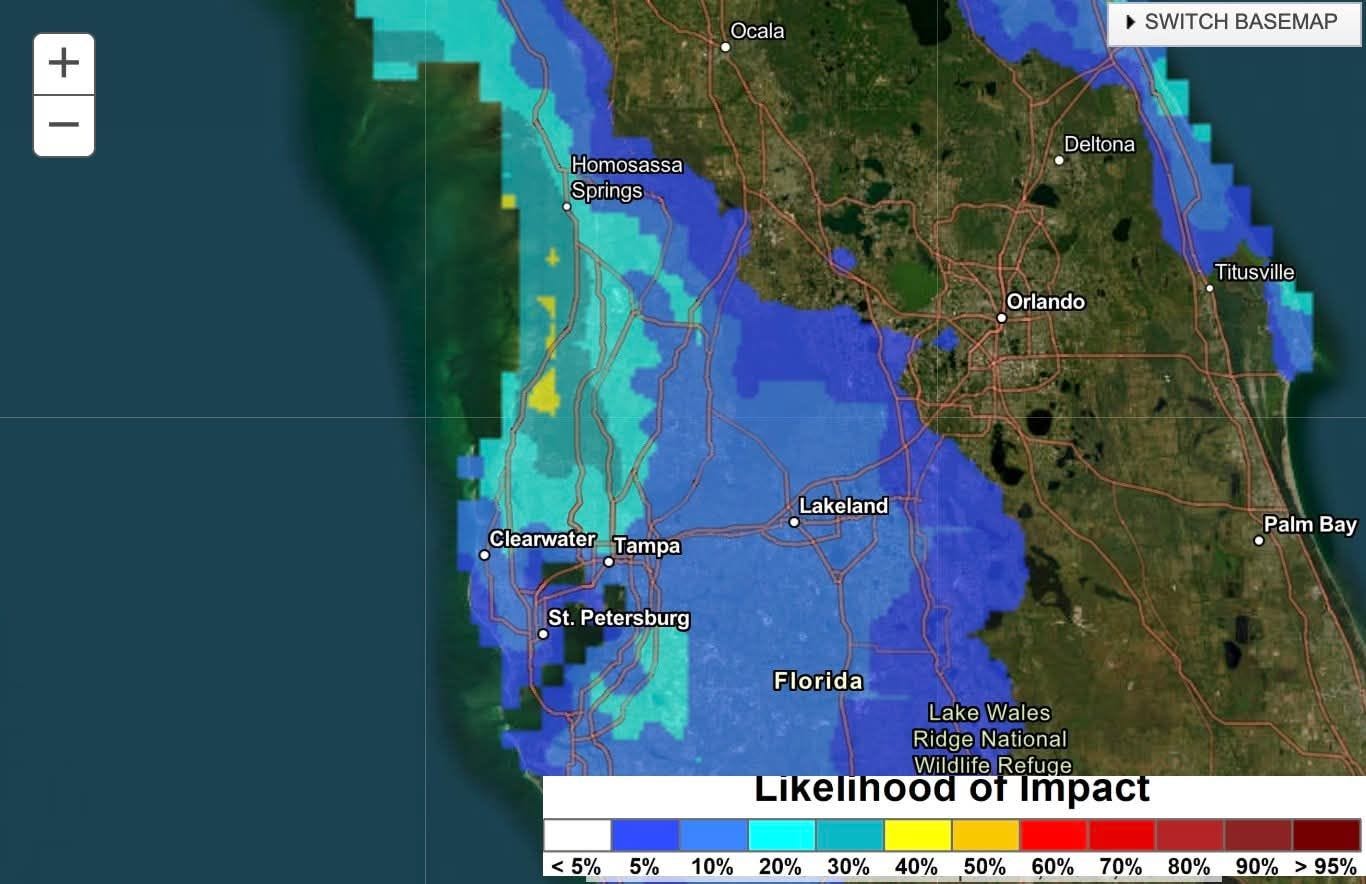
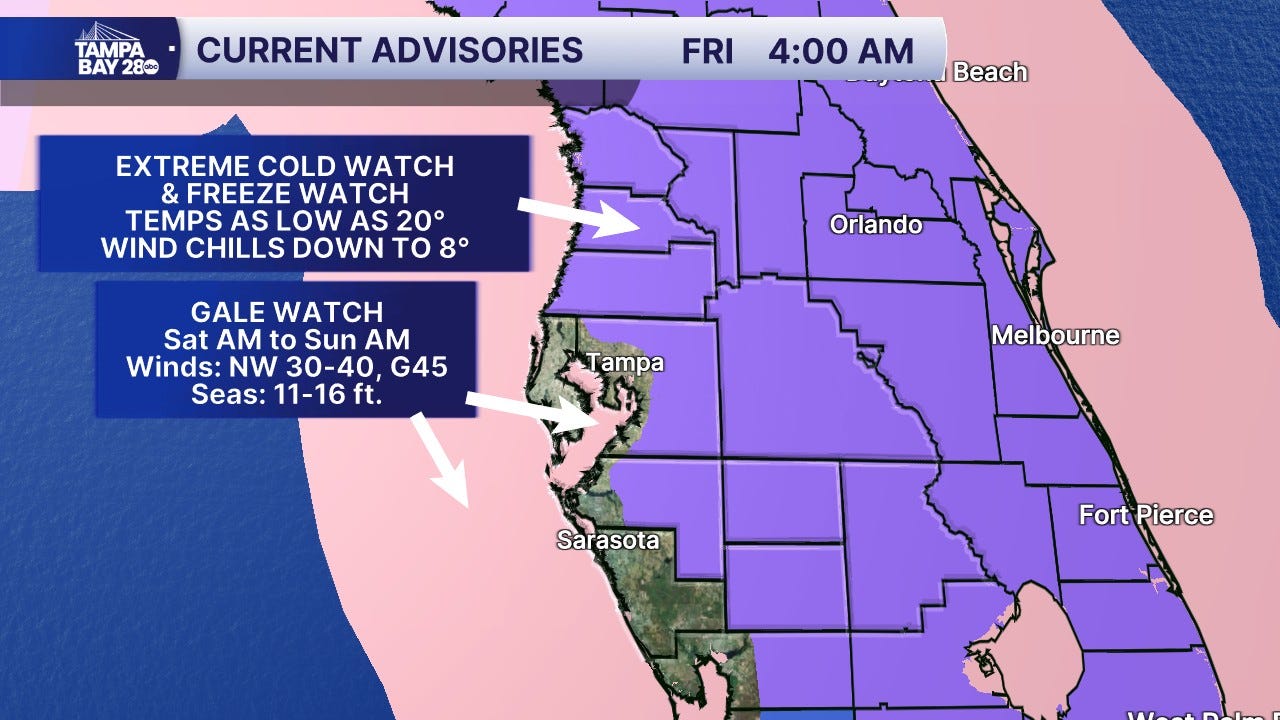
The climate in early 2026 is wild, both in terms of news events and actual weather. Last weekend the massive Winter Storm Fern dumped snow and ice across the country, with the Appalachian and midwest regions being hit particularly hard. That trend seems to be continuing with Winter Storm Gianna turning into a “bomb cyclone” that threatens blizzard conditions from the Carolinas to New England. Believe it or not, the Tampa-St. Pete area is actually predicted to get flurries tomorrow! While friends and family in upstate New York might sneer at a mere chance of minimal snowfall (that surely won’t stick), keep in mind that impact is based on whether an area is prepared for any given conditions—there aren’t exactly a lot of plows or salt trucks around town! I’m more concerned about icy roads and panicked drivers than the snow, so I plan to stay warm inside and hang out with the family 😊
As we wrap up a turbulent first month of the year, I wanted to share several news items about human and veterinary medicine you might find interesting. Read on below for stories about the return of the beloved ER show The Pitt, restarting federal veterinary loan repayment incentive programs, and a cool study that evaluates how ChatGPT does at generating client educational handouts.

One of the surprise streaming hits last year was the medical drama The Pitt on HBO. Starring Noah Wyle of ER fame, it debuted with almost no hype or marketing, yet quickly became a viral sensation on the strength of its characters and writing. The first season combined heroic scenes of saving critical patients with tackling thorny social issues like addiction and controlled substance diversion by doctors, how trauma centers manage mass shooting events, and even topical concerns like vaccine hesitancy. It swept the Emmy’s last fall with 13 nominations and 5 wins, including Outstanding Drama and Outstanding Lead Actor (Noah Wyle).
The Pitt is the rare medical show that has won the acclaim of not only TV audiences and critics, but also health care professionals, who praise its realism and message. Even vets love The Pitt—there are a lot more parallels than you might expect! Unlike other shows set in a hospital, like Grey’s Anatomy (focused on soap opera drama), House MD (more of a detective show), or Scrubs (mostly a comedy), The Pitt goes to absurd lengths to capture every detail of anatomy, terminology, and workflow so that you really feel like you’re working a 15-hour emergency shift with the staff. Dr. Dhruv Khullar, a hospitalist at NewYork-Presbyterian Hospital, wrote a glowing review of the second season for The New Yorker (“What ‘The Pitt’ Taught Me About Being A Doctor”):
What’s special about “The Pitt” isn’t that it’s medically accurate, although it is. (I even learned a few things about how to insert an emergency chest tube.) What’s special about the show is that it offers a kaleidoscopic view of how societal problems have come to pervade medicine. In recent years, I have written about E.R. overcrowding, the toll that caregiving takes on families, the physical consequences of global warming, language barriers in health care, discrimination against patients with sickle-cell disease, corporatization in medicine, and the promise and perils of artificial intelligence. “The Pitt” handles each of these themes, and many more, with nuance and grace. It’s as if the show’s creators absorbed every important conversation in health care today—and somehow transfigured it into good television.”
The new season debuted on January 8th and releases its episodes old school, one every week for the next few months. Three hours into this chaotic 4th of July shift—the ‘gimmick’ is every episode represents one real-time hour, like the show 24—and I’m already hooked. Check out the trailer below and then start watching!

One major issue facing veterinary medicine going back decades is a shortage of DVMs working in rural and farm communities. Back in 2008, when I was still in vet school, I wrote an editorial about this problem for Progressive Dairyman1:
“What’s driving my peers away from food animal medicine? The 2006 AVMA report concludes that the primary reason new graduates opt out of production animal medicine is financial concerns – particularly the debt-to-salary ratio. More than half of graduating veterinary students owe over $109,000 in educational debt [EJF: That number has risen to $169,000 in 2024], according to the DVM Newsmagazine’s March 2008 story, “Economic Emergency.” That same article lists some other interesting facts, such as veterinary school tuition nationwide increasing 100 percent since 1997, while vet salaries only rose 46.5 percent during the same time period.”
To help with the recruitment and retention of rural vets, Congress created the Veterinary Medicine Loan Repayment Program (VMLRP) within the USDA in 2010. Awardees must commit to working at least three years in one of several hundred designated shortage areas in 46 states. In return, they are given money towards their student loan repayment. Originally, it provided $25,000 per year up to a max of $120,000, although these totals have increased over time to keep up with student debt growth. The program has distributed over 1,000 grants during its existence.
This program was discontinued last year as part of the broader freeze on federal aid and grants. However, the VMLRP has been re-instated for 2026, the total amount of funding has more than doubled from $8 million to $18 million, and the award amounts have increased to $40,000 a year with an additional amount to account for taxes on these funds. The new maximum forgiveness amount has also increased to $166,800 per applicant over the lifetime of the program.
AVMA News has an accompanying article about the impact this program has on vets who have participated. Here are just a few stories from VMLRP awardees:
“Receiving the VMLRP was life changing for our family… It allowed me to continue to grow and invest money and time in my new veterinary practice” —Dr. Jody Kull, beef/dairy consultant in PA + assistant teaching professor at Penn State
“I’ve been on an income-based repayment plan since graduation, and my payments have been too low to even cover interest… Instead of another 20 years, I should be able to pay off the majority of my loans after three years of government service [with VMLRP]” — Dr. Emily Sabo, Assistant State Veterinarian for Utah
“Because I was able to gain so much experience working with egg-laying chickens, I will continue to seek employment and professional opportunities in this field” — Dr. Katie Schlist, poultry veterinarian in Minnesota
Separate from the VMLRP is the Veterinary Services Grant Program (VSGP), which is also run by the USDA. They offer several types of funding for rural vets that can go towards equipment purchases, overhead, and continuing education costs. The VSGP Notice of Funding document provides details, and you can email questions to: grantapplicationquestions@usda.gov
If you or someone you know would like to apply for the VMLRP, you can find eligibility details and the required forms HERE

I spend a lot of time criticizing large language models and AI in this newsletter. That said, in the interest of balance, I also try to highlight where it has potential to do good. One area that has long seemed ripe for chatbots to improve efficiency and understanding with clients is assisting with drafting educational handouts and discharges. These documents normally take a long time to write, and it can be challenging to balance medical accuracy with keeping the wording understandable for a general audience.
That’s why I was intrigued to see a recent study evaluating this very use case published in the Journal of Veterinary Internal Medicine:
“Utility of ChatGPT in generating accurate client handouts for common veterinary internal medicine diseases”2
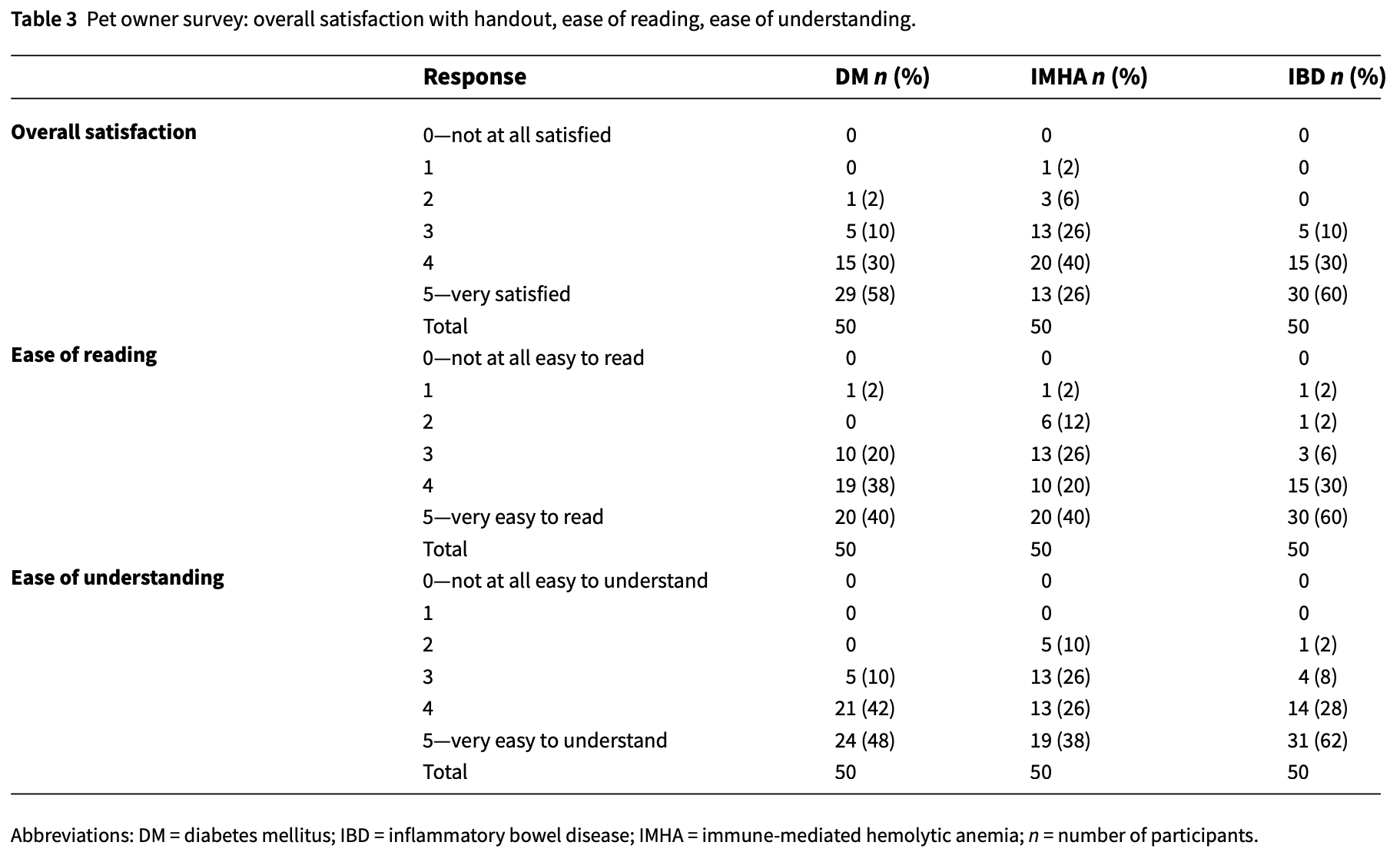
In brief, researchers at NC State and the University of Tennessee used ChatGPT-3.5 to generate client educational handouts for three common diseases (canine diabetes, feline inflammatory bowel disease, and canine immune-mediated hemolytic anemia).3 They took the outputs and asked 50 pet owners how useful and understandable they were. A pre-study survey showed that the vast majority of these clients had either not heard of the diseases or knew little about them. The data showed that owners had a significant increase in their understanding of them after reading the AI summaries. Their median satisfaction scores with the documents (graded from 0 to 5, with 5 being the best) were 4/5 for two of them (diabetes and IMHA) and 5/5 for IBD. The full pet owner survey results are summarized below in Table 3.
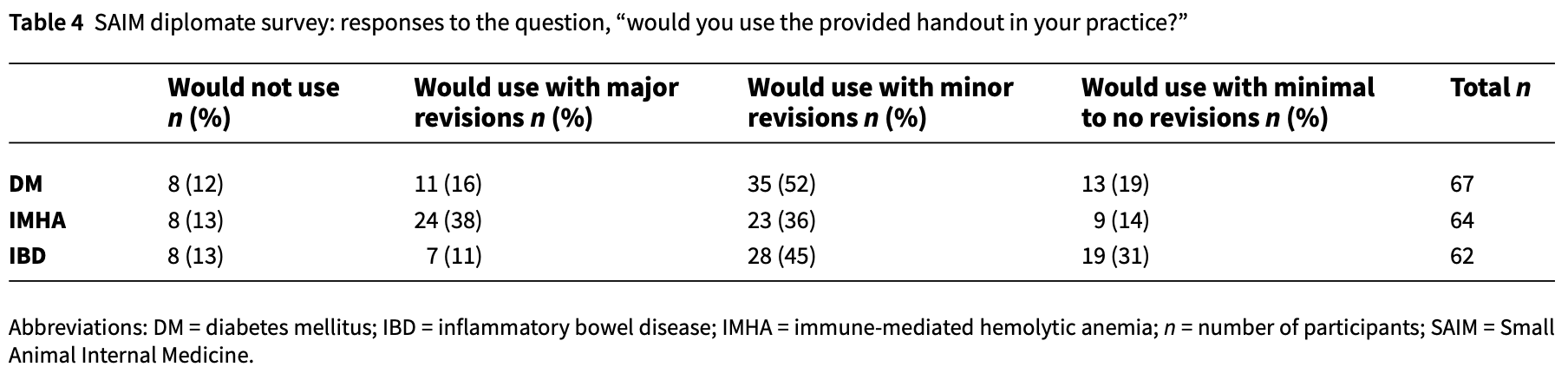
Okay, you might be thinking, it’s great if pet owners like it, but do veterinarians think they are accurate?? To answer that, the second part of this study asked 67 internal medicine specialists to assess the AI summaries. The majority of respondents indicated they would use them with minor or minimal/no changes (76% for IBD, 71% for DM, and 50% for IMHA); only 12-13% said they would not use them at all. Table 4 shows the distribution of opinions. The median accuracy score for all three handouts was 4/5. The medicine specialists did provide feedback on content they thought should either be added or removed, as well as general feedback on grammar and medical terminology.
Overall, I think this study shows the promise of using AI chatbots to help with paperwork in veterinary medicine. While the handouts weren’t perfect, and common sense dictates you should always proofread and customize the copy, the surveys show it doesn’t require a ton of editing. These positive results don’t surprise me; in fact, one of my first posts in 2023 showed examples of how ChatGPT could do a pretty good job generating discharge instructions for cats with diabetes and dogs after cruciate ligament orthopedic surgery. It’s also worth pointing out that this study was done with a much older version of ChatGPT (3.5), and the current version of 5.2 is much more powerful. I would suspect even less editing would be needed if this study were repeated today.

Finally, I had already mentioned that these guidelines came out in the form of a white paper on the ASVCP website. But I’m pleased to announce that on January 6th, they were formally published in our specialty’s journal Veterinary Clinical Pathology! Give it a read today 🤓
Citation:
Fish EJ, Hoepp N, Matlow JR, Ammersbach M, Steinberg JD, Freeman KP, Hancock TS, Cian F, Piccione J, Korchia J, Moore AR, Harr KE. Digital Cytopathology Quality Guidelines. Vet Clin Pathol. 2026 Jan 6.
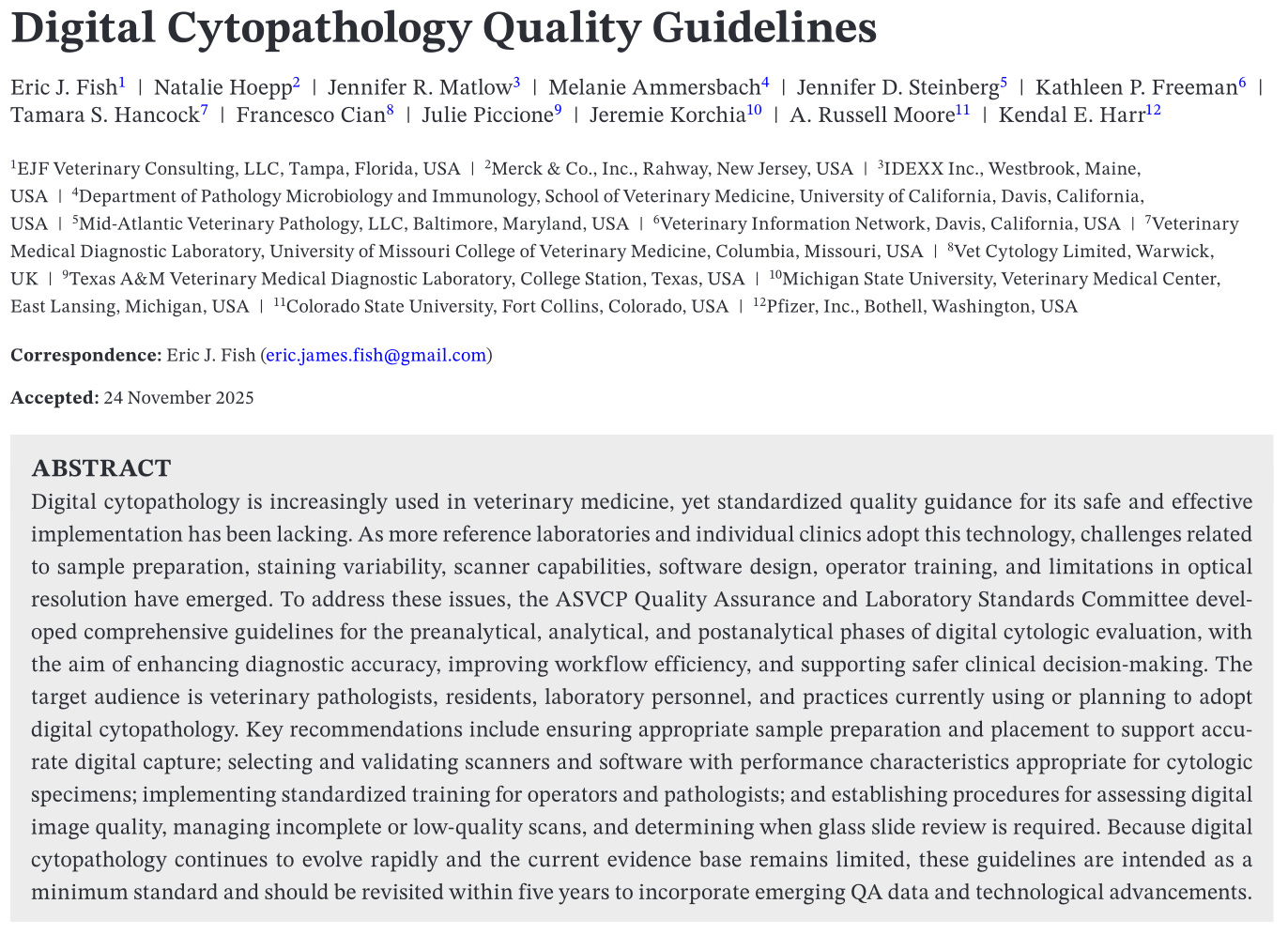
PS: If you don’t have institutional access to VCP, you can download the full paper PDF on ResearchGate…

Alright, that’s enough for January Field Notes, stay warm and safe through these winter storms!
—Eric
Full citation: Sara R Novak, Leslie Reed-Jones, April A Kedrowicz, Adam J Birkenheuer, Kenneth D Royal, Katherine E McCool, Utility of ChatGPT in generating accurate client handouts for common veterinary internal medicine diseases, Journal of Veterinary Internal Medicine, Volume 40, Issue 1, January-February 2026, aalaf058, https://doi.org/10.1093/jvimsj/aalaf058
You can find the handouts it generated along with the surveys in the Supplementary Materials on the journal website.
Comments
Nothing yet. Say the first thing.
Sign in to join the conversation.