
Editor - Alex
July 13, 2026
Adjusted stablecoin transaction volume hit a record $1.79 trillion in June, up 63% from May’s $1.1 trillion and 125% from about $795 billion in June 2025, according to Visa’s onchain analytics data reported by CoinDesk. Visa strips out bot activity and exchange shuffling before counting, so this is the closest thing to a real-economy number the industry has.
The first half of 2026 totaled $8.82 trillion, already more than the $5.8 trillion recorded in all of 2024 and within reach of 2025’s full-year record of $10.8 trillion. USDC carried about 70% of adjusted volume in H1 while USDT held roughly 25%, a near-perfect inversion of 2020, when USDT ran almost 90% of it.
Volume, not supply, is where adoption shows up first. Banks and payment companies settle in the coin their counterparties and regulators accept, and right now that flywheel is spinning toward USDC even while USDT keeps the bigger float.
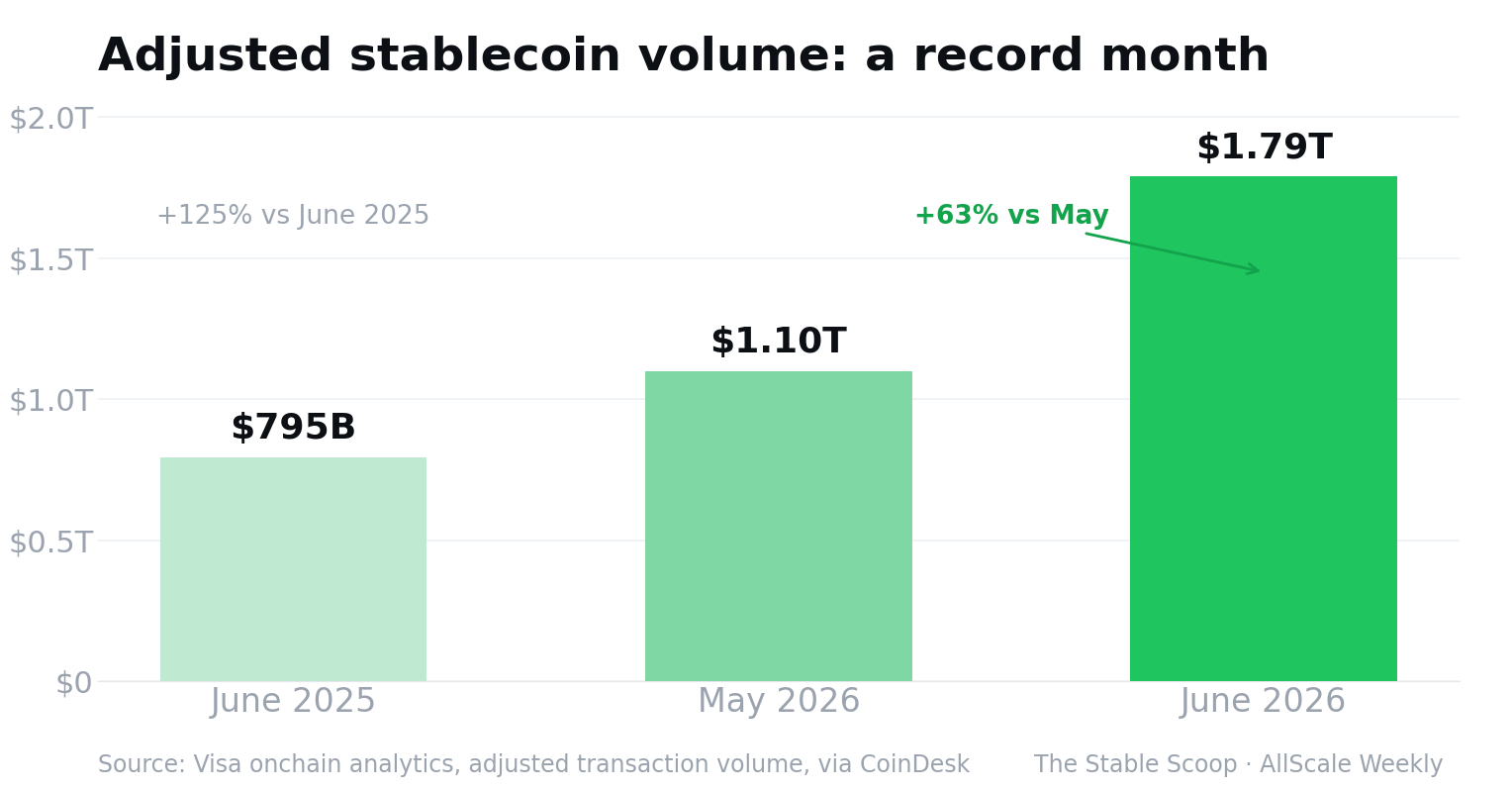
Adjusted monthly stablecoin transaction volume. Source: Visa onchain analytics, via CoinDesk.
Total stablecoin supply is pushing toward $312B - DefiLlama puts total circulating supply at roughly $312 billion, up about $3B on the week, with USDT near $188B and USDC near $78B still holding more than four-fifths of the market between them.
A new combined draft from the Senate Banking and Agriculture Committees could drop as soon as the week of July 13, with advocates targeting Senate floor time the week of July 20, per CoinDesk’s reporting.
Three disputes are still open: ethics and insider-trading disclosure demands from Senate Democrats, which sharpened after the President’s July 1 financial disclosure showed roughly $1.4 billion in 2025 crypto-related income; federal preemption of state regimes; and whether stablecoin yield programs survive, with prediction markets now pricing about a 40% chance of passage versus roughly 74% in early May.
The yield fight is the piece stablecoin operators should watch: Coinbase’s USDC rewards business alone is reported at about $1.35 billion a year, and the final text decides whether that distribution model stays legal.
Luxembourg’s CSSF upgraded Ripple’s preliminary license to a full Crypto Asset Service Provider authorization on July 6, clearing its regulated crypto and payments stack for all 30 EEA countries.
The approval converts the “green light letter” Ripple received on June 23 and stacks on top of the electronic money institution license it secured in Luxembourg in February, giving RLUSD a fully permissioned distribution path in Europe.
Timing is everything: MiCA’s last grace periods expired on July 1, so the EU is now a market where only licensed firms can operate, and the short list of fully authorized providers just became the distribution bottleneck everyone else has to route through.
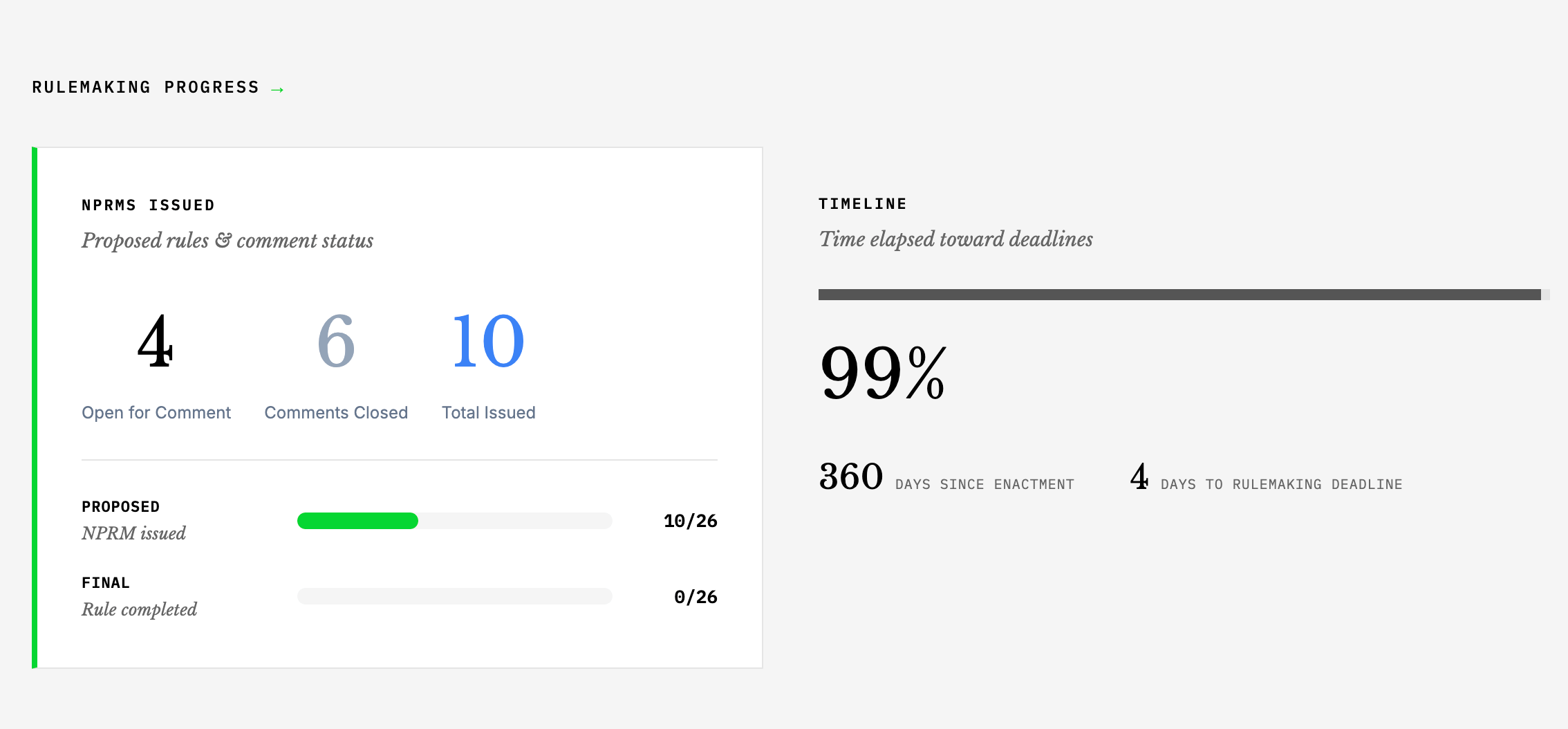
GENIUS Act final rules are due Friday - Six federal agencies face the July 18 statutory deadline to finalize the GENIUS Act’s implementing rules, with every major comment period closed since June 9; Paradigm’s rulemaking tracker is the cleanest way to watch what lands. Next week’s issue will likely be a rulebook special.
The OCC granted Circle final approval on July 10 to establish First National Digital Currency Bank, N.A., operating as Circle National Trust and authorized to open immediately. Circle applied June 30, 2025 and received conditional approval last December.
The trust bank starts with fiduciary custody for Circle and its affiliates, may extend custody to a limited set of institutions like banks and derivatives organizations, and is chartered to eventually bring USDC reserve management under direct federal oversight. CRCL shares jumped as much as 16% intraday on the news, clawing back a chunk of the roughly 19% drop that followed the OUSD consortium launch on June 30.
This is Circle’s counterpunch in the float war: OUSD’s pitch is shared economics, Circle’s is federal supervision. For treasurers choosing a settlement coin, “our reserves sit inside an OCC-chartered bank” is the kind of sentence that wins procurement meetings.
🌍 The rails are going institutional fast; banks are chartering, and issuers are federalizing. AllScale puts the same stablecoin rails to work for the business side, with checkout, invoicing, payroll, and settlement with compliance built in. See how AllScale can help your team pay, invoice, and scale globally.
Securitize is public and hunting for deals - Fresh off its NYSE listing, the tokenization firm behind BlackRock’s BUIDL says it has a $400 million war chest for acquisitions, money that will consolidate the infrastructure layer where tokenized funds and stablecoin reserves increasingly overlap.
Tether is working with UTEXO to issue USDT natively on Bitcoin via RGB protocol v0.11.1, per an announcement made through Bitcoin Magazine on July 7, with the launch expected within weeks, possibly this month. It is not live yet.
RGB pairs Bitcoin’s UTXO model with the Lightning Network, so USDT moves through native Bitcoin addresses with instant off-chain payments, no separate fee token, and fewer on-chain traces; UTEXO has built the mint bridge, APIs, and SDK, and Tether Wallet plans support at launch.
USDT started life on Bitcoin in 2014 before Tron ate its transfer volume, largely because RGB spent eight years in development. If Lightning-settled USDT works at scale, the cheapest dollar rail in emerging markets gets a serious challenger on the most battle-tested chain.
PayPal’s PYUSD has grown from around $500 million in mid-2025 to about $4.11 billion in circulation, making it the clear leader among fintech-issued coins; Ripple’s RLUSD sits near $1.42 billion after a recent pullback.
The coin also went live natively on Polygon on July 9, issued by Paxos with no bridging required and plugged into Polygon’s Open Money Stack, letting businesses accept funds from cards, bank accounts, or exchange balances, settle in PYUSD across borders, and cash out locally; Polygon says it has settled more than $2.6 trillion in stablecoin volume to date.
PayPal is proving the distribution thesis: a coin doesn’t need to win crypto-native volume when it ships inside a checkout flow that hundreds of millions of consumers already use.
Pulsar Money picked Arc for its consumer debut - The payments app will launch exclusively on Arc, Circle’s stablecoin-native L1, targeting European users with USDC and EURC support and giving the still-in-testnet chain its first consumer-facing financial app.
Circle Mint France turned on automated stablecoin payouts - Announced July 1 and worth catching up on: eligible European partners can now push compliant USDC and EURC disbursements via a Payouts API to third-party wallets in 180+ countries across 15+ chains, with EURC circulation around €381 million; merchant settlement, supplier payments, and contractor payouts are the launch use cases.
👋 That’s your stablecoin scoop for the week!
Until next time — AllScale Weekly
👉 Learn how AllScale can help your team pay, invoice, and scale globally
No posts
Comments
Nothing yet. Say the first thing.
Sign in to join the conversation.