
Editor - Alex
August 3, 2026
🌍 Macro: $306.7B outstanding, two dollars control 83%, and distribution is still the moat
Stablecoin supply is large, but the market is still a two-issuer infrastructure story
A fresh DefiLlama snapshot put aggregate stablecoin supply at $306.68 billion on 3 Aug. USDT represented $183.14 billion and USDC $72.04 billion.
Together, the two tokens accounted for $255.18 billion, or 83.2% of tracked supply. The next largest assets in the snapshot were USDS at $6.56 billion, DAI at $4.81 billion, USD1 at $4.01 billion, and USDe at $3.86 billion.
The practical consequence is that new payment products compete on more than minting. They need distribution, redemption access, liquidity, and operating controls strong enough to fit into the two-dollar market users already know. For a treasury team, the usable choice set is defined by where a token can be acquired, held, approved, reconciled, and converted back into local money.
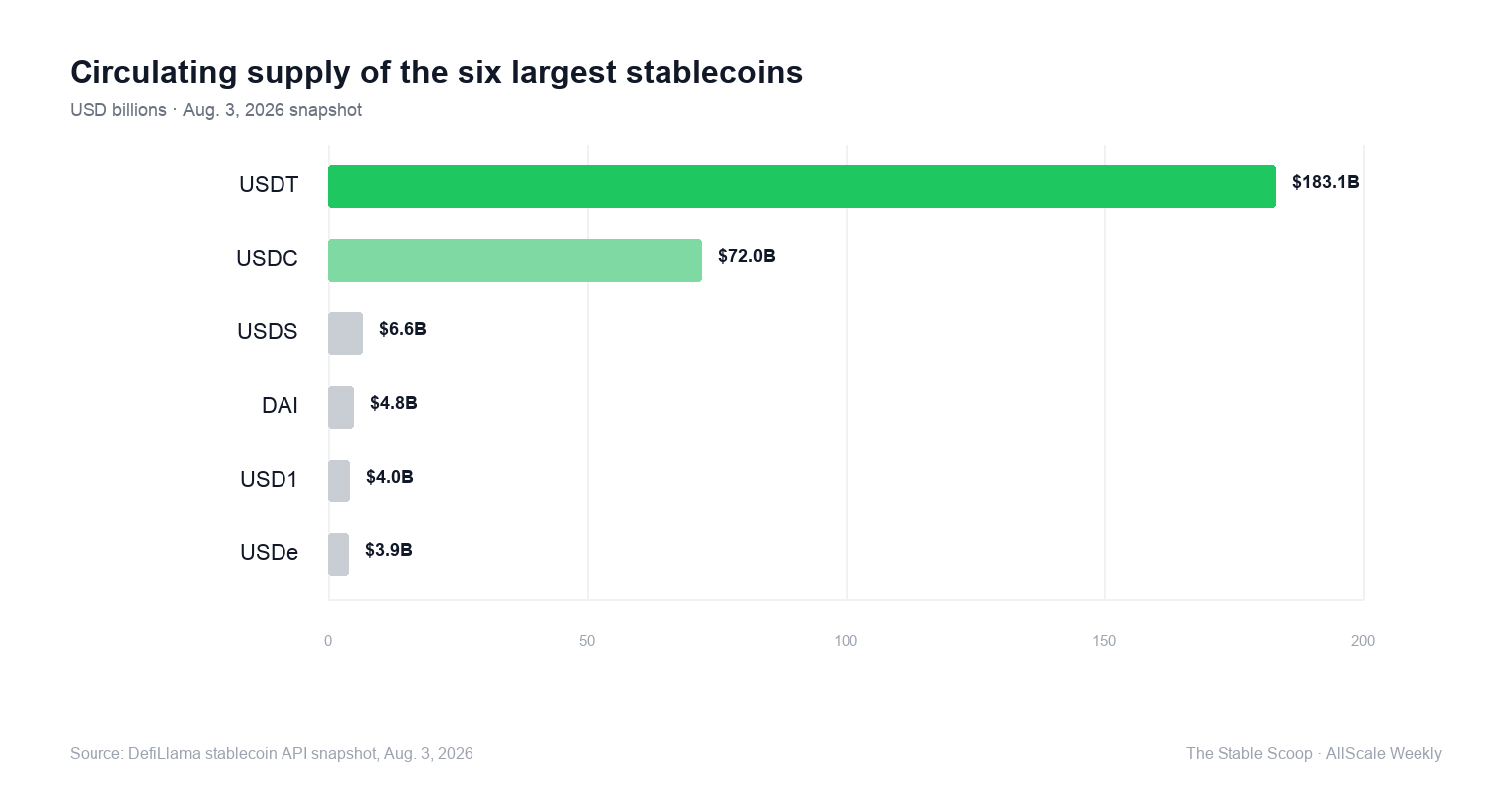
USDT and USDC’s combined share is a distribution benchmark, not a verdict on every smaller token - The same DefiLlama data shows a long tail of assets serving distinct use cases, but every issuer that wants business-payment volume still has to solve conversion and acceptance at the point of use.
🔍 Policies: Kenya puts operators on notice, U.S. CIP comments remain open, and compliance is becoming product design
Kenya’s new VASP rulebook makes stablecoin operations a licensing question
Kenya’s Virtual Asset Service Providers Regulations have moved the country’s 2025 VASP Act into an enforceable operating framework, according to a late-July FinanceFeeds report.
The report says the rules restrict stablecoin-interest arrangements and give existing operators until Nov. 4 to align. The underlying Gazette text was not retrieved for this issue, so those details should be read as reported rather than independently verified.
The timing matters for payment firms building in East Africa. Compliance, customer disclosures, custody, and local regulatory ownership have to be designed before a tokenized-settlement pilot turns into a service. A corridor can look global in a product demo while still failing at the local licensing, data, and consumer-protection layer that determines whether a business can operate it day to day.
The U.S. issuer-CIP proposal is still a live compliance deadline - The joint Federal Reserve proposal would classify permitted payment stablecoin issuers as financial institutions under the Bank Secrecy Act and require an effective customer identification program; comments are due Aug. 21. It remains a proposal, not a final rule.
🔥 Biz Beats: Tether reaches Nairobi, a Korea-Canada corridor takes shape, and Africa keeps building payment context
Tether and Nairobi Securities Exchange are exploring what tokenization could mean for a public market
The Nairobi Securities Exchange signed a memorandum of understanding with Tether to explore digital-asset education, tokenization, and financial-market innovation, Citizen Digital reported on July 28.
The announcement is an exploration agreement, not a live tokenized-security market or a USDt settlement rollout. That distinction matters, particularly while Kenya’s VASP rulebook moves from policy into operations.
Even so, it joins the payment-infrastructure conversation at the right layer: exchanges, issuers, banks, and payment firms must coordinate market access, investor protections, settlement, and compliance if tokenization is to shorten real operational cycles. An MOU earns attention when it brings the market operator into that conversation, but execution still has to prove the investor, custody, and regulatory paths.
ARACORE and VirgoPAY target a stablecoin lane for cross-border business flows
BPMG said its U.S. subsidiary ARACORE will work with VirgoPAY on a stablecoin-based global payment service for cross-border B2B payments, transfers, and settlement, in a company release.
The parties plan to combine ARACORE’s transfer and settlement technology with VirgoPAY’s payment network across North America, Europe, and other markets. They did not publish a launch date, transaction volume, or regulatory rollout plan.
This is the right enterprise test: not whether a stablecoin can move, but whether a finance team can send, receive, reconcile, and comply across the local payout rails where its suppliers and customers actually operate. The useful benchmark will be whether the service removes steps from a cross-border payment process without moving exception handling into a separate crypto operations queue.
🌍 The important work in global money movement is often the least visible: approvals, invoicing, records, and local payout choices. That is the same gap AllScale is built to address, bringing local and stablecoin payments into one business workflow rather than splitting them across wallets and spreadsheets.
🧰 New from AllScale: Claim Link — create a secure link to send USDT or USDC, then share it with the recipient. They can claim the funds to AllScale or an external wallet. For payouts, reimbursements, and refunds, it is a practical way to make the handoff simpler when collecting a wallet address should not become its own workflow.
Nigeria’s stablecoin builders and policymakers met in Lagos - The Nigeria Stablecoin Summit 2.0 convened on July 30 around payments, banking, and regulation. A conference is not a regulatory action, but the attendance mix is a useful reminder that African adoption is being shaped by financial institutions and payment operators as well as token issuers.
💡Rollouts: $25M of credit moves to Solana, CCTP V1 begins its exit, and RLUSD gains a Korean market
Coinbase Asset Management’s stablecoin credit strategy now has a $25M onchain share class
Superstate’s CUSHY asset page lists a $25 million Coinbase USD Stablecoin Yield Fund share class on Solana, represented by 250,000 shares at a $100 net asset value.
Coinbase Asset Management is the investment manager; the stated strategy targets stablecoin private credit, direct lending, and tokenized credit opportunities. The offering is a 506(c) private fund for eligible investors, not a consumer yield account.
The rollout moves the fund wrapper and transfer record onchain while keeping familiar institutional roles, including qualified custody, administration, and investor eligibility. That is a more useful measure of onchain finance than simply putting a yield label on a wallet balance. It also separates a regulated investment product from the payment-token balances that businesses use for working capital and settlement.
Circle starts the long retirement of CCTP V1, turning a protocol upgrade into an operations task
Circle’s CCTP page says the phase-out of CCTP V1 (Legacy) began July 31, with the newer CCTP version now the canonical USDC cross-chain rail.
V1 stays available during a gradual transition, but it will receive no new chain integrations or feature updates. Circle says the newer contracts and APIs are not backward compatible with V1.
Wallets, exchanges, bridges, and payment products should treat this as a migration plan, not a breaking-news headline. Native USDC movement is only useful when routing, reconciliation, and exception handling survive the version change. Teams should map where legacy contracts and APIs sit in their stack before assuming that a token transfer can be upgraded independently of the rest of the payment flow.
RLUSD gains KRW, BTC, and USDT markets on Upbit - A report citing Upbit’s notice says the exchange began trading Ripple USD against KRW, BTC, and USDT on July 28. The English primary notice was not located, so this is a distribution signal rather than a claim of broader Korean payments availability.
👋 That’s your stablecoin scoop for the week!
Until next time — AllScale Weekly
Comments
Nothing yet. Say the first thing.
Sign in to join the conversation.