
I gave it the broad strokes, some beats to hit, characters to include, and a general literacy style and feel, and it came up with the rest. It’s not bad. It even has a few nice turns of phrase. I’m not too worried about getting sucked in to the “magic” though. What do you think? If I didn’t tell you it was AI, would you have been able to tell? If so, what gives it away?
They were fished from the Atlantic like driftwood. Rose was still gripping Jack’s arm, her knuckles white, her lips blue. He hadn’t spoken since the whistle. She had screamed herself hoarse to summon the Carpathia—but now that the ship loomed like a judgment out of the fog, she was mute.
Jack didn’t wake until the second day. He blinked at the wooden ceiling of the infirmary, at the flickering lamp, and then at her.
“You,” he rasped.
“You,” she echoed, and let the tears fall for the first time.
New York was a gray, brutal welcome. April snow. Dockside chaos. Reporters clawing at the railings with pens like bayonets. Rose clung to Jack’s arm as they were herded onto the gangplank. Behind them, the sea churned with secrets.
They found lodging in a boarding house with paper-thin walls and a landlady who wore too much perfume. The sheets were clean, the water hot, and the neighbors blessedly uninterested in their story.
The city moved on. But Jack and Rose didn’t.
Jack worked odd jobs—lettering signs, hauling crates, painting fences. At night, he’d sketch by candlelight, his pencil like a whisper against paper. Rose found a job at a typing pool, her spine aching from hours at the desk.
They were alive. But that wasn’t always a blessing.
Once, Jack confessed in the dark: “I see them, Rose. In the water. Faces I don’t even know.”
She didn’t respond. She couldn’t.
Some nights she heard him crying in his sleep. On others, she sat awake, staring out the window, thinking of dresses and chandeliers and futures she once hated but now missed.
They had left death behind them. But grief had stowed away.
By 1914, New York began to feel like a stone in Jack’s shoe—unshakable, unwelcome. The city didn’t love dreamers. It tolerated them, fed them just enough to keep them hungry.
Rose wrote a letter to Molly Brown after Jack lost his job painting advertisements for a vaudeville theater that went under. The reply came swift: Come to Denver. Fresh air. New chances. Bring Jack.
So they did.
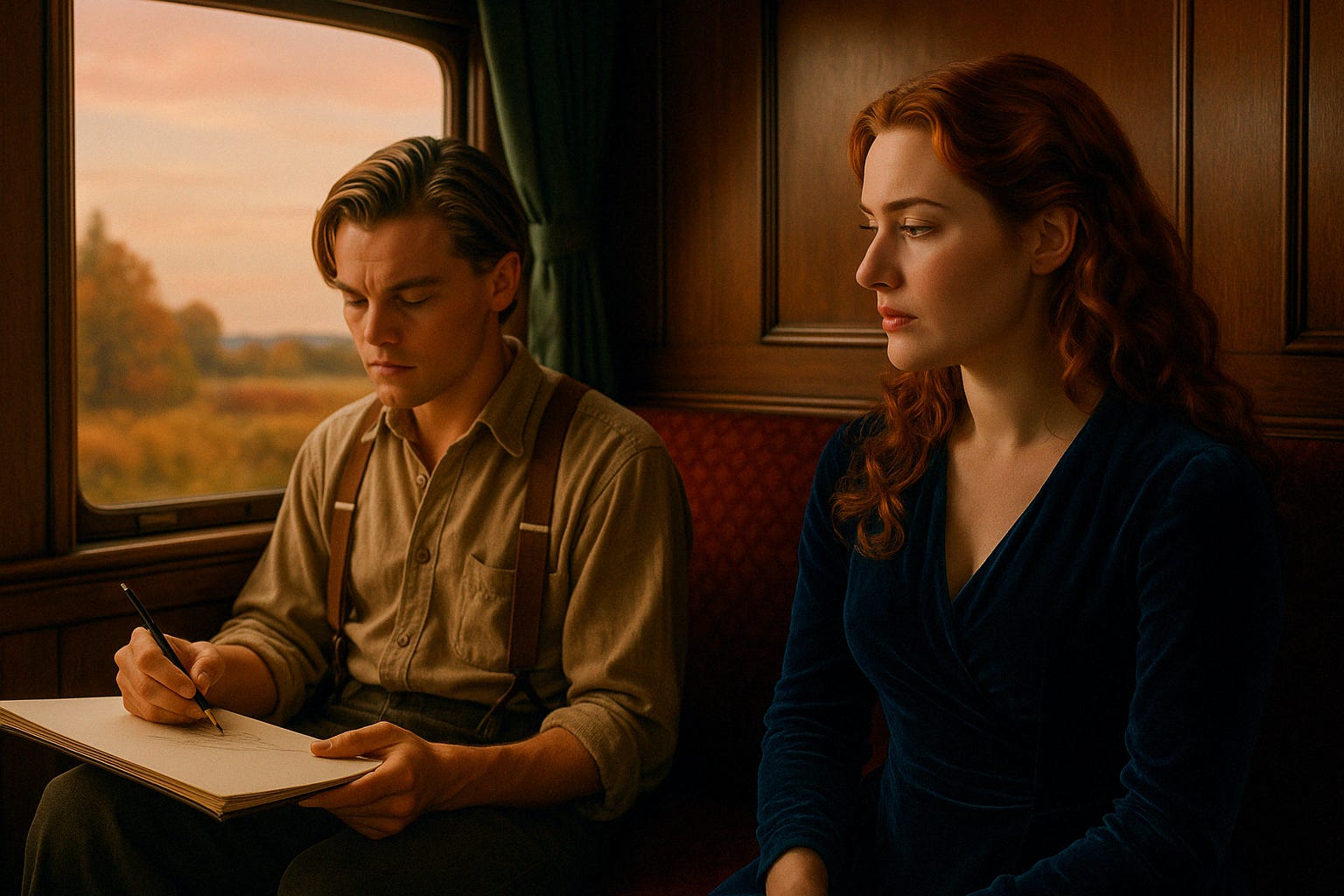
The train ride was long, the landscapes unfolding like paintings Jack might never afford the canvas for. The mountains stunned them into silence. For a while, Jack sketched again—scraps of towns, the curve of rails, Rose’s sleeping face against the window.
Molly’s house sat high above the city, overlooking rooftops like a woman watching her past. Her warmth was undiminished. “Look at you two!” she said, arms out, embracing Rose, then Jack, then both again. “Thought the sea swallowed the best of us.”
She was different, too—still bold, still laughing, but something behind her eyes was duller, like the sea had taken just a piece too much.
Dinner was loud and generous. Stories of Paris, of lawsuits, of parties thrown and ships avoided. But later, in the quiet of the drawing room, with a fire casting shadows like ghosts on the wall, the mood changed.
“We were gods for one night,” Molly said, swirling brandy. “And the sea spat us back out like a bad joke.”
Rose shifted in her seat.
Jack was silent.
“Do you ever dream of it?” Molly asked.
“All the time,” Jack said softly.
She nodded. “Me too.”
They tried to stay. Molly even offered Jack work on a renovation project—painting murals in a hotel she was helping finance. But he turned it down.
“I’m not ready,” he told Rose later.
“For what?” she asked.
“To pretend.”
She didn’t ask what he meant. She already knew.
They stayed six months. Jack painted small commissions—a nursery wall here, a church backdrop there. Rose volunteered at a theater, mending costumes, steaming dresses. It wasn’t glamorous, but she loved the backstage hush, the whispered anticipation before curtains lifted.
And then the telegram came.
Mother gravely ill. Stop. Come at once. Stop. —Ruth.
Jack didn’t want her to go. “She disowned you, remember?”
“She’s still my mother,” Rose said.
“You don’t owe her anything.”
But Rose went, and Jack stayed behind, packing their bags before she returned.
The visit was short and bitter. Ruth was not gravely ill—just bruised by loneliness and public shame.
“You made a fool of me,” she said as they sat in the cold drawing room of a smaller, sadder house than Rose remembered. “Of our name.”
Rose looked around at the faded wallpaper, the cracked porcelain. “Our name bought us lifeboats,” she said. “That’s all it was good for.”
Ruth turned away. “You look tired, Rose. This life hasn’t been kind to you.”
“No,” she said. “But it’s mine.”
When she returned to Denver, Jack was already packed. They left that night.
They drifted west again—Salt Lake City, Reno, Sacramento. Jack sketched strangers on park benches for coins. Rose taught piano to children who never practiced. They lived month to month, apartment to apartment, carrying the ache of survival in their ribs.
They never said it aloud, but they both knew: the Titanic never really let them off.
By the time war broke out in Europe, they had settled in San Francisco—settled in the loosest sense of the word. They rented a flat above a bakery where the scent of bread made it hard to stay angry for long. Jack took work at a theater, painting backdrops again. Rose gave piano lessons in the parlor.
They didn’t fight as much, but they also didn’t talk as much.
Life had become… bearable. Sometimes even sweet. They spent Sundays at the wharf, eating cheap oysters and watching gulls squabble. Jack taught Rose how to play blackjack at a tavern down the street. She never won, but she laughed when she lost.
And then Ruth came back.
Not in person. In a letter.
It was brief, penned with the same hard-edged cursive Rose remembered from childhood.
Rose,
Your name was in the paper—something about a gallery. I imagine you’re still chasing fancies. I hope at least you’re warm and fed.
—Mother
Rose crumpled the letter but didn’t throw it away.
Jack found it later. “You’re not writing back?”
“No.”
He nodded, then: “She’s alone.”
“So am I,” she said. “Sometimes.”
It was Cal who made headlines next. His fortune had ballooned through wartime industry—steel, railroads, whatever men used to kill one another more efficiently. His wedding photo appeared in Life magazine. His smile looked carved.
Jack scoffed. “Bastard’s doing just fine.”
Rose looked at the image longer than she meant to. “He always would.”
The years rolled on.
Jack’s paintings began to sell—first for pennies, then nickels, then a few dollars. Not enough for comfort, but enough for pride. He signed them J. Dawson, always in the lower corner, always in small print.
Rose found work with a gallery, not as an artist, but as a fixer—framing, arranging, making the walls look beautiful so others could shine. She didn’t mind.
But then the economy turned. Again.
Jobs dried up. Students vanished. The bakery downstairs closed. Their flat became drafty.
They argued again. This time not out of grief, but fear.
“I can sell the sketches,” Jack said.
“No,” Rose snapped. “You shouldn’t have to.”
“Then what?” he asked, his hands splayed like a man begging. “We’re not young anymore, Rose. This isn’t a romantic struggle. This is just… struggling.”
And then the crash came.
And then the telegram.
The news came folded on the doorstep, the way all devastating things arrive when no one’s ready: thin, casual, printed in ink that bled slightly from the rain.
CAL HOCKLEY DEAD IN PHILADELPHIA HOTEL
Prominent Businessman Lost Millions in Crash—Gun Found at Scene
Rose stood in the kitchen, reading it twice without blinking. She did not sit. She did not speak. The coffee percolated behind her, forgotten.
Jack walked in and took the paper from her hands. He read the headline, exhaled slowly, and set it down between them on the counter.
“Do you feel anything?” he asked.
“I don’t know yet,” she said.
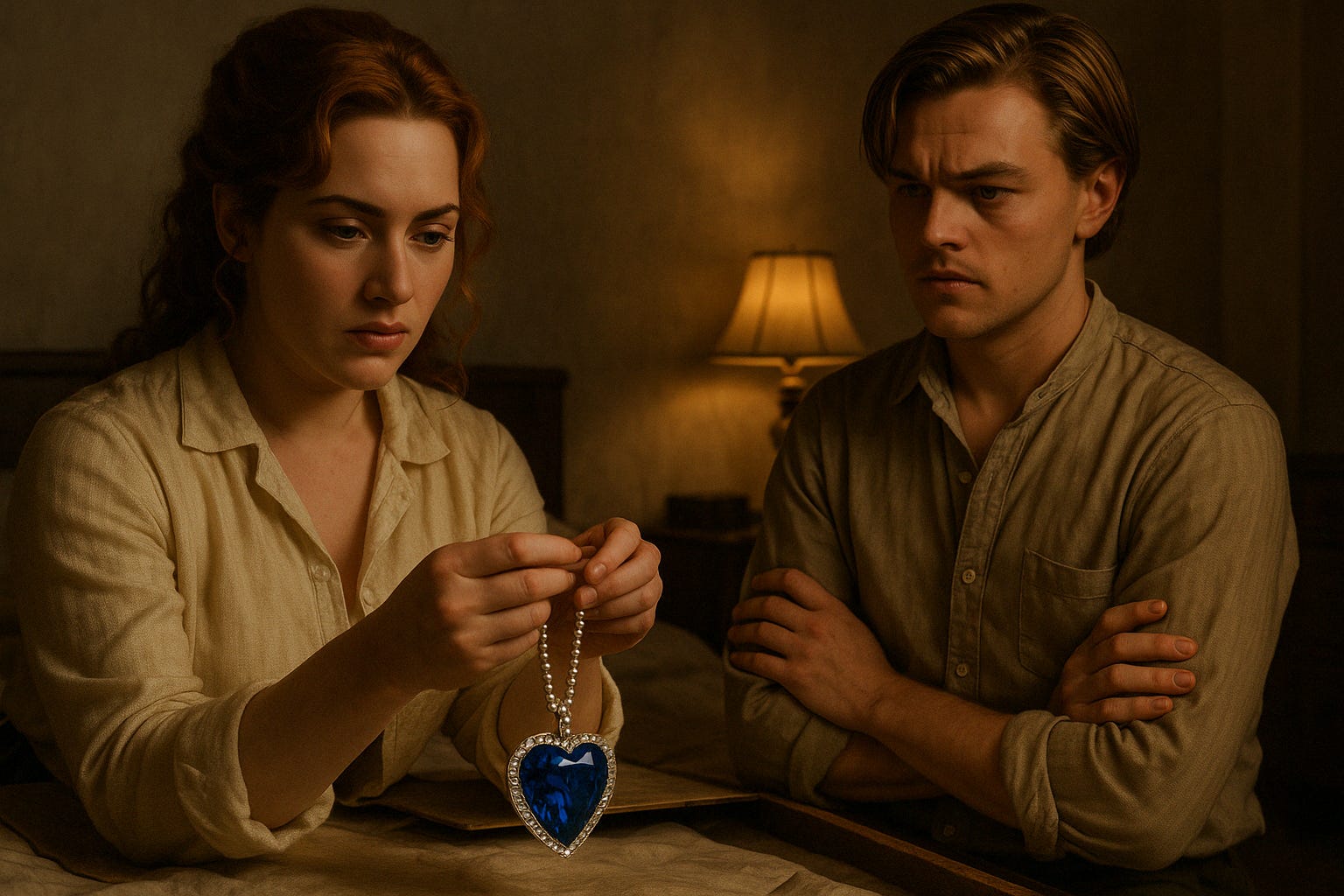
In the evening, she opened the floorboard beneath their bed and retrieved the small velvet pouch she hadn’t touched in over fifteen years.
Inside, the Heart of the Ocean caught the gaslight and fractured it into pale blue fire. It had not dulled.
Jack stood in the doorway, arms crossed, his face unreadable. “You kept it all this time.”
“I told you I threw it back.”
“You told everyone you threw it back.”
She looked up at him. “I needed something that was mine.”
He stepped forward, voice low. “So you kept the one thing that belonged to him.”
“No,” she said. “It never belonged to him. That was always the problem.”
She didn’t offer it to him. She didn’t hide it, either. They just stood together in the dim bedroom, staring at a stone that had outlasted a ship, a lie, and almost their love.
They sold it quietly, discreetly. An intermediary. Belgian. Wore gloves even indoors. No names. No fanfare.
The check came in a thick envelope. Seven figures. Enough to buy back a hundred lost years.
They bought a home in Pacific Heights. Stucco and arches. Room for a studio. Room for quiet. Too much room, if they were honest.
Jack painted again—first the sea, then doorways, then fractured faces with haunted eyes. The money gave him freedom but robbed him of hunger. His best work had been done with frozen fingers.
Rose joined the board of the museum. They called her “Mrs. Dawson” with respect in their voices. She stopped correcting them when they assumed she came from wealth.
They hosted dinners. They traveled. But something unspoken began to fester—not resentment, exactly, but a sort of slow spiritual mildew. The kind that grows in beautiful rooms too large for their owners.
One night, after a benefit for war orphans, Jack sat on the veranda with a cigarette burning down between two fingers. Rose joined him, wrapped in a shawl she didn’t need.
“You ever wonder what it would’ve been like if we’d never met?” he asked, staring at the bay.
“I wouldn’t have survived.”
“You would’ve married Cal.”
“I would’ve died before I married Cal.”
He nodded. “Maybe we both did.”
She took the cigarette from his hand, dragged on it once, and let the smoke settle in her lungs.
“This isn’t the life I pictured when I pulled you onto that door,” he said, finally.
“No,” she said. “But we weren’t picturing anything then. We just didn’t want to drown.”
They didn’t speak of Cal again. Or Ruth, who died three winters later and left behind nothing but unpaid debts and a mirror with a cracked frame.
But the Heart of the Ocean remained—now a number in a Swiss account, now a fracture in their unity.
Wealth had not cured anything. It had only removed the distractions that once kept their wounds from festering.
San Francisco was cold that winter. Not snow-and-fireplace cold, but that damp, bone-sifting chill that made joints ache and shadows linger a little longer on the stairs. Jack coughed through most of January, then stopped coughing entirely—which somehow worried Rose more.
The doctor was kind, if brisk. “His lungs aren’t recovering. Too much paint, too much fog. Too many years in the cold when he was young.”
The doctor didn’t know about the Atlantic. He didn’t know that Jack’s breath had once come in fractured gasps beneath a night sky, surrounded by the dead and dying.
“Rest,” the man said, as if rest were some foreign currency Jack had never been able to afford.
Rose moved a cot into the studio. She cooked oatmeal. She read aloud from books he liked in theory but had never gotten around to. He smiled sometimes. He slept more often.
One morning he woke with clear eyes.
“I had a dream,” he said. “You were old. White-haired. Beautiful as ever.”
“I hope I was wearing shoes,” she said. “I keep dreaming I’m barefoot in snow.”
He laughed, soft and wet. “You’re still strange, Rosie.”
She hadn’t heard him call her that in years.
Late February, the rain wouldn’t let up. Their street was slick, shining like oilcloth, and the gutters gurgled with runoff.
Jack sat by the window, sketching with trembling fingers. The lines weren’t strong anymore, but the shapes were still there—edges of things he didn’t quite want to say aloud.
Rose came in with tea. He didn’t look up.
“I kept seeing them,” he said suddenly. “The ones who didn’t make it.”
She paused. “Me too.”
“I thought if I drew enough faces, I could forget the ones I didn’t save.”
“And did it work?”
He shook his head. “They still float behind my eyes when I close them.”
She sat beside him, their shoulders touching. “Maybe they were meant to float with us. So we never forget what it cost.”
He looked at her then—not with regret or apology, but with something older than both. Gratitude, maybe. Or resignation. Or love, stripped of its illusions.
“You ever regret not letting go?” he asked.
She turned her head toward him. The sea had given them more than one second chance—it had given them decades of difficult mercy.
“Every day,” she whispered. “And never.”
Jack passed on a Tuesday morning in early March. Quietly, without ceremony. He was 63.
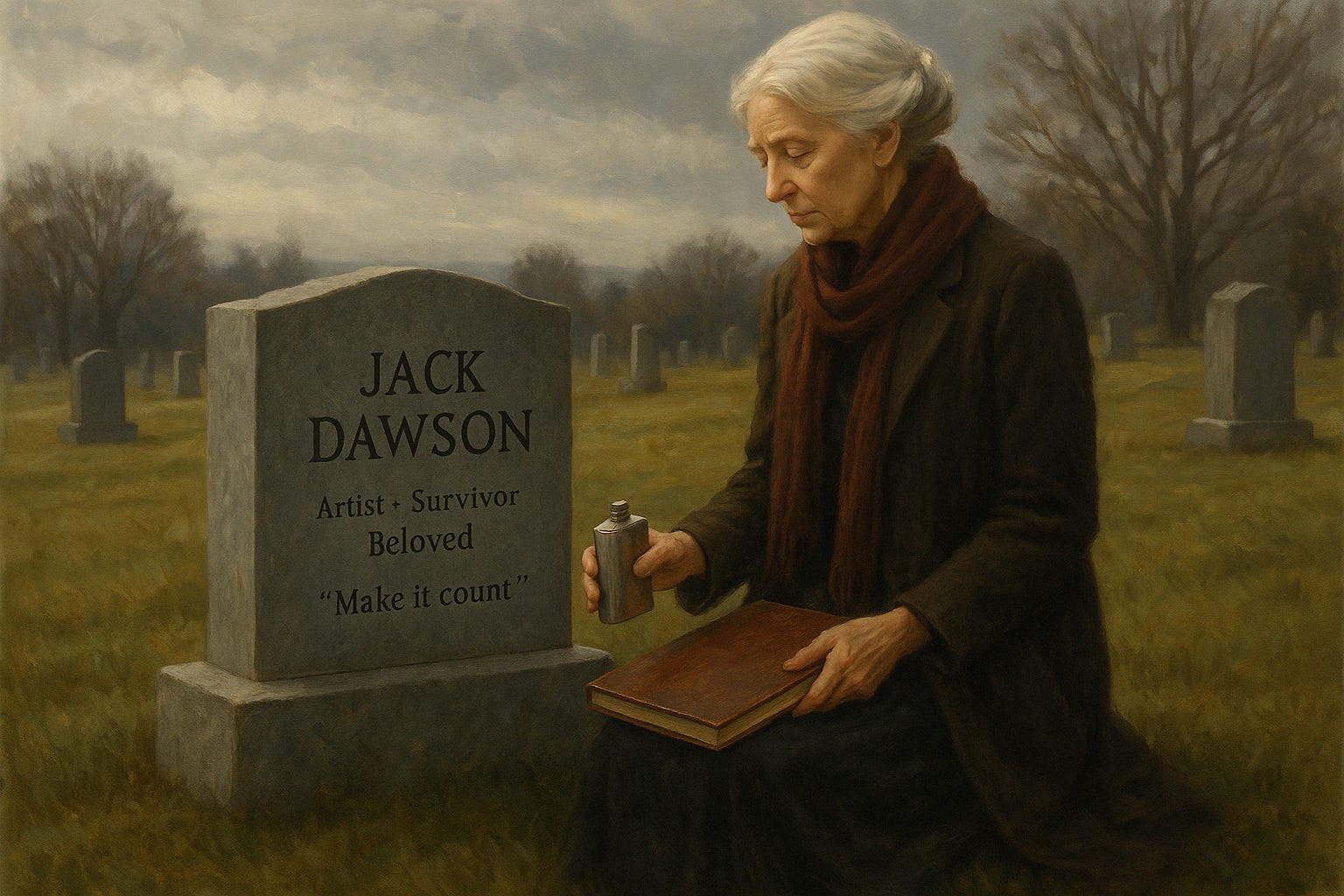
Rose buried him in a small cemetery just outside the city, near a bluff that overlooked the ocean. No great monument. Just a stone, etched with:
JACK DAWSON
Artist. Survivor. Beloved.
“Make it count.”
She visited every year on the anniversary. She brought him a flask of whiskey and one of his old sketchbooks. She talked about the museum’s latest exhibit. About the neighbor’s cat. About how the ocean still frightened her.
Time erodes everything but longing.
By 1953, the museum where Rose worked had acquired one of Jack’s early pieces—a pencil drawing of a faceless woman looking out to sea. They didn’t know its worth, not really. It hung in a back hallway near the staff lounge, occasionally mistaken for something left behind.
Rose passed it often. She never corrected the label, never donated the rest. She kept those—hundreds of sketches, some finished, some barely begun—in a cedar chest beneath her bed, tucked beside the shawl she wore the night he asked her if she regretted not letting go.
She never remarried. Never felt the need. People asked, politely and then not at all. She gave the same answer each time: “Once was enough.”
There were offers over the years—men who spoke well and smiled often, men who didn’t carry ghosts in their eyes. But none of them knew what it meant to be pulled from the edge of the world with someone else’s frozen breath in your lungs.
She donated the remainder of the money from the Heart of the Ocean to a maritime rescue fund. Anonymously. She didn’t want her name on a plaque. She wanted fewer widows.
Sometimes she’d dream of the necklace, still cold in her palm, its weight not measured in carats but in unspoken things. She wondered what became of it. Whether the Belgian ever sold it again. Whether some duchess wore it without knowing its history. Or maybe it sat in a velvet box, admired but unused—like so many beautiful things that outlive their context.
She never told anyone the truth about it. That was hers.
In her final year, she lived in a small house not far from the cemetery. She baked. She watched the fog roll in. She hummed old songs Jack had once sketched the sheet music for, even though neither of them ever learned to play them properly.
She died in her sleep. No drama. No farewells. Just an exhale, soft and complete.
They found a note in her dresser drawer. Not a will. Not instructions.
Just a torn sheet of stationery with one sentence written in her firm, elegant hand:
“The sea took nothing from me that it didn’t also give.”
And in a museum archive drawer—forgotten, misfiled, waiting—lies a sketch. A young woman on the bow of a great ship. Wind in her hair. Eyes closed. Arms outstretched.
No signature.
Just a small, penciled line in the corner:
“For Rose, who lived.”
Comments
Nothing yet. Say the first thing.
Sign in to join the conversation.