
French Catholic poet Madeleine Delbrêl wrote, “There are places in which the Spirit breathes, but there is only one Spirit who breathes in all places.”
Poetry is often deeply spiritual, even when it’s not explicitly religious.
The cadence, the rhyme, the alliteration, the onomatopoeia all speak to our souls in a way more rigid prose cannot. A poem is also not fully realized until read aloud, either to an audience or to oneself. The more passion the better. Speak not just with your lips but with your entire body. Put your heart and soul into it! Perform!
The accident, in the Catholic sense of the word, something that does not exist without a substance in which it inheres, is as important and maybe even more important than the substance itself, the thing that exists in itself. In other words, the message and the meaning delivered in the words of a poem are defined by how they are delivered. You could convey the same general idea of a poem in some bland text, and it wouldn’t mean the same thing on a soul level. Just imagine how different this talk would be if I suddenly delivered it in poetic verse.
Poetry is visceral.
It speaks to the soul.
The words are not as crucial
As the feelings poems sow.
Take an academic paper,
throw it in the trash.
Give me verse, give me cadence,
give me lightning’s flash!
I want to be inspired,
Not simply told what to think.
Bring the living waters forth
And let my spirit drink!
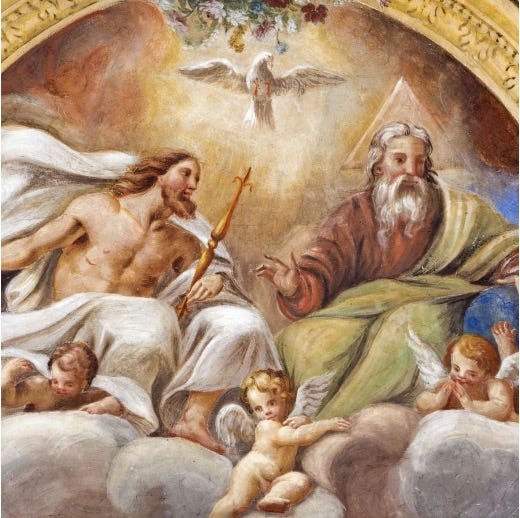
The Father, Son, and Holy Ghost
are in a sacred dance
With poetry as the music
Played ‘cross heaven’s great expanse.
John Adams wrote in a letter to his wife that he “must study politics and war that my sons may have liberty to study mathematics and philosophy. My sons ought to study mathematics and philosophy, geography, natural history, naval architecture, navigation, commerce and agriculture in order to give their children a right to study painting, poetry, music, architecture, statuary, tapestry, and porcelain.”
While the jobs of commerce we engage in are important and can and should be used to worship God and carry out His Word, Adams has a point. The highest achievement we can aspire to, a glimpse of heaven perhaps, would be the creation of art.
People will listen much more intently and even grasp a message at a deeper level if that message is relayed in way that speaks to the soul like poetry can.
Poetry is also accessible. Whereas most people, until recently in history, couldn’t afford paintings or maybe even instruments, they could memorize poetry, even if it was just a few lines, and use those verses to sustain their soul. The Rosary and many of the other prayers we memorize as Catholics are poetry, after all, and the Rosary, according to tradition, was given to St. Dominic by the Blessed Virgin Mary to give those of us who haven’t memorized all 150 Psalms a daily devotion.
Poetry even has the power to bring a soul to Christ. It was through the work of English poet and Anglican priest George Herbert, that French philosopher and mystic Simone Weil had a divine experience. After reciting the poem Love, she states that “Christ himself came down and took possession of me.” It should be noted that while Weil was attracted to the Catholic Church, she was never baptized. She had a skepticism of institutions and didn’t like the idea of excommunication, which likely kept her out of the Church. She also died young so it’s possible, given more time, she may have become fully Catholic.
Mother Teresa also was deeply moved by Herbert’s poem Matins, in which he writes of God as a lover doing all he can to attract us, His beloved. Seeing God as all powerful and transcendent is easy because we are small, reflected Mother Teresa. Knowing that God can come down and seek our love for Him on a personal level, that is hard to grasp.
Think about the words you’d write in a love letter compared to a memo you’d send to a fellow employee. How much more poetic is the love letter? How much more does it speak from your soul and to the soul of the recipient?
And how is God communicating with us through His Word? While there are certainly some pretty explicitly stern passages that leave little room for interpretation—the ten commandments and much of the Books of Leviticus and Numbers come to mind—overall, the Bible is a poem written by a lover to His beloved, not a memo written to an employee or a boss.
Not to dismiss our current academic focus on STEM learning completely. It certainly has its place, but if we don’t teach the arts, it’s all for not. As Catholic academic Anthony Esolen says, “Imagination is the driver. You neglect that, the imagination, Satan will gladly concede all that other stuff if he can get hold of the imagination.”
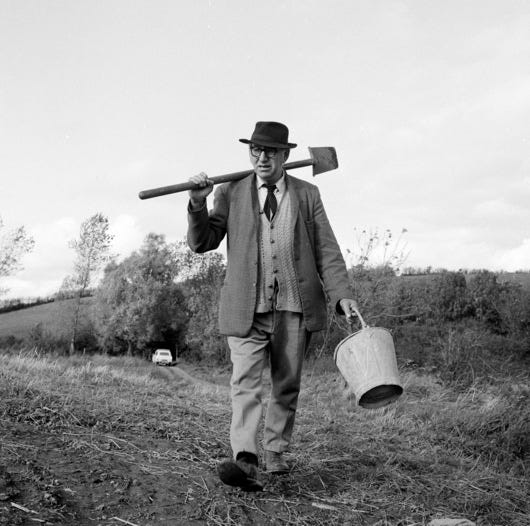
Patrick Kavanaugh, an Irish Catholic who lived from 1904 to 1967 and is considered “the second-best Irish poet after Yeats” “kicked the dead weight of the familiar into life” to quote another great Irish poet and one of his proteges Seamus Heaney.
Advent invites the reader to find rebirth in the ordinary. It’s a theology of the commonplace.
We have tested and tasted too much, lover- And the newness that was in every stale thing
Through a chink too wide there comes in no wonder.
But here in the Advent-darkened room
Where the dry black bread and the sugarless tea
Of penance will charm back the luxury
Of a child's soul, we'll return to Doom
The knowledge we stole but could not use.
When we looked at it as children: the spirit-shocking
Wonder in a black slanting Ulster hill
Or the prophetic astonishment in the tedious talking
Of an old fool will awake for us and bring
You and me to the yard gate to watch the whins
And the bog-holes, cart-tracks, old stables where Time begins.
O after Christmas we'll have no need to go searching
For the difference that sets an old phrase burning-
We'll hear it in the whispered argument of a churning
Or in the streets where the village boys are lurching.
And we'll hear it among decent men too
Who barrow dung in gardens under trees,
Wherever life pours ordinary plenty.
Won't we be rich, my love and I, and
God we shall not ask for reason's payment,
The why of heart-breaking strangeness in dreeping hedges
Nor analyse God's breath in common statement.
We have thrown into the dust-bin the clay-minted wages
Of pleasure, knowledge and the conscious hour-
And Christ comes with a January flower.
Kavanaugh even invites the reader to find God in the struggle. His quasi-epic poem—its 765 lines long in 14 sections—, The Great Hunger details the life of farmer Maguire struggling against nature and despair during the Irish Potato Famine. Kavanaugh was also somewhat familiar with this life, having been a peasant farmer himself before becoming a poet.
To Kavanaugh, God was to be found “in the bits and pieces of the Everyday,” to quote from The Great Hunger. He is “down in the swamps and the marshes,” (The One) and the duty of the poet as well as the Christian is to “do the will of God, wallow in the habitual, the banal.” (Canal Bank Walk)
A poet needs to be filled with wonder and wonder, a gift of the Holy Spirit, is fundamentally a seeking of the divine. God is the mystery which we all seek to understand. A poet, Kavanaugh proclaimed, is a theologian.
And wonder is more than mere curiosity, which is superficial and can be quickly discarded for the next distraction. Wonder never ceases. It is an insatiable desire to do more than just know. It is a desire to be. We can know of God. We can quote Scripture backwards and forwards, but until it touches our heart, our very soul, can we truly knowGod? Can we truly be filled with His divine spirit?
Even someone with the most rudimentary knowledge of poetry and the Bible will realize that it’s full of poetic imagery: trees, water, meals, shepherds, light. Taken as a sweeping epic, the Bible is one big poem.
But then there are specific books that are more specifically poetry. Psalms is probably the most obvious.
One of the things to remember when reading the Psalms or any poetry is that it is musical in nature. That doesn’t mean we necessarily need to sing it, although that’s not a bad idea and we do sing the Psalms every Sunday, but we need to realize there’s cadence. Slow down. Poetry, especially the Psalms, is a way of connecting with God on a spiritual level. The Jews used an image of a cow chewing its cud. Ruminate over it. You could read the same Psalm a hundred times and not get much from it and then one day something will hit you over the head. It may be you needed to read it that many times to fully understand it or it may be that a personal life experience connected you with the psalm like you couldn’t be before that experience.
With the Psalms especially, it helps to know that each verse is made up of two verselets with the second part of the line typically doing one of four things in regard to the first, either specification, intensification, dramatization, or concretization.
Mizmor le-David. Adonai Ro'i, lo echsar
Bin'ot deshe yarbitzeini, 'al-mei menuchot yenahaleini
Nafshi yeshoveiv, yancheini ve-ma'gelei-tzedek le-ma'an shemo.
Gam ki-eilekh be-gei tzalmavet lo-'ira ra,
ki-attah immadi, shivtekha u-mish'antekha heimmah yenachamuni.
Ta'arokh lefanai shulchan neged tzorerai,
dishanta va-shemen roshi, kosi revayah.
Akh tov va-chesed yirdefuni kol-yemei chaiyai,
ve-shavti be-veit-Adonai le-orekh yamim.
The Lord is my shepherd, I shall not want.
He makes me lie down in green pastures; he leads me beside still waters;
he restores my soul. He leads me in right paths for his name’s sake.
Even though I walk through the darkest valley, I fear no evil;
for you are with me; your rod and your staff—they comfort me.
You prepare a table before me in the presence of my enemies;
you anoint my head with oil; my cup overflows.
Surely goodness and mercy shall follow me all the days of my life,
and I shall dwell in the house of the Lord my whole life long.
So much of the rest of the Bible has poetic elements as well.
Job 7:1-6 records the lament using powerful imagery and simile. “Is not my life a toil, my days like a hired servant? Why do you count me as an enemy, so that you watch my steps and search for my sin?”
The Creation account in Genesis, while perhaps not poetry in its strictest sense, uses poetic elements, including the parallelism and imagery of the two creation accounts. In the first chapter, the creation story is written in broad strokes. In the second, the creation story is repeated, but zeros in on the important details, especially the creation of Adam and Eve.
Genesis 1:1 reads, “In the beginning God created the heavens and the earth.” Genesis 2:1-3, which could appropriately be called the end of Chapter 1, reads, “Thus the heavens and the earth were completed in all their vast array.” This symmetry is even clearer in the original Hebrew, which uses fewer words. The form, the word choice, are just as important as the idea conveyed.
As an aside, this is an important distinction between Catholics and our Protestant brothers and sisters, especially those of the more fundamental and literal persuasion who insist on limiting the message of the Bible to what the words mean without context or form, as if Genesis is nothing more than a high school textbook account of the early history of the universe. God is so much bigger, and the history is so much richer when one can be inspired by the poetry involved and have it speak to our souls, not just our minds. It’s also one of the strongest arguments for Tradition and the Magisterium. Priests and scholars have spent lifetimes, many lifetimes, learning these verses in their original Hebrew and the multiple layers of meaning contained within each. One can’t simply pull the KJV off the shelf and discern for themselves what it means.
Proverbs, Ecclesiastes, and Song of Solomon are considered the other three poetry books of the Old Testament. Revelation also relies heavily on poetic elements as does the Gospel of John.
Gospel of John 1:1-5 (Koine Greek, English Transliteration, English Translation)
1 ἐν ἀρχῇ ἦν ὁ λόγος, καὶ ὁ λόγος ἦν πρὸς τὸν θεόν, καὶ θεὸς ἦν ὁ λόγος.
En arkhêi ên o lógos, kaì o lógos ên pròs tòn theón, kaì theòs ên ho lógos.
In the beginning was the Word, and the Word was with God, and the Word was God.
2 οὖτος ἦν ἐν ἀρχῇ πρὸς τὸν θεόν.
Outos ēn en archē pros ton Theon.
He was with God in the very beginning.
3 πάντα δι᾽ αὐτοῦ ἐγένετο, καὶ χωρὶς αὐτοῦ ἐγένετο οὐδὲ ἕν. ὃ γέγονεν
panta di autou egeneto kai choris autou egeneto oude en o gegonen
Through him all things came into existence, and without him there was nothing. That which came to be
4 ἐν αὐτῶ ζωὴ ἦν, καὶ ἡ ζωὴ ἦν τὸ φῶς τῶν ἀνθρώπων·
en auto zoi en, kai e zoi en to phos ton anthropon
found life in him, and the life was the light of the human race.
5 καὶ τὸ φῶς ἐν τῇ σκοτίᾳ φαίνει, καὶ ἡ σκοτία αὐτὸ οὐ κατέλαβεν.
kai to phos en ti skotia phainei kai e skotia auto ou katalaben
The light shines in the darkness, and the darkness has been unable to overcome it
Much of what Jesus is quoted as saying, like the parables, are quite poetic in their symbolism. The Beatitudes are poetry in the truest sense. And, of course, so is the Lord’s Prayer.
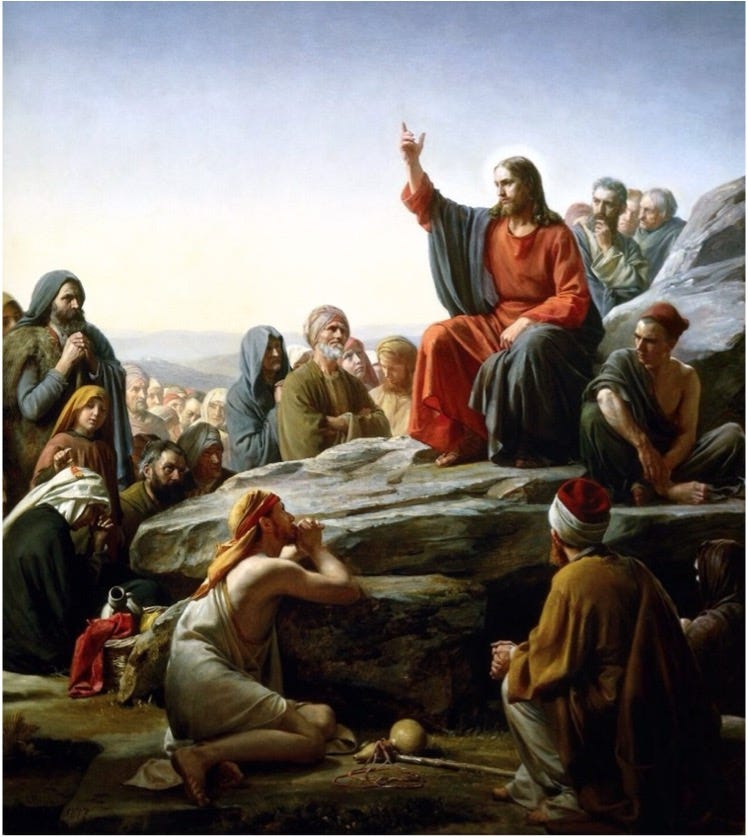
As important as it is to listen to the teaching of priests, scholars, the Magisterium, and the Catechism, when we read the Bible, let’s not forget its poetic nature that speaks to our soul and remember that we are blessed to have the Holy Spirit dwell inside of that soul. Don’t just scrutinize the text in a scientific manner, consulting the footnotes in your Bible or the explanation of Bishop Barron or Father Mike. Read it and digest it for yourself and let you soul be set afire by the Word!
I’m obviously okay with Vatican II and the Novus Ordo Mass, but I do understand the desire to celebrate in Latin. I love during Advent when we sing a lot more of the responses or during Lent, when the poetry of Latin is incorporated into the Liturgy.
During the 16th century, after Henry VIII broke from Rome, many Catholic teachings and devotions became discouraged and even outlawed under penalty of death. To relay our beliefs, Catholics came up with poetry which we now think of as largely innocent nursery rhymes and Christmas carols.
Ladybird, ladybird,
Fly away home,
Your house is on fire,
And your children all gone,
All except one,
And that’s little Anne,
For she crept under the frying pan.
The first two lines refer to Protestants’ feelings that Catholics (Ladybirds or The Blessed Virgin Mary) should fly back home to Rome.
Lines 3 and 4 refer to the burning down of the spiritual and temporal body of the Church, the torture of priests and those who renounced their Catholic faith to save their skin (children who were “gone” from the Church). Anne is probably a refence to Anne of Cleves, the last of Henry VIII wives to die and who reverted to Catholicism after her stepdaughter, Mary, became queen.
To be fair, the Protestants had their own subversive rhymes, like “Mary, Mary, quite contrary”, which is an allusion to Queen Mary Tudor, or “Bloody Mary”, as the Protestants called her, who tortured and burned at the stake recalcitrant Protestants.
The Twelve Days of Christmas is also thought to be a way that 16th century English Catholics communicated the faith, with the partridge in the pear tree being Jesus, through to the twelve drummers drumming being the twelve points of the Apostle’s Creed.
St. Teresa of Avila, a Spanish Carmelite nun, mystic, and one of only four female Doctors of the Church, lived during the dark days of the Counter Reformation. Her words and actions were inspiration for Catholics fighting back against the Reformation of Luther, Calvin, and others.
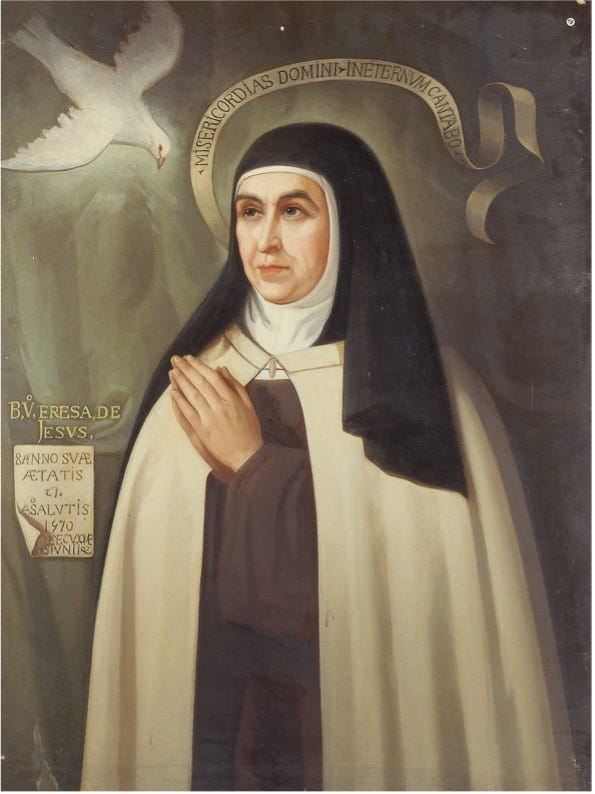
St. Teresa was a prolific writer, penning three books in addition to many shorter works. Her book, Interior Castle, while not poetic, does use elements of poetry in its overall form by using the theme of a castle with seven successive interior courts as the basis for a journey deeper into faith.
Her poetry is full of mystical wisdom, with each line able to transport the reader to a place where the ecstasies and the material world take the mind to a world of serenity and faith, a place where our souls connect with the rich unseen world of the divine.
St. Teresa of Avila died with poetry on her lips. "My Lord, it is time to move on. Well then, may your will be done. O my Lord and my Spouse, the hour that I have longed for has come. It is time to meet one another.”
Let Nothing Trouble You
Nada te turbe,
nada te espante,
todo se pasa;
Dios no se muda.
La paciencia
todo lo alcanza;
Quien a Dios tiene,
nada le falta;
Solo Dios basta.
Let nothing trouble you.
Let nothing scare you.
All is fleeting.
God alone is unchanging.
Patience
Everything obtains.
Who possesses God
Nothing wants.
God alone suffices.
Christ Has No Body
Christ has no body now on earth but yours,
no hands but yours,
no feet but yours,
Yours are the eyes through which is to look out
Christ’s compassion to the world;
Yours are the feet with which he is to go about doing good;
Yours are the hands with which he is to bless men now.
Divine Beauty
Oh beauty that does far transcend
all other beauty! That you design.
Without a wound our hearts to pain –
Without a pang our wills to bend
To hold all love for creatures vain.
O mystic love-knot that dost bind.
Two beings of such diverse kind.
How can you ever be severed?
For bound, such strength we gain from Thee,
We take for joy the griefs we find!
Things void of being linked, unite
With that great Beauty Infinite
You fill my soul, which still hungers
You love where men find only ill
Our nothing grows precious, by your might.
Contemporary English poet Sally Read’s story is one of God’s radical grace and power to transform. For the first 39 years of her life, she was an atheist and someone who “hated the Catholic Church.” While working as a psychiatric nurse in London, she began to ask herself about the existence of the soul and found that poetry could connect patients to memories long forgotten.
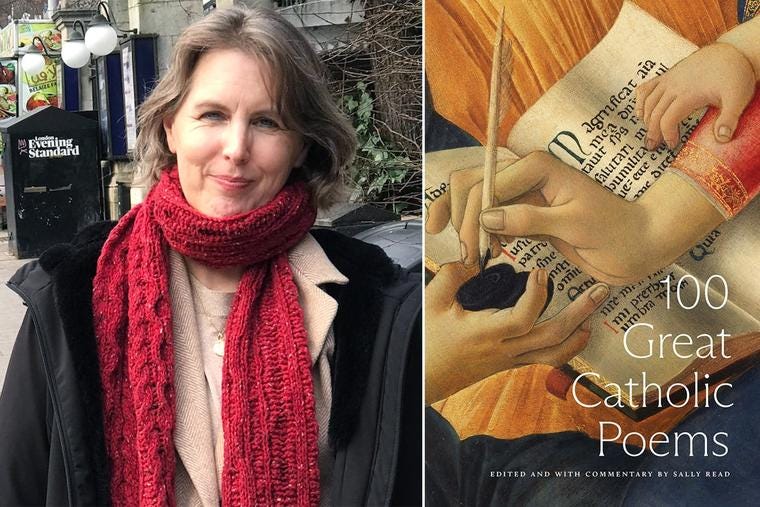
Later, after moving to Italy, she began to have discussions and debates with a priest in the coastal town she was living in, and eventually in a period of nine months in 2010, she went from being an atheist to Catholic, being received into the Church in the Vatican itself. While she was going through this transformation, one thing that struck her is that God is the ultimate poet, the ultimate Creator, and that she, as a poet, is simply an instrument of God. After her conversion, she became the poet in residence of the Hermitage of the Three Holy Hierarchs in Saskatchewan for three years.
In her essay, God and the Poet, she writes of her early, pre-conversation days as a poet using her art to bring form to the chaos and transform life into something bearable. Even for the secular poet, poetry has a power to sanctify an experience which was painful.
She soon realized, though, that the post-modern idea of poetry didn’t make sense and didn’t feed her desire to bring voice to what she’d witnessed as a nurse. For the post-modernist, traditional forms like end rhyme, the abstract, and odes to nature were frowned upon. There was even an unofficial list of banned words in these urbane circles, including transcendent, Jesus, and soul. It left her with the feeling of clipped wings. Even though much of her poetry is what could be called “free form” in that it’s not formulaic like a sonnet, she points out that even free form poetry has to follow a cadence, some sort of music.
As soon as she came to believe in God though, she felt seen by Him. “I felt as though I’d been pounding on a suffocating roof, only for it to be abruptly lifted, and infinity to come into view.” She also realized that every poem she’d written was an attempt “to see in ways that were not ordinary.” Poetry, she says, helps us to see as we’ve never seen before and understand anew.
She also recognized the poetry in the Mass, rich with metaphor, connection, and representation, making the invisible visible.
“At Mass, incense rises like prayer the altar is like a table for feasting. But the symbols of the Church, I would learn, go further. The blood issuing from Christ’s side is mercy; the Church is the Body of Christ. But we go further. The wine is like blood; but it becomes blood, and the bread is like flesh, but becomes flesh. Sitting at many tabernacles and knowing Christ’s real presence, I realized that Christ the Word made flesh is a poem: the definitively ineffable (God) given form and human voice and walking in the world. God is a poet, Christ is the poem.”
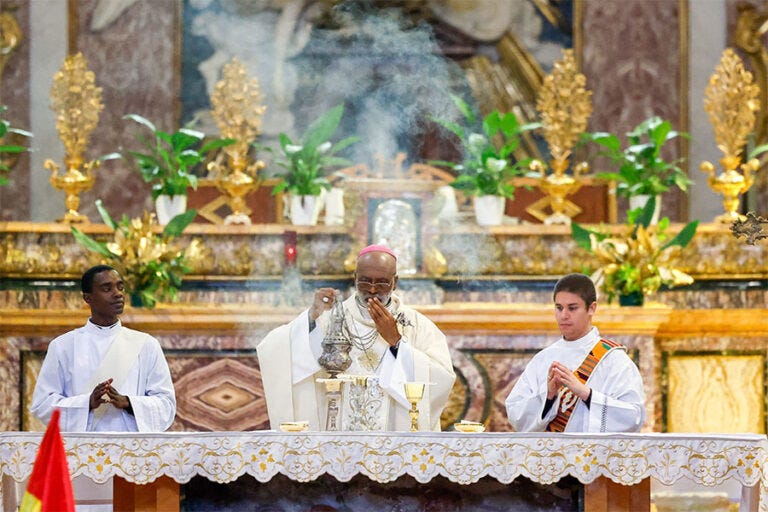
After her conversion, she lamented that “once faith was emptied, at least in part, from the world then the ignition went out of the creative engine.” She gives the example of modern art that takes little imagination or work to create. Garau’s lo sono, literally an “invisible sculpture, or Catellan’s Comedian, a banana duct-taped to a wall, come to mind.
She cites Alighieri, who call poetry “God’s grandchild.” On Dante’s tour of hell, he sees that any sort of creation, be it a building or a work of art, needs our sweat. Toil is required to achieve beauty.
Instruction (written prior to her conversion)
Check: water, soap, a folded sheet, a shroud.
Close cubicle curtains; light's swallowed
in hospital green. Our man lies dense
with gravity: an arm, his head, at angles
as if dropped from a great height. There is
a fogged mermaid from shoulder to wrist,
nicotine-stained teeth, nails dug with dirt –
a labourer then, one for the women.
A smooth drain to ivory is overtaking
from the feet. Wash him, swiftly, praising
in murmurs like your mother used,
undressing you when asleep. Dry carefully.
It he complained at the damp when alive, dry
again. Remove teeth, all tags, rip oft elastoplast –
careful now, each cell is snuffing its lights,
but black blood still spurts. Now,
the shroud (opaque, choir-boy ruff), fasten
it on him, comb his hair to the right. Now
he could be anyone. Now wrap in the sheet,
like a parcel, start at his feet. Swaddle (not
tight nor too loose) - it's an art, sheafing
this bundle of untied, heavy sticks. Hesitate
before covering his face, bandaging warm
wet recesses of eyes, mouth. Your hands
will prick - an animal sniffing last traces of
life. Cradle the head, bind it with tape
and when it lolls, lovingly against your chest,
lower it gently as a bowl brimmed with water.
Collect tags, teeth, washbowl. Open
the window, let the soul fly. Through
green curtains the day will tear: cabs, sun-
glare, rain. Remember to check:
tidied bed, emptied cabinet, sheeted form –
observe him recede to the flux between seconds,
the slowness of sand. Don't loiter. Slide
back into the ward's slipstream; pick up
your pace immediately.
His Face
His body is swaddled head to foot,
But his face is a window: one small pool of light.
This nakedness that even Adam would not cover
Is a tender dish of listening.
Hunger in the nuzzling nose and petal mouth
A sense of awe in the here and now
And dizzy distance like that one star
Announcing the expanse of night
Lady, see the depths of his dark eyes
This locked gaze is what keeps God and man together.
It is true prayer: he holding fast to your face
like a constellated sky, you tumbling softly
into him with no lights but those eyes.
Night Prayer
Don’t think the night’s all deadness—there are wells
of light and dark, and many kinds of silence. Tonight
the snow breathes light and three large hares, white
on white, are munching left-out carrots, lolloping trails
of nothing in a silky, new-ink silence. It’s the silence
of how your hair would sound when it rises on your scalp.
It wakes the hermit; that and the beating heart of Christ
that pushes through the night like a boat through
brackish waters. There is no chapel-bell, no tramping march
of monks. Just one mind in the wooden room, apiece
with the fresh-ink hush. Thoughts are indivisible
from prayer; speech inseparable from silence and his heart
which echoes endlessly with what God spoke. He rises.
The snow-light seethes around him, like insomnia or love.
When we are inspired enough and work hard enough to create something truly beautiful and authentic, we will grasp a small glimpse of the divine. We will look upon that work and, like God at the end of Creation will be able to say, “it was very good.” If we manage to channel that divine spark in an especially miraculous way, we may even be like the Psalmists, Dante, or Shakespeare, and our work will pass into eternity.
Divine Comedy, Dante Alighieri (1321)
The Dark Night of the Soul, St. John of the Cross (1579)
Upon the Death of M. Edmund Campion, St. Henry Walpole (1581)
Sonnet XVIII, Felix Lope de Vega Carpio (1598)
Love (1633), Matins (1633), George Herbert (Anglican)
As Kingfishers Catch Fire, God’s Grandeur (1877) Gerald Manley Hopkins
The Sign of the Cross, John Henry Newman (1895)
O God of Earth and Altar (1907), Lepanto (1911) G.K. Chesterton
The Great Hunger (1942), The One (1942), Canal Bank Walk (1958), Patrick Kavanaugh
The Annunciation, Thomas Merton (1957)
The Hundredfold, Anthony Esolen (2019)
Dawn of This Hunger, Sally Read (2021)
Doorways to Poetry, Louis Untermeyer (Secular) (1938)
100 Great Catholic Poems, Edited by Sally Read (2023)
Patrick Kavanagh is the Catholic poet we should be reading this Advent (America, The Jesuit Review)
Three Nursery Rhymes With Surreptitiously Sinister Origins (Catholicism, Pure and Simple)
“I Am Thine, I Was Born For Thee”: Five Poems of St Teresa of Avila (Catholicism, Pure and Simple)
Former atheist poet reveals details of her Catholic conversion (Catholic News Agency)
“God had to come to me…” Poet Sally Read on the journey from atheism to Catholicism(Aleteia)
God and the Poet (Humanum Review)
Biblical Poetry (Catholic Stuff You Should Know Podcast)
Poetry, Beauty, and the Shock of Grace w/Fr. Paul Murray, OP (Word on Fire Podcast)
Catholics Need Poetry. But Do We Want It? – Dana Gioia (The Catholic Culture Podcast)
Poetry of St. John of the Cross (The Catholic Culture Podcast)
Anthony Esolen on Catholic Poetry (Godsplaining Podcast)
Do We Need Catholic Poetry (Dr. Anthony Esolen) (The Catholic Current Podcast)
Comments
Nothing yet. Say the first thing.
Sign in to join the conversation.