
“The Iron Veil” is a series of monthly essays about Immortal Game and the stories from chess history that shaped it. If you’re only interested in book updates, you can unsubscribe from all sections except “allison saft” here.
Let us begin with the most obvious question about Immortal Game’s origins. Why faerie chess? The truth is that I did not think up this winning combination on my own. It’s already there in the canon of Irish mythology.
The Irish heroes you know are chess players.1 Cú Chulainn—son of Lug, the hound of Culann, who singlehandedly defeated Queen Medb of Connacht's army—is so dedicated to the game, he once killed a man (by hurling a piece at him, no less) for breaking his concentration. Finn mac Cumhaill—the leader of the Fianna, blessed with wisdom from the Salmon of Knowledge, and defender of Tara—plays many a game throughout the Fenian Cycle. Among my favorites is this one, described in the tale of Diarmuid and Grainne:
Finn challenged Oisin to a game of chess, and as Oisin began to make a move that would lead to Finn beating him, a berry dropped onto the square that he should move to. He made the move, and continued to follow the guidance of the rowan berries. Eventually, Oisin beat his father at chess for the very first time. Finn Mac Cumhaill sprang up, saying, “There’s only one man in Ireland who could have beaten me at chess, and that’s Diarmuid O’Duibhne.” And there was Diarmuid, looking down on them from up in the tree.
It tells us something that the most revered and powerful mythical figures2 play. In A Social History of Ancient Ireland, Patrick Weston Joyce writes that “to be a good player was considered a necessary accomplishment of every man of high position” (477). Chess was, both literally and figuratively, a game of kings. It was used—as it was in Soviet Russia—as an instrument for shaping and educating good citizens. In practical terms, it teaches tactics and cunning, focus and resourcefulness. In the mythic realm, chess becomes a proving ground, a test of guts. A single loss can alter the course of your entire life.
Nearly every game of chess you find in Irish mythology involves a bargain: The winner binds the loser to an unbreakable promise. Unless, of course, you’re clever enough to escape that promise; Finn himself weasels his way out of a marriage, thanks to a loophole in the stake he promised his opponent. (The connections between chess and the fae make themselves sometimes. What else can we call “I put you, O Finn, under bonds of heavy enchantment, to be my husband till a shovel puts seven of its fulls of earth on your head” but a faerie spell?) Marriage, servitude, or a humiliating death are common consequences of losing a game of chess. Our heroes often don’t know what their opponents will ask for until the game’s outcome is decided. Still, they play. When the stakes are so high, you must be confident that you can win.
The most dramatic and fascinating of these games occurs in Tochmarc Étaíne (“The Wooing of Étaín”) from the Mythological Cycle.3 I first encountered this story in 2014, in a class I took at University College Dublin. It’s sprawling and difficult to summarize. So, for simplicity’s sake, let’s say that it’s about Étaín, the most beautiful woman in Ireland, who draws the attention of a faerie.4 This faerie is none other than Midir, the king of the sidhe Brí Leith. The way he describes her is quite lovely: “By my pools and stones in all my long years, I have never seen such beauty, such grace and such sweetness.” Midir buys her from her father, but there is one small barrier to their happiness. Midir is already married, and his wife is a powerful and spiteful sorceress. He delays going home for a full year.
When he finally returns home with Étaín in tow, his wife is, needless to say, very unhappy with him. In a jealous rage, she transforms Étaín into a butterfly and casts her away on a gust of wind. One-thousand years later, butterfly-Etain lands in the cup of a mortal woman, who swallows Étaín whole and becomes pregnant. She gives birth to a new Étaín. This time, Étaín’s preternatural beauty attracts the High King of Ireland, Eochaid Airem, and he takes her for his wife. When Midir catches wind that Étaín has been reborn, he appears to her and asks her to return to the Otherworld with him. She has no memory of their past life together and refuses him. She will go with him only if her husband gives his blessing. So, bound to honor her wishes, Midir devises a cunning plan to get her back.
He goes to Eochaid and proposes that they play a few games of chess. Eochaid, of course, insists that he will only play for a stake: the loser must do whatever the victor asks. They play three games, two of which Midir loses (we’re meant to understand he is hustling Eochaid). When Midir finally wins the third round, he names his wish: one kiss from Étaín. Eochaid, very determined to not let this happen, tells Midir to come back in a month to claim his prize. Eochaid gathers the finest warriors in Ireland to guard his stronghold, but Midir slips past them. As soon as he takes Étaín into his arms, he transforms them both into swans—and off they go to his sidhe. There is more after this that I won’t get into. Eochaid’s quest to steal Étaín back from the Otherworld ends quite tragically for him.
This tale was presented to the class as a love story. Midir was figured as a romantic hero, devoted and loyal to Étaín across lifetimes and worlds. It is an understandable and tempting reading, I think, especially for contemporary readers and our fondness for immortal men who will do terrible things for the women they love. Every time I revisit this story, however, I can’t help wondering if Étaín even likes either of these guys. The trajectory of her life, over and over again, is dictated by their passionate love and passionate jealousy. She is bought and sold and bartered away. We never really see how she feels or what outcome she’d prefer. I wanted to know.
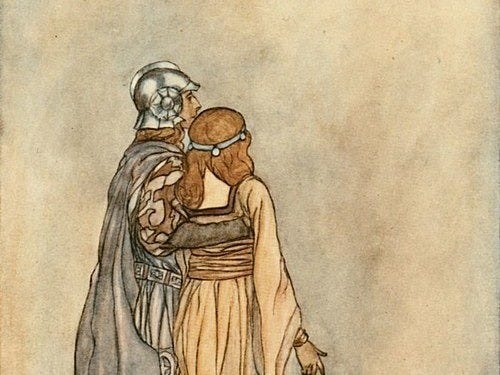
The mystery Étaín presents, the opaqueness of her dreams and desires, was the spark of Immortal Game. It is what kept me coming back to the idea for over a decade. But just as vivid in my mind was this chess game. It fascinated me. The story makes sure we know how the board and the pieces look. Midir and Eochaid even have a little argument about whose board they should use to play; only the finest and most bejeweled will do. The stakes they play for are outlined in rich detail, and the growing tension and resentment between the men is palpable. At one point, Eochaid’s foster-father advises Eochaid to “lay heavy burdens on him.” In other words: Since Midir seems to be a faerie, very bad at chess, and determined to keep playing, why not take advantage of him? Why not request increasingly impossible things from him and reap the rewards?
In 2016, when I first set out to retell “The Wooing of Étaín,” I sensed inchoately that chess mattered a great deal in this world. I didn’t really have the curiosity to explore why, though. It’s no surprise, then, that those early attempts to write my own version fizzled out. In my first iteration, Étaín was the protagonist: a girl in modern-day Appalachia who finds herself pursued by a faerie lord. The love interest, a stand-in for Eochaid, was not a chess player. When Midir challenged her to a game, she lost. There was never any doubt that would be the case. She’d never played chess before. I’d never played chess before. There was nothing interesting there. No drama, no tension, no reason for the game to happen at all. It seemed to me an unsolvable problem, but I couldn’t remove the game. The retelling wouldn’t be a retelling at all without it. So, I set the book aside and instead wrote Down Comes the Night.
A few years ago, one of my favorite streamers started playing chess. He made it look very cool—or at least like it might be fun to try. I liked the struggle of it. I liked how much it seemed to demand of its players. So, I started watching a ton of Levy Rozman's educational videos. The more I learned, the more I loved it, and the more I started to think about that idea I had, once upon a time, that hinged upon a fateful game of chess. My reimagining hadn’t worked because I didn’t care about chess. It was so incidental as to be meaningless. If I wanted to capture the magic and crackling tension of Midir and Eochaid’s game, chess had to be everything. The protagonist had to be a grandmaster. That decision completely changed my entry point into the myth. It wasn’t Étaín’s story I was retelling anymore. It was Eochaid’s. I made some adjustments; my version of Eochaid is a nineteen-year-old girl named Shea Fury, and she is Étaín’s sister.
Six years before the novel begins, Shea lost a game of chess to the High King of the Otherworld, Midir of Bri Leith, and as a result, he spirited away her sister. She hasn’t forgiven herself, and she’s devoted her entire life to entering Midir’s chess tournament, which he hosts in the Otherworld every 100 years. The winner can ask him for one wish. No one has defeated him before, but Shea intends to be the first. She intends to get her sister back, no matter what dangers she’ll encounter. Shea, whose life was irrevocably altered by a single game, is willing to risk it all again. Like a modern Irish(-American) hero, she must believe she can’t lose.
preorder: barnes & noble | waterstones | bookshop
The Queen’s Gambit x The Cruel Prince
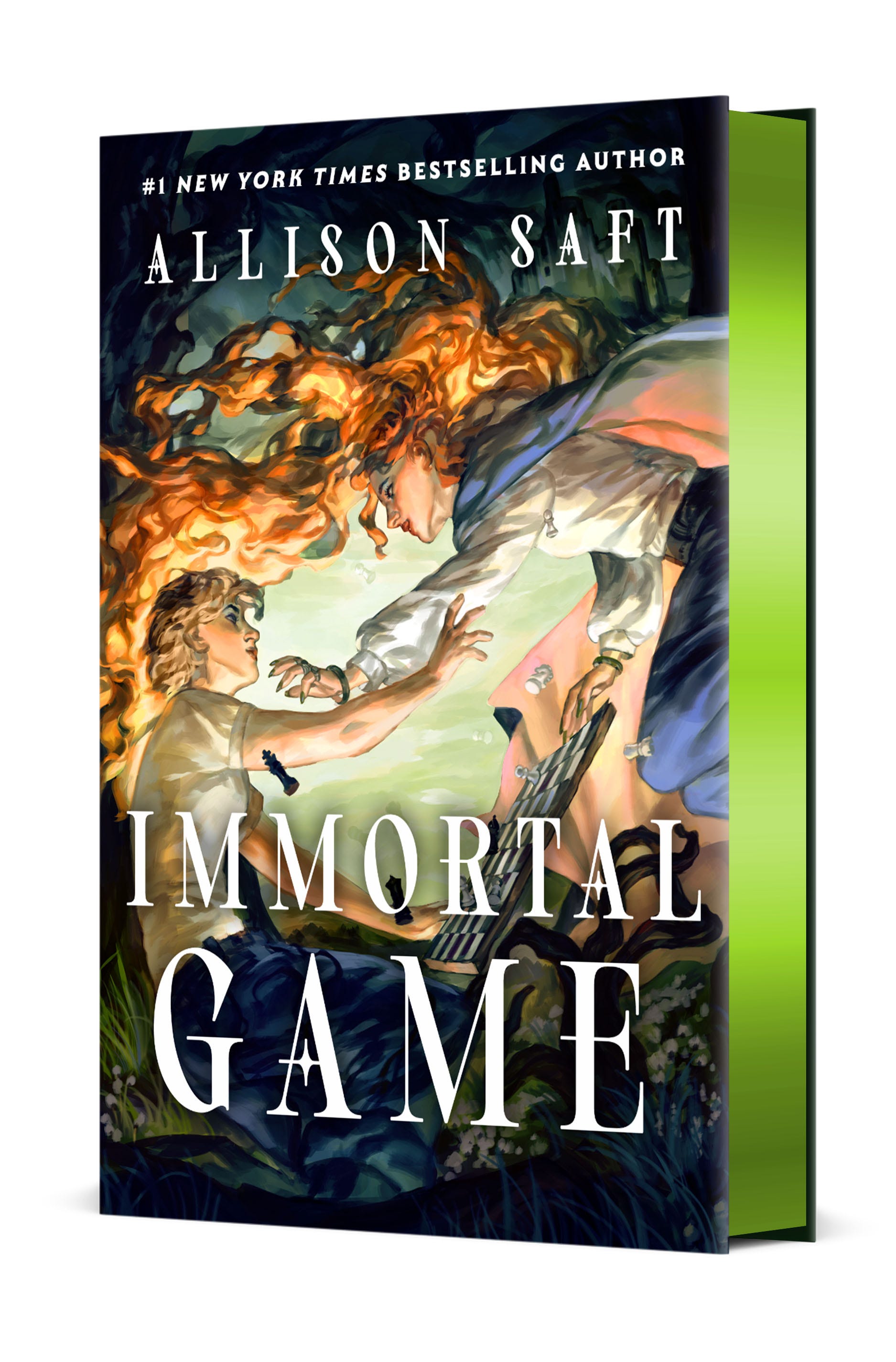
Six years ago, Shea Fury’s sister was whisked away by the High King of the Otherworld, the ruler of the treacherous land of fae. Although Shea has spent the years since dreaming of rescuing her sister from captivity, the Iron Veil that separates the human world from that of the fae has made it only a wish. That is, until an invitation to participate in a once-in-a-lifetime chess tournament in the Otherworld arrives on Shea’s doorstep. The winner of the tournament may ask the High King to grant one wish, and Shea is finally within reach of hers.
But entering the tournament and winning it are two different matters. Dark magic lurks around every corner in the Otherworld, and Shea’s cutthroat opponents are willing to bend the rules to make their own wishes come true. To make it to the end—and to find her sister—she is forced to strike an alliance with her longtime rival, the sharply beautiful fae princess, Ciara of Bri Leith. One wrong move, though, and Shea could lose more than just the competition: She’d lose her sister, her dignity, and maybe even her life.
It’s more accurate to say fidchell—an ancient board games which roughly translates to “wood wisdom”—here. But I will take after translators of these myths and use ‘chess’ and ‘fidchell’ interchangeably. No strategy or moves are ever described, and the games serve the same narrative purpose.
It’s worth noting that these stories aren’t exactly “authentic.” All the tales we have were preserved by medieval Christian scribes, who were making some attempt to reconcile pagan belief with Christian teaching as they built out this mythologized Irish past.
This is an old story. Parts of it were preserved in Lebor na hUidre, a manuscript from the 12th century; a full version also exists in Leabhar Buidhe Leacáin, which dates to the late 14th century.
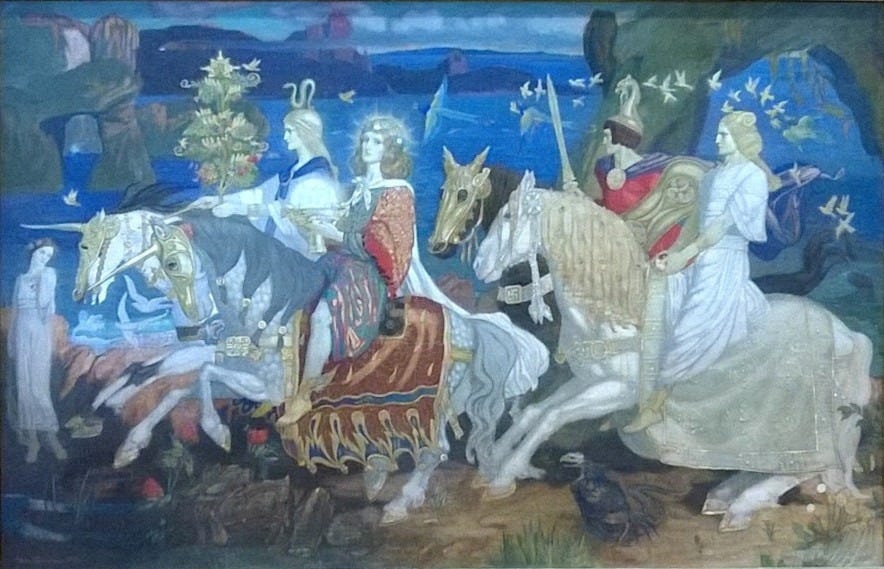
While I use the term faerie here, Midir is a member of the Tuatha de Dannan, a group of pre-Christian Irish deities. In Lebor Gabála Érenn—a mythologized history of six conquests of Ireland—the Tuatha De invaded Ireland, wreathed in clouds of black smoke that “brought a darkness over the sun for three days and three nights.” They’re not exactly what we would call fae. They have no pointed ears, no aversion to silver, and they can lie. They do, however, reside in the Otherworld and emerge from beneath the sidhe (fairy mounds or burial mounds) on solstices and equinoxes to interfere in the affairs of mortals. They are skilled in magic, forge ruinous romantic bonds with mortals, and place a high premium on artistic talents and craftsmanship. They’re long-lived and inhumanly beautiful. The faerie lore we’re all familiar with certainly draws on this tradition.
Comments
Nothing yet. Say the first thing.
Sign in to join the conversation.