
I dreaded my daughter’s six-month checkup, knowing another round of shots was coming. She’d be getting the final dose of several vaccines, and earlier rounds made her (and thus, me) miserable in the pediatrician’s office. They’d also presaged a night of bad sleep for her (and thus, me).
This was also the appointment, according to the handy magnet we received in the hospital, where she’d receive her first Covid shot. I wondered if we’d have to fight to get it - I vaguely recalled hearing news about some childhood immunization kerfuffle. Instead, the nurse told us the pediatricians in the practice were recommending we go ahead with the Covid vaccine, but we needed to be aware that it was technically “off-label.”
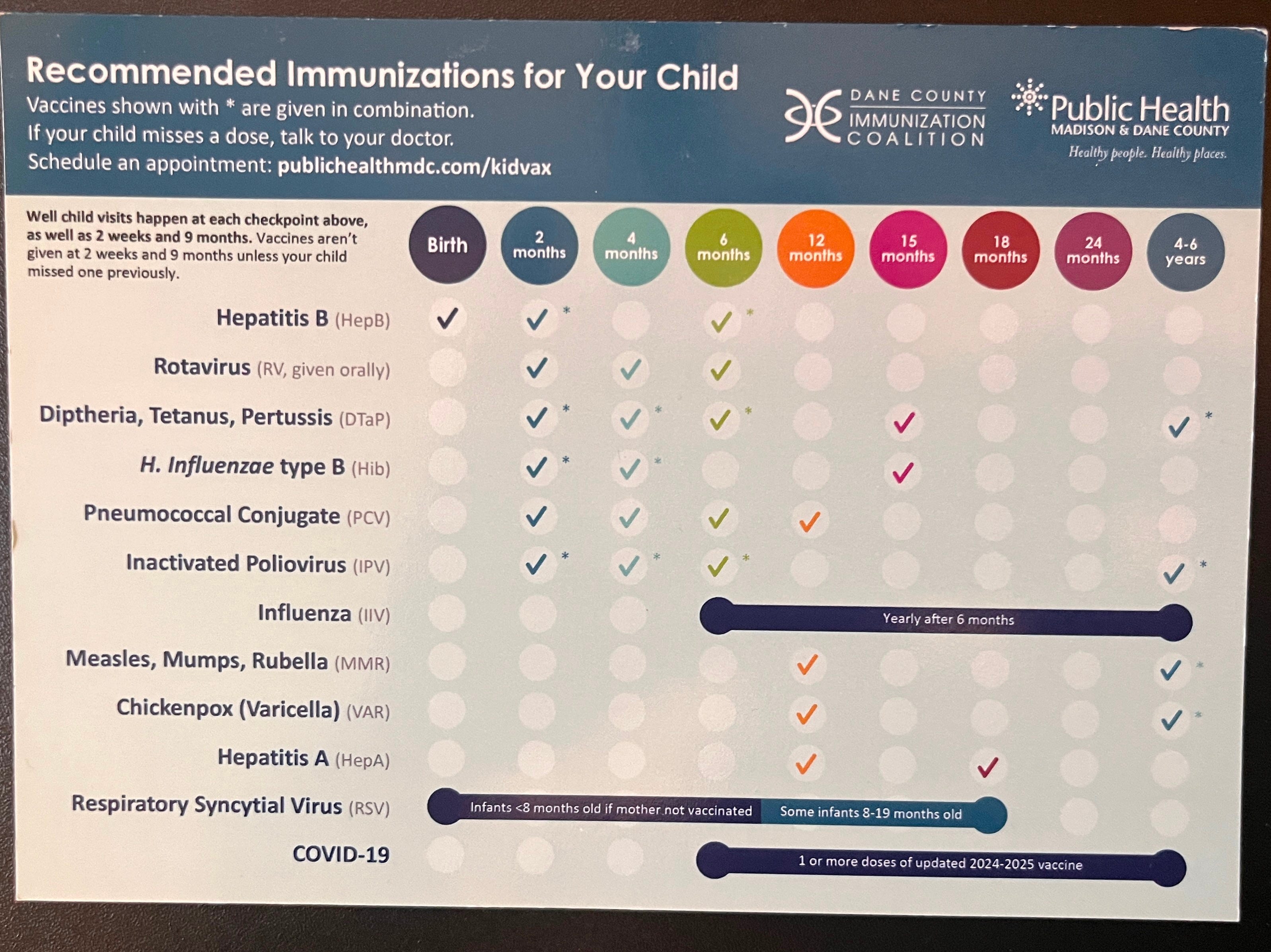
“Off-label” is not a particularly comforting phrase. After the visit, I spent a solid hour online trying to make sense of what had changed and what it all meant. The long and short of it: over the summer, HHS Secretary RFK Jr. dismantled the CDC committee charged with recommending which vaccines Americans should get. He then reconstituted it with new members more amenable to his views. This revised committee determined that Covid vaccine schedules should be driven by “individual-based decision making,” rather than a universal recommendation for kids my daughter’s age.
I’m not interested in wading into the do-vaccines-cause-autism controversy today. Instead, I want to make the case that as polarization over medical questions grows and trust in public institutions plummets, mothers like me will be forced to add “medical expert” to our already lengthy job description. I doubt the consequences will be positive for us or for our children.
More policy changes are expected in the coming months as Kennedy enacts his vision to “Make America Healthy Again” (MAHA). Under his leadership, an already tenuous public health consensus seems poised to further erode. In response to proposed or enacted federal changes, blue states are rushing to shore up vaccine mandates even as red states hurry to relax them. Professional medical associations are speaking up to defend the safety of the same medications federal agencies caution against.
The net effect of this confusion and controversy is to shift even more of the medical research and decision-making burden onto individual parents. In practice, women will likely bear the steepest costs.
Already, mothers are primarily responsible for making health decisions for their children. In pregnancy, mothers are the ones navigating guidance around foods they can eat, activities they can perform, and, yes, medications they can take. Later, mothers are disproportionately the ones conferring with pediatricians, monitoring the progression of children’s illnesses, and overseeing preventative health practices such as eating a balanced diet and practicing good oral hygiene.
In this new, hyper-politicized public health era, mothers’ health-related mental load is likely to grow considerably heavier. On one hand, they will be pushed to do their own research rather than accept now-suspect expert guidance. On the other, their familiar roles as family peacekeepers and conflict mediators will take on new weight as the circle of controversial health topics continues to grow.
“Parental choice” is often framed as unmitigated good. Many people believe that, so long as they are not abusive or neglectful, parents should have broad authority over how their children are raised, including the medical care they receive.
When deployed well, trustworthy expert guidance reduces mothers’ mental load without undermining their authority. Typically, government actors achieve this balance by setting default recommendations they believe reflect the medical consensus and promote both individual and public health. Then, they allow parents to deviate from that guidance if they choose, barring cases where such deviation is deemed unsafe.
In theory, at least, this system still holds. I wanted to vaccinate my daughter and was able to do so. Pregnant women looking to treat a fever can still access Tylenol. In practice, though, the overt politicization of public health is eroding parents’ trust, effectively outsourcing the work of expert synthesis to laypeople—mostly, to mothers.
In a new profile of Kennedy, journalist Michael Scherer reports that RFK Jr. spent a recent weekend reading 70 research studies related to the “possible connection between taking Tylenol during pregnancy and the development of autism or attention deficit disorder in children.” Kennedy hopes the rest of us will make similar choices:
“‘Trusting the experts’ is not a feature of science,” he likes to say. “It’s not a feature of democracy. It’s a feature of totalitarianism and religion.” But having everyone “do their own research,” as Kennedy recommends, was untenable even before the advent of technologies like nanoscience and genomic editing.
“Untenable” because the medical research literature is complex and often inconclusive or even contradictory. Relatively few parents have the skills needed to independently assess the evidence and identify the best treatment for their child. (I include myself in this camp: though I have a PhD and am definitely pro-research, I am wayyy over my head when I try to pick up journals like JAMA…)
“Untenable,” too, because there are approximately 1,273 decisions that need to be made on a daily basis (I’m rounding down), and it would be literally impossible to review and synthesize the primary research literature before making each one. If I spent my weekends reading medical journals, I would have no time to actually care for my kid!
The “do your research” ethos of the MAHA movement is but the latest incarnation of what my colleague Jess Calarco calls the “Supermom Myth,” which “paints a portrait of children in constant danger and of mothers as the only ones with the power to rescue them from harm.” Calarco writes:
Mothers matter, a lot. But they aren’t the only ones who should be protecting children. Nor would children need as much protection if we had a stronger social safety net…The Supermom myth leads us to ask the wrong questions—‘How can mothers best protect their children?’—rather than: ‘Why are women the ones tasked with protecting kids?’ Or even: ‘Why do we have so much to fear?’
Indeed, the list of things to fear grows ever longer. Here’s one of mine: as our public health system splinters, women and children alike will bear the costs.
Updates and happenings
🎤 The podcast fun continues! I spoke with couples therapist Dr. Alexandra Solomon for Reimagining Love and - for something completely different! - entrepreneur Adam Fishman for Startup Dad.
🏆 New Scientist named What’s on Her Mind one of its top popular science books of 2025!
🎁 Speaking of which, I bet WOHM would be a great gift for a parent in your life. You can find it on Bookshop, Amazon, and all the usuals. (There’s even an audiobook!)
Comments
Nothing yet. Say the first thing.
Sign in to join the conversation.