
This past Sunday was a very special day for our family. We celebrated the 13th birthday of my older daughter, and the First Communion and Confirmation of my younger daughter.
I tried not to, but I cried at the end of Mass, reveling in the heavenly experience we just participated in. My daughter Zoe was the only girl receiving her Sacraments, and looked so lovely in her white gown. Meanwhile, the Church was filled with family, friends, and community from our parish that we have gotten to know over the last few years. Such a gift, such a blessing.
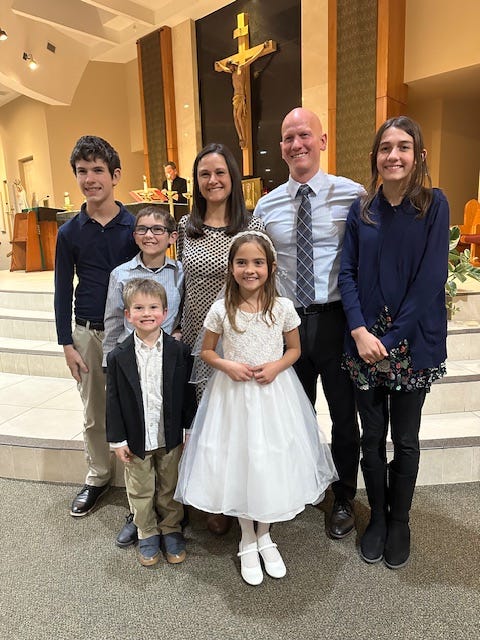
And to know we were all united in the worship of God, in receiving the Body and Blood of Christ, and being filled with Jesus’s love, grace, and presence? It was just too much for my heart, and the rejoicing overflowed into tears.
My faith life is deeply Eucharistic, and it is my greatest joy to introduce the Sacramental life to my children.
I was able to contrast that experience with a Lutheran service my husband and I recently attended for a friend of ours. Sometimes contrast helps the light to shine brighter, and the truth of my love for the Eucharist became more vibrant after attending a baptism and service at this Lutheran church.
As a cradle Catholic, I had never been to a Lutheran service, and with great reverence to my brothers and sisters in Christ, I want to highlight the differences that, for me, allowed the light of the Catholic Sacraments to shine.
The baptism occurred at the beginning of the Lutheran service with limited fanfare. There was no anointing with the holy oil of Chrism, and I found I missed the rich symbolism of the oil, which connects the baptized to the Old Testament anointing of prophets and kings, thus confirming our own baptismal call to be priest, prophet, and king. The symbolism of oil is rich– sanctification, healing, strengthening, dedication, consecration, and sacrifice. Plus, Chrism smells amazing (I definitely sniffed my daughter’s head a few times on Sunday)!
Back to the baptism, there were then a few questions to the congregation about believing in Christ and following Him, to which we all were invited to respond, “Yes, with grace.” There were no questions about rejecting Satan and all his works and empty promises. There was no mini-exorcism. The sense of spiritual warfare was entirely absent, whereas in Catholicism, the call to live in the Kingdom of God and reject the Kingdom of Darkness is center stage.
And I missed the language of “I do,” which we are all familiar with from weddings. The phrase, “I do” really reminds us of the solemn promise that we commit to in these Sacraments. “Yes,” is the answer I give to my husband when he asks if I want coffee in the morning. “I do” are the words I spoke to enter into a sacred covenant with my husband, and also the words I spoke at each child’s baptism to usher them into covenantal life with God.
To their credit, they did use water with the proper Trinitarian formula, and they did have what appeared to be a large Paschal candle, which was lit. But after the baptism was over, our friend was given an unlit, smaller candle to take home and was encouraged to light it on his baptism anniversary. This candle was never blessed or lit from the Paschal candle, which would’ve been done at a Catholic baptism, and so the entire meaning of why he would light the candle on his baptism anniversary was lost. Again, our Catholic symbolism is so rich because we light our baptismal candle from the Paschal candle—the great Easter candle— connecting our life in Christ to the death and resurrection of Jesus and the triumph of light over darkness. Jesus is the Light of the World, and we take on His light when we receive new life at Baptism.
My last two observations are on the atmosphere and communion.
The sense of community is what I believe drew our friend to this Church. They are very friendly and welcoming, and I think Catholics could learn a lesson or two from that. But there is no sense of sacredness in that space: no reverence, bowing, or kneeling. It was all casual. Their format had three different sermons from three different people. People chatted in between segments. The praise and worship was modern and less than stellar (which I do see sometimes in Catholic Churches), and although I grew up Charismatic and love a good P&W song, this experience left me longing for sacred hymns and solemn worship.
We all prayed the Our Father together (and I knew that one), and we also said the Apostles Creed which I was all about, until the last bit was changed to “I believe in the Holy Spirit, the Holy Christian Church, the forgiveness of sins, etc.” The original word is Catholic, meaning universal, which the Church was until it split during the Reformation and continued to splinter after.
Finally, they did have an altar, which wasn’t really used except to store their large round bins for communion, and they even had an altar rail, which also wasn’t used. Their pastor did bless these “platters” (I don’t know the term they would use) with the sign of the cross and repeated a few verses from the Last Supper. But it was brief, and what I love about the Catholic Mass is again the sacred sense of worship and ritual sacrifice, the elevation of the Host, and the fact that we are united in space and time to Christ’s sacrifice on the cross.
As my husband and I are not in communion with the Lutherans, we did not go up, but their communion line was reminiscent of many modern Catholic ones until we got to the part where they kicked back their mini cup of grape juice.
I genuinely am interested in what they believe they are partaking in; what kind of body and blood they are saying “Amen” to. Although Jesus said, “Do this in remembrance of me,” Catholics don’t understand that as having a memory of something in the past. Catholics understand remembrance as anamnesis, which makes the past present and thus becomes a real participation in the sacrificial events of Christ’s Passion. If the Lutherans really believe it is Christ’s body, what are the theological implications of that? Where do they store the leftover blessed bread? What do they do with all the little plastic cups that supposedly held the blood?
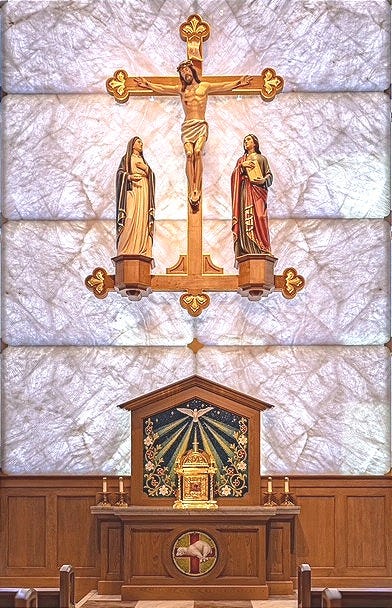
In the Catholic Church, we store the leftover Hosts in the Tabernacle for Divine Worship, Adoration, and future Communions. We have purificators for anything that touches the sacred species of Christ’s Body and Blood, and we even have a sacrarium in every Church: a special sink that bypasses the sewer and goes directly into the ground for all the water that touches the sacred vessels. We would never put the Precious Blood in plastic cups (precious metals only), let alone throw them away after they had touched His Divine Presence.
Jesus didn’t die on the cross so we could remember it while listening to sermons about following Christ or how grace is everywhere. We have grace in the first place because Christ’s presence communicated to us in the Sacraments sanctifies created things. Jesus’ Eucharistic presence is living in our Churches, Tabernacles, and Chapels. And when Catholics receive His very living Presence, we then take Christ into the world.
I’ve spent 25 years going to Mass and Adoration weekly – sometimes less but sometimes more. I know deep in my soul the real thing of Christ’s sacramental presence in the Eucharist. Like St. Ignatius of Antioch (martyred in 109 A.D.) said, “I want only God’s bread, which is the flesh of Jesus Christ, and for drink I crave his blood, which is imperishable love.”
Witnessing this type of worship at the Lutheran Church set my heart on fire for the real presence of Christ in the Eucharist: I want incense, altar rails, patens, and kneeling for Communion. I want to have our Masses be reverent, sacred, and other-worldly as to remind us of the great privilege of the Sacrament of Christ’s Body and Blood.
This kind of reverence does not preclude community-building or a closeness with God in prayer. Rather, it is an important part of the whole to pray what we believe so we can live it.
Sometimes we take for granted what a great gift we have in the Eucharist, but contrasting these experiences in allowed me to fall more in love with our Eucharistic Lord. My daughter couldn’t wait for her second Communion, so we went to Mass again two days later. Now we both look forward to when she loses count of how many times she’s received our Eucharistic Lord. It truly is a foretaste of Heaven.
Thanks for reading! Subscribe for free to read two posts a month. Or upgrade for as long as you want to access to my DIY retreat.
No posts
Comments
Nothing yet. Say the first thing.
Sign in to join the conversation.