
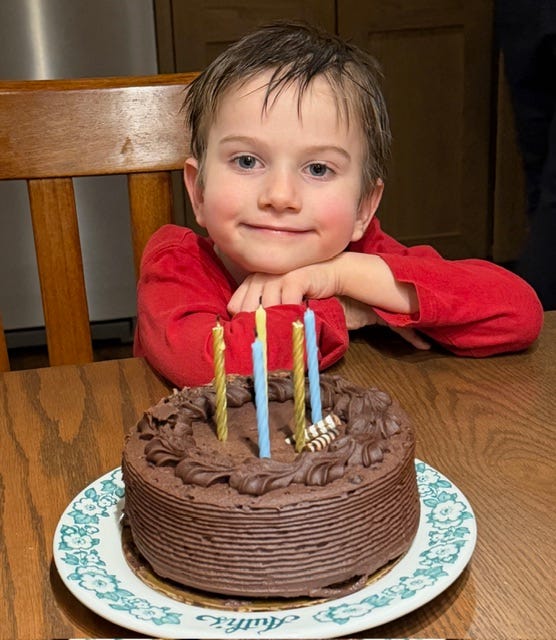
My newly minted five-year-old was snuggled up against me, huddled in his blanket, when he looked at me and asked, “Mom, aren’t I so cute?” The confident grin told me he already knew the answer: he is totally adorable. I love the boldness with which small children assert the truth: I am beautiful. I am cute. I am lovable.
And then somewhere along the way something breaks.
You begin to despise the body that doesn’t look like everyone else’s, or that people make fun of, or that doesn’t land you that date. You punish it, obsess over it, or change it in a grasp for control. Eventually, you find faith and think your hatred is justified because the Bible says that the world, the flesh, and the devil are sinful. So you *mistakenly* believe that your own flesh is bad.
Or maybe that’s just me.
Back in November, my husband and I were sitting on the couch, coffee in hand, and reading the daily readings. I chuckled to myself at the Gospel, in which Jesus seemingly tells us to hate ourselves: “If anyone comes to me without hating his father and mother, wife and children, brothers and sisters, and even his own life, he cannot be my disciple” (Luke 14:26). I chuckled because of the way I used to take that literally as an excuse to hate God’s canvas, to loathe what He made in me. I spent a few minutes in prayer that morning reflecting on how far I’ve come, allowing God to speak the truth to me that I am very good.
Later that day, I laughed again as I read a post written by Claire Dwyer entitled: Let Your Embodied Self Be Loved. In it she wrote, “Our physical bodies are the portals to sacramental grace and human love. They are the means of communion with God and others. . . They themselves are living expressions of what is eternal, and miraculously, not only a revelation of who we really are but of who God is. . .If we have forgotten how important our bodies are, our enemy has not. The devil wants us to dismiss, be disgusted by, or destroy our physical selves.”
She goes on to say how we must learn our limitations and not be destroyed by our own zeal. The whole thing is worth reading.
For someone who has had a complicated relationship with her body, as well as zeal for the faith, it was easy to think by that passage in Luke’s Gospel that I was doing what God wanted. I justified my false dichotomy with a spiritual excuse: God told me to hate my own life or I cannot be His disciple.
Only, that is not what Jesus is saying. There is another time the Hebrew word for hate comes up in St. Paul’s letter to the Romans: “Jacob I loved but Esau I hated.” (Romans 9:13).
Was Esau really hated? No, the idiomatic expression in Hebrew means, “to love less.”
Should we love ourselves less than God? Yes! That is the point. If we love ourselves more than God, that is idolatry. Even still, we are not given a free pass to dismiss our bodies or punish them and call it holiness. Rather, we are to love our bodies for the way they express the divine. God created us, put His Spirit into us, and destined us to share in His divinity. That is not something to hate!
I particularly had to confront the war with my body after my babies were born. What a miracle my body had performed to receive new life and birth it into the world! Yet all I could see was what was wrong with it. The struggles with nursing, the stubborn weight that hung on, the pain in my hips, the total exhaustion. I couldn’t dismiss them or explain them away.
I had to integrate them.
As I share in my DIY retreat talk about identity lies, I grew up thinking someone was wrong with me; that I was defective, broken. The postpartum difficulties brought the issues to the surface, and it was through my experience in spiritual direction that I believe I found healing. Not because all my problems were spiritualized away, but because I was loved in relationship.
As I told my spiritual director about the deep issues in my own life, I was always met with compassion, gentleness, and earnestness for me to see my own goodness. Then my director would direct me to prayer, and I would bring the pain to God. Over the course of years, of learning to take care of my body, forgive others, forgive myself, and encounter God in prayer, I learned to love myself the way God loves me. The fissures began to close, as Dr. Greg Bottaro shares in this insightful Substack:
I’ll give you the punchline:
“But it was Wojtyła who gave us a tour of the cathedral and showed us the way through. Not merely the mechanism of the wound, but the experience of living with it—the drama of the divided self, the felt impossibility of acting freely when the subconscious is running the show. And the path to healing, which runs not through insight alone but through relationship: the slow, patient, grace-soaked work of being received as a gift until we can finally give ourselves away.
The woman in my office is not a theological problem to be solved. She is a person to be accompanied. But she deserves to understand why she is stuck, and to know that her stuckness is not a verdict on her faith. The groove was cut before she knew what was happening. And the healing will take time—more time than she wants, more patience than feels fair.
But the healing is possible. That is the good news buried in all this anthropology. The track can be filled in and rerouted. The fissure within can be closed.
Not by knowing better. Not by trying harder. But by the slow work of being known—and, in being known, learning at last to feel what we have always believed.”
God loves your body! If He didn’t think your body was necessary, He would have made us angels.
If Jesus didn’t care about your body, He wouldn’t have taken on a body Himself so that yours could be resurrected. He suffered in that body to prove He loves you, and in the Eucharist, He became food to enter into our very bodies. Your body is your path to sanctification, for it is through your bodily encounters with the Sacraments that you come to union with God.
Your healing process must involve your body. Your body reveals your soul, and one day your body will be glorified in the Resurrection of the Body. It will be perfected, but it will still be yours. So I suggest you start loving it now, because God loves it.
We want to go to heaven when we die but how many of us have pondered what heaven is like? It’s not long white robes, harps, and bouncing on clouds, Fr. Mike Schmitz tells us. In his excellent Impact Session at Seek 2026 this year called “At the Hour of Our Death,” Fr. Mike reminds us that the God who made the coolest parts of this earth also made Heaven, which will be more than this life and more than this earth. Death is a separation of body and soul, but in Heaven, we will be reunited to our body. We will not be ghosts flying around but instead spend eternity with our bodies redeemed. Click to watch on YouTube to hear him talk about our resurrected bodies which will be incorruptible, undefeatable, and indefatigable.
Speaking of Seek 2026, I was talking with a man at the Seek Conference in Denver who had been very involved in healing ministry. He had a healing charism in that when he would pray with people, many would be physically healed. Not all, but many more than I’ve seen in my lifetime. Then he started noticing most of the prayer requests for healing came from ailments that were related to diet and lifestyle. And instead of miraculously healing these problems away, he felt that God was calling them to a different kind of healing, a lifestyle change that cares of their bodies. He still prays for healing, but his mission right now is to help people become more human. To be on screens less, to eat better, to exercise. It’s nothing miraculous, but it certainly is virtuous, and this he believes—and so do I—is the healing God wants for most of us: to appropriately care for the bodies God gave us.
I write about this in my book Baby and Beyond, where on Gaudete Sunday I prayed for joy and I didn’t miraculously feel joy afterward, but that afternoon I opened up a book that led me to look at my hormone imbalance. The physical healing gave way to spiritual healing because the two are always intimately connected.
I’m not saying I’m always great at it. I don’t like exercise and I lack muscle. If there’s gluten-free chocolate cake in the house, I will be eating it. I enjoy a glass of wine and struggle with putting my phone down. But I also do battle to grow in virtue, and I believe deeply that I am loved by God. I think I’m at least headed in the right direction.
So to wrap this up, God does not want you to hate your body. God loves your body and wants you to love it too. Not with Botox injections and wrinkle cream, but with a virtuous love that makes all your wrinkles look like wisdom. With a love that looks forward to the redemption of this body for all eternity.
In the end, I want a body that can snuggle up to God, look up at Him, and ask, “Aren’t I adorable?” And then know it’s true, because my heart is conformed to His.
Thanks for reading! Subscribe for free to get two newsletters a month delivered to your inbox. Please share with a friend if you think they would like it, too.
No posts
Comments
Nothing yet. Say the first thing.
Sign in to join the conversation.