
Over the weekend, I was looking at 827 portfolio companies of 40 European impact investment funds.
Let me start with the methodology. In total, there are 827 investments by 40 funds and a total of 792 companies. Each company has a description summarizing the business model. The description of the investments was translated into an embedding using a model called Multilingual-E5-large. The model gives us a vector with 1,024 dimensions. These dimensions need to be reduced to 2 dimensions (UMAP) and then clustered using K-Means Clustering.
In general, I was interested in three questions:
What are the clusters of investments we are seeing?
Are there differences between investments until 2019 and after 2020?
How concentrated are the investments of some of the most established impact investment funds?
Clusters of investments
Impact investments are investments with the aim to create social and environmental value. That is also the mandate of the fund investors who want to see some measurable impact.
It is also interesting to see that you can see impact investments in any field. Some examples include vertical farming, teacher training, neurodiversity consulting, social donation platforms, impact fintechs, AI-guided material discovery, career guidance, insect protein, digital health, EV charging, social housing, second-hand fashion marketplaces, climate risk modelling, mental health, wildfire detection or the development of microplastic alternatives. There are many more examples but it shows the variety of investments.
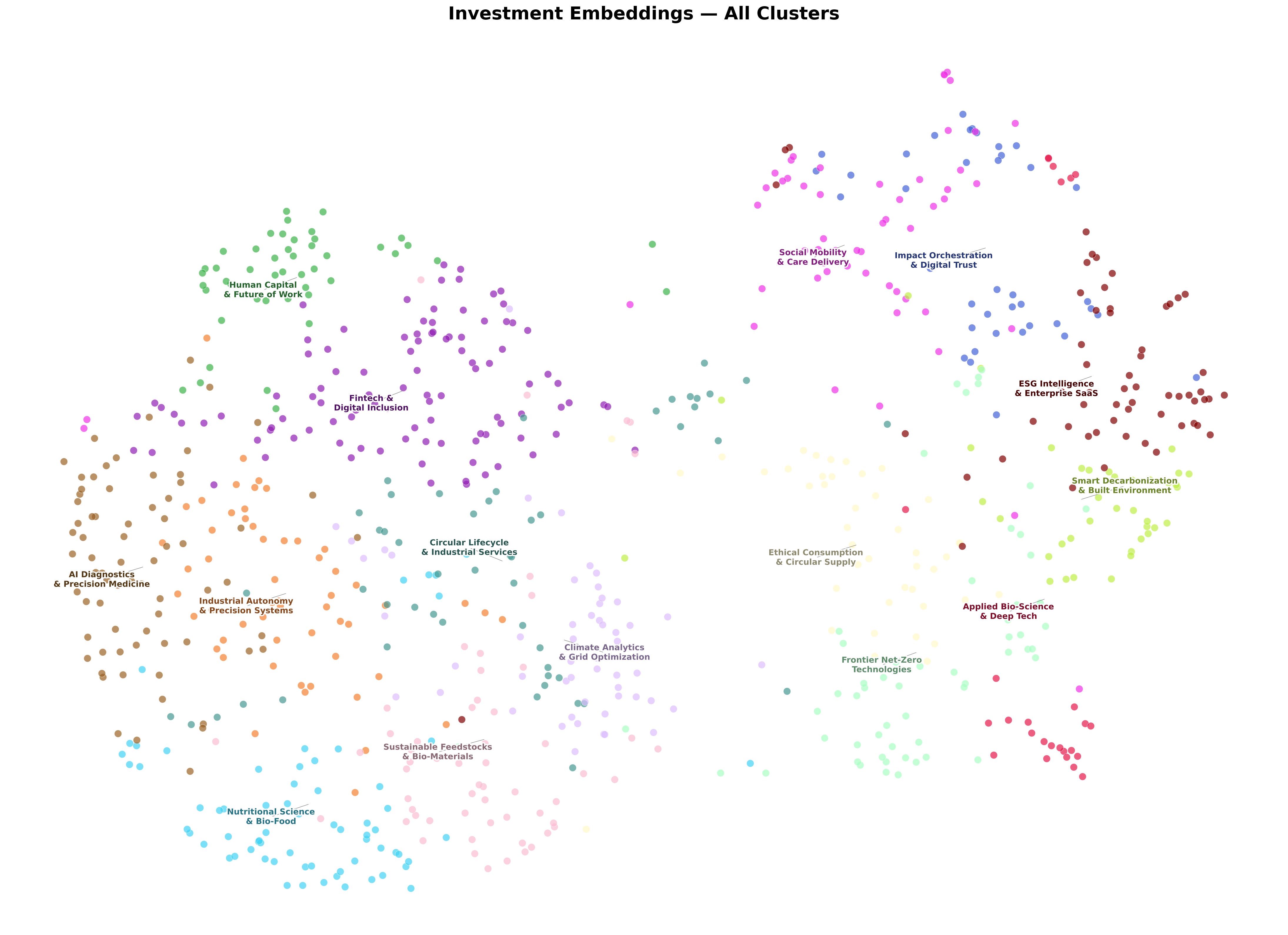
The total list of clusters with the investments per cluster is as follows:
Applied Bio-Science & Deep Tech (26 investments)
Human Capital & Future of Work (47 investments)
Impact Orchestration & Digital Trust (39 investments)
Industrial Autonomy & Precision Systems (56 investments)
Fintech & Digital Inclusion (102 investments)
Nutritional Science & Bio-Food (67 investments)
Social Mobility & Care Delivery (55 investments)
Smart Decarbonization & Built Environment (40 investments)
Sustainable Feedstocks & Bio-Materials (58 investments)
Circular Lifecycle & Industrial Services (52 investments)
Climate Analytics & Grid Optimization (54 investments)
AI Diagnostics & Precision Medicine (72 investments)
Ethical Consumption & Circular Supply (43 investments)
ESG Intelligence & Enterprise SaaS (59 investments)
Frontier Net-Zero Technologies (57 investments)
If you look at the investments, you see that there are no real concentrations and the investments are spread out evenly.
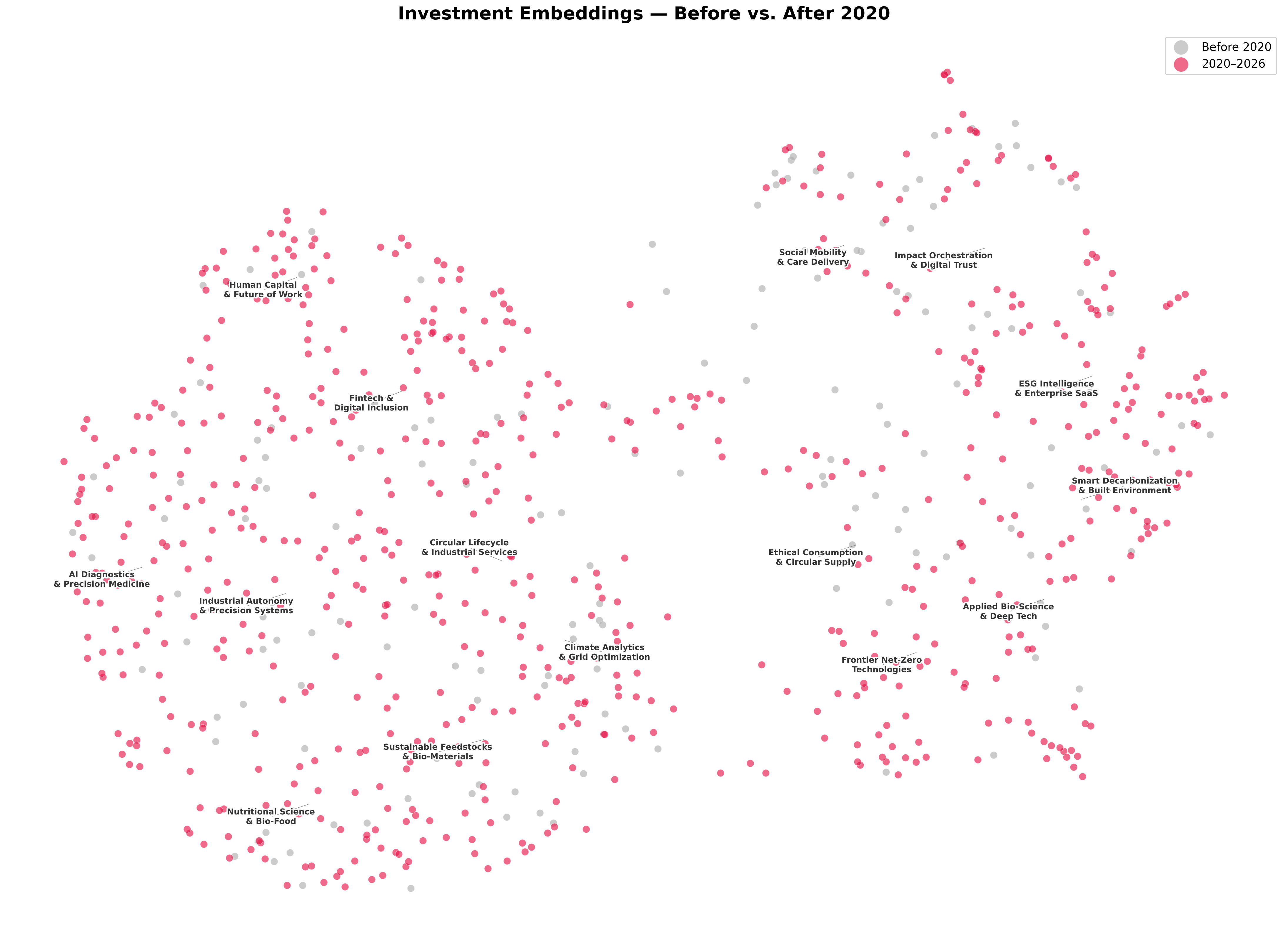
Investment before and after 2020
Most of the investments in this sample are from the period of 2020 to 2026 (161 vs. 666). I have surely missed some of the older investments, but it matches the development of the industry. Many of the funds have only been set up in the last few years. That was also one of the insights from this book chapter on impact investments in Germany. There are two aspects which are interesting to note.
Before 2020, we were able to see more investments in the area of social mobility and care delivery as well as investments which were focused on platform businesses. Funds had smaller volumes and the average investment sizes were much smaller than today.
In the last five years, fund sizes have increased substantially with some debut funds even reaching volumes above €100 million. Frontier Net-Zero is something that we began to see after 2020. This also applies to fintech investments and the investments with a focus on hardware and materials. These rather expensive investment were not feasible before.
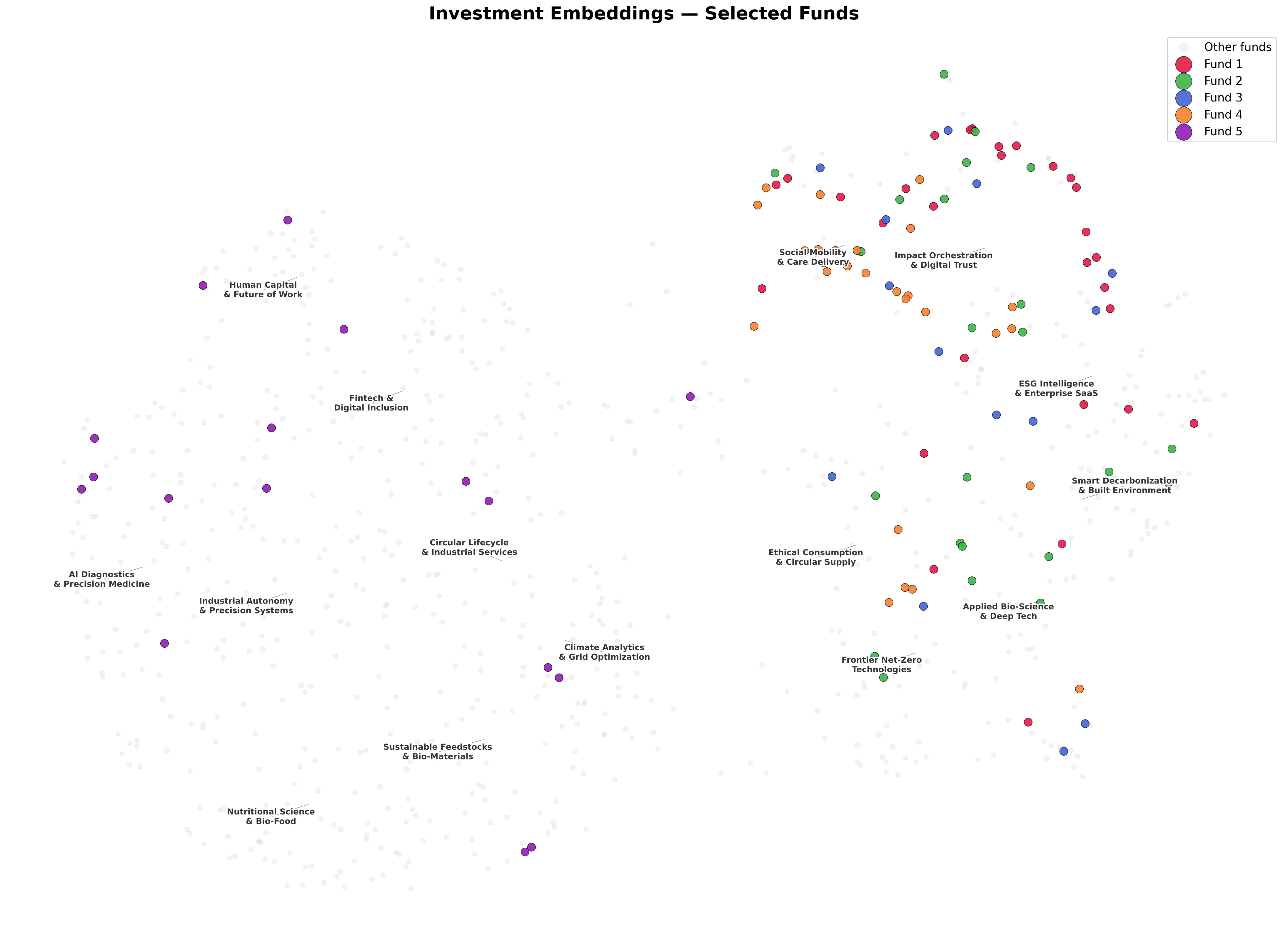
Fund strategies
15-20 years ago, it was obvious that there was a limited amount of investment opportunities and you could only follow a generalist strategy. A specialist strategy would have meant to only invest in health care in Germany or education technology in France. For this reason, funds tended to have a generalist approach.
I was interested in how the fund strategies are visible in the distance between the investments. It is not perfect, but it confirms the assumption. Funds which invest across different areas or tend to have a co-investment strategy have a wider investment portfolio. You can see these patterns in the visualization below with anonymized data. Funds 2 and 5 have the widest investment portfolio.
You might also be interested in the list of funds:
AENU
Alter Equity
Ambienta
Ananda Impact Ventures
Astanor Ventures
Asterion Ventures
Blue Earth Capital
BonVenture
CREAS
Chalmers Ventures
Citizen Capital
Climentum Capital
Contrarian Ventures
Den Social Kapital Fond
ECIIF
ESIIF
Educapital
Extantia Capital
FAMAE Impact
Feelsgood Capital
Five Seasons
FoodLabs
Giant Ventures
Industrifonden
LUMO Labs
Lightrock
Maia Ventures
Maze Impact
Norrsken VC
Oltre Impact
Phitrust
Planet A Ventures
RAISE Impact
Ring Capital
Rubio Impact Ventures
Summa Equity
Tilia Impact Ventures
Trill Impact
Voima Ventures
WorldFund
No posts
Comments
Nothing yet. Say the first thing.
Sign in to join the conversation.