
When I worked on the book “Artificial Intelligence and Blockchain for Social Impact” back in 2020, the world of AI looked very different.
The technology was already incredibly powerful, but the old world of AI was (1) narrow, (2) task-specific and (3) expensive. The new world of AI is a more accessible general-purpose technology. Let me illustrate these points with three observations.
The discussions were mostly dominated by use cases of large enterprises
The typical use cases were the following:
Postal services needed to scan millions of handwritten addresses per day.
Streaming platforms needed to recommend songs and series to millions of their clients.
Payment providers needed to detect fraudulent transactions amid millions of daily transfers.
Scanning of medical images.
You see the pattern. We are talking about repetitive tasks which happen millions of time per day. Models can only be developed if you have access to the underlying data as well. Nowadays, we have a technology which is much more general purpose.
The models were prohibitively expensive.
Frameworks like TensorFlor or PyTorch were open source since 2015-2016, but the models were mostly centralized and closed to the public (contrary to the company name OpenAI). They were also prohibitively expensive. Estimates for the costs of training large language models are always above $10 million and often in the range of $100 million. Training and inference costs sustains the demand for chips such as those provided by NVIDIA.
That changed in 2023 with Meta’s Llama and Mistral’s Mixtral which published open-weight models. Hugging Face pivoted to being a model repository in 2020 and as of today there are more than 2 million models available and almost 500,000 datasets.
In a way it is understandable. Transformer models were first introduced in 2017 and it took a few years until they were widely implemented by the open-source community.
The development is getting easy
I have a master’s degree in mechanical engineering, and I can well remember how difficult it was working on my own algorithms. Complex tasks that required specialist knowledge can now be set up in 30 minutes or less.
Let me give you an example. Below is the Harmonised Index of Consumer Prices (HICP) in Euro area from January 1997 to August 2025 provided by the ECB. We have one peak in 2022 driven by the effects of the pandemic and the Russian invasion of Ukraine which increased the energy prices in large parts of the Euro area.
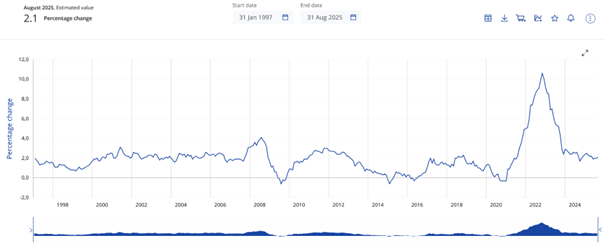
Time series prediction is a common area for artificial intelligence and let us see how it good it will be in predicting the peak in 2022 when we stop the time series at the end of 2020.
Usually, it takes less than 10 minutes to get everything up and running (and another 20 minutes to debug the code).
The code generated by Claude and Gemini is built on the Long Short-Term Memory (LSTM) model and you can check and run it yourself using Colab.
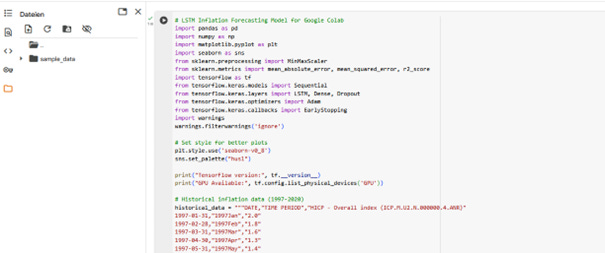
The final visualization looks like this. Obviously, it is not really fair as almost nobody was able to early predict the shocks which led to inflation levels even exceeding 10%.
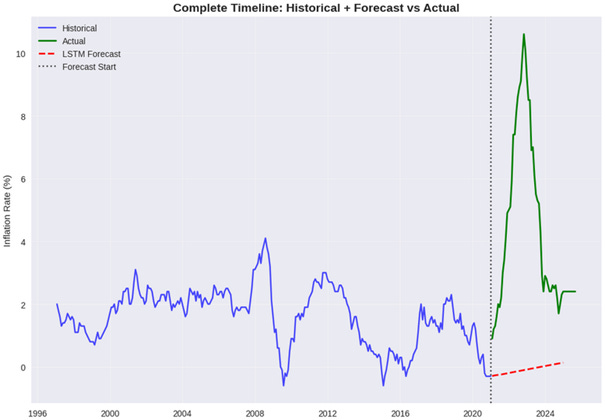
It also shows the problems with artificial intelligence. Time series forecasts work wonderful when you have stable patterns. You know that ice cream sales will always be higher in July than in December if you are in the Northern Hemisphere. Otherwise, you need to add context data to make the predictions more stable.
That brings me to the main point I want to make: We witness a shift from a task-specific technology to a general-purpose technology.
Things started to change in late 2022 with the availability of ChatGPT as a freely available web application which was followed by similar applications developed by Google (Gemini), Anthropic (Claude) or xAI (Grok).
You can these tools via the web application or via APIs to get a number of tasks done. These tools include capabilities for coding, text output, image generation, text-to-speech or video generation. Some models can have input of as much as 1 million words (tokens).
My impression is that smaller and medium companies are much more likely to benefit from this technology. Just consider for a moment, the range of activities a single employee has a to cover in a small or medium-sized company:
Replying to clients who have complaints about products
Creating a text for a business ad
Writing product descriptions for the online shop
Following regulatory changes
Writing reports for management
Analyzing feedback from customers
Assisting with HR tasks like job descriptions or onboarding guide
The scope of tasks for employees in larger companies is necessarily smaller to avoid chaos. Just imagine for a second if accountants start replying to customers or write text for the online shop.
For the time being, most use cases are not really end-to-end but rather mid-to-mid understood as the middle portion of a workflow. That implies that there is always a human involved in handling the process.
From my conversations, I also notice that these tools are being adopted more easily and quickly in smaller firms as compared to larger companies. The main concern is about the sensitivity of the data. You should not upload customer data, company IP or other sensitive data which is more relevant for larger companies. The other aspect is that larger companies have stricter protocols on how things get done.
In general, it might mean that we see a strengthening of small and medium-sized enterprises as they might disproportionately benefit from AI.
No posts
Comments
Nothing yet. Say the first thing.
Sign in to join the conversation.