
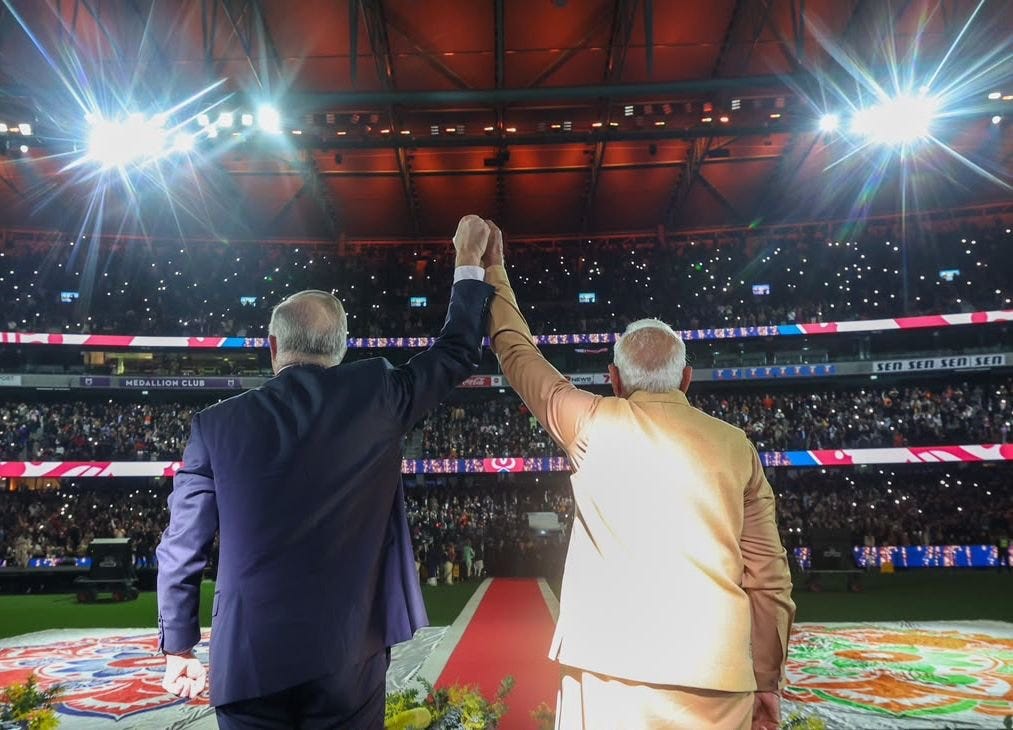
Last night, Narendra Modi walked into a packed Marvel Stadium and told tens of thousands of people: “The Indianness within you has always endured and been kept alive.” Minutes earlier, Anthony Albanese had thanked the same crowd for enriching Australia’s “multicultural character,” noting that around one million Australians now trace their roots to India.
One leader claimed the crowd’s soul. The other claimed its contribution.
Note the possessives.
Most of today’s coverage describes a diplomatic spectacle. Some describes a controversy, and gestures at the protesters outside. Both descriptions miss what actually happened on that stage.
Two governments are courting the same people.
Australia’s Prime Minister stood in front of Indian-Australians and called them ours — our success story, our multicultural triumph, our fastest-growing community. India’s Prime Minister stood in front of the same crowd and called them his — an Indianness that never left. Both men were applauded. Neither has it right.
That is the problem with stadium diplomacy. It turns a complex diaspora into scenery.
But the people in that crowd are not props in a bilateral relationship. They are making decisions every day that neither government controls: where to study, where to work, where to invest, where to raise children, where to belong.
We have seen this show before, almost beat for beat. In May 2023, Modi filled Qudos Bank Arena in Sydney with twenty thousand people, and Anthony Albanese — invoking Bruce Springsteen, who’d played the same venue — declared that even the Boss didn’t get a welcome like this. Questions about India’s treatment of its minorities were asked and deflected. Agreements were signed: a migration and mobility pact, a green hydrogen taskforce, a new centre for the relationship in Parramatta.
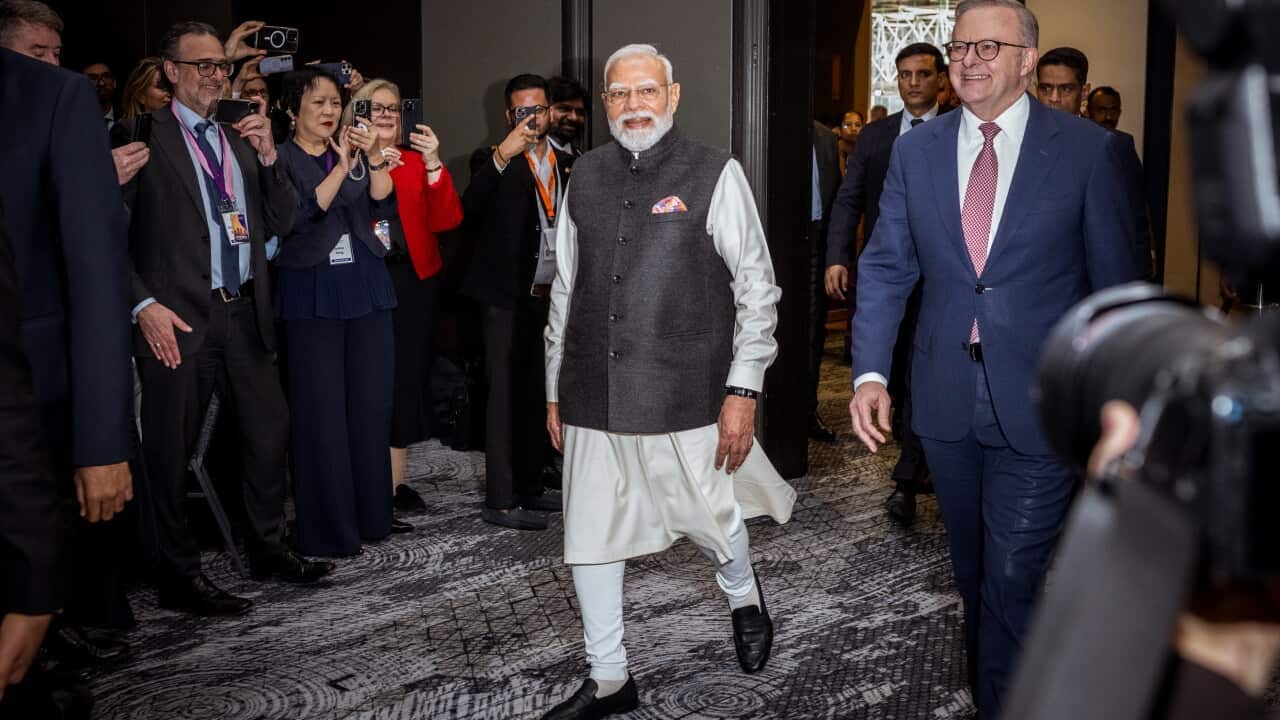
Three years on, the scorecard is revealing.
The trade architecture crawled. The comprehensive economic agreement that was “close” in 2023 remains unsigned in 2026 — at this week’s summit, the two leaders once again “instructed officials” to conclude it at the earliest. The hydrogen taskforce produced what taskforces usually produce: process. And the uranium arrangement finalised yesterday, the summit’s headline outcome, operationalises a framework signed in 2014 — twelve years from handshake to shipment.
But the people provisions worked. The MATES scheme launched, giving up to 3,000 young Indian professionals a year the chance to live and work in Australia, and is already in its second round. Two-way trade grew to $54.4 billion in 2024–25, carried substantially by education and services — sectors that are, at bottom, people. And in 2025, a quiet milestone: for the first time in Australia's history, India overtook England as the country's biggest source of overseas-born residents. Nearly a million Indian-born people now call Australia home.
Trade negotiations stall. Defence agreements take years. Taskforces produce reports.
The one part of the Australia–India relationship that never stops moving is people.
Three things separate this visit from the last one, and none of them is on the official agenda.
The scale changed. In 2023, Indian-Australians were a large community. In 2026, they are the largest overseas-born community in the country, concentrated in Melbourne’s west — which is why this visit is in Melbourne, not Sydney. When a foreign leader’s rally location tracks your internal migration patterns, the diaspora is no longer a footnote to the bilateral relationship. It is the terrain.
America changed. Donald Trump has tariffed Indian goods and attempted to attach a $100,000 fee to new H-1B visas — a move later struck down by a federal court, though his administration has continued signalling tighter skilled migration rules. For Indians, who accounted for 70 per cent of approved H-1B petitions in FY2025, the message was unmistakable: the American talent pathway is no longer as predictable as it once looked. Meanwhile the Quad, which Australia chairs this year, may not manage to convene. Both of this week’s leaders are middle powers embracing each other because the great power they built their strategies around stopped returning calls. The warmth in Melbourne is real. So is the anxiety underneath it.
India’s posture changed. On June 1, applications opened for India’s Prime Minister Research Chair scheme — packages worth up to A$2.5 million, covering fellowships, research grants, relocation support and lab access, explicitly designed to attract Indian-origin researchers, scientists and professionals abroad into Indian institutions, in semiconductors, advanced computing and AI, atomic energy, space and defence, critical minerals, energy, cybersecurity and biotechnology. Applications close on July 15. The scheme was open for business while Modi was on stage at Marvel Stadium. India is no longer just celebrating its diaspora. It is recruiting it.
Put that beside MATES and look closely. Australia is building pathways to attract young Indian talent in AI, engineering, renewables and fintech. India is building pathways to attract Indian-origin talent back into AI, semiconductors, atomic energy, advanced computing and space. These are not contradictory policies. They are the new reality: friendly countries can be partners at the diplomatic table and competitors in the global market for people.
The symmetry runs deeper than the sectors. MATES accepts only graduates of the top 100 institutions on India’s official NIRF university ranking. The Research Chair scheme places its fellows back into — the NIRF top 100, and India’s national laboratories.
Two governments are working from the same talent map — and recruiting in opposite directions.
This is not unique to these two countries. China, Israel, Ireland, Nigeria and the Philippines all now treat their diasporas as strategic infrastructure. Governments increasingly compete through mobility, not territory — and Australia has been slow to notice that the competition runs in both directions.
Nobody at the summit will describe it this way. But the real negotiation isn’t happening across a table. It’s happening in a million individual decisions about where to build a life.

Governments often speak of diasporas as though they are constituencies to be won or assets to be managed. They are neither.
They are communities with agency — including the sincere Modi supporters filling the stadium, the small group of Khalistan supporters who reportedly gathered outside his Melbourne hotel, the Sikh families in Wyndham for whom this week reopens old wounds, and the researchers who left India precisely because of the country Modi has built, and who will weigh his fellowships against what Amnesty International documents as the continued targeting of academics, journalists and human rights defenders under India's sedition and anti-terror laws.
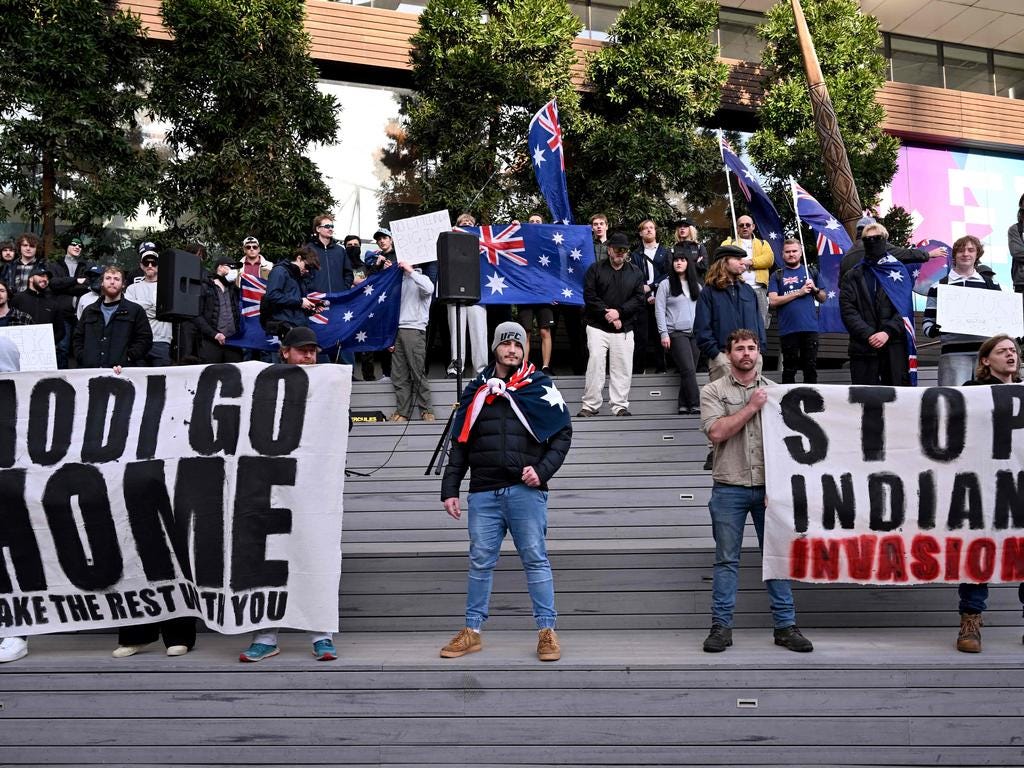
Consider what else happened yesterday: a self-described anti-mass-migration group organised a protest march from the Home Affairs office in Docklands toward the stadium — aimed, by the organisers' own account, not at Modi's politics but at the diaspora itself: the students, the migration pathways, the "people-to-people links" both prime ministers celebrate. In a single day, Indian-Australians were claimed as an asset by two governments and blamed for housing pressure by an anti-immigration movement — everything, it seems, except being asked.
So I asked. In the hours around the stadium event, I put three questions to community groups: what did this week mean to you, does India’s pull change how you think about your future, and what do you wish either government understood? The range of the answers is the point.
Sandip Desai, in Victoria, wrote of feeling “proud and powerful,” of a heritage pride that no longer conflicts with “new-found patriotism” — and then asked Australia to see the community “beyond tokenism”: “We certainly offer a lot more than Bollywood, a good game of cricket or a suburban takeaway option.”
Prakruti Gururaj, in Queensland, put her choice plainly: “No matter what my country of birth may claim... nowhere else could I have achieved what I have been able to accomplish in Australia.”
Dr Heena-Sinha Cheung, Independent candidate for the seat of Box Hill, Victoria said, “As someone born in India who chose Australia as home, this week reminded me that identity doesn’t have to be either-or. I can be proud of my Indian heritage while being deeply committed to Australia’s future. For many migrants, those identities don’t compete—they enrich one another.”
And Samama Alam, a Bangladeshi-Australian in Brisbane watching a spectacle aimed at a neighbouring diaspora, named what both governments miss: “Belonging isn’t created through speeches or stadium events. It’s built through everyday experiences — feeling welcomed, represented and included in the country you call home.”
Then there is Sukruti Narayanan, in New South Wales, who runs a girls’ satellite-building program she says was inspired by one of Modi’s own campaigns — as sympathetic a voice as the Indian government could hope for. She ended her message with the sentence both prime ministers should read twice: “People can make their choice based on which country serves them well.”
A Modi admirer and a Modi sceptic, arriving from opposite directions at the same fact: the choosing belongs to the people.
The most important decision made this week will not happen in Marvel Stadium or in a bilateral meeting room.
It will happen quietly, one person at a time, as Indian-Australians decide where to build their careers, raise their families, invest their money and exercise their voice.
Governments can compete for talent. They can celebrate diasporas. They can court them in stadiums.
But they cannot own the people making those choices.
The Australia–India relationship is not built in Parliament House or South Block.
It is built in departure lounges.
Comments
Nothing yet. Say the first thing.
Sign in to join the conversation.