
It took Pauline Hanson 30 years to reach the National Press Club, and she used the moment to say the one thing guaranteed to make the multicultural sector rise to its feet: “We cannot be a multicultural society. We are a multiracial society, but we must be monocultural.”
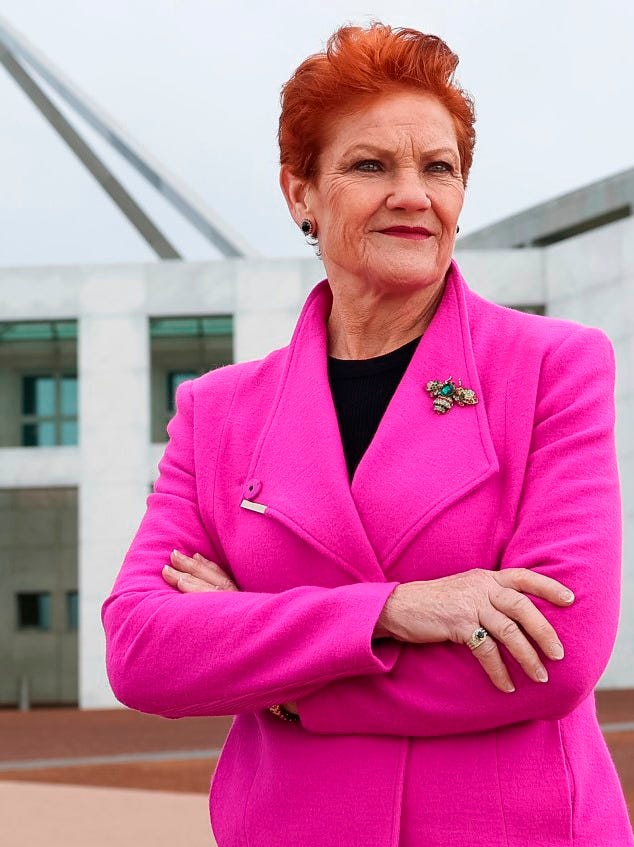
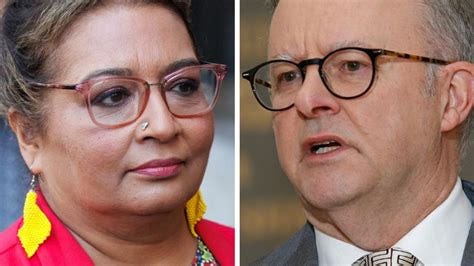
The sector rose on cue. Within the hour the Prime Minister had posted that diversity is a strength, the Green party’s deputy leader Mehreen Faruqi had branded the speech “the same tired, hate-filled message,” and a GetUp banner had been unfurled and torn down on the Club’s own stage while Hanson was giving her speech.
Everyone performed their part in a script written years ago. How predictably boring. *proceeds to turn on Netflix*
Strip away the theatre and you are left with a strange spectacle: a quarrel about multicultural Australians, conducted entirely by people multicultural Australians do not trust, in a room none of us were in.
Senator Hanson sneers at the “Muslim community leaders” who supposedly hide the truth from the public. Her opponents wheel those same community leaders out as proof that diversity works. Both sides treat the intermediaries as the story. Both sides are arguing over the legitimacy of spokespeople that their people already have abandoned.
As CEO of Allies in Colour, I can say that with some confidence, because we have just finished asking them.
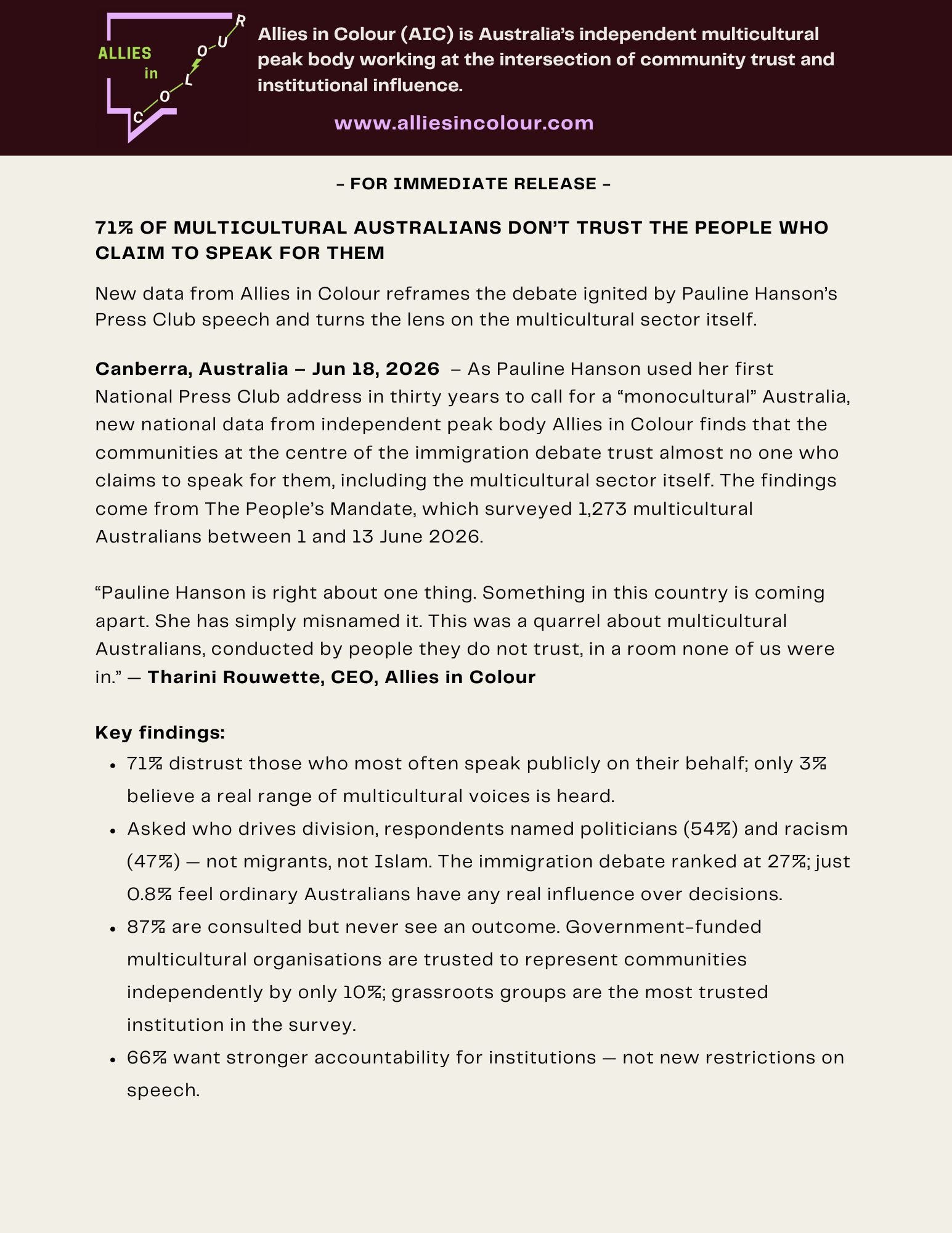
In the first 2 weeks of June 2026, through our national civic voting platform, The People’s Mandate, we surveyed 1,273 multicultural Australians — which included a civically active cohort, 91% citizens, and two-thirds of whom have contacted a Member of Parliament. These are not the disengaged. They are the people who show up. And what they told us reframes Hanson’s speech entirely.
71% do not trust, or barely trust, the organisations and individuals who most often speak publicly on their behalf. Just 3% believe a genuine range of multicultural voices is heard in public life, while a majority say the same handful of “representatives” are recycled again and again. When asked who actually drives division in this country, they did not name migrants, and they did not name Islam. They named politicians — 54% of them — followed by racism and discrimination at 47%. The immigration debate came in at 27% while cost of living came in at 26%. And when asked whether ordinary Australians have any meaningful influence over the decisions that shape the country, fewer than one in a hundred — 0.8% — said yes.
A quarrel about multicultural Australians, conducted entirely by people multicultural Australians do not trust, in a room none of them were in.
Read those numbers against the speech and the monoculture-versus-multiculture axis dissolves. It is a decoy. The communities at the centre of the argument are not lying awake over whether Australia is one culture or many. They are watching a political class they distrust profoundly, stage a fight over their heads, about their belonging, without their voice, and concluding, rationally that none of it will change anything.
85% say the country feels more divided than 5 years ago.
Something is genuinely coming apart. Hanson has correctly sensed it. She has simply misnamed it, just as her role in this theatrical performance requires her to.
*I’ve already watched this movie… sigh…*
The reflexive rebuttals are not wrong. “Monoculturalism” for a society that is one-third overseas-born is not a policy but a coercive fantasy (delulu much?). The conflation of a billion Muslims with the actions of terrorists is the oldest move in her repertoire. And on her central economic claim, the evidence is genuinely contested: most of the serious housing economists treat migration as one pressure among many — a decade of under-building, planning gridlock, tax settings that reward the established over the aspiring — and net overseas migration has in fact already fallen, to 306,000 in 2024–25 from 429,000 the year before. All true. All worth saying.
But being right is not the same as being heard, and our own data on Trust on a scale of 5, is brutal on this point.
Consider the Prime Minister's reply: "diversity is a strength." It defends a proposition nobody actually contested. It comes from government — an institution multicultural Australians rate just 2.3 out of 5 on trust. And it asks our communities once again, to sit quietly while others argue about them.
Mainstream media, the channel amplifying the whole exchange, scores just 1.61 out of 5 on trust — the lowest of any institution we measured, below politicians. It is the right answer delivered by the wrong messengers to an audience that stopped believing the messengers a long time ago.
Here is where I part company with most of what will be written about this speech — including what my own sector will write.
Read honestly, our data does not flatter us. It indicts us.
The crisis Hanson is exploiting is not, at its root, about diversity. It is not even about settlement. It is about representation. And the multicultural sector is not the answer to it: we are part of how it was built.
Consider what our communities have actually told us about their representatives. Government-funded multicultural organisations — the bodies with the offices in Canberra, the standing invitations, the seat at every consultation — are trusted to represent communities independently by a mere 10% of respondents while 80% believe these very bodies are either constrained by their funding or unwilling to challenge the government that funds them.
Grassroots organisations, by contrast, are the most trusted institution in the entire survey, at 3.38 out of 5 — and among the least powerful, according to our data.
The actors communities trust most hold the least power. The actors they trust least — corporations at 68%, lobbyists at 41%, politicians at 38% — hold the most.
Large, established peak bodies, the same ones quoted in every article about Hanson, are trusted to understand community experience by just 22% of their community they claim to represent.
This is the part the sector does not want to read aloud.
Australia did not build a multicultural democracy. It built a multicultural consultation industry — and then funded it.
The state learned that it could purchase the appearance of multicultural consent more cheaply than it could share power: a peak body to consult, a festival to fund, a settlement program to point to, a spokesperson to stand beside the minister.
87% of our respondents say they are consulted and then see no outcome. 45% saw no action whatsoever from their most recent consultation while only 5% saw some outcome. 69% have no confidence that government acts on multicultural inquiries at all.
One respondent put it more economically than I can:
“It’s all just consultation theatre. Nothing happens.”
That is not a complaint about manners. It is a description of a system working exactly as designed — to manufacture the look of inclusion while withholding its substance.
I am not exempting Allies in Colour from this, and I want to be careful not to. We take no government grants, which is the only reason I can write these paragraphs without choking on them.
The point is not that some organisations are venal and others pure. The point is that the architecture itself rewards compatibility with government over fidelity to community, and that the communities can see it. Only 7% of community name government grants as the funding model that gives them confidence in independent representation. They have understood the incentive structure better than the sector has been willing to admit.
So now Hanson’s speech can be read for what it actually is. She surveys a landscape of low trust, thin belonging, consultation without outcome, and a political class held in open contempt — and she calls it the failure of multiculturalism.
It is nothing of the kind.
Almost every symptom she names is a symptom of a state that chose to simulate cohesion rather than build it: that ran migration as a fiscal instrument and called the human consequences someone else’s problem, and that ran representation as a consent-management instrument and called the resulting alienation diversity’s fault.
Hanson has confused the failure to govern a multicultural democracy with the failure of the multicultural democracy itself. Her opponents make the mirror-image error. They rush to defend the intermediaries — the peak bodies and the familiar spokespeople — that our communities have already walked away from, and so they end up defending the system instead of the people it was built to represent.
This is why the binary on offer — more migration or less, one culture or many — cannot reach the actual wound. You can win that argument in either direction and leave untouched the thing our respondents are actually telling us: that they have done everything a citizen is asked to do, contacted the MP, attended the consultation, filled in the survey, and learned that none of it moves the outcome.
The international literature is sober about where that learned powerlessness leads.
Research from Tufts University’s CIRCLE finds that the strongest predictor of young people across the West giving up on democracy is not ideology or race but the lived sense that the system does not deliver for them.
We are careful not to over-claim: our survey measures trust, voice and outcome, not extremism. But the conditions it documents — low trust, no consequential voice, endless consultation without result — are precisely the soil in which scapegoating grows. A society that will not let its multicultural citizens be heard should not be surprised when someone offers them, and everyone else, a simpler story with a nameable villain.
So what is the distinctive thing for Allies in Colour to say — the thing neither One Nation nor the government can say, because both are implicated in the system that produced the problem?
It is this: the answer to Pauline Hanson is not a better spokesperson for multicultural Australia. It is the end of “representation” altogether.
The reform that actually addresses what our data documents is not another peak body, another grant, another consultation. It is infrastructure that lets multicultural Australians register their own views, in their own numbers, and have those views carry consequences — which is the entire reason The People’s Mandate exists, and the reason 1,273 people used it in a fortnight to say what no intermediary had said for them.
That shifts the agenda away from defending diversity and toward rebuilding democratic legitimacy. 3 reforms follow directly from the data.
First, a national civic-accountability standard. Governments would have to publish who they consult, how those groups are chosen, and what they actually did with the advice — an answer to the eighty-seven per cent of our respondents who are consulted and then met with silence.
Second, an independent, arm’s-length funding model that resources organisations on the trust communities place in them, not on how long they have existed. The bodies people actually trust would no longer be the bodies with no power.
Third, real investment in civic capability infrastructure — the literacy, the access and the participation pathways that treat a multicultural citizen as someone who helps build cohesion, rather than someone cohesion is done to.
66% of our respondents asked for exactly this: accountability for institutions, not new restrictions on speech.
They are not asking to be protected. They are asking to be heard.
Australia has spent decades arguing about how many people should come. It has spent almost no time asking how well it governs the people it has already welcomed, and even less asking whether the citizens it welcomed have any real say in that governance.
That is the missing national conversation, and it is one neither Hanson’s monoculture nor the government’s managed diversity is built to have. It puts Allies in Colour on the ground that no one else occupies: not defending the status quo, not arguing for closed borders, but asking the question the whole quarrel was staged to avoid.
What does competent, legitimate, power-sharing governance of a multicultural democracy actually look like — and who gets to decide?
Pauline Hanson spent 30 years earning that podium so she could tell multicultural Australians what they are. But we have never been silent. We have contacted the MP, sat through the consultation, filled in the survey — and watched it change nothing.
The radical act now is not to give us a voice; we already have one. It is to build a politics that is finally obliged to answer it.
The People's Mandate is a national civic voting infrastructure for multicultural Australians. This article draws on a survey of 1,273 multicultural Australians conducted between 1 and 13 June 2026. The People's Mandate is an initiative of Allies in Colour, Australia's national independent multicultural peak body. For the full research, visit alliesincolour.com.
Comments
Nothing yet. Say the first thing.
Sign in to join the conversation.