
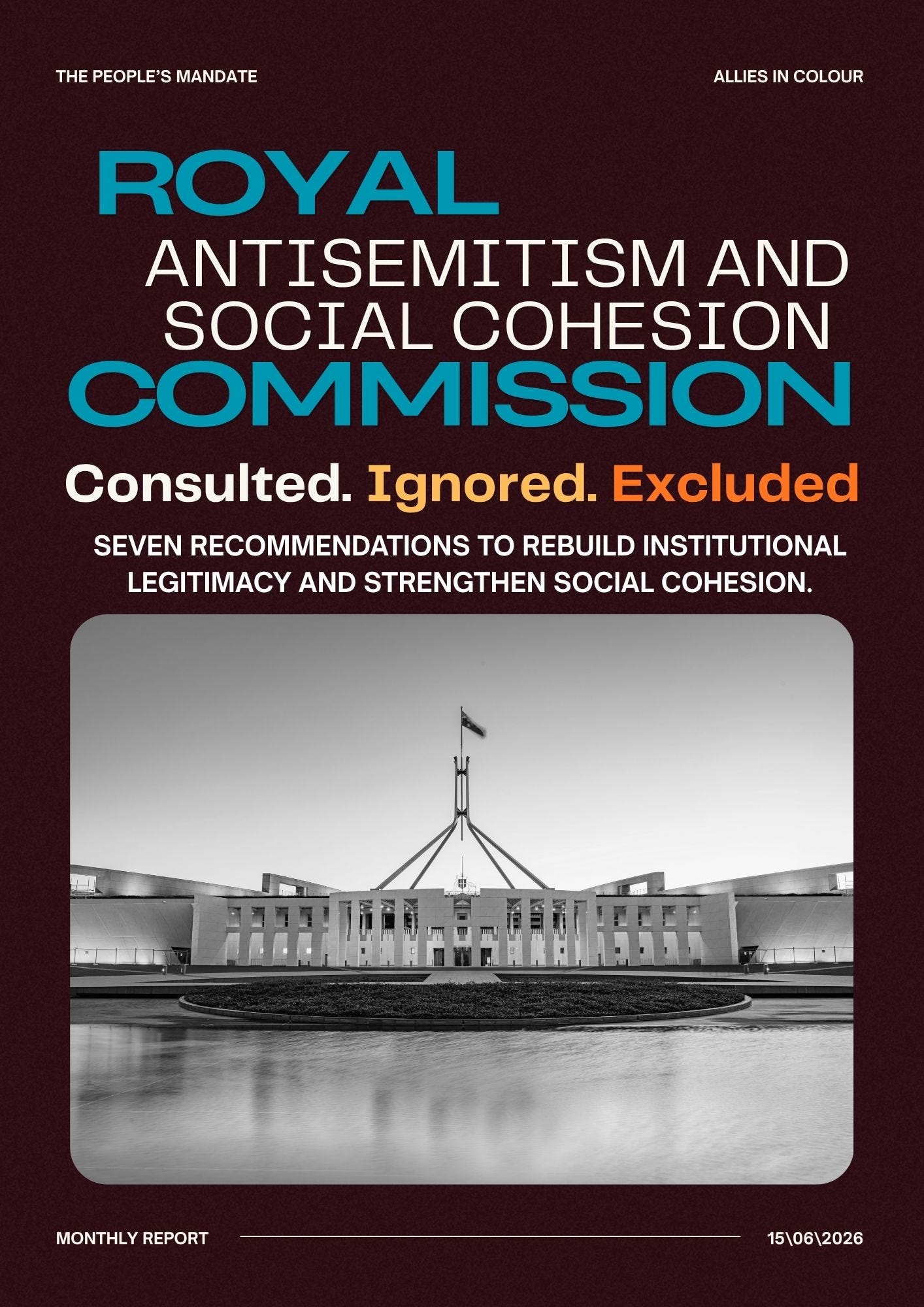
When 67% of multicultural Australians have contacted a Member of Parliament, you might assume they are politically engaged. When 87% say they have been consulted by government or institutions, you might assume they feel heard. When 95% report that ordinary people have fewer opportunities to influence decisions than the well-connected, you might assume they understand how power works.
But when only 0.8% believe ordinary Australians have meaningful influence over important decisions, something else is going on.
This is not a story about disengagement. It is a story about institutional legitimacy in crisis—and why almost everyone discussing social cohesion, political polarisation, and extremism is measuring the wrong thing.
There is a gap between participation and power. Multicultural Australians are doing what democracy asks: they are showing up, raising their voices, filling out surveys, attending consultations. And then they are watching very little change.
This teaches a lesson. Not that democracy is flawed. But that the institutions exercising power are not responsive to them. That lesson, accumulated over years of consultation followed by silence, erodes something crucial: institutional legitimacy.
Institutional legitimacy is not the same as trust. You can trust an institution personally while doubting that it is accountable to communities like yours. Legitimacy is the belief that an institution exercising power is responsive, transparent, and accountable. It is the conviction that your voice matters not because you like the people in charge, but because the system is built to hear you and act.
When institutional legitimacy weakens, participation becomes performative. People go through the motions because they have to, or because they remember when engagement felt consequential. But they do not expect change. They do not believe their input will reshape outcomes. And over time, they stop trying.
This matters for a reason that extends far beyond democratic theory.
Societies with strong institutional legitimacy have what researchers call “civic protections”—legitimate channels through which communities can raise concerns, expect to be heard, and see responsive action. These protections matter most when societies are under stress: during disagreement, polarisation, or crisis. That is when divisive narratives—those that exploit social difference, scapegoat particular communities, or promise simple solutions to complex problems—gain the most traction.
Societies with strong civic protections can counter these narratives because their institutions retain credibility. Communities believe that legitimate channels exist to address grievances. They trust that institutions will respond to evidence. They feel ownership over the systems that govern them.
Societies with weakened institutional legitimacy lose these protections. When communities have raised their voices many times and seen little change, they stop believing that legitimate channels work. When institutions prove unresponsive to documented community concerns, they lose credibility. When people feel locked out of power, they develop what researchers call “disengagement and cynicism”—precisely the conditions in which divisive narratives can take hold.
This is not a small risk. It is foundational to understanding how societies navigate disagreement. A multicultural society that maintains institutional legitimacy can disagree fiercely and remain cohesive. A multicultural society in which institutional legitimacy has eroded cannot—because the shared belief that “we are governed by responsive institutions” has broken down.
For nearly two decades, Australia’s social cohesion discourse has been shaped by a single measurement framework: the Scanlon Foundation’s Mapping Social Cohesion Index. This index measures five dimensions: belonging (pride in Australia, maintenance of Australian culture), worth (financial satisfaction), social justice and equity (trust in government), participation (voting, political engagement), and acceptance (especially regarding immigration).
There is a problem with this framework. It measures attitudes and identity. It asks: “Do you feel you belong? Do you trust institutions? Are you satisfied?” But it does not ask: “When you participate, does it actually change anything? When you raise your voice, do institutions respond?”
This is the distinction that matters. The dominant discourse on social cohesion has been about cultivating the right feelings—belonging, pride, trust—rather than ensuring institutions are actually responsive and accountable. As Emeritus Professor Andrew Jakubowicz has argued, this framing allows governments to focus on managing attitudes and identity while avoiding the deeper structural issues: inequality, institutional responsiveness, and fairness.
The result is a policy apparatus designed to make people feel better about institutions rather than to make institutions actually more legitimate.
Commercial polling and most institutional consultation research ask the wrong questions. They ask: “Are you satisfied with consultation?” “Do you feel heard?” “Have you participated?” “Do you feel you belong?” These questions measure engagement and attitudes. They do not measure institutional legitimacy.
The People’s Mandate asked a fundamentally different question: “You have been consulted. You have raised your voice. Has it changed anything?”
The answer was stark.
87% of respondents said they had been asked for input but did not always see outcomes. 45% reported seeing no visible action or change after their most recent attempt to participate. 69% were not confident that governments act on major reviews once they are completed.
These are not measures of engagement. They are measures of responsiveness. They reveal something that standard polling and media commentary have largely missed: multicultural Australians have high civic participation but perceived powerlessness. They are doing what citizens are supposed to do. They are concluding that doing it changes nothing.
This is the distinction commercial polling has failed to capture. It is also the distinction that matters most to understanding institutional legitimacy and social cohesion.
The People’s Mandate conducted a survey of 1,273 multicultural Australians between 1 and 13 June 2026. The respondents were predominantly female (62%), long-settled (81% born in Australia or resident for 20+ years), and citizens (91%). They were established members of Australian society—not marginal voices, but people integrated into civic life.
Here is what they reported:
67% have contacted a Member of Parliament.
95% say ordinary people have fewer opportunities to influence decisions than those with established relationships.
87% say communities are asked for input but do not always see outcomes.
0.8% believe ordinary Australians have meaningful influence over important decisions.
71% do not trust—or barely trust—the organisations most often speaking publicly on their behalf.
66% want decision-makers held accountable. Only 3% want stronger laws about what people can say.
The last statistic is critical. These respondents are not asking for restrictions on speech. They are not demanding protection from offensive narratives. They are asking for institutions to be accountable—to show their work, explain their reasoning, demonstrate responsiveness. This is the basic condition of institutional legitimacy in a democracy.
Yet the institutions they trust most—grassroots organisations, community leaders, local networks—hold almost no formal influence over major decisions. The institutions they trust least—large corporations, lobbyists, segments of media—exercise significant sway over policy, narrative, and political outcomes.
This is not a perception problem. It reflects structural reality.
Anyone working on social cohesion, political polarisation, or the conditions that make societies vulnerable to extremism needs this data.
You cannot solve a problem you do not diagnose correctly. If you believe the problem is “multicultural communities are disengaged,” you will design engagement programs. You will run more consultations. You will expand participation opportunities. You will solve nothing—because the problem is not engagement. The problem is that engagement has become disconnected from power.
The solution requires a different diagnosis: institutions are losing legitimacy because they ask for input and do not demonstrate responsiveness. If that is the problem, the solution is accountability, transparency, outcomes reporting, and representation. It is rebuilding the relationship between trust and power.
Your constituents—particularly multicultural constituents—are telling you something specific. They are not asking for more. They are asking for different. They want to know who you consult, how you choose those voices, and what changed in response to their input. They want to see themselves represented in the institutions that make decisions. They want to believe that raising their voice will reshape outcomes. That is not a radical demand. That is institutional legitimacy.
This data challenges the standard narrative about multicultural engagement in Australia. The story is not “multicultural Australians don’t participate.” The story is “multicultural Australians participate at high levels but believe it changes nothing.” This is not a story about apathy. It is a story about institutional failure. It is also a story about how that failure creates conditions for polarisation and division. It deserves to be covered with the seriousness it warrants.
The evidence points to a clear diagnosis. Institutional legitimacy is failing. The civic conditions that protect societies against polarisation and divisive narratives are eroding. This is upstream to extremism, not downstream. It is the foundational problem that must be solved.
7 recommendations flow from this diagnosis:
1. Establish a National Civic Accountability Standard for Multicultural Representation. Create transparent, measurable standards for how government and institutions consult with multicultural communities, who they listen to, and how those relationships are chosen. Accountability begins with visibility.
2. Diversify the Funding Architecture of Multicultural Advocacy. Establish independent, arm’s-length funding mechanisms that support community-embedded organisations—the grassroots and local leaders communities actually trust—rather than concentrating resources among established intermediaries. Power should flow toward trusted voices.
3. Mandate Outcomes Reporting for Government Consultations. Every consultation involving multicultural communities must end with a clear, public response: what was heard, what will change, what won’t, and why. Consultation that leads nowhere teaches people their voice does not matter. Responsiveness teaches the opposite.
4. Commission Independent Research into Democratic Exclusion and Extremism. Fund rigorous Australian research into how democratic exclusion, institutional distrust, and weakened civic participation relate to vulnerability to extremist narratives. Understanding these relationships is essential to strengthening civic conditions that help societies resist polarisation.
5. Establish a National Civic Capability Framework. Create a comprehensive national framework addressing democratic participation, media literacy, intercultural understanding, and confidence in engaging with institutions. This is upstream infrastructure—the foundation that prevents disengagement.
6. Resource Civic Capability Initiatives through Community-Grounded Delivery Models. Fund implementation through open, competitive processes that draw on tested, community-embedded organisations. Civic capability is built locally, not centrally.
7. Examine the Role of Contemporary Media Ecosystems in Social Cohesion. Commission inquiry into how concentrated legacy media ownership and algorithm-driven social platforms shape the information environments in which communities form views about each other and about institutions.
Collectively, these recommendations shift attention upstream. Rather than focusing exclusively on responding to hatred or division after it emerges, they seek to strengthen the civic conditions that help communities resist polarisation and scapegoating before those harms take hold.
This data exists. This evidence is documented. The diagnosis is clear.
The question now is whether policymakers, politicians, and institutions will act on it.
The People’s Mandate did not conduct this research to produce a report that sits on a shelf. It conducted this research because multicultural Australians deserve institutions that are responsive, accountable, and legitimate. Because societies require institutional legitimacy to remain cohesive. Because when legitimacy fails, the civic protections that prevent division fail with it.
Reporters have a responsibility to cover this finding with the seriousness it warrants. Policymakers have a responsibility to read the diagnosis and act on it. Politicians have a responsibility to listen to what their constituents are actually saying—not what polling companies or media commentary claim they are saying.
And anyone working on social cohesion—in government, civil society, academia, or media—has a responsibility to understand that institutional legitimacy is not an abstraction. It is the foundation upon which societies either cohere or fracture.
The data is clear on what needs to happen next. The question is whether we will do it.
The People's Mandate is a national civic voting infrastructure for multicultural Australians. This article draws on a survey of 1,273 multicultural Australians conducted between 1 and 13 June 2026. The People's Mandate is an initiative of Allies in Colour, Australia's national independent multicultural peak body. For the full research, visit alliesincolour.com.
Comments
Nothing yet. Say the first thing.
Sign in to join the conversation.