
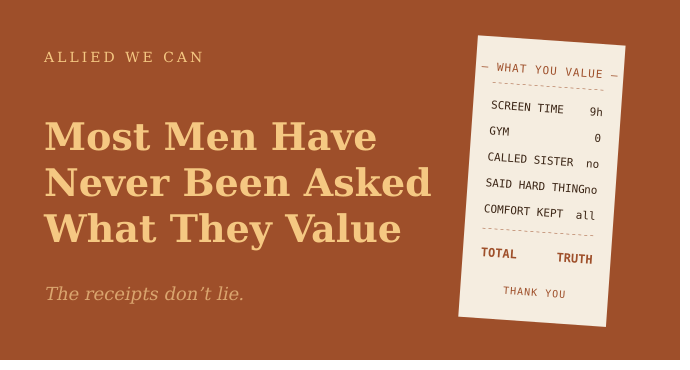
Ask a man what he thinks about something — politics, sports, the latest scandal, the latest podcast and he’ll tell you all about it for an hour. Ask him what he values, what he’s actually building his life around, what he wouldn’t trade away if you put a price on it, and he’ll go quiet.
It isn’t because he doesn’t know. It’s because nobody has ever asked him.
We live in a country that has trained men to mistake opinions for identity. Every platform you scroll asks you to weigh in on something else. Every podcast you listen to is a man with strong takes about subjects you didn’t know you cared about ten minutes ago. Every algorithm you feed gets better at handing you positions to defend.
By the time you’re thirty, you have a vast collection of opinions. About foreign policy. About lifting routines. About what makes a real friend. About what other men should do with their lives. The opinions arrive faster than you can examine them, and you defend them online and at the bar and at the family dinner like a man who knows what he believes.
The problem is that opinions and values aren’t the same thing. Opinions are what you have when someone asks. Values are what you have when nobody asks.
A value is a commitment that costs you something. That’s the test.
If you say you value honesty but you only tell the truth when it’s convenient, honesty isn’t a value of yours. It’s a preference. If you say you value family, but you aren’t there for your sister, family isn’t a value. It’s a poster on your wall. If you say you value courage, but you’ve never said the hard thing in a room where it might cost you, it’s something you admire from a distance, not something you live.
Values aren’t what you say. Values are what you do when there’s friction. Values show up in the specific, repeated choices that mostly goes unnoticed.
Most men have never been asked to look at the difference between what they say they value and what they actually value. The two lists are different. They’re always different.
If you wanted to sell something to a man, the last thing you’d want him to do is sit down and figure out what he actually values. A man who knows what he values is a hard sell. He has a filter. He has a frame. He can hear an offer and ask: does this fit? does this serve what I’m building? does this cost me something I’m unwilling to lose?
The men selling masculinity online don’t want you doing that math. So they hand you a pre-built value system on day one. Money. Power. Status. Dominance. Women. They market it as masculinity, but it’s actually a set of values that just happens to be very profitable for them when you adopt it.
If you don’t know what you value, someone else will gladly tell you. They’re running a business.
First: where are you spending your time, your money, and your attention this week? Not what you say is important. What does the bank statement and the calendar and the screen-time report say is important? You may say you value your kids and spend nine hours a day on screens. You may say you value your health and not have moved your body in a month. The receipts don’t lie.
Second: what are you willing to be uncomfortable for? Comfort is the enemy of values. The things you’re unwilling to lose any comfort for aren’t your values. The things you’ll choose discomfort for, repeatedly, against your own short-term interest, are your values whether you can articulate them or not.
Comments
Nothing yet. Say the first thing.
Sign in to join the conversation.