
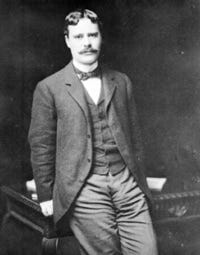
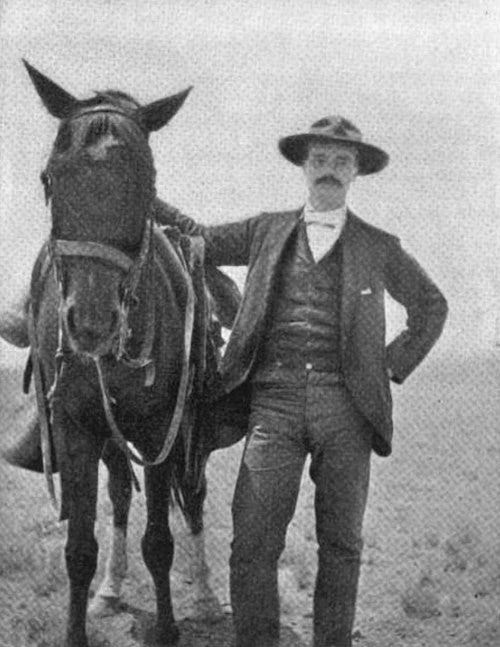
Owen Wister (1860-1938) became a celebrity when his novel, The Virginian: A Horseman of the Plains, appeared in 1902. The novel eulogizes the vanishing American West and, with it, cowboy culture. It was not an obvious topic for an Eastern elitist, but it proved to be a tremendous success.
The Virginian has never been out of print. It has been adapted for television and musical theater, and it has been filmed four times, first in 1914 by Cecil B. DeMille. Regarded as the most influential novel about the cowboy ever written, it was, and remains, a beloved story, one of a kind.
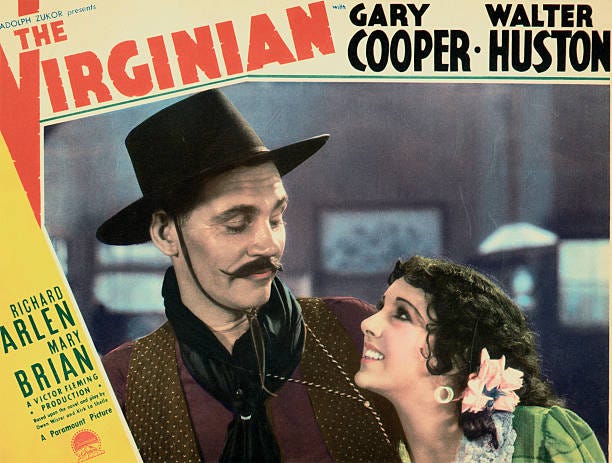
The 1929 version, directed by Victor Fleming
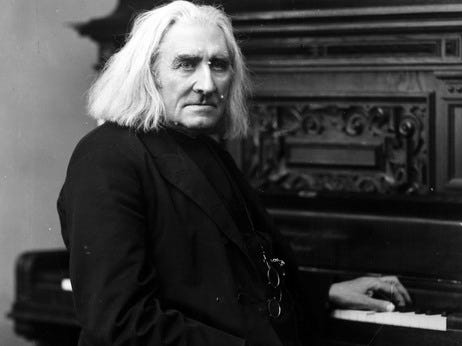
Wister is remembered for The Virginian and for little else. But he was prolific. He wrote many books, including another novel (Lady Baltimore) and six operas. He was a trained musician and composer. Darwin Payne begins his biography of Wister with an account of the young man in Bayreuth, Germany, in 1882. Seated at the piano in the home of Franz Liszt (1811-86), one of the nineteenth-century’s towering geniuses of piano literature and performance, Wister played one of his own compositions. His grandmother, to the great actress Fanny Kemble, had written to Liszt about Wister. After he played, Liszt offered a few suggestions and later wrote to Kemble to say that her grandson had “un talent prononcé” (pp. 4-5).
Almost everything we know about Wister points to his remarkable gifts and his enormous confidence. He is much out of favor today and, to be sure, he was out of favor long before democratic socialism and wokeness turned literature and the arts into monocultures. Wister’s views were those of the hard right. But it would foolish to let his lack of recognition in the proudly biased world of arts and letters today blind us to his genius.
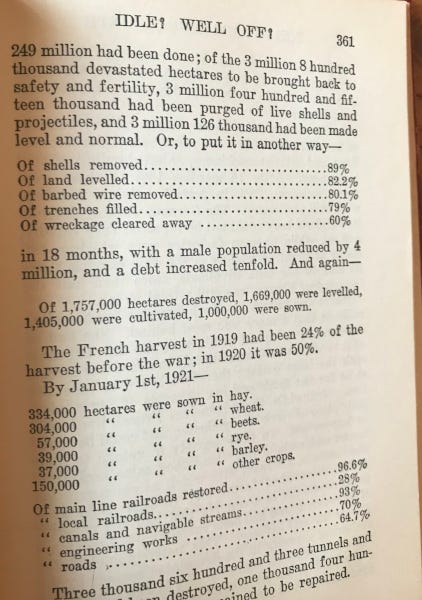
The extent of Wister’s papers, chiefly his diaries and journals, is daunting. He wrote hundreds of thousands of words about his travels to the West. He also wrote three books about World War I, material that was again based on his travel notes and diaries. Wister kept detailed records of his expenses—train timetables, cabs, tips, and more. He left a massive paper trail, perhaps to be expected of a man who left nothing to chance. He tracked other things as well, such as France’s return to productivity after the war (below: Neighbors Henceforth, p. 361).
Born in Pennsylvania and educated in Europe and at Harvard, Wister had no connection to the Wild West until he was diagnosed with neurasthenia. In 1885 he was sent to Wyoming by his doctor, Silas Weir Mitchell, for a “rest cure” at the home of a judge whom Mitchell knew. At that time, neurasthenia was associated with depression; we now associate it with shell shock (Rotundo; see also Shephard, p. 28, and Will, pp. 294-96).
His health took Wister to Wyoming often between 1885 and 1900. Not the delicate flower or dandy he might seem to have been, and certainly no tourist, Wister kept busy during these visits. He worked with cowboys and spent time at U.S. Cavalry outposts. He was, after all, only 25, hardly older than the cowboys who fascinated him. He was a young man with a young man’s energy.
By coincidence, the diagnosis of neurasthenia gained prominence during World War I, which was a conflict about which Wister, along with his good friend Theodore Roosevelt (president 1901-09), had strong feelings. Both men were eager for the United States to enter the conflict. Wister’s keen interest in the war is seldom explored. It is covered in a single, short chapter in Darwin Payne’s otherwise excellent biography of 1985, still the standard work on Wister. Wister was not a warmonger; he wanted to defend France, not capture Germany. But his pro-war activism and writing distanced him even from readers in his own time.
In 1915, just a year after the war broke out, Wister, then age 55, published The Pentecost of Calamity. He claimed that the Belgians, when invaded by the Germans, had “blessed their martyrdom.” They did so, he said, because the German invasion of August 1914 had awakened the Belgians’ national spirit (pp. 45-46). With the book, which was in its fifth printing within a year, Wister hoped to rouse enthusiasm for the war in the United States. Although he had good reason to believe that he had touched the national spirit, the U.S. did not enter the conflict until late in 1917. Most historians agree that American forces turned the tide against the Germans.
In November 1918, when the war ended, Wister and Roosevelt were among those who wanted Germany to be punished as harshly as possible. To confirm his resolution and to amplify his influence, Wister went to France early in 1919. He was one of the first civilians to tour the battlefields. It was a disturbing experience: the dead were still unburied; French citizens were living in bombed-out basements; hunger was everywhere.
Subsequently Wister wrote two books setting out his post-war views, both inspired by his potent mix of fervent nationalism and masculine idealism: A Straight Deal, or The Ancient Grudge (1920) and Neighbors Henceforth (1922).
A Straight Deal attempts to defuse tensions between England and the United States that stemmed from English exploitation of its North American colonies, a topic he touched on Neighbors Henceforth as well (ch. 23). Wister addressed the biased representation of England in accounts of the American Revolution in history textbooks and sought to counter it.
Neighbors Henceforth aims to describe “the plight of France, the deed of Germany, and the international destiny of the United States” (p. vii). By this time, Wister had assumed the role of the public intellectual; he saw himself as an expert on international affairs. His post-war journals show that he was well-connected in diplomatic and military circles. He was proud of these ties and used them, and his wealth, to get the necessary permissions to visit the war zone. Fires still burned, landmines had not been disarmed, and supplies along the front-line areas were scarce. Not just any civilian could observe these conditions first-hand.
When he visited the front, Wister took his cowboy spirit with him. Cormac McCarthy has written about that spirit. The Virginian, McCarthy says, was the prototype of “the ideal cowboy in books and movies,” which is to say he was a man who is “strong, righteous, silent, passionate, intelligent, and handsome.” In France, Wister looked for evidence of this ideal in the American men stationed there. Wister saw the doughboy as the cowboy’s successor. He expected to find some of the cowboy’s admirable qualities in the American soldiers he met. But he was disappointed, for three reasons.
First was the scale of war, which dwarfed anything Wister had experienced or written about. French military deaths numbered about 1.3 million, German about 2 million, and English deaths about 900,000. The United States lost about 120,000 men, half of them to the 1918 worldwide influenza epidemic. Nobody needed Wister to tell them about misery that they had already experienced.
Second was the stark contrast between the West and the Western Front. In the American West, a new civilization imposed itself on the wilderness. But the war in France had created a wilderness, the German invasion blotting out an ancient culture that, in 1914, had long been complete. Wister was slow to see that the cultural dynamics of the Western Front reversed those of the frontier.
Third, Wister seemed to be unaware that his pre-war audience was elite, highly literate, and familiar with the literary tradition he exemplified. His popularity depended on those readers. The Virginian was a best-seller, but the world of Western writing was far larger than that book’s reach. Popular Western fiction took form in so-called “dime novels” that enjoyed a vast and less selective audience. Novels in that tradition were not at all like The Virginian; they were simple, plot-driven, and full of shoot-outs. “Dime novels” would have been known to the doughboys, who were, in the main, not the readers to whom Wister’s famous novel was addressed.
In The Virginian, Wister wrote like the artist he was. He employed a naïve but eloquent narrator who could be educated by cowboy culture while defending the superiority of his (and Wister’s) elite Eastern views. In Neighbors Henceforth, Wister abandoned fiction and spoke in his own voice. Few people would argue that Wister was better as a political writer than he was as an artist. His harsh social and political commentary and his hatred of Germany warred against his reputation as the author of The Virginian. As Payne notes, Wister’s war writing aroused criticism. A Straight Deal was denounced by one reviewer as a mix of “passion and hate and ignorance,” words that until then would have been unthinkable when applied to Wister (Payne, p. 302).
However, Wister himself sought to establish continuity between The Virginian and his war-related work. His device for doing so was a new version of the cowboy, situated at a new frontier that was, like the Western frontier, visited by an attentive observer. The use of two locations and two points of view in The Virginian allowed Wister’s narrator to contrast the values of the East to those of the West. In Neighbors Henceforth, dual locations serve a comparable didactic purpose.
In the parts of the book set in Paris, Wister debates tradition and the merits and the necessity of war. The parts set at the Front show how tradition played out in battle and its aftermath.
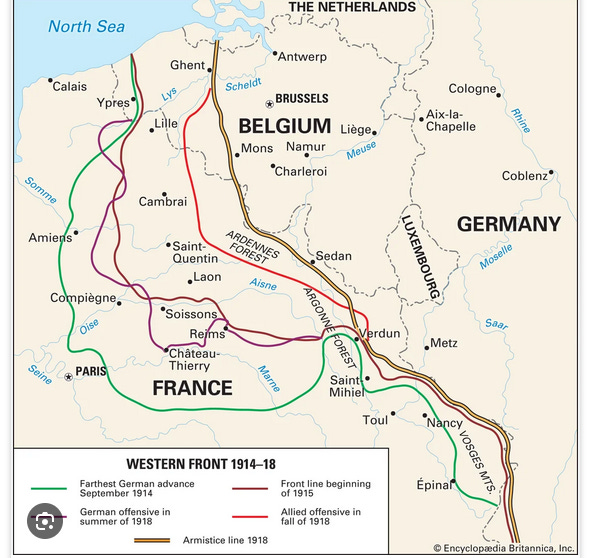
The green line (left) shows the German advance into France in 1914 (note location of Paris). The gold line to the right shows where boundaries were settled in 1919.
In his visits to Amiens, Soissons, Laon, Reims, Verdun, and other cities along the Front (several clear in the map above), Wister lamented the ruin of cathedrals and other emblems of ancient culture. These ruins repeatedly brought the West to his mind. He saw "the Western [American] bad lands" as "nature’s doing, boiled or baked, and so cooked to their strange chemical look when our continent was shaping and before man was there."
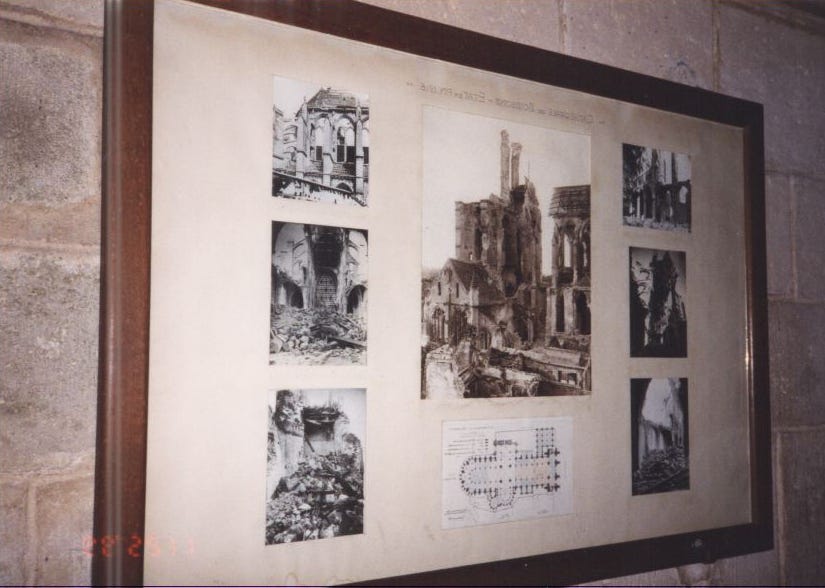
Never forget: Images of the ruins of the cathedral at Noyon, preserved today in the vestibule (my photograph, 1999).
In contrast, the "bad lands of France” had been Edenic. They “had once waved with grain, rustled with leaves, smelt of fruit blossoms and gardens. Their present leprosy had been dealt them by the hand of man." The silence of Western bad lands "speaks of the mystery of the universe" and was “nature’s doing,” he wrote, "while this French silence spoke of the mystery of evil" (Neighbors Henceforth, pp. 54-55; see also pp. 236, 272, 276). The primitive conditions of hastily-reconstructed, post-war French towns brought to Wister’s mind the haphazard towns quickly constructed near mines in the West (p. 356).
The most riveting scenes in Neighbors Henceforth include his conversations with French peasants living in the basements of their ruined homes, his talks in rain-swept tin shelters with British soldiers or French workers, and his glimpses of Chinese laborers disinterring the dead for reburial in military cemeteries. There is nothing glorified there. These are the book’s best pages.
Chapters set in theaters and cathedrals in Paris, Amiens, and Reims are less successful. They seem artificial and staged, with polemic that is disguised as dialogue between Wister and those he meets. Especially in the book's second part, which describes his second visit to France in 1921, Wister pursues what William R. Handley calls "the wishful literary equivalent of executive power or of the presidential bully pulpit" (p. 50). Roosevelt joined him in that effort. Long since out of power, and defeated by the peace-loving Woodrow Wilson the 1912 presidential election, Roosevelt was a vocal critic of Wilson’s peace-oriented policies and still a master of the bully pulpit.
The war had been won, but Wister was unable to find a voice other than his own to glorify it. He did not look into possible explanations for the difference between his triumphalist views and the grim outlook of those who had actually experienced the war and had to cope with its ramifications. In his tirelessly polemical mode, Wister routinely discounted opinions contrary to his own.
In France, Wister maintained his faith in cowboy-style masculinity. But even as he clung to this idealized image and looked for the cowboy in the doughboy, Wister began to see the distance between the West and the Western Front. In Neighbors Henceforth, the doughboy served as the locus of Wister's most concentrated thoughts about the war and its significance for both France and the United States. Wister's treatment of the doughboy as a new American masculine emblem is not admiring.
Wister often contrasted the behavior of the French to that of American soldiers, especially those men from western and southern states. The French were thrifty, for example, while American men had thrown gold "to western bartenders for a drink" and never missed the money (p. 102). Wister saw the doughboys as naïve. They were careless with their funds. Yet they continually complained that the French exploited them financially.
Wister recounts an ugly episode at Epernay, where his train, loaded with doughboys, pauses. A Frenchman of 18, about the same age as the doughboys, is pushing a rolling cart of refreshments along the train cars. The soldiers take “buns and the bottles they had picked out, cursing him [the Frenchman] for a robber and a cheat” (p. 180). Wister laughs at this misbehavior at first but then writes that he “was ashamed of them, and of myself, too, for not protesting.” He recounts other examples of the doughboys’ unchecked rudeness (p. 181).
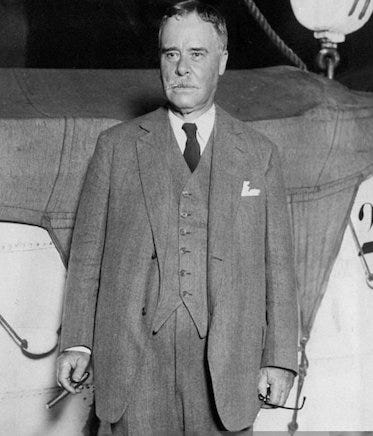
The Front, like the frontier, was a dangerous place for simple men, which is how Wister, ever the patrician, saw men in uniform. In an especially damning comment (for him), Wister writes that pornography found at the Front was, to the doughboys, as a dose of frontier whiskey had been to the Sioux or the Cheyenne (p. 253). Wister frequently commented on the doughboys' preoccupation with sex and their resentment of "uplift" missions led by American civilians eager to reform military morals. Whose side was Wister on? On the one hand, he admired masculine bravado; on the other, he was puritanical and deeply conventional.
In Neighbors Henceforth, we see that the doughboy, like the cowboy, stands for a larger figure. Both men are types of the American man. Neil Campbell claims that "Wister's cowpuncher or Virginian" appears as the "essential American writ large." Campbell believes that Wister rooted his ideal of American identity "within a European, Saxon genealogy buried deeply in the American experience." The novel's account of Westward expansion, Campbell writes, provided "a laboratory for the soul to rediscover the repressed energies that Wister viewed as essential to an Anglo-Saxon bloodline." In the end, an "old, essential Saxonism" was "emboldened in the West" (pp. 215-16).
The active agent in that “laboratory of the soul” was the cowboy. Commenting on Wister’s essay, "The Evolution of the Cow-puncher," Payne calls the cowboy seen there a "heroic Anglo-Saxon knight." The essay was published in Harper’s in 1895, with an illustration by Frederick Remington that sets the cowboy against a background of mounted men, including two knights in armor (seen below, just behind the mounted Cavalier).
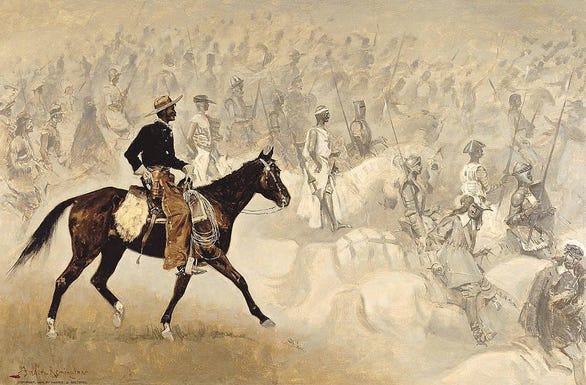
Remington, who was Wister’s friend, did not like the idea that the "cowboy was an atavism, a throwback to the lordly knight of the Middle Ages" (p. 148). Remington saw this nod to European and English roots as undermining American originality. To academics today, the conflation of the Anglo-Saxon warrior with the chivalric knight strikes a false note, eliding as it does several centuries of cultural change that followed the Norman Conquest. Moreover, knights of any age held an aristocratic status that the cowboy did not enjoy. Nonetheless, Payne’s statement and Remington’s image make their point.
Wister set high standards for the men he imagined as the followers of Anglo-Saxon warriors. But if he had been looking for the “repressed energies” that Campbell sees as essential to Anglo-Saxon racial identity, Wister was bound to be disappointed. Wister failed to find doughboys who lived up to the standard he had imagined for them, men who would find a place in Remington’s image. His recourse in Neighbors Henceforth, as in The Virginian, was to resort to imaginary dialogues in which he both asked the questions and supplied the answers.
For example, in Neighbors Henceforth he recounts his talk with an American officer at Amiens. This man told Wister that he had found war terrible and said that he wished that he had never come to France. Referring to the horror of his experience, the officer, who had volunteered before the U. S. entered the war, says, "I’m glad I didn’t know beforehand. I don’t believe I’d have gone in." Wister tries to change his mind, and replies, "I believe you would" (p. 37).
The officer argues that modern warfare is worse than any war waged by "heathen savages." Wister agrees but extols a new spirit of international cooperation (as in “neighbors henceforth”), a world in which pity has “grown great,” while “wickedness is no larger than at the beginning." The young man falls silent. "I believe you have said something," he says, and adds, "I am glad we met" (pp. 40-41). Wister writes what he himself wanted to hear and then uses the young man to support his views.
Later, at Albert, Wister joins a group of British Tommies. “A Scotch boy” sits among them. Wister’s literary imagination quickly goes to work. “Life, as it had come along, had day by day written copiously and clearly upon his alert mind,” he says of this soldier, to whom he does not speak. “This war, this gigantic adventure, through which he had come alive, had evidently set free in him every power of observation and reflection that he possessed” (pp. 50-51). The “boy” is not unlike the Virginian. Both men are made ennobled by conflict and contest. Here again Wister, the ventriloquist, speaks for the man he was presumably talking to. When facts failed his standard of heroic masculinity, he resorted to fiction.
Once the war was over, fighting of a diplomatic kind continued in Versailles. President Woodrow Wilson attended the peace conference that began in January 1919 and ended in May with the Treaty of Versailles. Wilson had been welcomed there as a hero. But, to the dismay of many, he refused to travel to the Front for fear that the expedition would be seen as prejudicing him against the Germans.
"Wilson's failure to visit the devastated regions at once chilled the Allies not only to him but to us," Wister wrote, “us” meaning Wilson’s fellow Americans. "Any man with 1/4 of a heart would have asked to be taken to the devastated regions the first thing" (1919 notebook, April 14). A man with more than "1/4 of a heart," Wister wasted no time in going there himself.
Wister did not let death and destruction dent his vision of war as a glorious theater of masculinity. His thoughts were artful and his expectations bookish, and he did his best to present his findings in a light that confirmed those expectations.
That meant, inevitably, that he sought to veil a dark, disaster-laden war with fiction. He did not allow the convictions he brought from Philadelphia to be undone by what he saw in France, which is to say that he never changed his tune. Perhaps we should expect nothing less from an accomplished pianist and composer. He stuck with a glorious vision even when he was confronted by ugly reality. Wister had steel. He could not resist the chance to show it, and, by doing so, to confirm that he was, after all, a man’s man.
September 2025
Sources
Handley, William R. "Wister's Omniscience and Omissions." In Melody Graulich and Stephen Tatum, eds. Reading The Virginian in the New West. Lincoln: U of Nebraska P. 39-71.
Kuenz, Jane. “The Cowboy Businessman and "The Course of Empire": Owen Wister's The Virginian.” Cultural Critique 48 (2001), 98-128.
McCarthy, Cormac. “Blood Meridian vs The Virginian.” https://www.reddit.com/r/ cormacmccarthy/comments/13fp0s6/blood_meridian_vs_the_virginian/. Seen August 25, 2025.
Rotundo, E. Anthony. American Manhood: Transformations of Masculinity from the Revolution to the Modern Era. New York: Basic Books, 1993.
Seelye, John. Introduction to Wister, The Virginian: A Horseman of the Plains, Penguin, 1988. https://www.booksamillion.com/p/Virginian/Owen-Wister/9780140390650
Shephard, Ben. A War of Nerves: Soldiers and Psychiatrists in the Twentieth Century. Cambridge: Harvard UP, 2001.
Shulman, Robert, ed. The Virginian. See Wister, Owen.
Will, Barbara. "The Nervous Origin of the American Western." American Literature 70 (1998): 293-316.
Wister, Owen. The Virginian: A Horseman of the Plains. New York: The Macmillan Company, 1902. Ed. Robert Shulman. Oxford World’s Classics. New York: Oxford University Press, 1998.
Wister, Owen. Neighbors Henceforth. New York: Macmillan, 1922.
Wister, Owen. The Pentecost of Calamity [1915] and A Straight Deal [1920]. New York: Macmillan, 1928. PDF downloaded 9/4/2025.
Comments
Nothing yet. Say the first thing.
Sign in to join the conversation.