
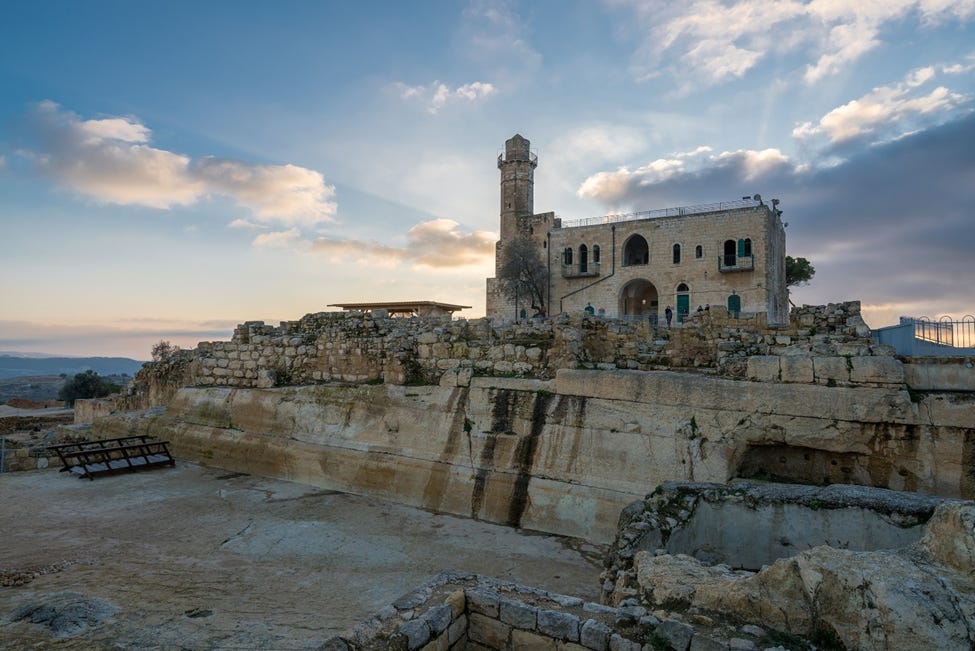
Tomb of Samuel the Prophet (Biblical Mizpah)
Semicontinuous - Psalm 8; Exodus 1:1-7; Romans 2:1-11
Complementary - Psalm 18:1-3, 20-32; 1 Samuel 7:3-13; Romans 2:1-11
(What are semicontinuous and complementary readings?)
___
Grant, O merciful God, that your Church, being gathered together in unity by your Holy Spirit, may show forth your power among all peoples, to the glory of your Name; through Jesus Christ our Lord, who lives and reigns with you and the Holy Spirit, one God, for ever and ever. Amen. (Book of Common Prayer)
In our passage, Samuel’s first command as Israel’s prophet and judge to the people is to return to the Lord with all of their heart. Israel has done more than neglect God; they’ve been trying to worship the God of Israel, while also holding on to the pagan deities of the surrounding nations. But nothing less than complete repentance, that is a turning away from these idols is required. Their allegiance must not be divided.
Repentance involves action. Samuel tells Israel that they must put away their foreign gods for good. Biblical repentance is more than just feeling sorry for one’s sins and expressing regret. That is an acceptable definition for children’s Sunday school, but it does not explain what repentance is in its totality. Repentance involves changing one’s direction, thinking differently, acting differently, and speaking differently. Whatever it is that has displaced God in their lives must be removed. And it’s action that demonstrates repentance is also inward. How one acts reveals the condition of the heart.
Samuel gathers Israel at Mizpah. For Israel, Mizpah becomes a place of national gathering, confession, and renewal. The people take water and they pour it out before the Lord. This is a ceremony that represents their penitence and their dependence upon God. They also fast along with their confession of sin. Their confession is direct and clear. They do not blame the Philistines. They don’t condemn their circumstances. They don’t indict the previous generations. Confession does not look for scapegoats. It understands who is directly at fault.
Samuel intercedes on behalf of his people. He is a prophet, a judge… and an intercessor. He stands between God and the people and he prays on their behalf.
And as Samuel offers burnt offerings, the Philistines now approach to attack. But God is present and responds with thunder and throwing the Philistines into confusion. Israel pursues and defeats them. This victory is attributed specifically to God. The people’s deliverance does not happen because all of a sudden Israel has become a military power. It is God and God alone.
Samuel does something that we have seen in Genesis and Exodus. He wants the people remember what God has done; so he sets up a marker—a stone—that becomes a physical reminder of God’s faithfulness. To remember God’s help in the past strengthens faith in the present for the future. Faith needs memory. Human beings are forgetful and can soon forget what God has done. Samuel names the stone “Ebenezer,” which in Hebrew means “thus far the Lord has helped us.” God will continue to help his people in trouble.
But their faithfulness to God is required.
PRAYER: God, you are the power of liberation, calling your servant Moses to lead your people into freedom, and giving him the wisdom to proclaim your holy law. Be our Passover from the land of injustice, be the light that leads us to the perfect rule of love, that we may be citizens of your unfettered reign; we ask this through Jesus Christ, the pioneer of our salvation. Amen. (Revised Common Lectionary)
___
No posts
Comments
Nothing yet. Say the first thing.
Sign in to join the conversation.