
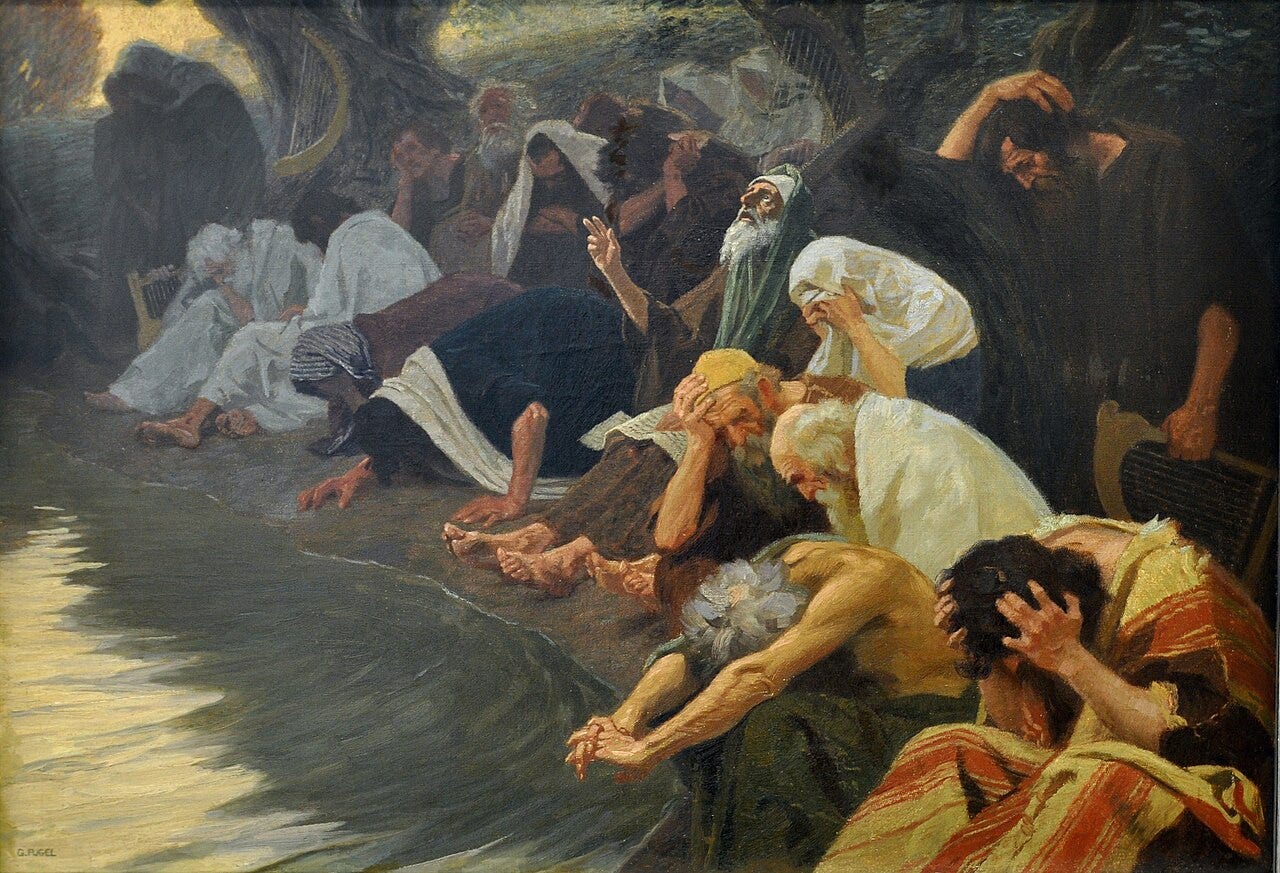
“Waters of Babylon” (1920) by Gebhard Fugel
Scripture
Semicontinuous - Psalm 133; Genesis 41:14-36; Revelation 15:1-4
Complementary - Psalm 67; Isaiah 45:20-25; Revelation 15:1-4
(What are semicontinuous and complementary readings?)
___
Prayer
Move us to praise your gracious will, for in Christ Jesus you have saved us from the deeds of death and opened for us the hidden ways of your love. We ask this through Jesus Christ our Lord. Amen. (Revised Common Lectionary)
___
Reflection
Isaiah 45:20-25 is the culmination of themes repeatedly expressed in Isaiah 40-48. It was written to comfort the Jews in exile in Babylon, who were wondering whether their God was no match for the deities of Babylon. They needed reassurance that it is their God, the God of Israel, who indeed was the Lord, Creator of the universe, who had been with Israel throughout their history. Cyrus, the Persian king whom God would use to defeat Babylon and bring the exiles back to Jerusalem, was evidence that history was indeed moving in God’s direction, not in the direction of emperors and idols.
The opening sentence is a summons for the nations to come together and to admit that their idols are nothing. Isaiah offers a satire on pagan idols. Craftsmen chop down a tree, burn some of it, and then turn the rest into an carved deity they worship. The prophet’s intent is to show how ridiculous it is to trust something made with human hands. In contrast, Israel’s God is not created by craftsmen. God is the Creator of heaven and earth, who governs nations.
Verse 21 states, “There is no other god besides me, a righteous God and a Savior; there is no one besides me.” The relationship between righteousness and salvation is crucial. God’s righteousness is a quality of divine character revealed in God’s action in Israel’s history. His saving work is also a work of righteousness. God proves himself faithful to the promises made long ago by bringing his people home from exile.
Verse 22 is an invitation to all people. “Turn to me and be saved, all the ends of the earth!” The God of Israel is not a provincial deity who only cares about one nation. His heart stretches out to all people. The renewal of Israel also has a view to a larger purpose--to proclaim the truth of God to the world. This universal vision runs through the whole of the book of Isaiah. Israel‘s calling has always been to serve God’s international purposes.
Verses 23-25 underscore the unchallenged authority of God. God swore by himself since there was nothing else to swear by. The knee of every creature shall bow, and every tongue shall confess him as Lord. St. Paul applies this affirmation to Jesus in Philippians 2:10-11. The Apostle understands the Lordship of Jesus as the fulfillment of Isaiah’s vision.
The last section of the text ends on a note of hope. The ones who were angry with God will be ashamed when they come to him, the children of Israel will be justified, and bring glory to the Lord. The emphasis here is on the faithfulness of God to bring about his saving purposes. The God who rules over all nations and is the same one who invites the nations to come to him for salvation. God’s providence doesn’t exist to destroy the world but to redeem it, to bring about justice and restoration and hope to all who trust in him.
PRAYER: Holy One, hear our prayers and make us faithful stewards of the fragile bounty of this earth so that we may be entrusted with the riches of heaven. Amen. (Revised Common Lectionary)
___
If the writing here is meaningful, consider becoming a paid subscriber to support the work and keep the conversation going.
Comments
Nothing yet. Say the first thing.
Sign in to join the conversation.