
The Catholic Church is currently preparing to use an 800 year-old procedure to elect its 267th pope, in a city that has been the religion’s spiritual home for over a millennium and a half. The image of massed, berobed cardinals can have changed little over the past 500 years. This week, “the Eternal City” feels like an apt epithet for Rome.
It is a phrase that appears everywhere — in the first paragraph of Rome’s Wikipedia entry, in the title of almost every tourist guide — but where does it come from? And how did a piece of pagan propaganda come to be worked into the fabric of Christian thought?
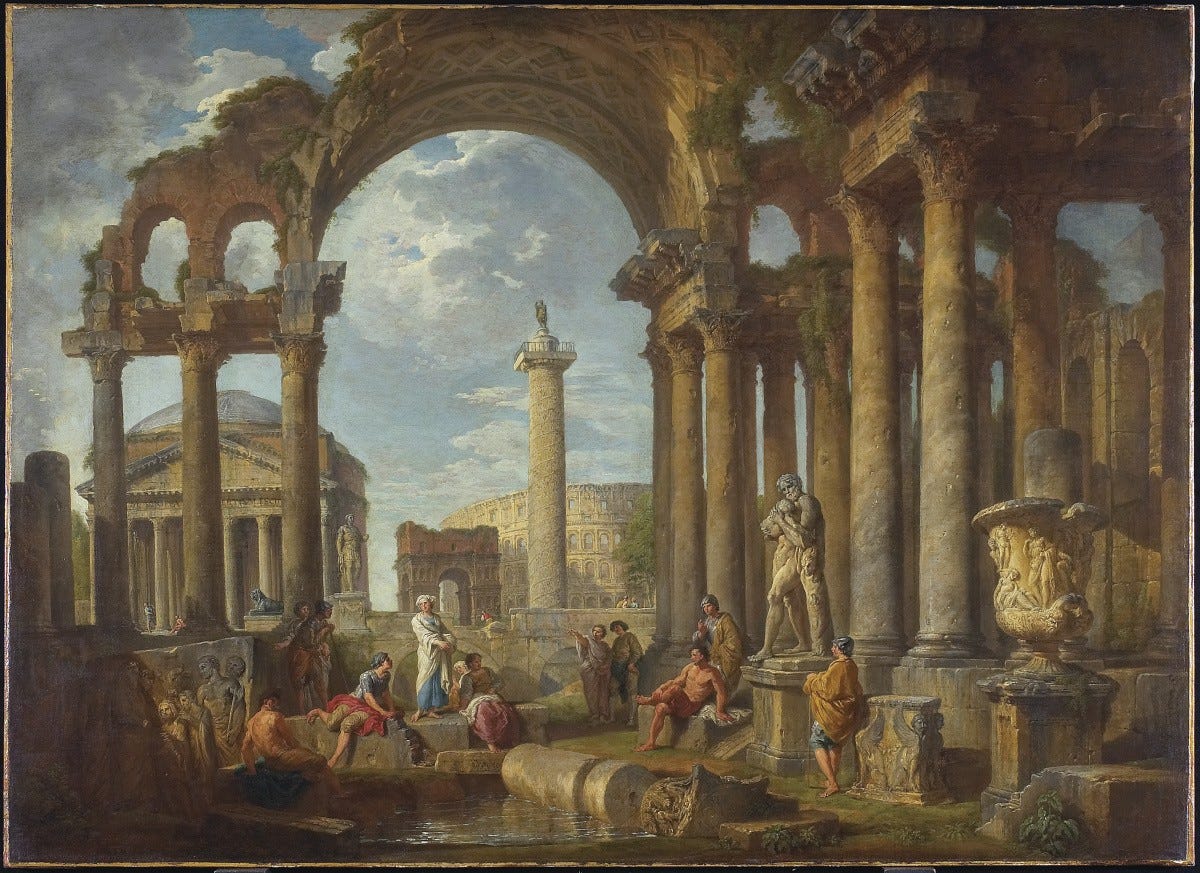
Urbs Aeterna
The first known reference to Rome as “the Eternal City” comes not from an emperor or a prelate but from a love poet named Tibullus.
Ode 2.5 deviates from Tibullus’ usual themes. Instead of pastoral idylls or the tortures of unrequited love, it describes the origins of the Sibylline Books. These collections of often apocalyptic prophesies were consulted in times of crisis for the state — but in Tibullus’ hands they become sanguine oracles of Roman greatness. They were more ancient, he claims, than the city itself, having been spoken by the Cumean Sibyl “when Romulus had not yet laid the walls of the eternal city”.
Tibullus’ poem was not intended to be political. It was intended only to flatter his patron, whose son had just been appointed to the priesthood that looked after the Sibylline Books. But it was remarkably prescient. Over the next few decades, under the auspices of Rome’s first emperor Augustus, Rome would come to be associated ever more ideologically with the idea of preordained eternity.
An Empire without End
Rome in the 2nd and 1st centuries BC had been plagued by the fear that she was spiralling towards collapse. When Augustus, victorious in the final bouts of Republican civil war, assumed sole rule as Rome’s first emperor, he promised those fears could be laid to rest.
The rhetoric of eternity suited Augustus on two counts. Firstly, it helped him maintain the fiction that there had been no revolution at all — that, even as he transformed Rome’s Republic into an autocracy, his interest was in nothing more than restoration. Augustus positioned himself as restorer of Rome’s ancient religious practices and of her traditional moral values; the idea that these things were and should be eternal, justified and guaranteed his program — drawing an unbroken, mollifying line from Rome’s idealised past into what might feel like a changed present.
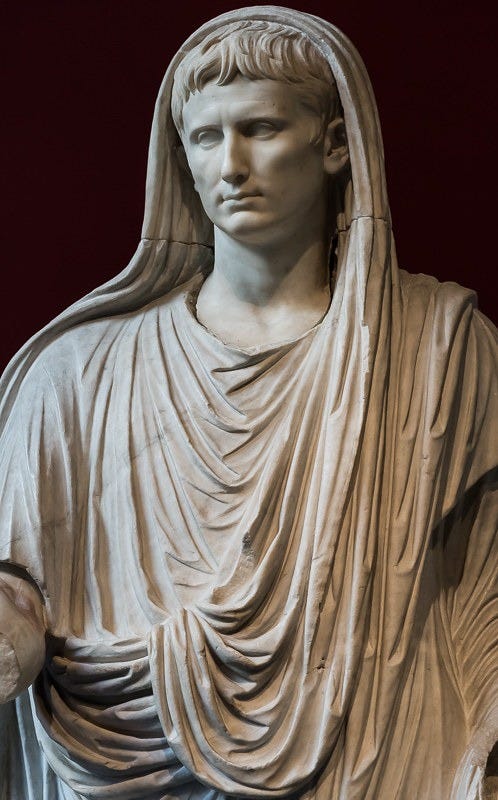
Secondly, there could be no greater way to express his promise of stability. If continuity was the great lie on which the Augustan regime was built, stability was the great truth. A lot of men had given up a lot of freedom, some of them quite clear-sightedly, in return for the order and security Augustus offered after two generations of civil war. To speak of eternity was to promise that this peace and prosperity would not be short lived.
Much of Augustus’ self-presentation was designed to seem timeless; to create the sense that Augustus was the conduit linking Rome’s great past to her infinite future. As well as stressing his credentials as a renovator, he associated himself with Rome’s founder, Romulus, and revived “archaic” rituals of dubious veracity including “Secular Games” designed to proclaim that Rome had entered a new golden age. When he built a new forum for the city, he decorated its colonnades with statues of Rome’s historic heroes, stretching right back to the days of legend, and placed an image of himself riding a four-horse chariot at its centre — the man who would carry forward the old virtues into Rome’s future.
The poets of the Augustan era picked up the theme. In book one of the Aeneid, Virgil has Jupiter, king of the gods, promise Rome “an empire without end”, unbounded both in time and space. In Virgil’s hands, the idea of Rome’s eternity was tied more than ever to the idea of her divinely-ordained greatness: not only would the city survive forever, she would also forever remain the greatest power in the world.
The structure of Virgil’s Aeneid implied that Rome’s boundless power relied upon the abiding rule of Augustus — but the poet Ovid made the connection explicit. In his Fasti, he talks of Augustus’ eternal name protecting the eternal flame of the goddess Vesta, whose ceaseless burning was meant to ensure the endurance of the city. Later, desperately grovelling to be allowed to return from exile, he would apply the epithet aeternus directly to Augustus himself.
Ovid had got to the heart of another reason eternity appealed to Augustus. In the Republic, Romans might have dreamed that Rome herself would be unceasing, but they wanted the magistrates that governed them to change year on year. Under Augustus, the idea of Rome’s immortality became linked to the idea that her government should also be stable and eternal: for Rome’s greatness to be everlasting, it was suggested, she should be ruled by Augustus while he lived, and then forevermore by the dynasty he was in the process of establishing.
The Problem of Worldly Empires
For centuries, emperors propagated the imagery of Roman permanence that had been established under Augustus. They continued repeating it through civil wars, epidemics, and invasions. The edges of the empire had already frayed to a remarkable extent before people began to countenance the idea that Rome might not last forever — but in AD 410, when invading Goths sacked the city itself, the possibility became impossible to ignore.
By this time, Christianity had been the official religion of the Roman empire for thirty years, and so it was Christian thinkers who were forced to parse the aftermath of the city’s destruction.
The Gothic sack was the first time Rome had fallen to foreign invaders in 800 years. Many of those who had remained pagan argued that this had happened now because Rome had turned her back on her original gods — the ones who, Augustus and his poets suggested, had made Rome great and guaranteed her power without end.
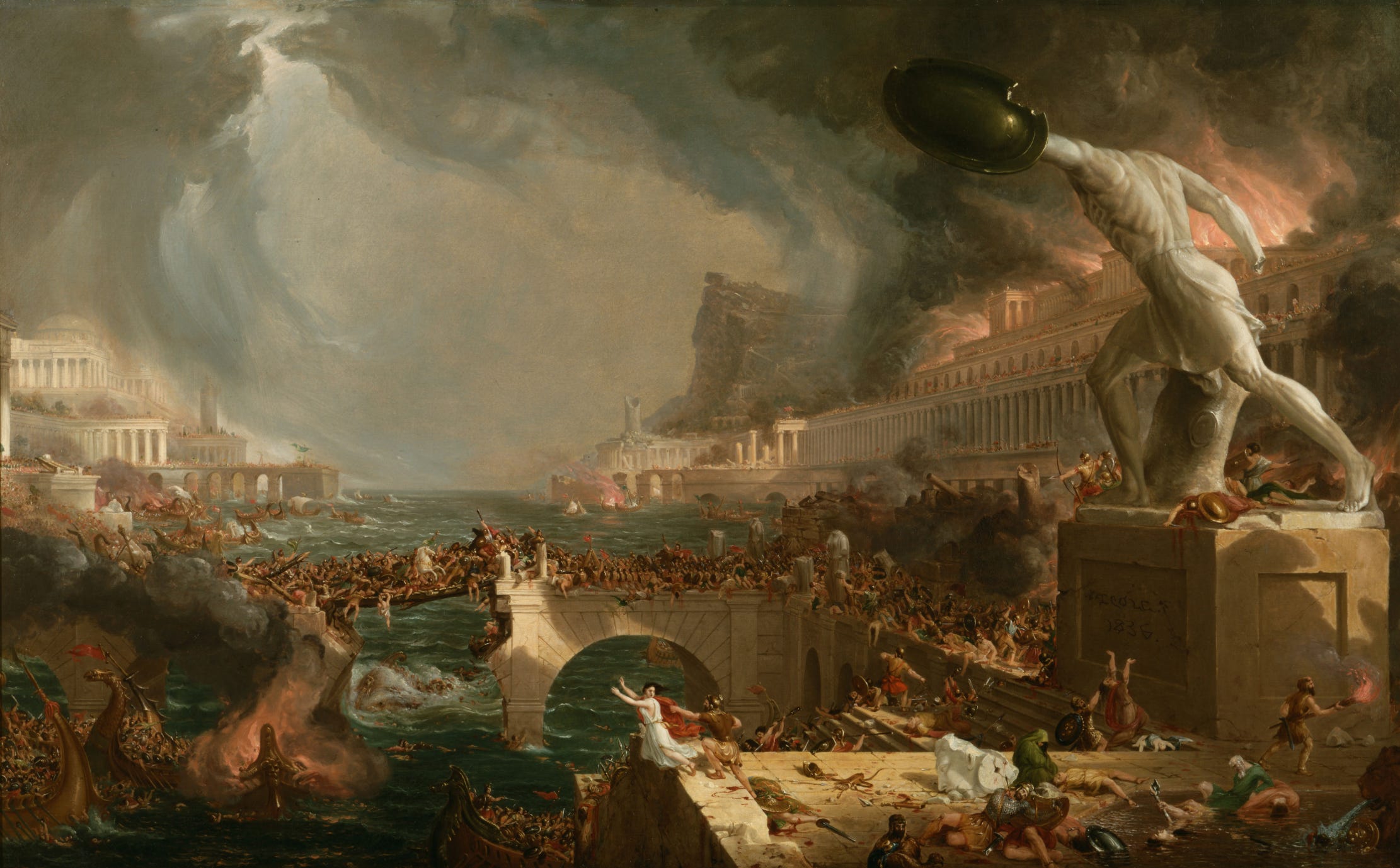
A cadre of Christian thinkers pushed back. In the North African city of Hippo Regius, the bishop (and later saint) Augustine began work on an epic opus entitled The City of God. In it, he argued not only that Rome had fallen because of her own moral failings, but also that nothing temporal — no earthly empire, power, or city — could last forever; eternity was to be found only in the spiritual civilisation that existed in heaven.
The Eternal City / The Holy City
The idea that the destruction of Rome was inevitable — perhaps even desirable — was not a universal one among Christians.
Over the course of the 4th century, the relationship between Christianity and Rome had shifted unimaginably. In AD 313, with Constantine’s edict of Milan, Christians had gone from being persecuted to being tolerated; and then in AD 380, with Theodosius’ edict of Thessalonica, they had been transformed from a tolerated sect into the state religion of the empire. By the time the Goths broke through the gates of “the Eternal City”, a number of theologians had begun to align the power of the Church closely with the power and survival of Rome.
Even before Thessalonica, some theologians had argued that the Roman empire, with its well-guarded networks of communication, had been created by God as an instrument to facilitate the spread of Christianity. By AD 410, the infrastructure and symbols of the Roman empire — once used to oppress the Christian faith — were being worked into the fabric of the Church.
Augustine was not the only future saint to comment on Rome’s sack. The letters of Jerome, a theologian who had spent much of his working life in Rome, betrays an existential anxiety about the import of the city’s fall. “A dreadful rumour came from the West”, he recalls in one, “the City which had taken the whole world was itself taken”. This was not something to be shrugged-off or rejoiced in, “My voice sticks in my throat,” Jerome admits, “and as I dictate, sobs choke my utterance”.
It is clear that, to Jerome, risk to Rome means risk to the Church: he describes the pope facing the flames as the city burns and finding, as the smoke clears, that “churches once held sacred are now but heaps of dust and ashes”. In another letter, Jerome quotes Virgil: “If Rome be weak, where shall we look for strength?”. And then he strengthens his sentiment into something altogether more desperate: “If Rome be lost,” he asks “where shall we look for help?”.
But Rome wasn’t lost in AD 410. After three days, the Gothic troops had had their fill of pillage. They continued on towards southern Italy, leaving Rome smouldering but free. The Roman people, meanwhile, returned and rebuilt. The Roman empire in the West would continue for at least another sixty-five years; in the East she would continue, as the Christian Byzantine empire, for another millennium.
A few decades after Rome’s sack, Pope Leo the Great gave a sermon on the apostles Peter and Paul, both of whom had died in Rome in the 60s AD. In it, he presents the Christian Church as the inheritor of Rome’s worldly empire, painting Peter and Paul as better leaders for Rome than the pagans who had laid her foundations. They had made her “a chosen people, a priestly and royal state, and the head of the world”; because of their efforts, he claims, Rome had “attained a wider sway by the worship of God than by earthly government”.
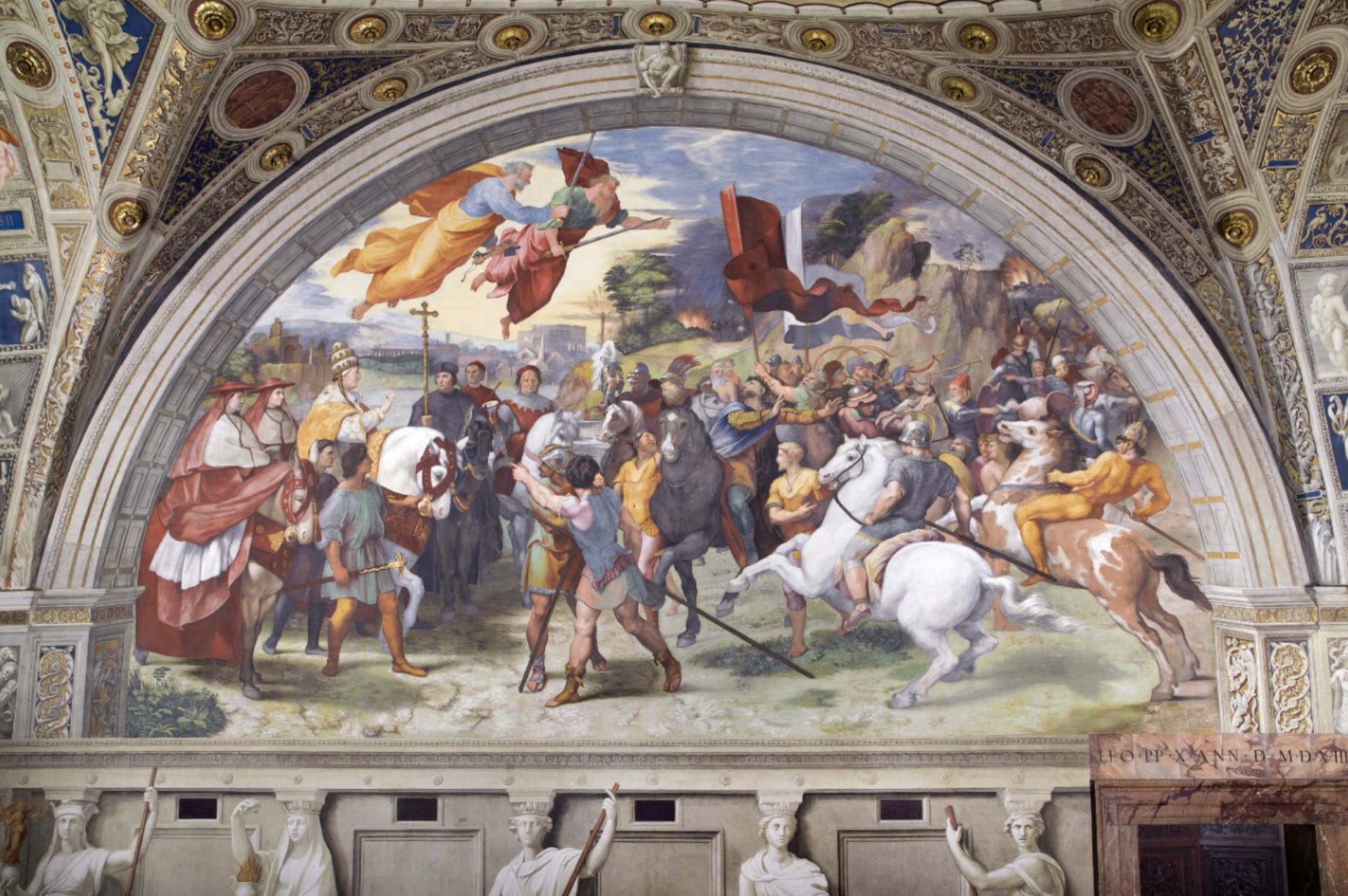
Just as Augustus had claimed that his rule was a continuation of Rome’s eternal greatness, Pope Leo presents the coming of Christianity as a necessary step in an unceasing history. For Rome to be, as Virgil had predicted, truly unbounded in time and space — for this really to be an “Eternal City” — she would have to turn to God.
In a sense, Pope Leo the Great was right, it was the fact the city remained the seat of the Papacy and the centre of the Catholic Church that guaranteed Rome a place in the next 1,500 years of history — long after her last emperor was deposed.
Finally, I’m excited to be starting a paid tier.
You’ll lose none of the content you currently get for free, but if you do decide to upgrade to paid you’ll get more — including extra deep deep-dives and self-study guides to the ancient world (the first of which, on the Rise of Rome, will be arriving next week).
And of course you’ll join a long lineage of illustrious patrons of classical learning. Think of yourself like a Medici!
Comments
Nothing yet. Say the first thing.
Sign in to join the conversation.