
And then, that hour the star rose up,
the clearest, brightest star, that always heralds
the newborn light of day, the deep-sea-going ship
made landfall on the island . . . Ithaca, at last.
The Odyssey 13.105-117, trans. Robert Fagles
The Odyssey is a story of homecoming, even if its hero is remarkably willing to dally with half-divine sorceresses along the way. And the name of Odysseus’ homeland — Ithaca. Ithaca — threads through Homer’s poem like a heartbeat or a siren call.
Ithaca is where the story opens. Homer’s poem does not start, like Nolan’s film, with our lost hero, but rather with his son Telemachus and the disordered, suitor-infested home he has left behind. Before long, Telemachus too has sailed away in search of his father, but even when we’re not on Ithaca, we hear about it constantly
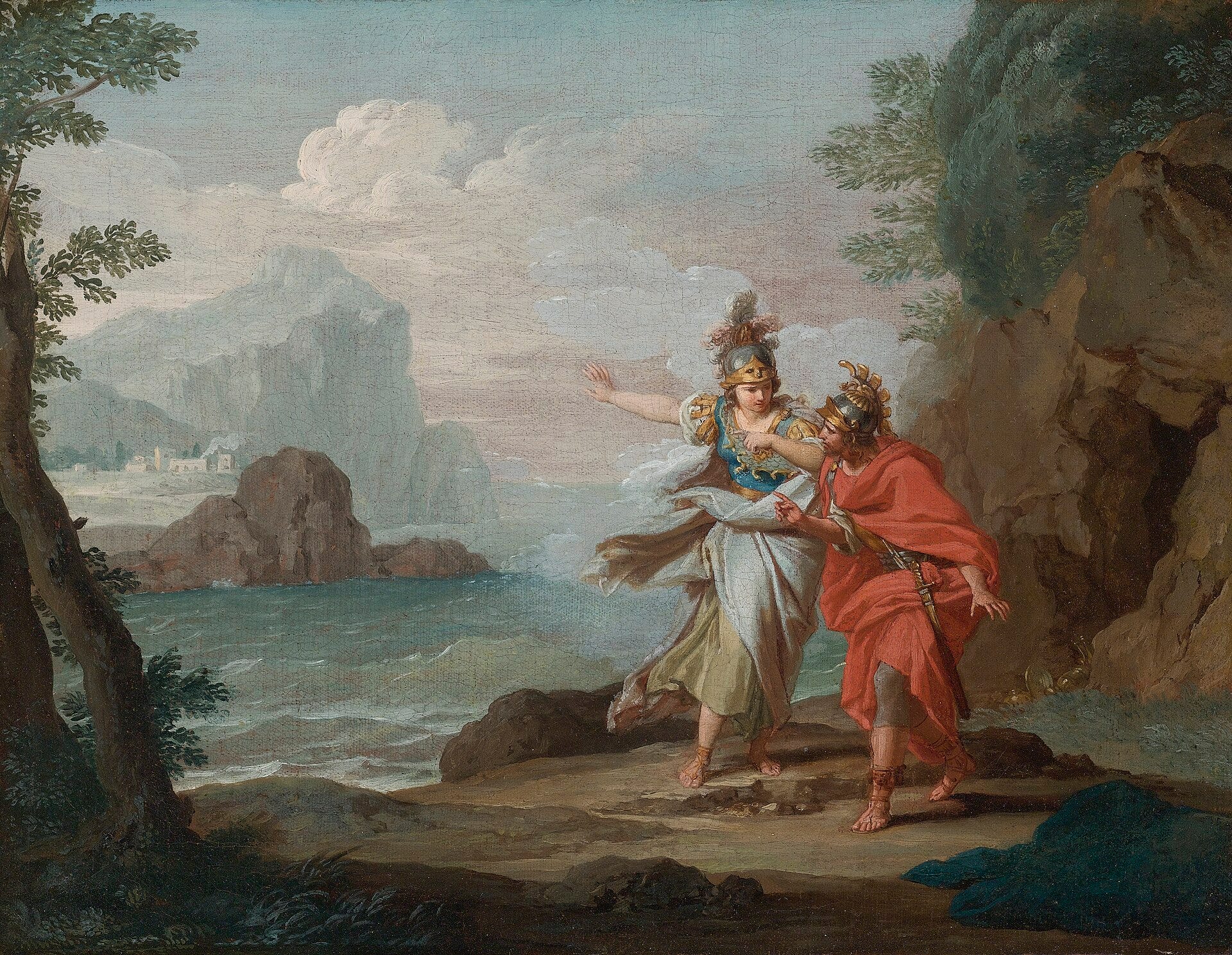
Both Odysseus and Telemachus admit that Ithaca is not “good land” in a practical sense and yet they find themselves compelled by it more than any other place on earth.
Telemachus, turning down King Menelaus’ offer of a shining chariot fitted out with three swift stallions, explains:
Those horses I really cannot take to Ithaca;
better to leave them here to be your glory.
You rule a wide level plain
where the fields of clover roll and galingale
and wheat and oats and glistening full-grain barley.
No running-room for mares in Ithaca, though, no meadows.
Goat, not stallion, land, yet it means the world to me.
None of the rugged islands slanting down to sea
is good for pasture or good for bridle paths,
but Ithaca, best of islands, crowns them all!”
The Odyssey 4.676-686, trans. Robert Fagles
It is the longing for Ithaca – and Penelope – that causes Odysseus to turn down an offer almost unmatched in all of Greek mythology: eternal life and eternal youth on the island and in the bed of the beautiful nymph Calypso.
Homer’s stories don’t exist in a fantasy realm, but in a strange, timeless version of the real one. Much of his geography maps onto the real geography of the Mediterranean, raising the irresistible possibility that we might be able to identify the “real” Ithaca.
At first, there doesn’t seem to be any mystery at all. There is an island called Ithaki in the modern Ionian archipelago; naturally, this was long assumed to be the land of Odysseus. The islanders treat the hero as their common ancestor. It’s great for tourism, of course, but the habit goes far further back: recent archaeology suggests Odysseus has been worshipped on the island for thousands of years.
I was sailing there last summer, (or, more accurately, being sailed – I was dangerously incompetent) and – in between reading trash and dreaming of the sea bass, cocktails, and stable land awaiting me on shore – I enjoyed picturing Odysseus washing up on the shores, Penelope waiting for him somewhere inland, a house full of as yet un-slaughtered suitors.
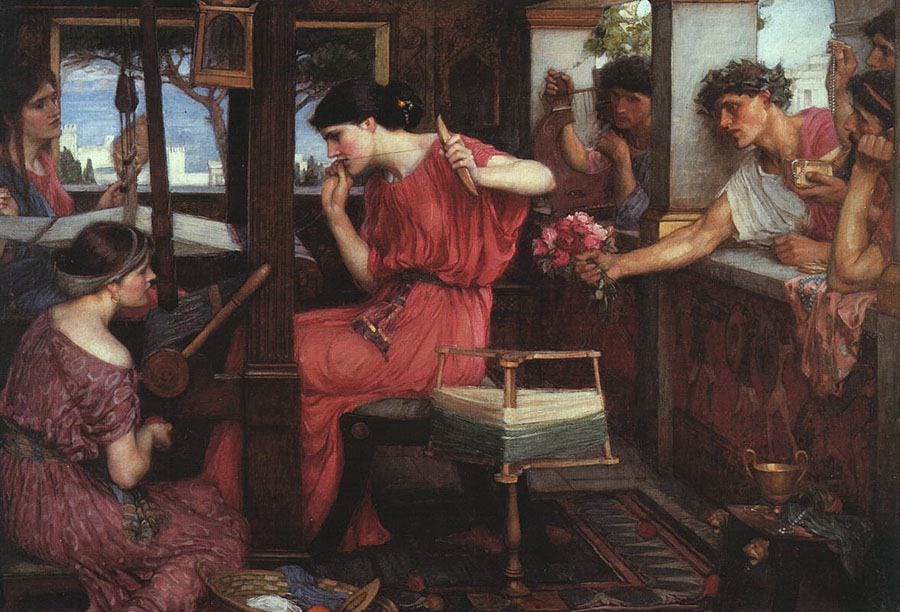
Had I revised the Odyssey rather than reading Jilly Cooper, I might have realised that the land I was looking at bore no resemblance to the Ithaca Homer describes.
This is how Odysseus puts it in Book 9:
I am Odysseus, son of Laertes, known to the world
for every kind of craft —my fame has reached the skies.
Sunny Ithaca is my home. Atop her stands our seamark,
Mount Neriton’s leafy ridges shimmering in the wind.
Around her a ring of islands circle side-by-side,
Dulichion, Same, wooded Zacynthus too, but mine
lies low and away, the farthest out to sea,
rearing into the western dusk
while the others face the east and breaking day.
Mine is a rugged land but good for raising sons —
and I myself, I know no sweeter sight on earth
than a man’s own native country.
The Odyssey 9.21-32, trans. Robert Fagles
The speech tells us two hard facts about Ithaca’s geography:
Ithaca has one main peak, Mount Neriton, but the rest is not high above sea level
It lies close to – and to the West of – three islands: Doulichion, Same, and Zacynthos
Two of these islands can be easily identified as part of a tight group within the Ionian archipelago: Zakynthos retains its name today and Same is agreed to refer to modern Kefalonia.
The problem is that modern Ithaca is not to the west of either of these islands. In fact, it lies directly to the east of Kefalonia.
Nor is it low-lying. The island we were sailing around was mountainous, with steep forested slopes that seemed to rise straight out of the sea.
So, what can be done?
One option is to dismiss Homer’s description of Ithaca as poetic licence or geographical incompetence.
Homer – and most of the poets who made up the oral tradition he synthesised – may never have been to the Ionian Islands. Perhaps some traveller’s report had been garbled, or perhaps they simply created the sort of homeland they imagined might produce a hero like Odysseus.
There’s nothing wrong with this solution, but it’s not fun, and it’s not romantic. It also ignores the fact that Homeric geography does appear remarkably often to have a basis in fact.
If Homer’s Ithaca is based on a real place, however, we need to look for it beyond modern Ithaki.
In 2005 a man called Robert Bittlestone came out with an ingenious theory: Odysseus’ Ithaca should be identified with Paliki – the westernmost peninsula of Cephalonia. The geography fits remarkably well: within the cluster of islands Homer mentions, Paliki is the most low lying and the farthest west.1
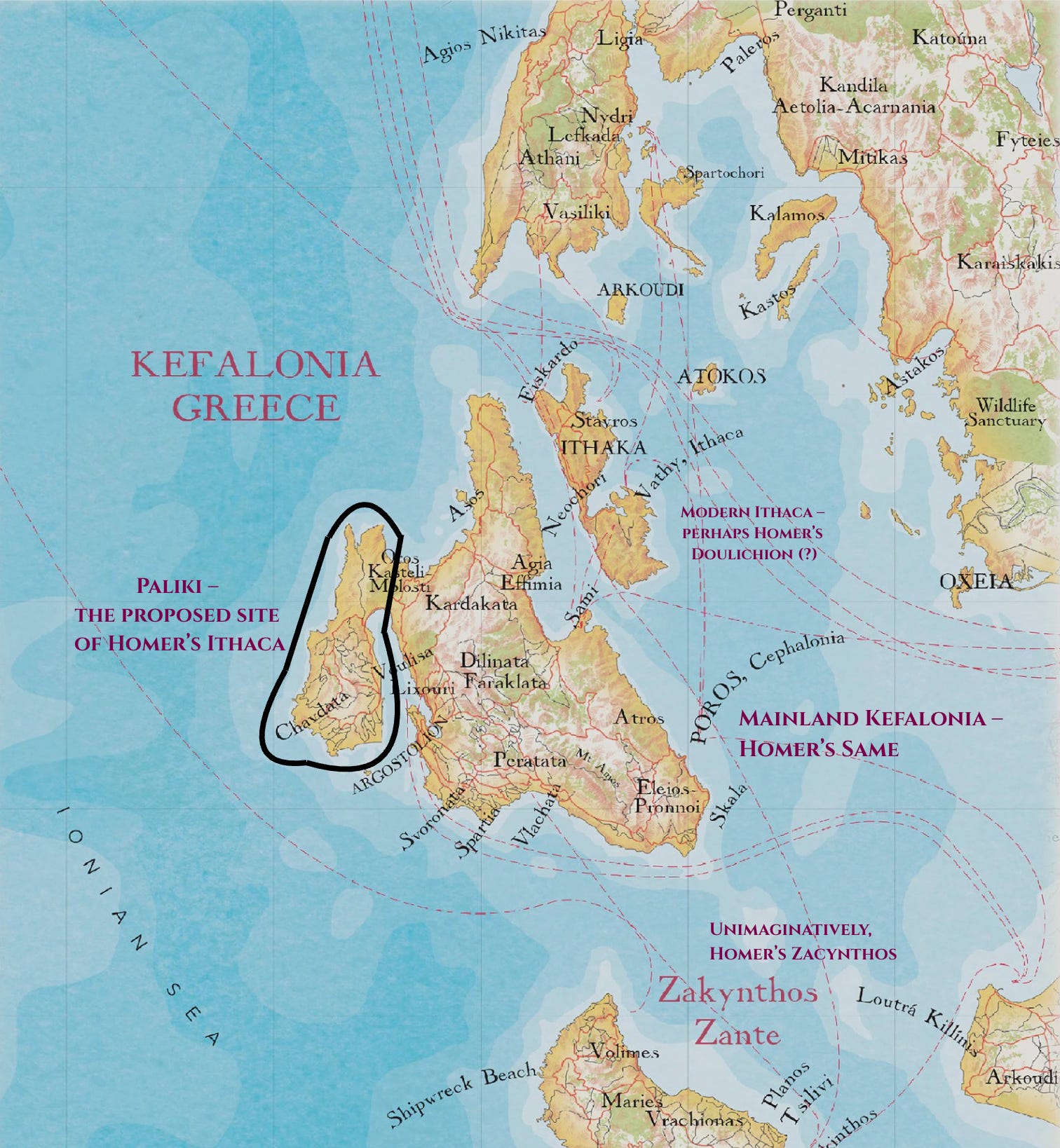
The problem, of course, is that Paliki isn’t an island. And everyone, everywhere, always, has assumed that Ithaca is an island.
At first, Bittlestone theorised that, although it is connected to the mainland by a low valley today, Paliki may have been an island in Homer’s day. He found some intriguing evidence for this idea in the work of the Grecco-Roman geographer Strabo, who gave the following description of Kefalonia around the start of the 1st century BC:
“Where the island is narrowest it forms a low isthmus, so that it is often submerged from sea to sea. Near the narrows, on the gulf, are Paleis and Cranioi.”
Strabo, Geographica 10.2.15, trans. H. L. Jones
To investigate further, he enlisted the help of a geologist named John Underhill and the classicist James Diggle, the Emeritus professor of Greek and Latin literature at Cambridge – and the man who, quite literally, wrote the ancient Greek dictionary.
In 2005, the three men published a book, identifying Paliki with Ithaca and laying out the following theory:
In ancient times there had been a sea-channel where the Thinia valley – the narrow stretch of low land connecting Paliki to the mainland – now lies. Later the earthquakes to which the region is prone triggered enormous landslides which filled the channel and created a permanent land connection between the two-parts of the island.
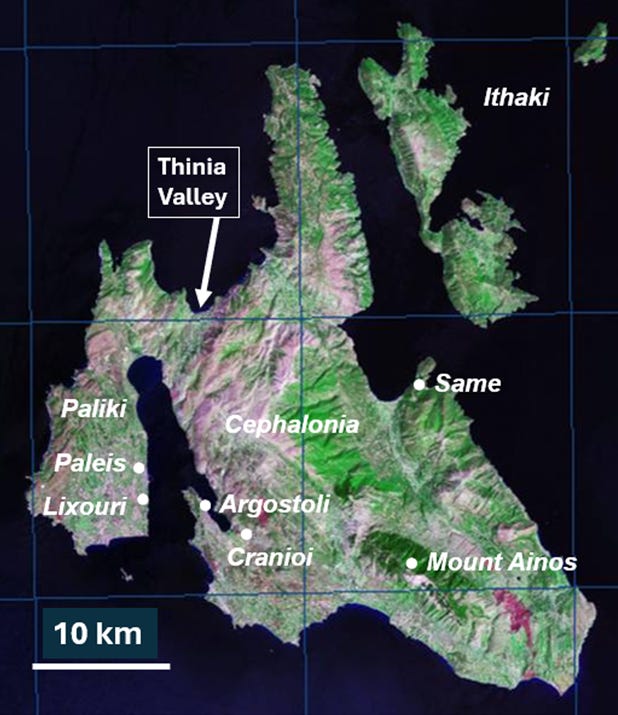
At the time, the theory was well received and the scholarly community widely convinced: Paliki, in its old island form, was Homer’s Ithaca.
The new evidence emerging from their continuing investigations, however, soon created difficulties. Underhill’s experiments proved that the valley had been completely covered in ocean water at one point in its history – but not since sometime between 290,000 and 400,000 years ago.
In other words, Paliki had not been an island in Homer’s day. Indeed, the formation of the land bridge may have occurred before the evolution of the homo sapien. Collective memory and the oral tradition are good, but they’re not that good.
Underhill realised that the Strabo passage had not been describing a marine channel at all. Instead, it referred to an oddity of the island’s geography. Two rivers, each running in a different direction, stemmed from a basin at the centre of the Thinia Valley. This basin flooded whenever the water level rose, leaving Paliki cut off by double rivers from the rest of Cephalonia.
These new discoveries looked like they might destroy the theory entirely. Whilst Underhill had been drilling boreholes, however, Diggle was going back to the text itself.
Diggle must have read the Odyssey hundreds of times before, but this time he noticed something new. Something which forces us – like the twist in an Agatha Christie novel – to look at all of the evidence in a new light.
This month, Underhill and Diggle (Bittlestone sadly having died in 2015) have published a new argument in favour of identifying Paliki as Ithaca, founded on an altered version of the theory and backed by significant new evidence. I find it very compelling, and I’d be curious to know if you agree.
What Diggle noticed was not something in the text, but rather something that was missing.
Never once, in all the Odyssey’s 12,109 lines does Homer actually call Ithaca an island.
Certain elements in the way Homer describes Ithaca — its grouping alongside known islands and the mention of ferrymen, for example — had led everyone from antiquity to the present to assume it was an island, but that fact is never once stated explicitly.2
When Diggle started looking more closely at the intricacies of Homer’s language, he noticed a clear pattern in the vocabulary he chooses to use and, crucially, the vocabulary he doesn’t.
The Odyssey uses a number of terms to refer to Ithaca:
γαῖα, gaia – land
πατρίς, patris / πατρὶς αἶα/γαῖα, patris gaia – native land, fatherland
δῆμος, dēmos – country or region
But never νῆσος, the Greek word for island.3
The picture becomes still more intriguing when we look at the epithets4 Homer uses to describe Ithaca versus those he applies to known islands.
The classic Homeric epithet for an island is:
ἀμφίρυτος (amphirhytos) meaning “with water flowing all around, sea-girt”
But when describing Ithica, he uses something slightly different:
ἀμφίαλος (amphialos) – “surrounded by sea, sea-girt”
At first glance these seem like synonyms, but the pattern of their use suggests that there may originally have been a subtle distinction in their implication, visible to the Greeks but lost on us today.
Homer certainly does not use them interchangeably. Nowhere in the Odyssey is a place we know to be an island described as ἀμφίαλος (amphialos), whilst Ithaca is never described asἀμφίρυτος (amphirhytos).
We find amphialos, the epithet Homer applies to Ithaca, in only three other places in Greek literature. On two occasions it is used to describe an island; but on the third, it’s applied to the Isthmus of Corinth – the long, narrow strip of land which connects the Peloponnese to mainland Greece. In this context, amphialos does not mean “encircled by sea”, but rather “flanked by two seas on two sides”.
Suddenly, we might well be in the realm not of an island, but of a peninsula.
The case for Paliki-as-Ithaca becomes stronger when we look at how Odysseus himself is described.
In the Iliad, Odysseus is introduced as the leader, not of the Ithacans, but of the “gallant Cephallenians”. And in the Odyssey, Laertes, Odysseus’ father, remembers the time when he himself “ruled the Cephallenians”. And the suitors draining the family’s storerooms are described as “the noblest of the Cephallenians”.
On a number of occasions, Homer makes it clear that term “Cephalleniens” does not just refer to the inhabitants of Ithaca, but of another nearby region too – almost certainly Same (the Homeric name for modern Kefalonia, as noted above). The name of these combined peoples, of course, aligns exactly with “Cephallenia” – the name used to refer to the whole island in Greek texts from the 5th century B.C. at the latest.
It seems, then, that the men of Ithaca and those of Same could in some instances at least be treated as one people, with a single name and an integrated leadership. It is possible that this sort of connection could arise between an island and a mainland, but it is almost impossible that it would not emerge between a mainland and its peninsula.
Paliki, in other words, might fit what Homer tells us about the politics of Odysseus’s homeland as well as its geography.
With all this in mind, let’s look more closely at the passage quoted at the very start of this piece.
the newborn light of day, the deep-sea-going ship
made landfall on the island . . . Ithaca, at last.
A natural rendering of these lines in English makes it seem that Homer is describing Ithaca as an island: Odysseus is making landfall on an Island, and that island is Ithaca.
But when we look at the Greek text, that implication disappears. Homer ends one line on the word island - νῆσος (nisos). And then, in another, he clarifies that the boat has stopped in the region – δήμῳ (dimos) - of Ithaca.
It seems, therefore, that Homer might be using the name Ithaca to designate a territory of the larger island mentioned first. He is telling us, in other words, where Odysseus and his family really come from: not just the name of their island, but the specific location of their home. If this is the case, Paliki, a peninsula separate but connected to the larger island of Cephalonia, is the perfect candidate.
Homeric geography is never going to be a precise science, nor should it be. This is a mythical version of the world, c. 1,200 BC, created some 2700 years ago, peopled with sorceresses and cyclopes. Many classicists would also stress that the “true” location of Ithaca doesn’t really matter, and technically, of course, they’re right.5
For me, however, the idea of finding the land that inspired Odysseus’ Ithaca is too deliciously romantic to pass up – and I think it may well have been found in Paliki.
I would love to know what you think in the comments and if you want to look at the arguments in more detail, Diggle and Underhill have published an extremely readable and well explained report.
Mount Neriton might be identified with a ridge on the north western part of the penninsula or with one of the higher peaks on the mainland of Kefalonia. The latter is perhaps more likely, given that it is being used as a landmark for navigation.
The three lands he places it alongside (Doulichion, Same, and Zacynthos) are explicitly described as islands, and Diggle argues that Homer’s syntax carefully, though subtly, separates Ithaca from this grouping.
Homer also describes animals being brought to Ithaca from the main part of Kefalonia by ferry, but this does not preclude the existence of a land bridge: crossing the short strait would likely simply have been quicker and easier than driving the animals around the island and across the land bridge.
The omission of the word for island can't be explained as the product of poetic necessity. Νῆσος (island) is identical in syllables and stress to δῆμος (country, territory, or region), A term Homer does use in relation to Ithaca. ‘Island’, therefore, often fits Homer’s metrical scheme precisely – he must have chosen not to use it for other reasons.
An epithet is a short descriptive phrase repeatedly attached to a thing, place, or person in Homeric poetry (e.g., swift-footed Achilles or rosy-fingered dawn or the wine-dark sea.)
But even the most pragmatically minded would have to admit that the search for Ithaca has yielded remarkable new insights into Homer’s text.
Comments
Nothing yet. Say the first thing.
Sign in to join the conversation.