
It is the autumn of 44 BC, six months after Julius Caesar bled out on the senate floor. The tense entente that followed his death is fracturing by the day: his assassins Brutus and Cassius are massing armies in the Eastern provinces; in Rome, the relationship between Mark Antony, Caesar’s right-hand man, and Cicero, the senate’s greatest orator, has been darkening for months. It is about to break down irrevocably.
On the 2nd of September, Cicero delivers a scathing speech against Antony. On the 19th, Antony stands in the senate to deliver an equally scathing reply. Cicero, afraid for his life, is not present at the meeting, but he does compose a response, known to us today as the Second Philippic.
The Second Philippic is the longest, most vicious, most scorched-earth of all Cicero’s attacks on Antony. It is a comprehensive exercise in character assassination. Mark Antony emerges from Cicero’s stylus as a scoundrel, a villain, a tyrant, an enemy of the state, an existential threat to Rome, and . . . a prostitute?
Around half-way through the Second Philippic, Cicero breaks off from his discussion of Rome’s impending doom to tell us a scurrilous tale of Antony as a rich-kid turned rent-boy, a doomed romantic, and a secret drama at the heart of one of Rome’s most illustrious families. To the modern eye, the story looks sorely out of place. This is a speech about high politics and the future of the state — one that ends with Cicero proclaiming his willingness to lay down his life for the Republic. Surely this is not the moment to be airing Antony’s sexual laundry?
But this excursus would not have seemed strange in 44 BC. Any Roman, whether they believed Cicero’s gossip or not, would have recognised that the melodrama he presented was not frivolous — it was the foundation upon which his characterisation of Antony as an enemy of the Republic was built.
Understanding why this is reveals some fascinating things about Roman politics, morality, and culture. Below you’ll find my translation of this fascinating, juicy passage and a guide to the key points that unlock its meaning and significance.
The passage begins around half-way through the oration. By this point, Cicero has set the pitch emphatically to ‘fever’ — calling Antony ‘an enemy of his fatherland’ and presenting himself as Rome’s last line of defence. He has just finished a fiery rebuttal of the serious charges Antony had levelled against him in the speech he’d made to the senate on the 19th.
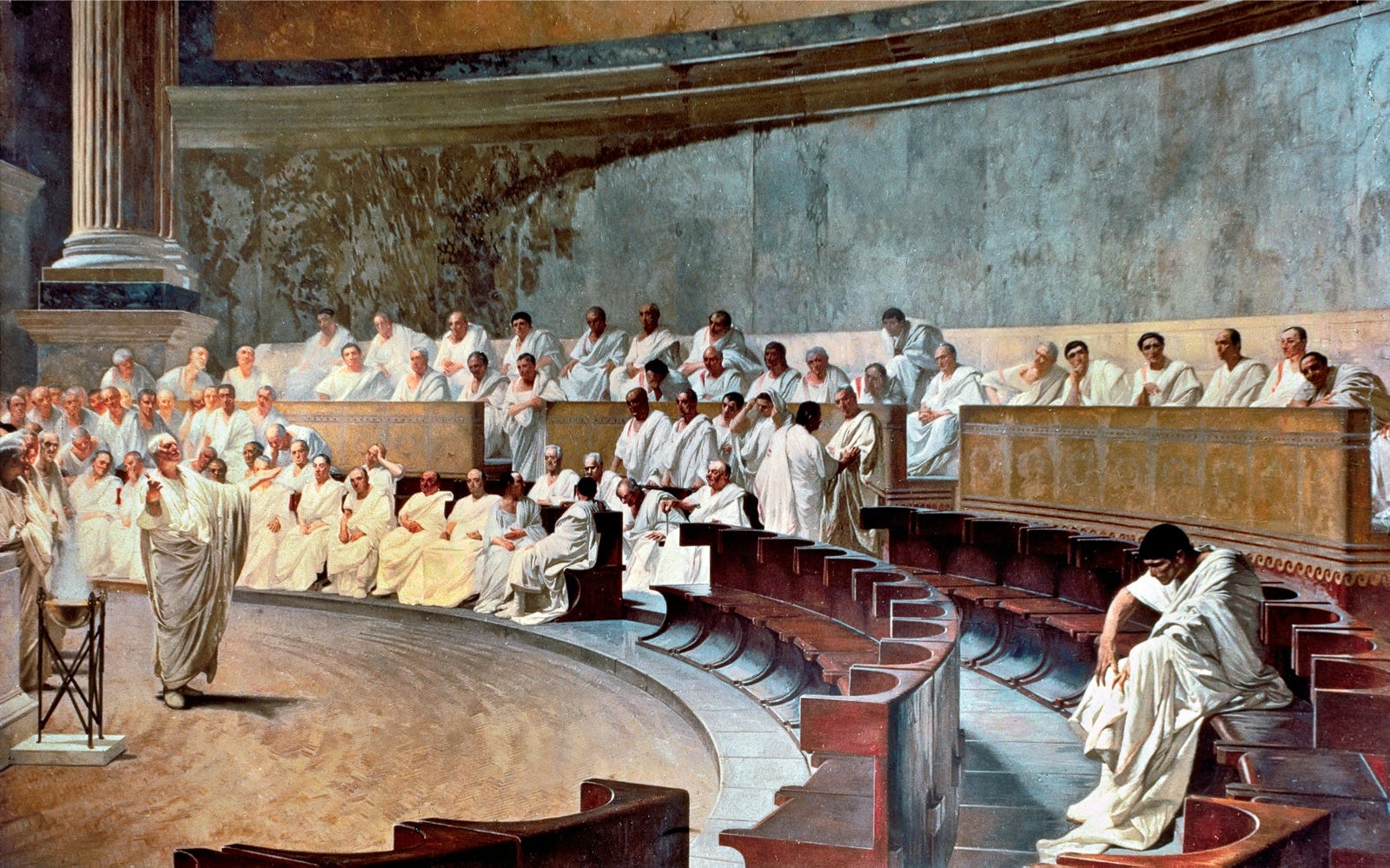
Now, however, Cicero turns his attention away from the immediate crisis of 44 BC, transporting us back to a very different Rome. It is around twenty-years ago, and the scene we are about to see is straight out of a soap-opera.
The young Mark Antony, Cicero tells us, is bankrupt. In urgent need of funds to maintain his lifestyle of excess and dissipation, he begins to barter his sexual favours to a series of rich protectors. One of his lovers, however —a rich young aristocrat named Gaius Scribonius Curio — falls hard and, desperate to have his undivided attention, promises to cover all Antony’s expenses himself.
The two embark upon a passionate, rash, brazen affair. Curio’s father disapproves. There are scenes at the door and in the street. Antony begins breaking into the house through the roof at night. The fights between father and son worsen. One day, when Cicero, a friend of the family, visits the house he finds the elder Curio has taken to his bed, sick with the shame of it all. Outside, the younger Curio is panicking. The situation is dire enough already — and his father hasn’t even discovered the money problem yet.
Curio explains everything to Cicero. Antony has run up more debts. Curio has guaranteed them. But he can’t cover them himself. He has no real money of his own after all; all he has is pocket money, a family name, and the distant hope of a great inheritance. But the creditors are pressing now, and Curio is beginning to realise he is going to need to ask his father for help. Still excusing and justifying Antony’s behaviour, he begs Cicero for help; asking him to intercede on his behalf, to explain the situation to his father, to protect Antony from the fall out. He’d rather leave Rome and go into voluntary exile, he proclaims, than to be parted from Antony.
The drama! The farce! The romance! The tragedy!
As a piece of gossip (a category which I feel well qualified to judge) the tale is tough to match, and Cicero tells it with all the prurient relish it deserves.
Here is the passage translated in full:
Comments
Nothing yet. Say the first thing.
Sign in to join the conversation.