
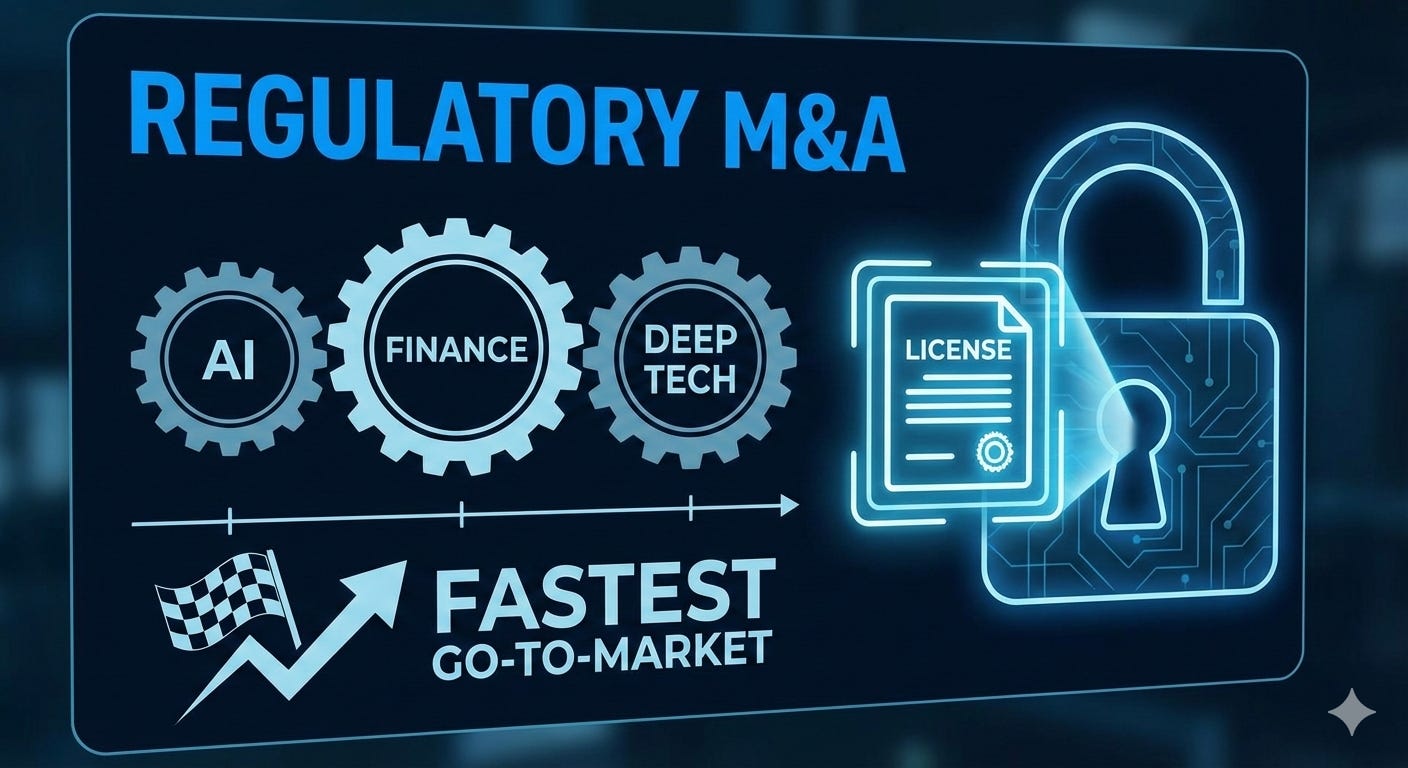
In regulated markets, speed is rarely just about engineering.
Speed is also about time under supervision.
The uncomfortable truth is that many go-to-market strategies are no longer product strategies. They are regulatory acquisition strategies.
You are not buying a company. You are buying the right to operate while everyone else is still filling out forms.
Most teams model TAM, CAC, infra cost, latency, model performance.
Then they treat licensing like a checklist.
In practice, licensing behaves like a scarce production input:
It is slow to produce
It is hard to accelerate with money alone
It compounds advantages because it unlocks distribution and trust
It is path-dependent (the first “yes” makes the next “yes” cheaper)
In AI + finance + deep tech, that last point matters most.
Once you have a credible permission set, counterparties stop treating you like a science project. They treat you like an institution.
That shift changes pricing, distribution, and survivability.
When founders say “we need the license,” they imagine a document.
Regulators do not regulate documents. They regulate behavior over time.
A functioning license is usually a bundle:
Legal permission Charter, registrations, approvals, permits, authorizations.
Operating system Policies, controls, audit trails, reporting cadence, incident response, governance routines.
Institutional credibility A history of exams, remediation, and non-catastrophic outcomes.
This is why buying a licensed entity often beats building.
You are buying a running compliance metabolism, not a stamp.
These three worlds share a trait: the downside is asymmetric.
When things go wrong:
In finance, losses propagate through trust and balance sheets.
In AI, errors propagate through scale and automation.
In deep tech, errors propagate through safety, sovereignty, and physical reality.
So regulators optimize for one thing above all: control of tail risk.
That pushes markets toward incumbency and permissioned rails.
Which creates an arbitrage for operators who understand one simple idea:
Regulatory time is an asset. Assets can be bought.
You always have three options.
You apply, wait, iterate, build trust from zero.
Pros: Clean slate. No inherited baggage.
Cons: Time-to-revenue is long and uncertain. You burn runway while learning supervision in real time.
You partner with a bank, broker-dealer, issuer, prime, gov contractor, CRO, or any regulated intermediary.
Pros: Fastest pilot path. Lower upfront capital.
Cons: You rent permission. The owner of the license owns your timeline, your margins, and often your product roadmap.
You acquire an entity that already has permission and a supervision history.
Pros: You buy time. You buy credibility. You compress the learning curve.
Cons: You inherit everything. Including problems you cannot see in a data room.
Most companies start with B, try A, then end up at C when the business model proves out and the clock starts to matter.
Buying is not “easier.” It is more decisive.
It tends to win when these conditions hold:
You are in a market where the first credible operator becomes the default counterparty.
This shows up in:
Stablecoin issuance and settlement networks
AI agents touching payments, credit, claims, or payroll
Defense and dual-use supply chains where procurement cycles reward incumbents
Infrastructure plays where permits and interconnection queues are the true bottleneck
Some permissions change how the market treats you.
A bank charter, trust charter, broker-dealer registration, money transmitter coverage, or a facility clearance can turn “nice demo” into “approved vendor.”
That is not compliance. That is go-to-market.
In regulated markets, your best incremental investment is often not another engineer.
It is buying time-to-revenue.
This is capital allocation, not legal ops.
Partnership is rational when:
You are still searching for product-market fit Buying too early locks you into a compliance cost structure before you know what scales.
The license owner truly adds edge Some intermediaries are not “rent-seekers.” They are distribution and trust engines.
The regulatory perimeter is still moving In fast-evolving regimes, owning the license can put you in the blast radius of changing expectations.
The clean logic is simple.
Rent permission while you are still learning. Buy permission once you know what you are scaling.
This is where teams lose years.
A “zombie license” is permission that exists on paper but fails under real scrutiny once you scale, change ownership, or change product scope.
Zombie licenses show up when:
The licensed entity stayed small by avoiding complexity, not mastering it
The compliance program is people-dependent, not system-dependent
The regulator tolerated the old operator but does not trust the new one
The license is technically valid, but operationally brittle
The trap is psychological.
Founders see a shortcut. Regulators see a change-of-control event and a new risk profile.
The deal closes. Then supervision resets.
Suddenly you are operating a regulated entity while rebuilding controls from scratch, under a spotlight, with your brand now attached.
That is not acceleration. That is self-inflicted leverage.
Standard M&A diligence focuses on financials, customers, tech.
Regulatory M&A flips the order.
You diligence the supervision reality first, because it determines whether the business can operate at all.
Here is the diligence stack that separates real licenses from zombie licenses.
Exam cadence, findings, and remediation speed
Any consent orders, MOUs, enforcement actions, lookbacks
How the regulator describes management credibility (this leaks through documents and patterns)
Governance: board minutes, risk committee rhythm, escalation paths
Compliance staffing: who actually knows how to run the machine
Internal audit maturity and independence
Incident response: what happened when something broke
If the licensed entity touches credit, payments, fraud, underwriting, claims, or surveillance, then AI is not “innovation.” It is model risk.
You want evidence of:
Model inventory and change management
Monitoring and drift controls
Human override and escalation
Logging and audit trails that a regulator can follow
Clear accountability when an automated decision causes harm
If an AI agent is in the loop and nobody can reconstruct decisions, you are not buying a license.
You are buying a future remediation plan.
In AI, data is often the hidden regulatory surface area.
You check:
Consent, permissible use, retention, deletion workflows
Third-party data contracts and downstream sharing constraints
Cross-border transfer and localization exposures
Security program reality, not the slide deck
In regulated markets, “we have the data” is meaningless without “we have the rights.”
Even a great license can be destroyed by a sloppy integration.
Three integration principles matter more than synergy math.
Do not rip out governance and compliance routines in the first 90 days.
You can change product. You cannot abruptly change supervision behavior and expect trust to remain.
Your first deliverable after close is not a roadmap.
It is a narrative of competence:
Who is accountable
What controls exist
What will change
What will not change
How you will monitor outcomes
Regulators do not want vision. They want containment.
This is where founders underestimate execution.
Scaling a regulated entity is two businesses:
growth and distribution
supervision and resilience
If you only fund one, the other will eventually stop you.
Put a price on time-to-permission If you cannot quantify the value of shaving 18 months off approvals, you will underinvest in the only constraint that matters.
Decide whether you are renting or owning permission Partnership is fine until it becomes a strategic choke point.
Build AI like you will be audited If your AI cannot explain itself in logs, it will eventually be regulated through enforcement, not guidelines.
Re-rate “regulatory infrastructure” as a real moat Licenses with credible supervision history are not overhead. They are defensible distribution.
Underwrite integration risk like technical risk A license acquisition can create value or destroy it, with the same speed.
Watch for permission arbitrage The best deals often look boring: small entities with clean supervision history and strong control systems that can be scaled.
Regulatory M&A is not a hack.
It is a recognition that, in AI, finance, and deep tech, the scarce resource is not only talent or compute.
The scarce resource is also institutional trust, earned under supervision, over time.
You can build it slowly. You can rent it temporarily. Or you can buy it - if you are disciplined enough to buy the real thing, not the zombie version.
That is what “buy-to-comply” really means.
It is not buying a license.
It is buying time.
𝘈𝘯𝘺 𝘷𝘪𝘦𝘸𝘴 𝘰𝘳 𝘴𝘵𝘢𝘵𝘦𝘮𝘦𝘯𝘵𝘴 𝘦𝘹𝘱𝘳𝘦𝘴𝘴𝘦𝘥 𝘢𝘳𝘦 𝘮𝘪𝘯𝘦 𝘢𝘯𝘥 𝘯𝘰𝘵 𝘵𝘩𝘰𝘴𝘦 𝘰𝘧 𝘮𝘺 𝘦𝘮𝘱𝘭𝘰𝘺𝘦𝘳
No posts
Comments
Nothing yet. Say the first thing.
Sign in to join the conversation.