
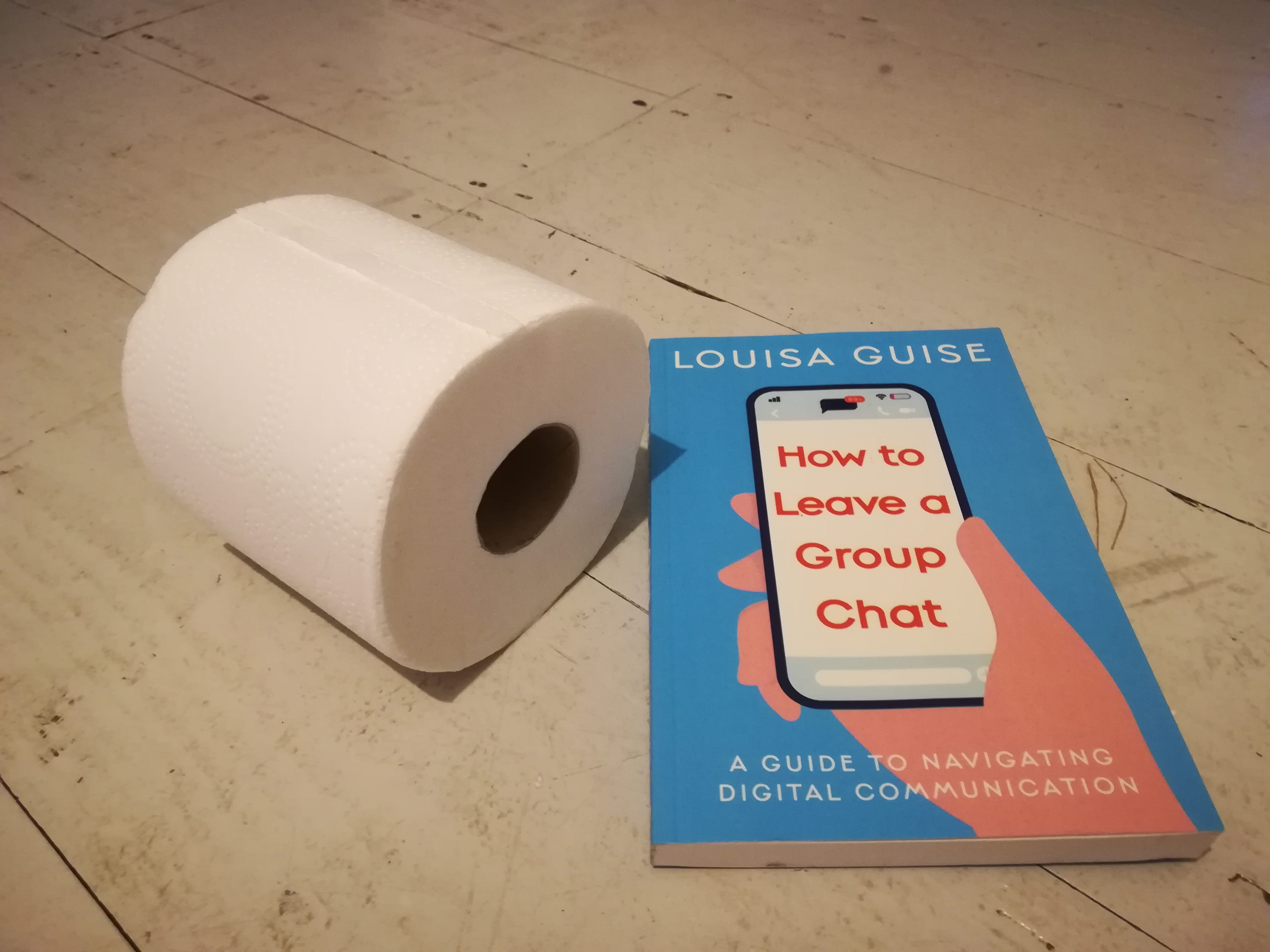
So last week I made the papers, and it wasn’t quite as I expected. Rewind to a couple of weeks ago, I went to Aldi. I like Aldi, the Special Buys keep life exciting. But amongst the solar powered light sets and dog toys, there was one item that caught my attention. The Easy Home 3-in-1 free-standing toilet seat holder.
What’s so amazing about a toilet seat holder you ask? Well, this one has a small tray on top, to hold your phone, to hold your phone whilst you are doing your business in the toilet.
I wrote a book about smartphone use called How to Leave a Group Chat, and we’ve entered a time where the world is finally calling time on screen time, so I was shocked that Aldi would sell an item that encourages phone use. I thought it was an oversight on their part, however I also found it amusing, and a bit of a gimmick. Long before smartphones existed you could buy other jokey bathroom products such as toilet golf and toilet basketball. My main point of interest was that it was relevant to my book, How to Leave a Group Chat, and the discussion around smartphone use. I took a photo. I posted said photo on social media.
My post didn’t actually say very much (maybe a picture really does say a thousand words), and I was also happy that on that particular visit there were a lot of small children shopping and none of them were being pacified with screens. So I said that. That’s relevant to my research too. I hoped it’d be a small talking point.
Then someone added me to social. Kennedy News and Media wanted to talk to me about the toilet roll holder. Brilliant! We had a little interview.
In my mind this was a light hearted interview about a gimmicky product at Aldi which encourages smartphone use, with a few more serious overtones that would be a way into discussing the wider issue of smartphone use – and my book, of course! I submitted some photos, some with my book, some without. It took over a week, so I began to think that no one would be interested.
Then my contact messaged to let me know that the article had been published. Great!
I’m not gonna lie, I was a bit jarred by the original title referring to me as an “anti-addiction author”. I don’t understand how anyone can be anti-addiction, because addiction is an illness. I did request one media outlet changed their title, and they obliged. It wasn’t that the news agency did anything wrong necessarily, but rather that my words were interpreted in a way that I hadn’t meant them to be. The interview also happened pretty instantly so there was no time for me to think about this and plan answers, and in my experience often if you don’t pounce, you miss the mouse. The focus of the final article was on my opinion of the toilet roll holder and didn’t lead to a discussion about smartphone use in a lot of detail. My book was named and I as the author, but it wasn’t quite the publicity that I wanted. The photos used were only of me too, and not the ones featuring my book - assuming they were sent on, it’s for each newspaper to decide which images to add to their articles. Newspapers have the power to rewrite the press release and make it their own – here’s a little secret, many don’t, or they make minimal changes.
At the same time, the agency interviewed me, wrote up the article and distributed it to outlets with minimal effort on my part, which is a good thing because I’ve worked my arse off chasing leads. And all because of a social post. I’m interested to see how this plays out, and if I get any sales from it.
How can you get picked up by the media?
Posting something interesting or different online is one way to get noticed and picked up by the media, and you might be lucky. But in most cases, you’ll be the one approaching them. Here are some things you can try.
Send your chosen media outlet a press release directly – I already wrote a blog detailing how to do this.
Search social media with the hashtag #journorequest – Twitter is a hotbed for this.
sourcebottle.com is a website that posts requests from all kinds of media outlets – everything from big papers and TV channels to bloggers and podcasts, so it’s worth having a look to see if any of the listings are relevant to you. Similar sites include qwoted.com and muckrack.com.
Monitor call-outs on media sites such as Google Alerts, Haro and Talkwalker (which after a quick Google might have changed to Lumen).
What can you do if a news piece about you or your business isn’t quite what you envisioned?
Request changes are made – you can contact the agency or the outlet where the story appears.
Pull the piece if it’s likely to do more harm than good.
Consider how you’d handle it differently next time.
If you’d like to feature on the All about Digital Marketing blog, please check out the guidelines blog and get in touch. Don’t forget to subscribe.
Louisa Guise is a Digital Marketing and Communications Professional and the author of How to Leave a Group Chat, a book about communication and smartphones and she’s a poet too. Subscribe to All About Digital Marketing for more gems like this.
Comments
Nothing yet. Say the first thing.
Sign in to join the conversation.