
A newsletter from the shed of
Now then,
Welcome back to the Losers' Club, thanks for dropping by. How are you doing?
I am somewhat flagging because I have broken my cardinal rule of never going out more than once a week.
On Tuesday I went to see Ru Paul's Drag Race UK with Zosia and Hazel, and then, on Friday night, I went to the latest Mek Summat Indie Disco with Beth, Helen and Hazel.
(this is Hazel's first mention in my newsletter, and I know, like so many of my mates, she just skims this to see if I am talking about her so... hello Hazel! I've put you right at the top so you can stop reading now ha....).
I had an excellent time on both nights but now because I am old I don't want to do anything more strenuous than put the kettle on and make a brew.
It may take me weeks to recover.
(Helen also tried to get me to go to the adult roller disco last night as well because she is a MACHINE who will never be broken but there was no way that could happen when I had so much laying down on the sofa to do).
Other than my drag and disco exploits, I have a couple of media type things to report. My essay on Audition, for Arrow Films, is now freely available online. Enjoy! (or if you don't want to think about Asami and her sack, maybe don't read after all).
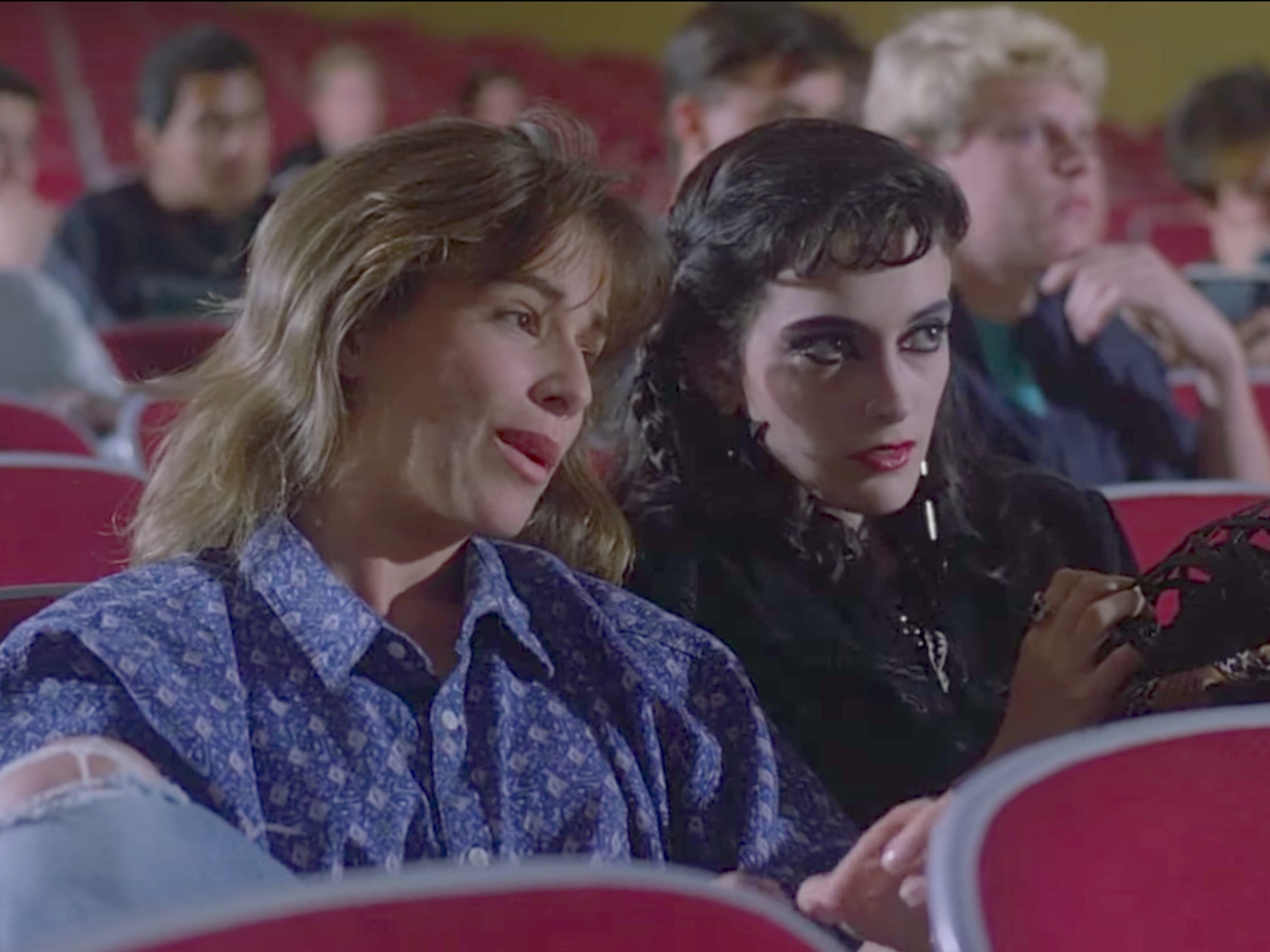
I guested on The Film Buds podcast again, this time for Women's History Month. I chose a double bill of women-made horrors from 1990 - Pale Blood (which I've chatted to you about before, here), directed by V.V. Dachin Hsu, and Mirror Mirror, directed by Marina Sargenti (pictured above, at the top of the newsletter).
I love talking about these kinds of films, that currently lurk on the edges of women's film history. Both are relatively low budget Indies - Pale Blood is straight-to-video while Mirror Mirror had a very limited theatrical release before going to video - and they are both clearly made during the period when financiers and distributors were attempting to capitalise on the home distribution market. But they are both a lot of fun, and Mirror Mirror is particularly strong on teen female friendship, which I enjoy very much.
On Friday, I did a keynote for the Boris Karloff: The Many Faces of a Film Icon, where I talked about one of my favourite films ever, The Mummy (1932). My first book, After Dracula: the 1930s Horror Film, published nearly a decade ago now, went into some serious depth on this film and it was really pleasurable to go back and revisit it and become re-acquainted with this material - it felt like coming home.
Many thanks to Eddie Falvey, the organiser, just in case he is reading this!
Although, I don't know how much he might have regretted inviting me.
I was the first speaker of the symposium, which was online, and Zoom just wouldn't give any sound for my film clips, which I eventually worked around, then I rubbished Powerpoint and said I wouldn't use it and it was boring which upset lots of people who were presenting later with powerpoint, and then I said Lugosi was a crap actor which added fuel to the audience flame, and then the postman came to my shed door and delivered my eldest daughter's new trainers right in the middle of the presentation.
I told Paul, later, and he said it sounded like the start of The Eric Andre Show which is about right.
That kind of tickled me, tbh.
I might add the start of The Eric Andre Show to my list of "cultural things that inspire me on how to behave in my academic career", a list which also includes:
the total don't-give-a-fuck vibes of British artist Maggie Hambling
Mike Patton performing Out of Nowhere on Top of the Pops when he's giving I know my job is ridiculous but lets roll with it
and finally, that moment, at 2 mins precisely, when Siobhan Fahey steps out into the light in the Shakespears Sister Stay video and is clearly having the time of her life.
***
The main work thing that has been occupying me over the past week or so, is this special issue of MAI: Feminism & Visual Culture. For new members of The Losers' Club, I'm editing a special issue of this journal entitled Doing Women's (Global) (Horror) Film History, which is intended to explore the work of women filmmakers working in horror from around the globe - not just the usual North American and Anglophone directors we see discussed time and time again in popular culture.
I am now in the final stages of whittling down my contributors from the huge response I've had. The sheer number of submissions has blown my mind, and even though I am now planning to triple the number of contributors I had originally envisaged (triple!) I could still fill the issue many times over.
I'm sure I'll want to talk more about my final choices next time we chat, but for now, I wanted to linger on something else that I've discovered while reading through all the submissions.
I'm fascinated by who the main filmmakers of interest are, in the outside world, beyond my little shed, and which films have the most penetrated the popular consciousness when it comes to women-made horror.
Jennifer's Body remains the winner, of course, with A Girl Walks Home Alone at Night not far behind.
This, I expected.
But, beyond that, I've also been pleasantly surprised by the other filmmakers that I've had a ton of proposals on:
Nong Hak / Dearest Sister (2016, Laos) directed by Mattie Do (streaming on Shudder);
Atlantique / Atlantics (2019, France / Senegal), co-written and directed by Mati Diop (Netflix)
BeDevil (1993, Australia), written and directed by Tracey Moffatt (Vimeo)
Vuelven / Tigers are Not Afraid (2017, Mexico) written and directed by Issa López (Shudder)
Bulbbul (2020, India), written and directed by Anvita Dutt (Netflix).
I didn't get much on BeDevil or Atlantique to start with, but they all flooded in at the end.
Then, a film I hadn't heard of before, that I got tons of interest in, was Marlina the Murderer in Four Acts (Amazon Prime), an Indonesian rape revenge film from 2017, directed by Mouly Surya.
It looks brilliant and all the proposals on this film have also been brilliant. I have no idea how I am going to pick one person to cover this film.
I am also fascinated that the majority of the films that are most popular for proposals are ones that are available to watch on major streaming platforms.
I mean, of course, that's obvious - for people to watch, and for word of mouth to happen, there needs to be access - but it raises more intriguing questions for me:
What happens to all the films that don't get picked up for major platforms?
How do we get those into the mix, into the discourse, of women and horror?
On it's most basic level, how do we get legal access to these films?
What decisions are made, and when, about what goes on which streaming provider, and in which territory?
Also, who choose which films, and how are decisions made, for a physical, home release?
For example, I really wanted a submission on the Thai horror Arpat (2015), written and directed by Kanittha Kwanyu. But the only place to find it is on Netflix Thailand and my.... usual ways of dealing with geoblocking don't seem to work. And if I am having trouble accessing it, I'm sure other people are. This makes Arpat a more difficult proposition to write about, if you don't live in Thailand, never mind create a video essay on - which is what my contributors are going to do.
These issues of access, selection, circulation and ensuing canonisation are something I really want to explore further in my next book, Her Chainsaw Heart, and it is going to take a lot of talking to people, a lot of interviewing, I think.
Anyway, I want to say a big thank you to everyone reading this who pitched to me, and / or submitted a proposal for MAI. It's been an exhilarating process and has - genuinely - made me totally rethink what I want to do with the rest of my AHRC fellowship.
And for everyone else just interested in horror - putting the call out for this special issue has opened up a world of new women horror filmmakers for me, and I can't wait to share them all with you. There is so much more to come on this!
***
What have you been watching and listening to? Owt or nowt?
My women-made horror film viewing has been shameful. I rewatched Mirror Mirror for the podcast, and that's it!
You need to imagine me hanging my head in shame here.
I have been watching other stuff, with Paul - we are comfort-rewatching Coen Brothers films, and have done The Big Lebowski, True Grit, Barton Fink etc, but I don't imagine you are super interested in that.
The horror I have been consuming, has, for once, come from telly.
I'm rewatching Stranger Things from the beginning, with my eldest, in anticipation of season four dropping in May; and at the same time, I'm working my way through Archive 81 (both Netflix). I'm enjoying both, but it is also super interesting, from a geeky analytical / writer perspective, watching them together.
I loved the Archive 81 podcast, and listened to it when it came out, a sufficiently long time ago that I remember the premise but not really any of the plot - probably an ideal scenario for going into the tv adaptation.
I really enjoy all the analogue media in the tv series (in another life I did my Masters at The Selznick Graduate Program in Film and Media Preservation and became a film archivist), and the smart ways that the multiple nonlinear storylines are intersecting, but, if I'm honest, I don't feel the series has the emotional connection I need.
In Stranger Things, when Steve Harrington finally gets his shit together in series one episode eight and takes on the monster; when Dustin sorts all his friends out again, for the umpteenth time, when El faces down the beast against the blackboard, I feel for them, so hard.
And I defy anyone not to cry multiple times in the final episode of season one.
But there's no emotional attachment in Archive 81. I enjoy it, but it is with a curiosity once removed. Like a specimen, under a microscope, a new spool of tape wound into a cassette - hmmm, what will happen? how will the story turn out? What will become of Dan and Melody?
But it's a clinical question, not a feeling.
It doesn't really have the heart that I desire.
***
To the reading (and listening) recs! Last time I asked if you were interested in a guide to horror film books - what came out when, what's good, where to start, and it turns out you are, but I *promise* I will start that next newsletter.
Before then, I want to share a few other recs with you.
We all now know about my love of Shedunnit podcast, but I have two new ones to add to my recs. First, is the 1990s-set (can you see a theme here hmmm at what point do I admit I have never progressed beyond 1997) YA mystery series Maxine Miles from Atypical Artists. Maxine Miles is created and written by Laura Shippen, who created the brilliant The Bright Sessions, a SF podcast following therapy sessions for people with supernatural abilities (also great).
Second, if you haven't already listened to Rabbits, you need to get onto it, right now. It's not straight horror, more horror adjacent, kind of Ready Player One with a deeply paranoid Lovecraft vibe, but I love it. I am long-term serious fangirl of everything produced by Terry Miles and the Public Radio Alliance. It started with The Black Tapes in 2015, which is a kind of Serial for horror VHS tapes (yes of course you are in at this point) and I have devoured everything since.
Two fiction books you might like too. First, I have just started The Kaiju Preservation Society by John Scalzi, which is very funny, smart, fast paced, and promises to be packed with GIANT MONSTERS so what more do you need?
I also just finished reading The Shadow Glass by Josh Winning, which has been getting a ton of media noise around its homage to 1980s fantasy horror films.
Here's the synopsis which I am reposting in full as every sentence has something in that flags YES PLEASE for me and so I think it might for you:
Jack Corman is failing at life. Jobless, jaded and on the “wrong” side of thirty, he’s facing the threat of eviction from his London flat while reeling from the sudden death of his father, one-time film director Bob Corman. Back in the eighties, Bob poured his heart and soul into the creation of his 1986 puppet fantasy The Shadow Glass, a film Jack loved as a child, idolising its fox-like hero Dune. But The Shadow Glass flopped on release, deemed too scary for kids and too weird for adults, and Bob became a laughing stock, losing himself to booze and self-pity. Now, the film represents everything Jack hated about his father, and he lives with the fear that he’ll end up a failure just like him. In the wake of Bob’s death, Jack returns to his decaying home, a place creaking with movie memorabilia and painful memories. Then, during a freak thunderstorm, the puppets in the attic start talking. Tipped into a desperate real-world quest to save London from the more nefarious of his father’s creations, Jack teams up with excitable fanboy Toby and spiky studio executive Amelia to navigate the labyrinth of his father’s legacy while conjuring the hero within––and igniting a Shadow Glass resurgence that could, finally, do his father proud.
The book opens with a quote from Labyrinth so I feel like it is written for me.
1980s kids fantasy films were 100% my gateway for horror films. In podcasts, I'm often asked about my earliest horror memory and it is, without a doubt, sat on the sofa one Saturday afternoon, watching Legend with my mum while she did the ironing (a suitably rare occurrence as this is my dad's domain), and seeing Tim Curry rise up, iridescent red, as the Lord of Darkness, and being absolutely totally terrified out of my wits.
And then, wanting MORE.
***
Right, that's all from me for today. I'm not going to finish by telling you what horror film I plan to watch next as that seems to be a curse which means I never then watch it.
Instead, I'll signal a couple of new women-made horror films that have made their way onto VOD that you might want to have a look at:
A Banquet (2021), directed by Ruth Paxton, UK, streaming on Curzon Home Cinema
The Long Walk (2019), directed by Mattie Do, Laos, streaming on Amazon Prime UK
You Are Not My Mother (2021), written and directed by Kate Dolan, Ireland, streaming on Amazon Prime USA
I hope this newsletter gives you a few ideas what to watch next.
And, as ever, if you want to say hi, just reply to this email and let me know a bit about yourself. I'd love to know, where do you live, what do you do, what are you into? Or, are there any excellent films, books, podcasts that you've devoured recently that you think I might enjoy?
I really do love hearing from everyone, and I do always write back, albeit very belatedly.
Also, feel free to forward this newsletter onto anyone you think might be up for joining us in The Losers' Club. And, if you've been forwarded this missive by a friend (who, let's face it, clearly has excellent taste), you can sign up y'sen and view past issues here.
Take care and speak soon, my lovely horror family.
Chin up,
Alison
The Losers' Club is a newsletter by Alison Peirse, associate professor of film and
author / editor of Women Make Horror; After Dracula and Korean Horror Cinema.
No posts
Comments
Nothing yet. Say the first thing.
Sign in to join the conversation.