
Thanks for reading gotham girl! This is a free post, so please share it on social media; just be sure to include a link. Sincerest thanks to every single paid subscriber. You are keeping the lights on around here, and I can’t thank you enough for it.

I believe it was Lenin who said, “There are decades where nothing happens, and there are weeks where decades happen.” This has been one of those weeks.
It has been nothing short of gut-wrenching. In Minneapolis, a beloved ICU nurse was killed by federal agents during an enforcement operation, sparking widespread outrage and protests from a city already reeling after the homicide of Renee Good by an ICE agent earlier this month.
They shot him ten times. And it was filmed. He held up an iPhone and an empty hand, and they threw him to the ground and emptied a gun into him. His poor parents.
The deaths of these two U.S. citizens—and the randomness with which these states of force are deployed—have highlighted a harsh reality: state terror is often effective precisely because it is unpredictable. It erodes our sense of security, our agency, and our faith that the world operates on any kind of human logic at all.
Cultural Critic Masha Gessen and others have written about how state terror works to undermine our agency, not as a dramatic spectacle, but as ordinary randomness dressed up as authority. In a moment like this, when the images we bear witness to shake the very ground under our feet, it’s tempting to feel reflexively small. And that’s precisely the psychological point of such state terror: to make the individual feel powerless, chaotic, and detached.
Comedy, strangely enough, pushes back against that.
Comedy teaches rhythm and pattern. Even in the darkest material, laughter is a response to recognition, to connection, to shared understanding. It is an assertion of agency. When you recognize the punchline —as absurd or tragic as the setup—you are engaging your mind, your body, your nervous system.
You are not a passive receiver of chaos; you are an active interpreter of the world.
This was something Mary Tyler Moore embodied exquisitely—not by telling jokes, necessarily, but by modeling a way of being in the world that trusted in one’s self and in others. Mary Richards didn’t rush her moments. She didn’t overexplain her emotions. Her pauses, her small expressions, her willingness to feel before she reacted—those were acts of agency. Each moment of timing—each comic beat—was a tiny resistance to the hysteria outside of the scene. And that’s why The Mary Tyler Moore Show still feels human, not because it’s silly, but because it trusts emotion and connection without condescension.
Laughter and comedy don’t erase tragedy, and they certainly don’t diminish the real grief and anger over the death of Pretti, the ruling of Good’s death as a homicide by the medical examiner, and the intensifying protests in Minneapolis. But there’s an aspect here that allows us to remain participants in our own lives and stories, rather than spectators to randomness and fear.
Comedy helps reclaim agency because it requires presence. To laugh, you have to be there, consciously. You have to recognize pattern, then surprise. That’s not passive.
That’s a kind of resistance to chaos. It’s saying: “I see you. I see this moment. I will interpret it. I will respond.”
Mary Tyler Moore would have understood this.
She would have looked at the madness around her—the noise, the uncertainty, the pain—and found the beat. Not to make light of it, but to insist that even in the face of randomness, we are still capable of meaning, connection, and a well-timed response.
When I was detained in China, this lesson arrived… practically gift-wrapped.
One of my guards was a young woman—twenty-five, maybe twenty-six—very stern, very efficient, and barking her questions at me like a terrier with a clipboard. Didn’t I know I had broken all the laws of the universe by being in Shanghai? That my papers were not the correct papers. That United never should have let me board the plane in the first place?
For context: I had just traveled forty hours from the boonies of Northern California to meet clients and manufacturing partners. I was loopy with exhaustion, cotton-mouthed, stomach doing summer somersaults on empty, muscles locked into a defensive crouch from pretzeling myself into row 70 of economy. My anti-seizure meds were gone with my luggage. My phone was gone. Things were… trending poorly.
A week earlier, I’d been talking with a full-blown Hollywood jerkwad about a hypothetical Mary Tyler Moore biopic—how I might actually be the right person for the job, having known Ed, Valerie, and Cloris and having been steeped in Mary’s voice since childhood. And now here I was, sitting on a hard floor in detention, trying very hard not to fall apart or seize in front of international authorities, when the thought bubbled up:
What would Mary Tyler Moore do right now?
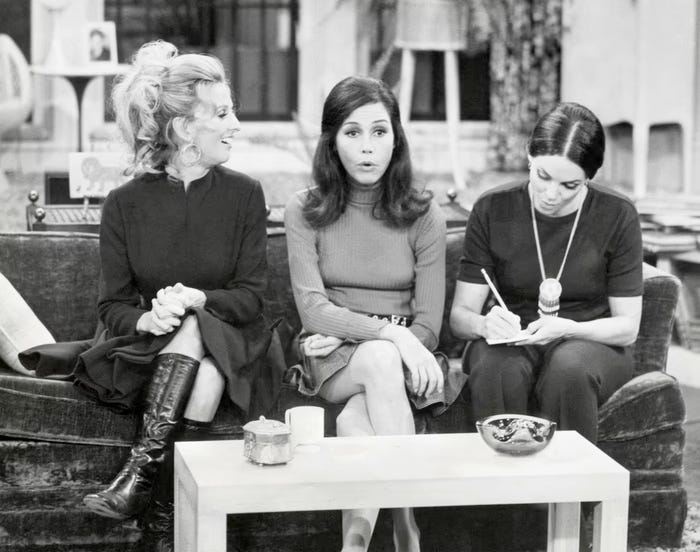
Would she dissolve into hysterical, unstoppable laughter à la Chuckles Bites the Dust?
Or would she ask a slightly off-topic question that gently—but decisively—changed the temperature in the room?
So I looked at my guard and said, very calmly, channeling my best Mary:
“You know… You have the most amazing skin. It’s like… alabaster.”
She freezes. Narrows her eyes.
“Alabaster? What is it?”
“Oh—uh—it’s a soft, fine-grained, translucent stone—”
“So,” she says, frowning, “my skin is rock.”
“Oh NO,” I say quickly. “The BEST rock EVER. A glowing, expensive rock. Like… Egyptian?”And then—this part was not planned—I start cracking up.
“I mean—do you use a serum?”
She stares at me for one terrifying second. Fuck, fuck, fuck… fuuuuuuuck.
And then she starts laughing.
I shut up immediately. Timing. Moral issue.
Through her laughter, she says, “Serum. You Americans…” shaking her head.
“I use all Korean.”
She sighs, asks if I’d like some water, and just like that—just like that—we are no longer enemies in a fluorescent-lit standoff. We are two women, briefly allied by absurdity. That was the beginning of things getting fixed. I was, eventually, undetained.
Comedy doesn’t make bad things good. But it keeps us alive long enough to fight the randomness that tries to define our world.
And in that sense, timing isn’t just a comedic device.
It’s a moral stance.
WEEK TWO: TIMING IS A MORAL ISSUE
Or: When to Shut Up Is the Joke
One of the great lies about comedy is that it’s about speed. I’m guilty of buying this one. I’ve always said… If it’s fast, it’s funny.
Being quick. Being sharp. Being the first one to get the joke out before someone else does.
It’s not.
I was wrong about this.
(as I am with so many things in life)
Comedy is about rhythm.
About timing.
About knowing when to speak—and, just as importantly, when to stop.
Which is inconvenient, because most of us were raised to believe that if something isn’t landing, the solution is to explain it again, slightly louder, with more words and maybe a clarifying metaphor. This is how jokes die. This is also how meetings last ninety minutes.
Carol Burnett understood the beat better than almost anyone. She could say a line, pause, widen her eyes, let the audience catch up—and then do absolutely nothing. That nothing was the laugh. The pause wasn’t empty; it was loaded. The audience did the work and loved her for trusting them.
This reel, even though it’s bloopers, shows some of this work at its best.
Most people rush the beat because silence feels like danger. Silence feels like bombing. Silence feels like your nervous system whispering, We’re losing them. But silence is not the enemy. Silence is where the laugh lives.
Bob Newhart built an entire career on this principle.
His one-sided phone conversations are master classes in restraint. He stammers, hesitates, pauses, lets the imaginary person on the other end “speak,” and responds with mild, polite disbelief. The joke is never what he says. The joke is what he doesn’t. He perfected the art of letting the audience fill in the blanks—and those blanks are always funnier than anything you could spell out.
Newhart’s genius was moral, too. He never overreached. He never begged for the laugh. He trusted the audience to be smart enough to keep up, and that trust became the comedy.
Nora Ephron knew this in prose. Her last lines were not explanations; they were exits. She understood that the final sentence is a weapon. Explaining a joke is an act of violence. It’s dragging the body back onstage and saying, No, wait, you didn’t appreciate this enough.
The best last lines feel slightly unsafe. Like you’re leaving the party without saying goodbye. Like someone might text you later and ask, Were you aware you just walked out?
Yes. Yes, I was.
And then there’s Mary Tyler Moore—who taught us that timing isn’t just about jokes. It’s about emotional pacing.
Mary Richards wasn’t funny because she was loud or fast. She was funny because she paused. Because she took in the room. Because she let reactions play across her face before responding. Her raised eyebrow, her delayed smile, her perfectly calibrated exasperation—those were beats. Her timing told us who she was before she ever explained herself.
That iconic hat toss worked because it came after the struggle, not during it. Joy arrived on time.
This is why timing is a moral issue. It’s about restraint. It’s about dignity—yours and the audience’s. It’s about trusting that the reader, the listener, the viewer can handle the silence without you rushing in to rescue them.
Sometimes the funniest thing is not being funny.
Sometimes emotional regulation is the punchline.
A small assignment, if you’re feeling brave:
Take something you’ve written lately. Delete the last sentence.
Read it again.
If it’s funnier, congratulations—you’ve learned timing.
If it’s terrifying, congratulations—you’re learning restraint.
Come for the laughs.
Stay for the craft.
Next week: CHARACTER IS DESTINY (AND COMEDY)
Or: Funny People Aren’t Funny—They’re Consistent
Over in the Empress universe, we’re deep in our pre–London Book Fair shuffle while simultaneously migrating to new global infrastructure—one of those necessary-but-humbling exercises that reminds you just how many miracles have to line up for a book to exist in the whole world. We’re moving toward true in-country production—Australia, India, the UK—which is thrilling, complicated, and entirely dependent on collaboration, microscopic attention to detail, and a saintly amount of patience. If our sales and IT teams are reading this:
We see you, we adore you, and we absolutely owe you gifts for our recent bout of transition-induced crankiness. Possibly edible ones.
In the midst of all this, I had the great joy of being a guest on ’ podcast alongside and —an appearance that will forever be remembered for two things: a genuinely wonderful, wide-ranging conversation…and the fact that I showed up completely unshowered because our plumbing had gone rogue. There’s nothing quite like discussing art, ambition, and lived life while quietly hoping no one can smell the infrastructure collapse at home. Very on-brand for this season.
Meg is a dream—thoughtful, generous, incisive—and her forthcoming novel See Dot Smile (out September 15th) is exactly as bold, sharp, and emotionally alive as its cover-in-progress promises. (Truly: the cover alone deserves its own round of applause.) I’m so grateful to have crossed paths with her in this slightly feral, deeply human way that seems to define so much of creative life lately. Preorders coming soon!

All of which is to say: books are being made, systems are being rebuilt, conversations are happening, and even when things feel messy, they’re moving forward. Sometimes with grace. Sometimes with dry shampoo. Always with much heart.
I think we need a song and a recipe to carry us out:
I self-reg by cooking, so here’s some Lasagna Soup (gift link) with shrooms and sage?

Stay safe, stay warm, and strike - xoxo,
Gotham Girl 🖤
PS - I am a human typo. Amnesty appreciated.
Comments
Nothing yet. Say the first thing.
Sign in to join the conversation.