
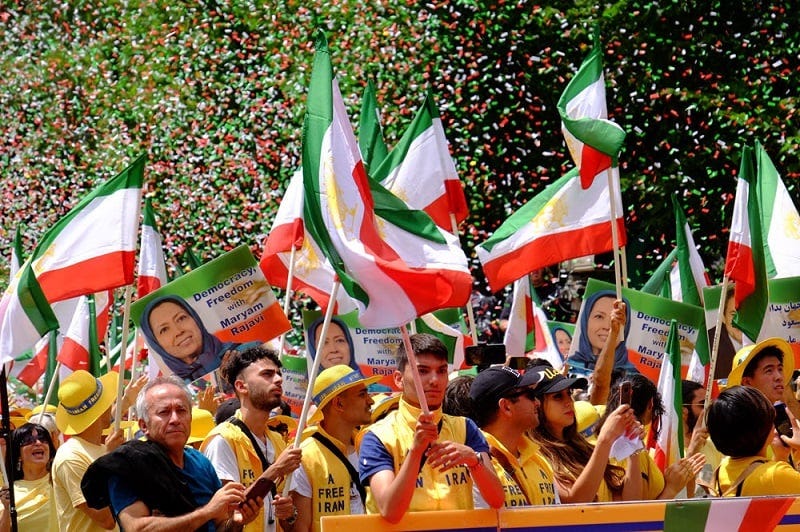
Is Michael Rubin auditioning to be Iran’s unofficial envoy in Washington? Or just recycling the same tired script for the mullahs? Whenever Iran’s theocracy feels the ground shake, like the ongoing 15-day nationwide uprising, Rubin swoops in like a loyal sidekick to engage in a pathetic attempt aimed at discrediting the Mujahedin-e Khalq (PMOI/MEK), Iran’s most organized democratic opposition. Tehran reaches for the noose; Rubin reaches for his keyboard.
How convenient. His latest gem? Urging a “re-designation” of the MEK as terrorists—right on cue with the regime’s most savage crackdown in years: sham in absentia trials since 2023, mass death sentences, and public hangings to terrorize supporters. In July 2025, Behrouz Ehsani (69) and Mehdi Hassani (48) were secretly executed for the crime of MEK sympathy. Eighteen more await the gallows. If the MEK were truly “irrelevant,” why does the regime keep decorating its prisons with their supporters’ corpses? Ah, yes—because nothing says “no backing among Iranians” like a fresh execution spree.
Rubin would love you to ignore the legal graveyard of his position. U.S. and European courts systematically dismantled the MEK’s old terrorist labels years ago: The UK’s Proscribed Organizations Appeals Commission and subsequently the Court of Appeals for England and Wales called its own proscription “perverse“ and struck it down in 2007–2008; Courts in the European Union unanimously rule to annual the asset freeze in 2008 for lack of evidence; France dropped charges in 2011, affirming the right to resist tyranny. In 2012, the D.C. Circuit Court (the nation’s second-highest) issued a rare writ of mandamus—the first against a Secretary of State since 1803, forcing Hillary Clinton to delist the MEK after a unanimous ruling and a ticking deadline.
These aren’t suggestions—they’re decisive and unanimous rulings that exposed the original designations as political favors to Tehran, not evidence-based decisions. Rubin pretends none of this happened.
Selective memory must be exhausting. Rubin has been at this since 1997, shortly after his cozy visits to Tehran and privileged access to regime archives “revealed” that Iranians supposedly “despise” the MEK—a claim somehow immune to polls, protests, or court verdicts. Three decades of being ignored by policymakers haven’t dimmed his enthusiasm. He just keeps waving the tattered flag of a long-demolished terrorist label, as if nostalgia could resurrect credibility. When facts, judges, and due process all say “no,” but you keep yelling “yes”—that’s not analysis; that’s a vendetta in academic drag.
His favorite line? “Most Iranians despise the MEK.” Based on... what? No independent surveys, no data—just the regime’s propaganda, where MEK sympathy can get you hanged. In Iran, silence isn’t consent; it’s survival. Yet Rubin treats terror as public opinion polling. Brilliant methodology. Worse, he frames the regime’s repression as “counterterrorism.”
Re-designating the MEK would echo Tehran’s script: validate sham trials, applaud executions, and let Washington do the mullahs’ PR work abroad. At the regime’s weakest moment in decades, with people in the streets, Rubin suggests siding with the executioners over the opposition. How very “pro-democracy” of him.
The original U.S., UK, and EU listings? Never about evidence—pure appeasement. U.S. officials admitted the 1997 FTO tag was a “goodwill gesture to the newly elect moderate president Mohammad Khatami.” British and EU moves bowed to the same pressure. Rubin now pushes the identical logic: let Tehran dictate U.S. policy. For American policymakers, this isn’t harmless punditry—it’s dangerous. A former Iraq War cheerleader now urges suppressing Iran’s main opposition, mirroring the regime’s playbook. Washington tried appeasing Tehran before; the mullahs only got bolder, more violent, and more convinced US pressure is optional. Rubin isn’t just wrong—he’s pushing Tehran’s line on American soil, dressed up as expertise. Whose agenda is he really serving? The gallows in Iran seem to approve.
Ah, yes—Michael Rubin’s favorite zombie claim: the MEK supposedly targeted U.S. military officers and Pentagon contractors in Tehran half a century ago. Because nothing screams “credible analyst” like dusting off allegations from when Rubin himself was still in diapers (he was all of one year old in 1972, still sucking on a binky and sitting in a playpen.) Let’s get the timeline straight, shall we? By May 1972, the Shah’s notorious SAVAK had already executed or imprisoned virtually the entire MEK leadership and 90 percent of its cadres. Massoud Rajavi, the sole survivor among top figures, had his death sentence commuted to life imprisonment following a major international campaign by his elder brother, Prof. Kazem Rajavi in Switzerland, and appeals by the renowned French philosopher Jean-Paul Satre, François Mitterrand, and Amnesty International among others. The first high-profile U.S. officer assassination—Lt. Col. Lewis Lee Hawkins on June 2, 1973—came after this brutal crackdown, when the organized MEK was effectively decapitated. Even the U.S. State Department has acknowledged the complexities in its reports, including the Country Reports on Terrorism in 2005. Yet those same reports, along with credible analyses (from think tanks like the Council on Foreign Relations and historical accounts) distinguish between the core MEK (under imprisoned leaders like Rajavi) and radical Marxist splinter factions, such as Peykar, which carried out violent acts, including targeting Americans, during that chaotic period. Notably, those same killers also murdered senior MEK members who opposed their methods. Rubin, bless his selective memory, keeps recycling these oft-debunked talking points like a broken record—Johnny One-Note with a grudge. Facts? Those pesky things he has no interest in. The assassinations were carried out by fringe elements in a time of internal fracture and regime repression, not the leadership-directed MEK that exists today. But why let history, timelines, or the State Department’s own nuanced record (and eventual delisting after judicial pressure) get in the way of a good smear? In short: Rubin wasn’t there in 1973 (literally), and his narrative hasn’t aged any better than those recycled allegations. When the regime’s propaganda and a pundit’s vendetta align so perfectly, you have to wonder who’s really reading from the same script.
Safavi (@amsafavi) is a member of the Foreign Affairs Committee of the Paris-based National Council of Resistance of Iran (NCRI).
No posts
Comments
Nothing yet. Say the first thing.
Sign in to join the conversation.