
If you see a pattern of behaviour occurring in one context and you recognise it from seeing it another context, it’s not paranoid or conspiracy-minded to assume that a similar motivation or dynamic might be driving the behaviour in both contexts. In a sense, the process of pattern recognition to inform future actions is the basis of all cognitive growth; animals that fail to recognise patterns end up prey to predators that have evolved to take advantage of that failure.

As adult human beings we should have the ability to recognise patterns we see in our real lives, but there is an entire industry (informally called ‘the media’) dedicated to cleverly convincing us not to trust our innate ability to recognise recurring patterns, but instead to allow that industry to interpret them for us in each discrete context. This can lead us to hate or fear other people based on aspects of their identity like race or religion or political beliefs, but it can also be used to make us second-guess and deny our instinctive aversion to behaviour that actually is threatening or hostile.
The following are some patterns that I’ve noticed and you may have too, because they’re alarmingly common. They frequently include behaviour that could be classified as:
‘Splitting’ or binary thinking - the psychological process of seeing two opposing sides in a debate as being entirely Good or Bad, and completely mutually exclusive. Got criticisms of Joe Biden? You love Trump and helped get him elected! See problems with the idea that people literally are whatever gender they say they are? You hate LGBT people and want them all dead! Notice that our democratic system always results in big money getting its way, no matter who wins? You're a Communist! Or a Fascist! Depending who's talking!
‘Straw-man’ arguments - the tactic of misrepresenting something someone said and arguing against that misrepresentation. Goes hand in hand with Splitting. So common as to be practically the default mode of discourse for western liberals to discuss certain topics.
DARVO (Deny, Accuse, Reverse Victim and Offender) - a favourite tactic of the gaslighting narcissist and the Cluster B personality-disordered, to project their own antagonistic behaviour onto others.
This is something I’ve encountered a lot over the last three years, since I started to interrogate my own opinions more thoroughly and share what I was discovering from alternative sources, which almost always ran counter to prevailing mainstream media narratives. The media’s One Simple Trick™ is to always speak with absolute confidence and to assume the other party’s acquiescence and trust - it’s the deceptively simple method that snake oil salesmen, con artists and Lotharios have been using since time immemorial to make you feel smart for believing them and doing what they want you to do, by convincing you it’s actually what you want to do. No one wants to admit they got tricked by a huckster, so once a mark has committed to the line they’ve been sold, they’ll angrily defend their position even if they don’t quite know why they’re doing it. As the saying goes, it’s easier to fool a person than it is to convince them that they’ve been fooled - and it’s easier still if all the media they consume continues to tell them that they weren’t fooled at all, and that those telling them they were fooled are actually devious foreign actors.
In early 2022, shortly before Russia launched their Special Military Operation in Ukraine, I started to look more deeply into the Ukraine conflict and I began to understand the depth of deception and misinformation that had been undertaken by western media, going back to at least 2013. When I took to Facebook in April 2022 to try and show my friends how the media was lying about events in Ukraine to cover up the actions of murderous fascists and mercenaries fighting for Ukraine (but really on behalf of the NATO-led empire that gives them their orders), I took pains to show what I was talking about, including lots of video testimony from people who had been evacuated from Mariupol and elsewhere in the DPR and LPR. These people all had horror stories of what the SBU (Security Service of Ukraine) and nationalist thugs like Azov had been doing, not just since Russia intervened in February 2022, but since the coup in 2014 that had empowered those thugs.
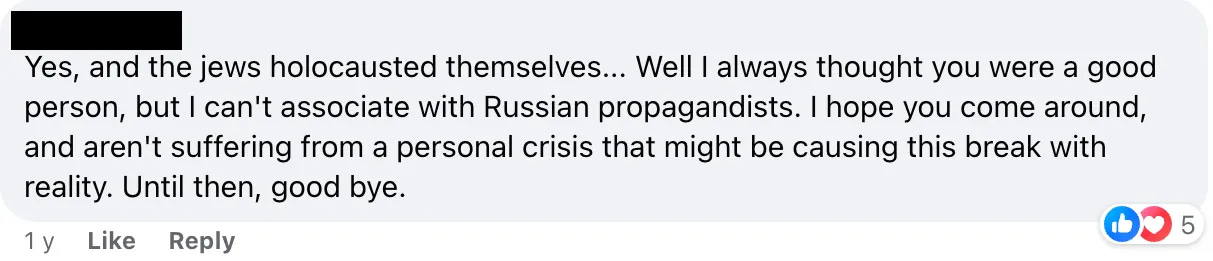
I got a lot of angry reactions to that post from real people who had hitherto been my friends, including one Jewish American whom I’ll call ‘Jon’ (because it’s his name) who nonsensically equated my dissent to Holocaust revisionism and called me a bad person, which others agreed with and which I’ll repeat here because it still boggles my mind that someone actually wrote this:
Despite lots of withering concern-trolling like that, none of my detractors addressed any of the specific evidence I had presented, besides linking to poorly-written hit pieces about the authors of some of the content I shared. Some of those hit pieces have since been removed (like the one on Patrick Lancaster), and one of them may even have contributed to getting its subject killed (RIP Gonzalo Lira). Everything I had presented was preemptively dismissed as Russian propaganda because it went against the narrative (an example of the aforementioned ‘splitting’), and in response to it many people shared either news stories repeating the prevailing narratives but with no first-hand testimonies like those I’d shared, or suspiciously convenient social media content like the Radio Free Europe video1 below, allegedly showing a man and his father coming under ‘Russian attack’:
The former friend who posted that RFE video - I’ll call him Screech because he’s annoying and American - also took it upon himself to react positively to every single comment critical of my post, and to contact me directly to send me yet more inane news stories that did little but malign the Russian state. When I replied to him as patiently as I could about how the Ukrainian nationalists had been terrorising Donbass for 8 years, had ignored the Minsk Accords, and were proud of their historical connection to the OUN and Nazi Germany, his response was “you’re wrong”. Just ‘wrong’, with no further explanation but plenty more withering condescension, as well as calling me arrogant, which I found strange at the time.
The implication was that yes, of course Screech knew the Ukrainian Nazis are a real thing, but they didn’t justify Russia’s - all together now! - brutal, unprovoked, full-scale invasion (which mainstream media is slowly starting to admit was provoked). Since Nazis are the midwit liberal’s favourite go-to supervillains from history, it’s hard to imagine what would constitute a justification for an invasion if not to stop neo-Nazis killing and raping people, but you can’t expect that kind of consistency from those still in thrall to empire propaganda when that propaganda has been calling Putin Hitler and Russia the Nazis; the ubiquitous messaging takes precedence over inconvenient facts. The real implication was simply that I was fundamentally Wrong and Bad for questioning the prevailing narrative; a genuine ad hominem attack, which is to say an attack on one’s character. How else do you explain someone disagreeing with you when they can’t say what they disagree about?
It’s not just me that’s noticed when this happens to them, either. A friend who has also spoken out on Facebook about things like NATO’s role in Ukraine, shared with me this reaction he received (one of many) to talking about how NATO was not a defensive organisation, but in fact has always existed to antagonise Russia, terrorise the populations of its member states and undermine any genuine socialist movements:
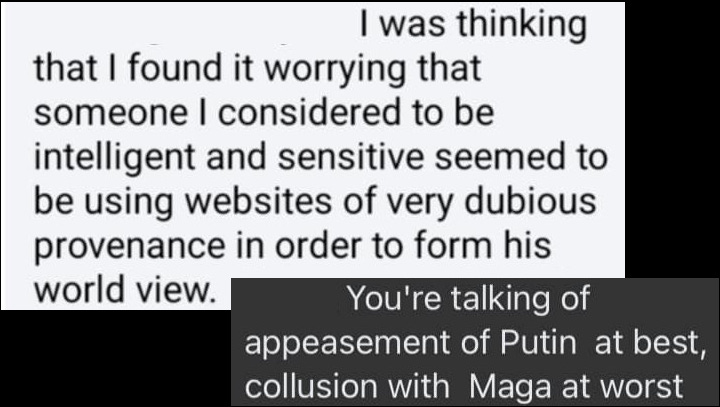
It’s just dripping with condescension and plaintive disapproval and disappointment - “someone I considered intelligent and sensitive” - but again not specifying why, beyond vague accusations of “appeasement” of Putin (and it’s no accident that the Nazi-associated word ‘appeasement’ is getting thrown around now that Trump has been talking about ending the Ukraine conflict). He didn’t say which “websites of very dubious provenance” he meant, but safe to assume he meant non-mainstream news sites. It costs money to design websites and keep them hosted, hence why mainstream news sites can look flashy and expensive (and presumably not dubious), but sites made by ordinary people who want to talk in an uncensored forum about what is happening tend to look much more rudimentary, because they don’t have wealthy backers and advertisers won’t touch them. It’s remarkable how many people who consider themselves open-minded or even part of the laughable ‘Resistance’ actually value aesthetics over content, and fail to recognise when censorship is having its intended effect.
To return to my experience with Screech, it was infuriating and demoralising but this person wasn’t a close friend, and this was just on Facebook. At the end of 2023 I had a similar experience but in real life and with someone I’ve known for 25 years, which affected me much more and which I wrote about the day after while the experience was still raw, such was my state of agitation. It still bothers me, as you might imagine.
I was in a pub in Brighton, where my friend and his wife live, and he told me that he had read my blog (i.e. this blog) and disagreed with some of it. Thanks for reading it, I said, What do you disagree with? Asking him what he disagreed with was the trigger for him and his wife (who hadn’t read it) to start repeating slogans and thought-terminating clichés at me, starting with “Putin’s a dictator! He’s been in power for 25 years!”. Well, he hasn’t been President all that time, and they have elections2 in Russia, but even if he could in some sense be called a dictator… how is that a disagreement with me? Asking questions like these didn’t elicit answers, it just made them both progressively more angry.
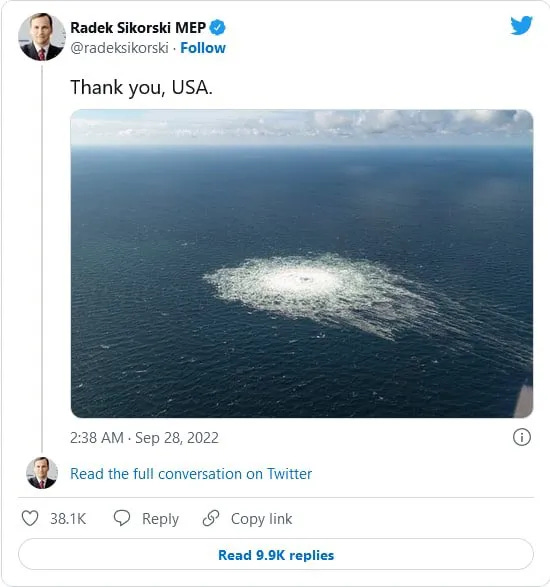
The closest my friend got to a criticism of anything I’d written was saying he disagreed with me about Nordstream, but he didn’t say what it was about the Nordstream incident that he disagreed with me over - just ‘Nordstream’, the topic. It’s a testament to the power of mainstream programming that believing that Russia blew up their own pipeline full of their own gas is now considered a sane and ‘normal’ idea, but believing that the US did it after they threatened to do it and said they were pleased when it was done, is considered a wild conspiracy theory. And of course there was this:
At some point, the angle of their argument shifted to suggesting that I was simply objecting to them disagreeing with me, as if I wouldn’t tolerate any dissenting opinions. I countered that they weren’t disagreeing with me, because they weren’t responding to anything I’d said. How can you disagree with me if you don’t say what I said that you disagree with, or if you don’t even know what I’ve said?
“What about trans rights in Russia?” his wife asked at one point, à propos of nothing. OK, what about them? “Oh, just stop,” she replied with disgust. Stop what?! You just brought it up! What rights do you mean? “Don’t talk to my wife like that!”, chimed in my friend, and Hey Presto, now we’re arguing about how I reacted to his wife’s criticism of me, even though that criticism had nothing to do with me and was in fact just a rhetorical question about Russia. It was a perfect and terrifying example of straw-manning and splitting: I was now simply a Russia apologist, and since Russia were understood to be inherently Bad, I was Bad, therefore end of discussion and end of civility.
I tried to stay calm, but it’s hard to stay calm when people are browbeating you as if you’ve done something terrible, while not saying what that something is. Their point, like Screech’s the year before, was just that I was Wrong and Russia is Bad, but this time it was because books with openly gay characters allegedly aren’t allowed in Russian school libraries, which along with the vague ‘trans rights’ issue was uniquely important to them because they’re ‘Brighton people’ (which the recent arrest of former Labour MP for Hove Ivor Caplin shows is not necessarily a good thing). It didn’t have to make sense, because these were purely emotional arguments. My friend even said to me, in the manner of someone explaining something simple to a petulant child, that he believes Putin is evil, which was more important than any details about why Putin is evil, let alone what that had to do with anything I’d written.
My friends being ‘Brighton people’ and this being in a hipstery pub in hipstery Brighton, the staff naturally took my friends’ side when they came over to ask us what the problem was. My friends even apologised to the staff for me, even though they had been arguing with and shouting at me, and I think that was the point at which I walked out. A bit later, my friend shouted at me that my blog didn’t prove anything because he could just as easily have written a blog to prove the opposite, but he hadn’t done that because he hadn’t “spent the last two years wanking and watching YouTube videos”. The fact that I had spent time looking into the subject and writing about it was the very reason why I could be called a wanker and my writing dismissed out of hand. I had to walk away from him then, too, to stop myself from doing something I might have later regretted, or perhaps not regretted.
I don’t care if Jon, Screech and all their equally dull friends think I’m a bad person, but I was best man at this couple’s wedding. Since moving to Prague in 2011, I visited them almost every time I came back to the UK, which was at least once a year, and got to know and love their children since they were born. And yet, their behaviour towards me followed the same pattern as how Screech and others had behaved towards me online: performative outrage, ridicule and histrionics, and never addressing anything I’d actually said. The common tactic was to claim to disagree with something I’d said, but instead of saying what that was, to present a new, maximalist statement only tangentially related to anything I might have said, demand that I respond to that statement, and then act like my response had been the source of disagreement all along. This must be what it’s like being Vladimir Putin, so no wonder he doesn’t have much time for western media.
This straw-manning or whataboutism is infuriating and exasperating to deal with, akin to being trapped in a hall of rhetorical mirrors, and when you’ve experienced it more than once you can’t help but recognise it for what it is. It’s the kind of thing an obnoxious talk show host like Piers Morgan does to try and force his subject to respond to the points he makes (it’s beautiful to watch a guest calmly take him down), and it’s not something you do to someone you like or respect. Questions can never be addressed seriously or sincerely, and the opposing side (because everything is subject to Splitting into Us vs Them) can never be given any credibility whatsoever.
There’s a vacuum of anger, hatred and fear at the centre of this kind of argument, that sucks all reason into it; like a black hole, you can only define it by all the things it claims not to be, by how it distorts everything around it. It’s an emotionally exhausting way to go about interpreting reality and it seriously impairs one’s ability to think critically. I speak from bitter experience, only having woken up fully from the mass psychosis a few years ago: I didn’t speak out about COVID, I had two shots of the ‘vaccine’ believing I was protecting my parents, and I feel foolish and humiliated for it now.
The Russian military action in Ukraine was a prime example of an external force presented as an existential threat, which justifies any and all hostility towards it and which cannot be ‘appeased’ even in the slightest, even if that means sending every Ukrainian to die for nothing. The fact that the reality was so different, was why the propaganda campaign had to be so intense: a constant barrage of horrifying atrocity propaganda with either very shaky evidence or none, to detract from the mountain of actual evidence to the contrary, hidden by an ever-expanding censorship regime.
The same can be said of the ‘Israeli’ genocide against the Palestinians, starting in earnest in October 2023: it doesn’t matter what the IDF and Israeli settlers had been doing to Palestinians prior to October 7, the fact that the Palestinians responded at all gave Israel carte blanche to massacre them mercilessly and sadistically. Our media continues to accept the Israeli framing of Palestinians as terrorists while Israel targets hospitals and homes (in just the first 6 months of the Gaza genocide they dropped more bombs than were dropped on London, Hamburg and Dresden in all of WW2), and our media never questions Israel’s “right to exist/defend itself” (a right that is obviously never extended to Palestine) including by attacking Lebanon and Yemen when they stand up for the Palestinians. The obvious reason for this is that Israel is doing the capitalist empire’s bidding and the media is that empire’s mouthpiece, but according to said media, that’s just another one of those ‘antisemitic conspiracy theories’.
But these are stories about geopolitics that probably don’t hurt us personally, besides the arguments we might get into over them. What if we thought that we, our friends or loved ones might be personally at risk from something? Wouldn’t you fight to protect them?
Enter Trans Rights (again): a movement so hysterical that it sees any challenge to its intentionally vague core tenets as tantamount to violence, and if those tenets are challenged systemically, somehow tantamount to genocide. The slogan “Stop Trans Genocide” implies that this ‘genocide’ is already happening, although it’s never made clear exactly how or where3. But as my friend’s wife in Brighton demonstrated, there are plenty of people who believe that trans people are at the very least having their rights curtailed somehow, even if they can’t say what those rights actually are beyond tautologies like “the right to identify as whatever gender you like”. Thinking seriously about the implications of slogans like that is a lot harder than repeating the slogans and getting angry with anyone who asks you to elaborate.
On a bus from Napoli airport to the city centre last year I saw an English woman about 25 years old, wearing a T-shirt that stuck with me. It featured the image below, of a man dressed in cowboy attire pointing a revolver, and the text "We'll have no misgendering in this saloon partner" underneath:
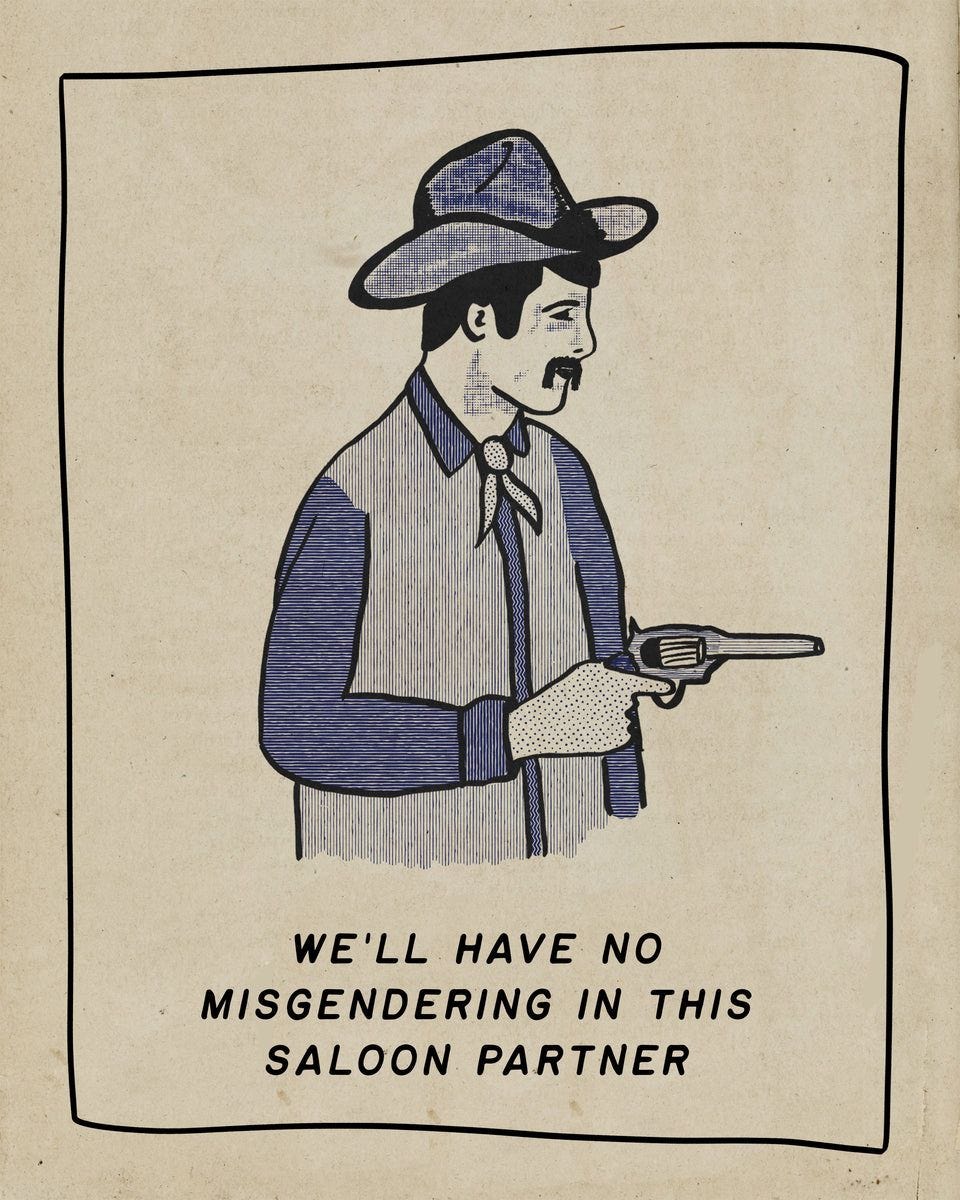
The T-shirt stood out because it simultaneously demanded knowledge of a niche lifestyle that encompasses bespoke pronouns and misgendering, and semi-ironically threatened violence for failure to validate that lifestyle. Plenty of people, especially older people, wouldn’t have a clue what 'misgendering' means, and if they were to find out what it was, they'd almost certainly find it ridiculous. Is the ironically detached logic of the T-shirt suggesting that they should be shot if they get it wrong?
The woman in question looked exactly how you might expect: androgynous clothing, uncomfortable-looking piercings, tattoos with things like unicorns and rainbows on them (things that she will definitely never regret getting), beady John Lennon glasses, a bit chunky and unattractive. She could have been more attractive if it weren't for her confrontational appearance, but those tattoos are permanent, so she's painted herself into a corner so to speak.
I'm calling this woman a woman and referring to her as she, but judging by her presentation and the T-shirt, there’s a good chance she goes by some other gender identity/pronouns. Presumably she expects everyone she meets (including in the foreign country in which she's just arrived) to ask her her pronouns before they refer to her in the third person. I wondered, does she do that to everyone she meets? Does she think that everyone is being terribly rude for not doing it to everyone else they meet? Sounds like a tedious4 kind of existence if so, but one suspects that in practice this courtesy is only supposed to be extended to her and her equally enlightened friends, because they are the only ones who care.
The ironic threat of violence was unsettling, but consistent with some other language and imagery used by the pro-trans crowd, the crowd that insists they just want love and acceptance. Failed Vice Presidential candidate and self-confessed knucklehead Tim Walz signed an executive order in 2023 while he was Minnesota governor, intended to ensure access to ‘gender-affirming care’ (i.e. irreversible drugs and experimental surgeries). “In this state, hate has no home” he is quoted as saying, while he was flanked by a boy in a dress and Lt. Governor of Minnesota Penny Flanagan, who was wearing a widely-available T-shirt featuring the slogan ‘Protect Trans Kids’ and a picture of a knife:
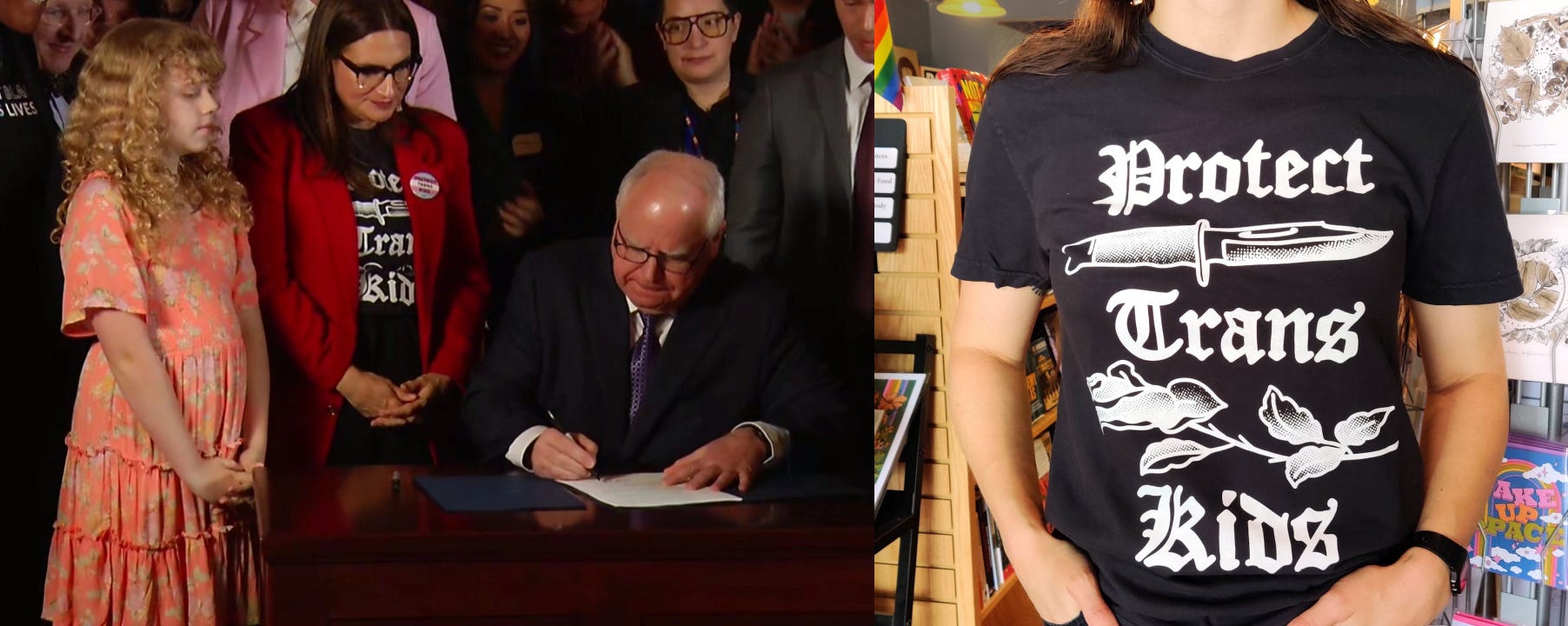
The implication is that ‘trans kids’ need protection, to the point where violence might be necessary. Protection from whom, though? Bullies? Or more likely, given the context, people who want to stop them getting that gender-affirming ‘care’, which probably includes their parents. The Substack Parents with Inconvenient Truths about Trans features dozens of those parents’ stories, and a common theme amongst them is rage at a politically-captured medical establishment that has convinced their children they had something wrong with them, which they could only solve with the aforementioned ‘care’. It’s not uncommon for trans-identifying young people to ‘go no contact’ from a parent or parents who refuse to affirm their identity.
Richard and Rita Zajko were murdered at the end of 2022 by their non-binary-identifying adopted daughter Michelle, who is a member of the Zizian cult. The recent story of the Zizians killing people almost brought trans violence to public attention, but mainstream media has barely mentioned the fact that many of the members (including founding members) are trans, instead focusing on them being vegan, ‘rationalist’, ‘highly educated’ or ‘computer experts’.
On March 27th 2023, trans-identified female Audrey Hale carried out a shooting in her old school in Nashville that left three teachers and three 9-year-old students dead. It’s worth pointing out that the woman on the bus in Napoli was wearing the “we’ll have no misgendering” T-shirt some months after Hale’s shooting spree. Although she apparently identified as trans, media still referred to Hale as female, as they did with Zajko, for whom there was little mention of her non-binary identity. In the case of Zizian founder Jack Lesota, on the other hand, he is referred to either as a transgender woman or with gender-neutral terms.
A ‘Trans Day of Vengeance’ rally, which had been planned before Hale’s attack on the school, was due to take place outside the US Supreme Court in Washington DC on April 1 (April Fool’s Day, coincidentally), but it was cancelled after Hale’s rampage:
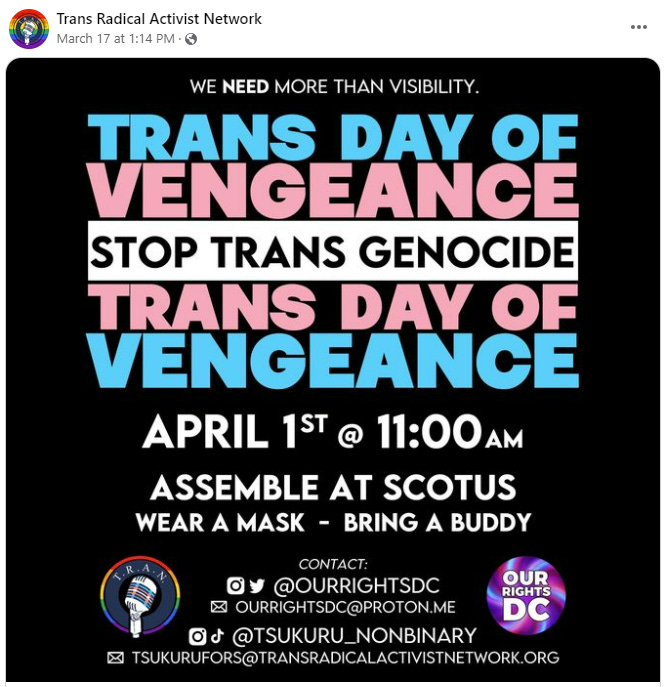
It’s unlikely that the rally specifically incited Hale to go on a rampage in her old school, but the messaging is common: trans people “need more than visibility”, they need to take ‘vengeance’ for the unspecified injustice that has been done to them. The poster even repeats the call to ‘stop trans genocide’. So what is this great injustice for which trans people need to take vengeance? If there were massacres of trans people taking place we would surely have heard about them, from the trans activists themselves if not in media.
Instead, the examples that are brought up as evidence of anti-trans bigotry tend to be objections to things like children being encouraged to believe they are trans, trans-identifying men being allowed into women’s spaces and employees being punished for expressing gender-critical views in their workplaces. It’s the con artist and narcissist’s trick of subtly shifting boundaries and expectations: getting what they want shifts to become the new baseline for normal, and anything less than that is deemed unfair to them, even if it means others’ discomfort or suffering. The neologism Trans Exclusionary Radical Feminist (or TERF) to describe a woman who, for example, demands single-sex spaces, frames a long-established and entirely reasonable status quo as ‘radical’ and ‘exclusionary’. For standing up for herself and other women and girls, she’s accused of something vaguely nasty and sinister; it’s not dissimilar to the connotations of the much older gendered term witch.
Gender ideologues’ anger is primarily directed at women (like JK Rowling) who refuse to yield to their demands, but there is a common response strategy deployed against anyone critical of trans ideology. One step is to accuse the critic of either expressing hatred or of not being sufficiently ‘anti-hatred’, and another is to equate any criticism of trans ideology with ‘marginalisation’ of trans people. They’re both examples of linguistic reframing: disagreement (about radical and unnecessary changes) becomes ‘hatred’ which angrily precludes any discussion, and not giving trans people special attention simply because of their trans identity becomes ‘marginalisation’.
In this framing, the women and girls being forced to share changing rooms with men are not being ‘marginalised’, they are simply expected to accept this New Normal for fear of being called bigots - a threat that works much better against women than against men, which is the reason why women are the primary targets. Even our instinctive understanding that men are more prone to violence is under attack, as violent male offenders who identify as women are recorded as female (and often imprisoned with women), but trans-identifying women like Audrey Hale who commit crimes are still called women.
The reasoning behind transgenderism follows the pattern of DARVO (Deny, Accuse, Reverse Victim and Offender), and media dutifully validates their framing. The UK - where since 2004 a man has been able to get a Gender Recognition Certificate to legally change his gender, allowing him to go into women’s spaces - is called ‘TERF Island’ among activists because of a supposed rise in loosely-defined ‘hate crimes’. Trans activism requires oppression because the moment they accept that trans people actually have the rights they say they want, trans activists lose the social capital associated with being an ‘activist’.
Regarding the question of access to bathrooms, the phrase “We just need to pee” has gained traction, and on its face it sounds reasonable: who’d want to stop people going to the toilet? Media reports on it call the issue ‘divisive’ and ignore the fact that no one is stopping trans-identifying men from using men’s spaces: in practice, men’s bathrooms and changing rooms are already unisex because no men will object to a woman using them, so the demand is really only on women to allow trans-identifying men in their spaces. We are supposed to accept the premise that trans-identifying men are somehow at risk in the men’s bathrooms, but even if you search for “trans woman attacked in bathroom”, most of the results are stories about trans-identifying men assaulting women and girls in the women’s bathrooms, which is unfortunately exactly what you’d expect if your mind hasn’t been broken by years of gaslighting propaganda.
This issue came to a head last December in the US House of Representatives, when South Carolina’s Republican member Nancy Mace introduced a bill restricting access to bathrooms in federal buildings by biological sex. This was seen as a response to the election to the House of its first transgender member, Sarah (né Timothy) McBride. Later that day, pro-trans activist James McIntyre was arrested for allegedly assaulting Mace on Capitol Grounds, but liberal media have repeated an alternative interpretation of the event, that McIntyre merely gave Mace an overly-strong handshake (you know, just to show her how she didn’t need to worry about overbearing males). What ever happened to “believing women”? Not if they hold opposing political beliefs, it turns out.
There might not seem to be much connection between ‘supporting’ Ukraine (by believing that they should keep fighting to the last Ukrainian), and ‘supporting’ trans people (by believing that they should be allowed and encouraged to transgress boundaries and/or become lifelong medical patients). I wrote before about how the topics feel uncomfortably similar, even it’s difficult to identify what they have in common - the principal similarities are the absence of a coherent argument at the centre of them, and the hysterical reaction one encounters trying to discuss them, when any questioning of the details is treated as outright hostility. They could certainly be considered co-morbidities: if someone believes the narrative on Russia/Ukraine there is a high chance that they will also concur that gender identity is a real thing, as well as have predictable opinions on other things like COVID, climate change, China, Iran, the DPRK, Communism… the list goes on.
Ultimately, the status these positions have in common is one of surrender. It might be reasonable to argue that one’s understanding of events in Ukraine, Israel or wherever depends on the media you consume (I would still argue that if the media you consume never shows you proof, you shouldn’t trust it), but believing that the subjective attribute ‘gender identity’ is more important than the objective attribute ‘sex’? That’s not a belief that anyone comes to by reasoned argument; only indoctrination can convince you of something that obviously crazy and harmful, and yet it is accepted in certain places as fact, certainly in petty bourgeois circles. For some reason, accepting that reality exists and that some opinions are objectively false no matter how many people insist they are true, is now a subversive opinion.
All these bizarre, disjointed opinions express a kind of social chauvinism, that a strongly-held belief is more important than facts. This chauvinism often doesn’t benefit the one repeating the opinions; the benefit is to the capitalist imperialist system in which we live and which demands constant expansion of profits and markets at any human cost, whether it’s Ukrainians dying or healthy children and adults having elective medical procedures. So it is, that discussions about these topics are never about the thing they claim to be about: they must always become an emotionally-charged argument, must always be about judging the essential morality of the dissident and can never be about the relative merits of anything they said.
The same way imperialism colonises foreign countries to extract their resources and force them to become markets for its goods, it colonises the minds of those in the imperial core to fervently believe that there can be no viable alternative to it. Hence why anyone challenging the imperialist worldview can expect to get ridiculed not only by the culture in general, but even by their friends and family. Our nightmarish neoliberal order has succeeded in doing the thing that it has been accusing communists of doing for years.
The worst part is that it’s practically impossible to convince someone of the trick that’s been played on them. Everyone has to understand it for themself before they can break out of the colonised way of thinking, and the most one can hope for is to be part of a chorus of voices showing (not telling) them how and why this has been done. For every story that you painstakingly debunk, the news has a thousand other stories to point to, and it’s on every individual to understand that it’s much harder and more time-consuming to take a lie apart than it is to tell one, and they should just stop giving the news the benefit of the doubt.
I doubt that either Jon, or Screech, or my friends in Brighton will have changed their minds one bit since their interactions with me. Screech still has an EU/Ukraine frame on his Facebook profile pic, and is still posting stories about Ukraine every bit as ludicrous now as they were in 2022. Nonetheless, I still hold out hope that one day they will come to the realisation that those of us pushing back against the media narrative were trying to show them the chains that are keeping their minds tied to a decaying Empire of Lies, to paraphrase a certain V. V. Putin.
Morrissey - whom many people will say they hate, even if they can’t say why - put it nicely in this song from 2017:
Although RFE is closely connected to the National Endowment for Democracy (the organisation created to “do overtly what the CIA did covertly”), nonetheless the video might be real - although if I came under fire in a car with my father, my first instinct would not be to record everything on my phone. Even if it is real, there’s no way of knowing who’s firing on them, but amongst the Russophobic hysteria, such questions were (and still are) shouted down and angrily ridiculed.
Elections in Russia are consistently portrayed in western media as illegitimate, precisely because Putin has kept winning since 1999. The idea that he might win because he has improved life for Russians since the disastrous 1990s is dismissed, and so it is that many people believe the literal conspiracy theory that Russian democracy is a sham.
‘Trans genocide’ occupies the same cognitive space as ‘the Uyghur genocide’, for which there is also no evidence, and in fact the East Turkistan Islamic Movement (ETIM), which seeks to create an Islamic state in Xinjiang province for Uyghurs and other ethnic groups, has been responsible for numerous terror attacks.
No posts
Comments
Nothing yet. Say the first thing.
Sign in to join the conversation.