
This is a story about how utterly depraved the British media are and have been since at least the 1990s, and how they knowingly lie in order to serve their bourgeois masters. Satyr-like they laugh at us as they do it, even telling us what they’re doing, safe in the knowledge none of their targets will be paying close enough attention or thinking critically enough to question it. Vampire-like they make it our choice to let them in and to be deceived by them. A girl died, or maybe didn’t die, and the British media used the story to conduct a psychological operation of emotional blackmail on an entire population. The political class played along and passed an Act ‘in response to’ the psy op. Advertisers supposedly worked pro bono to ‘help out’ with a psychologically brutal poster campaign. That doesn’t all happen by accident.
The story of Leah Betts looks like a coordinated attempt by big money interests to write a modern fairy tale that would support their revenues, and help suppress real working class solidarity that could have come from the rave scene. Bourgeois media all presented it like it was real when it wasn’t, and they knew what they were doing because psychological manipulation is what they do. For British people who remember the 1990s, realising that even the Leah Betts story was nonsense, should be enough to make them see the news media for what it is and has always been - a tool of mind control, not an impartial reporter of reality.
Leah Betts
In November 1995 Britain became briefly transfixed on the plight of Leah Betts, a young woman from Essex in the UK who allegedly collapsed at her 18th birthday party “after taking Ecstasy”, as the story went. On November 12, the British media solemnly informed the nation that she had been rushed to Broomfield Hospital in Chelmsford in the early hours of the morning and was in a coma on life support. Her father, Paul Betts, and his wife (Leah’s stepmother) Janet Betts gave press briefings in the hospital to keep the public abreast of her condition. They released this photograph of Leah in hospital, which became famous:
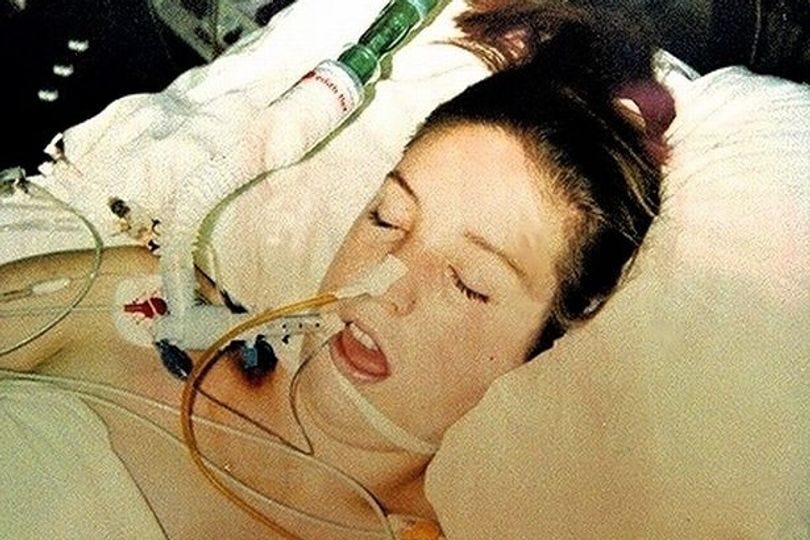
She was kept on life support for four days, until on November 16 Paul and Janet told the assembled reporters that she had been pronounced dead earlier that morning. She became an unwitting icon of the anti-drugs campaign in Britain and while her story must have scared some young people, it scared far more young people’s parents, who saw their own children in Leah Betts.
I was 12 years old in 1995, and the story above was about as much as I knew about Leah Betts at the time. I remember my mother being shaken up by it and making me promise never to try drugs (sorry Mum), but by the time I was of an age when drugs might be a possibility it was a distant memory, and even by then it was understood that Betts had actually died from water intoxication (or hyponatremia), supposedly as a result of following the advice to drink water while on E too enthusiastically. Turns out there was a lot more to the Leah Betts story than any of us could have realised at the time and it’s only now, 30 years later and with a newfound distrust of the mainstream media, that people are starting to take a more critical look.
Over the last few years the Essex police have also been taking a more critical look at the convictions of Michael Steele and Jack Whomes, who were sent to prison for the murders of three drug dealers in December 1995 (known as the Rettendon Murders, the Range Rover Murders or the Essex Boys Murders) that were attributed in the media to revenge for Leah Betts, to the point that Steele and Whomes have been released early from prison after serving more than 20 years - although the media still call them “killers”, and “rules on [Steele and Whomes] using technology and speaking to the media are in place” so they can’t defend themselves in a public forum. That triple-murder case has to a degree eclipsed the Leah Betts story, even spawning the 2000 film Essex Boys and the later Rise of the Footsoldier series of movies ‘inspired by’ the life of one of the slain dealers, but this article will just be focusing on Betts.
The media landscape was very different in 1995 to what it is now, before the internet and later social media were to change how we interact with news reporting. Besides newspapers and radio, TV news and ‘current affairs’ TV programmes (which weren’t available on demand and which you couldn’t pause or rewind unless you’d recorded it) were how we heard about ‘newsworthy’ events, with no alternative news sources existing on the same scale. TV news was the only way we saw news in video format, so to give a story like Leah Betts prominence on a broadcast guaranteed to be seen by millions was very different to a similar story appearing now, which might be seen by a much smaller number of people on TV but which would probably be ignored by most people if it was just a clickable headline on a news website.
In 1997, with the help of ghostwriter Ivan Sage, the Betts wrote a book called The Party’s Over: Living Without Leah, but unless one were to read that and really go hunting for tapes of TV footage and newspaper clippings, one’s understanding of the Leah Betts story would probably have been about as patchy and incomplete as mine was. Anyone acquainted with the dance music scene or Ecstasy at the time no doubt saw the moral panic for what it was, but they probably wouldn’t have been aware of just how bizarre, nonsensical and sometimes farcical the story was if one really paid attention to the details.
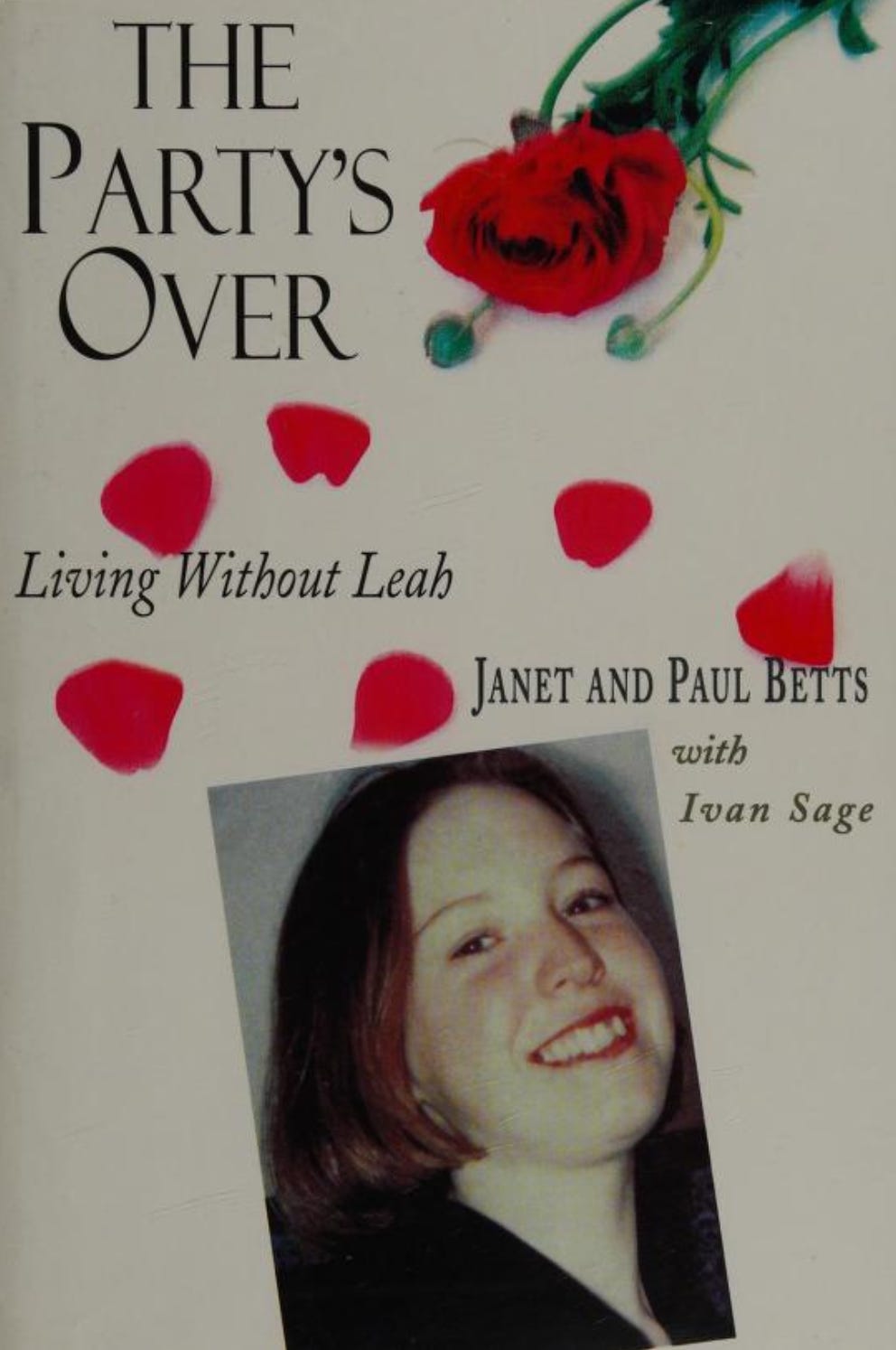
I first heard this discussed on a recent episode of Francis O’Neill’s podcast in which he and Leo Biddle spoke to Sarah Newlyn about Leah Betts (Sarah wrote a fantastic article on it and they’ve since recorded another discussion together), which led to me watching Sacha Wall’s series of deep dives into the book and into various videos made about Betts - so thanks to all of them for their work organising and collating much of the content that was presented at the time, and some that’s been made since. Like me, they all remembered the story (Sacha was even working at the time in the club in Basildon where Leah’s pill allegedly came from, and was interviewed by Channel 4 as part of a Dispatches special), but none of us remembered the sinister focus on organ donation that, with hindsight, was an important part of the story.
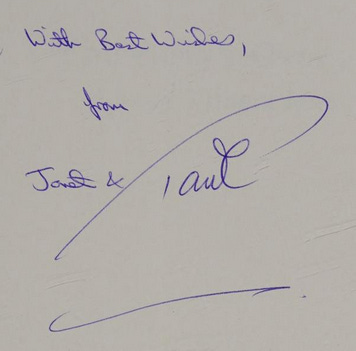
I also read Paul and Janet Betts’ book, available at https://archive.org/details/partysoverliving0000bett - this version consists of PDFs scanned from a signed copy of the original hardback book, so the written public record of Paul and Janet’s version of events is literally signed by them:
Francis’ podcast also inspired me to read Anna’s Story, a remarkably similar book written about a 15 year old Australian girl called Anna Wood who allegedly died under remarkably similar circumstances to Leah just a few weeks prior, and the narrative surrounding it had a remarkably similar focus on organ donation.
Rigorously examining the testimonies of Paul, Janet, their son William and various others who were allegedly present when Leah collapsed and eventually died, it becomes clear that there are some very important details omitted from the story, and numerous glaring contradictions, but the media never questioned Paul and Janet’s story. The media itself is an invisible but crucial actor in telling their story, and Leah’s alleged death was primarily a media event, and must be seen as such. The real questions to ask to understand the Leah Betts event are why the media suddenly rushed to her hospital and focused on her, and why Janet and Paul were so amenable to their presence.
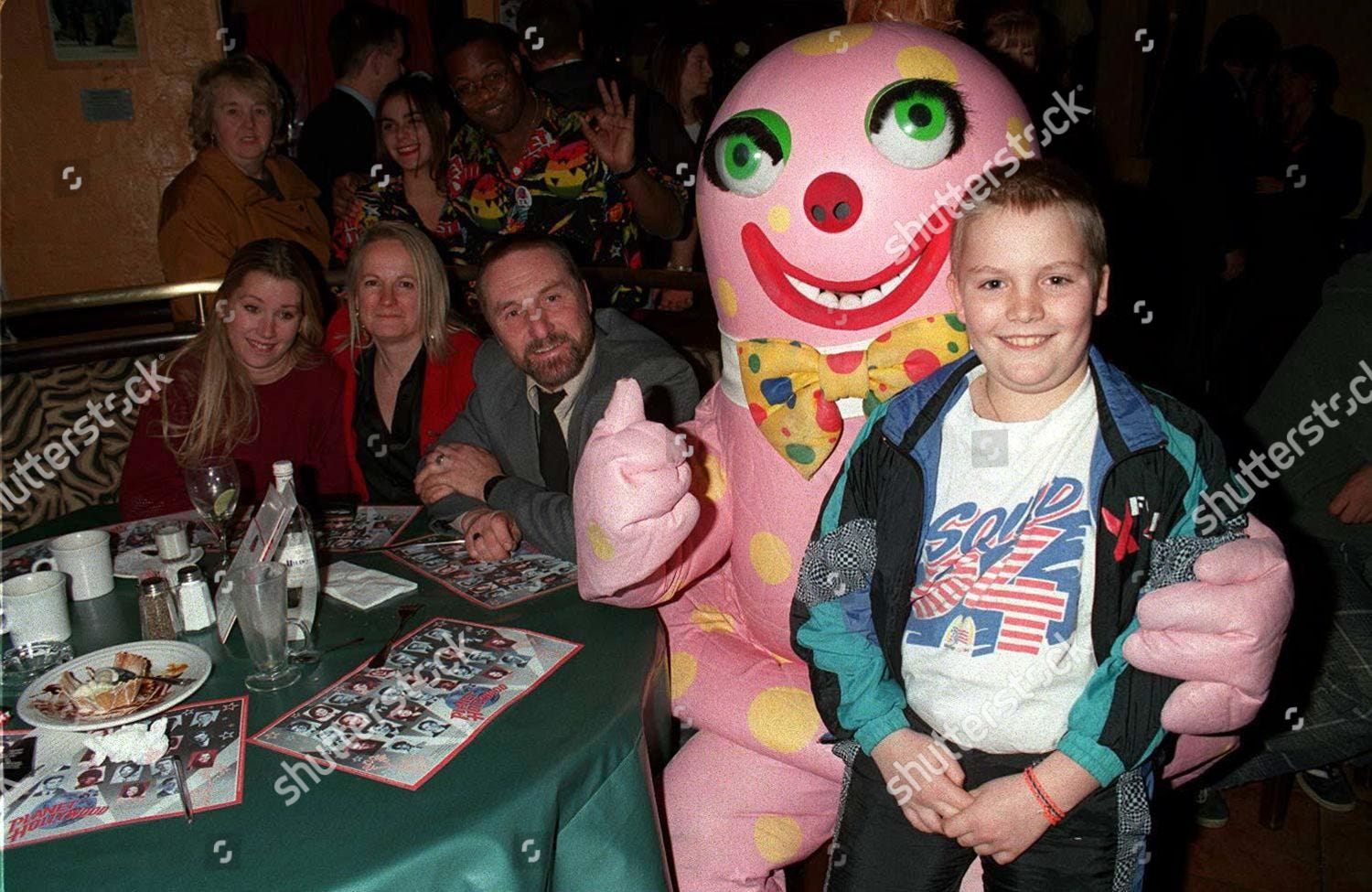
Janet, Paul and William’s behaviour on camera and as described in the book feels so unnatural - sometimes even inappropriate - that it’s remarkable no one looked into it at the time, and again the question is why no one did. For example, this incongruous photograph of Paul and William dated December 1995 at Planet Hollywood in London is freely available on Shutterstock (the pink monstrosity is Mr Blobby, it’s a British thing):
The police apparently did not consider Leah’s death suspicious, and on February 1 1996 (as reported by The Herald Scotland and The Independent) coroner Malcolm Weir ruled it an “accidental death caused by non-dependent abuse of drugs”. From The Independent:
Dr Alasdair Short, the consultant who treated [Leah], said tests showed she had a much higher water level in her body than might have been expected and was effectively suffering from "water intoxication". The resulting pressure on the brain stopped the part which controls normal functions, such as breathing, from working properly.
Toxicologist Dr John Henry of the National Poisons Unit at Guy’s Hospital, London, told the inquest that “drinking too much water to counteract Ecstasy's effects could be just as damaging as the dehydration often associated with the drug”, and that Ecstasy could impair kidney function. Dr Paula Lannas, the Home Office pathologist, said that “there were no safe levels of the drug”. Dr Henry said that Leah “would have survived if she had not drunk so much water” but the question of how Leah managed to drink enough water to die was never addressed, and Dr Weir concluded that “If she hadn't taken the ecstasy, she wouldn't have had the problem”.
The amount that she allegedly drank is not clear - the coroner’s report isn’t publicly available, but The Herald stated that Dr Henry (who it appears did not see Leah’s body for himself) told the inquest that “blood and brain tests taken from Leah when she arrived at hospital showed she had drunk more than three litres of water during the night”.
Then over the course of various unsourced media reports that figure increased to seven litres, and the Wikipedia page currently states (without a citation) that she drank seven litres of water in 90 minutes. Drinking 7 litres of water in a day would be excessive, in 90 minutes it’s impossible. The media effectively played a game of telephone with each other and agreed to keep repeating each other’s exaggerations, apparently with no pushback from Dr Short or Dr Henry.
It’s not just the question of how much water Leah allegedly drank, or why - everything we know about the case is filtered through the various media that told us the story, which is frequently contradictory. Even the book contains internal contradictions. There’s no point singling out a particular news source because they all pushed the story - of all the British TV news outlets, only Sky News don’t seem to have any available reporting on it.
What follows is an attempt to organise the story as it was told by those who say they were present, to show how ridiculous and inconsistent it is, and how much the media played an important role in obfuscating details. The story is so implausible in those details as to sound fake, but records of Dorothy and Leah Betts’ deaths are publicly available, so the question is either how Leah really came to die as the inquest found she did, or how the story of her death was fabricated, and why. First follows some important context on the Betts family.
The Betts family
The following is mostly according to Janet and Paul in Living Without Leah (ch.2):
Paul married Leah’s mother Dorothy (or Dot) in 1972, and they lived in Forest Gate, London. Paul, like Dot’s father, was a policeman. Leah was born on November 1 1977. In 1979, Paul suffered from Meningitis and at around the same time, their marriage started to falter. Paul laments that Dot, an assistant headteacher at a primary school in Dagenham, was overly focused on her work (and baby Leah), and he began to “feel very lonely”.
This coincided with the failing marriage of Paul and Dot’s friends Alec Lambert (a policeman who worked under Paul) and his wife Janet, and Paul and Janet ended up leaving their respective partners for each other. Alec and Janet had three daughters, Wendy (born 1973), Emily (born 1975) and Cindy (born 1976), and they got divorced in 1981. Alec is never mentioned again. Paul says that he left the home he shared with Dot when Leah was 3, and at some point Paul moved in with Janet and her daughters. Leah stayed with Dot. “Not long after” Paul left the home he had shared with Dot, Dot’s new partner Chris moved in, and Chris and Dot “soon sold up and moved, with Leah, to Laindon, near Basildon”.
Paul says that in 1982 “Dot divorced me for adultery, which I never challenged”. His time with Leah was limited to one weekend a fortnight, and he was not allowed to take her on holiday with him. In a video clip Paul says that this was at Dot’s insistence, not the court’s. Paul says that Dot “had a lot of hate for me after the divorce and, at one stage, I suppose Leah became the subject of an emotional tug-of-war between her mother and me. I regret it now.” Also in 1982, on September 25 Paul married Janet - they had to get a Methodist priest to marry divorcees - and all four of their daughters were bridesmaids.
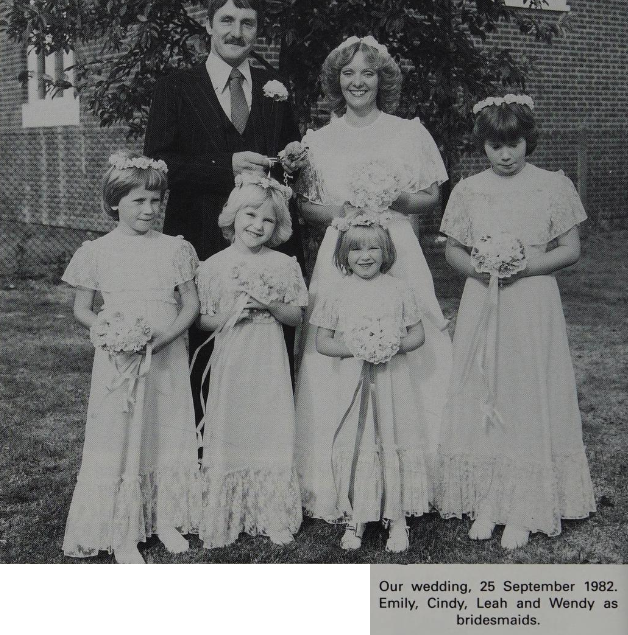
According to The Independent, Paul’s father died of cancer in 1982 and his mother died on Christmas Day 1994.
In 1984, Paul and Janet’s son William was born.
There is no more information about Dot and Chris until 1992, when “Dot became very ill. On September 1 she collapsed. When Leah and Chris found her they tried artificial respiration and got her to hospital, but she was dead on arrival. She was only 45.” Paul says he believes Leah had hoped that he would get back together with Dot, but he doesn’t say why he believes that.
“Dot’s death made my access to Leah easier … for the first time in many years, I had my daughter back.” This and other unsettling statements suggest that Leah came to live with Paul and Janet after Dot’s death, but later on (p104) Paul and Janet say that Leah’s bedroom in their house was their guest bedroom. Presumably Leah kept living with Chris for some period of time after Dot’s death, but Chris barely appears in the story, and is never given a surname.
Paul was medically retired from the police with Post Traumatic Stress Syndrome after he was attacked at a wedding that he was called to, which the book says (p15) happened in August 1994, but The Independent says happened “a few months” before Leah’s death. The mother of the bride allegedly hit Paul in the face with an open Coke can and the ringpull somehow cut his eyebrow and also “curled round the eyeball and severed an artery”.
The information above doesn’t appear in chronological order in the book and it’s very easy to lose track of when things happened, but it is important context to understand before hearing how Janet and Paul talk about Leah, and how the media talked about them. In the book Janet calls herself Leah’s mum and says that Leah called her Mum, which seems very unlikely if Leah’s real mother, whom she lived with, was alive until only 3 years before Leah’s death. Janet’s daughters also seem to refer to Paul as ‘Dad’, and it’s not clear whether their real father Alec is still in their lives, or even still alive.
There are numerous instances of Janet being referred to in media as Leah’s mother, or of Janet and Paul being Leah’s parents, with no mention of the fact that Janet is her stepmother. The inside front cover of the book even calls Leah “Janet and Paul’s daughter”. The media never mentioned that Leah had not lived with Paul since she was 3 years old, or that, as Paul puts it, “until the last three years of Leah’s life, I had not had much involvement in her upbringing”. The fateful birthday party at which Leah allegedly collapsed is often referred to as happening at ‘their’ house, without clarifying that it happened at Paul and Janet’s house, but Leah didn’t live there.
It’s very strange that no effort was made by the media to talk to Leah’s mother’s side of the family, notably Dot’s partner Chris. Also at the inquest into Leah’s death, witness statements were only taken from Janet, Paul, Leah’s friend Sarah Cargill and some experts in drugs and poisons, including the aforementioned Dr John Henry.
Paul, Janet and William moved to Scotland in 1999 after allegedly receiving threats related to their anti-drugs campaigning. In 2005 they stopped campaigning, claiming Tony Blair’s government had let them down.
In May 2007, William Betts went on trial in Edinburgh for the rape of a woman and a sex offence against a girl under 16. In September 2008, he was charged in Inverness with the rape of a 25 year old woman.
Paul Betts died of Motor Neurone Disease on December 8 2020, but his death was not widely reported until November 2025.
Leah’s collapse at the party
This summary is based on a few sources, which offer sometimes contradictory accounts. Chapter 3 of the book is called The Party Night, but it by no means contains all of Paul, Janet, William and Sarah’s descriptions of the night of the party; there are crucial statements scattered throughout the book. Sarah gives her account in chapter 16, Sarah’s Lesson in Life.
Sarah and the Betts also spoke about the night of the party in various media produced at the time and since, notably in a very strange first episode of the BBC’s educational series Short Circuit in 1996, ostensibly about Homeostasis but mostly telling the story of Leah Betts. During the episode all the interviewees speak directly to camera, and it features Dr John Henry handling a real human kidney and dissected brain to demonstrate exactly where MDMA affects the body.
As well as Paul and Janet, three alleged friends of Leah’s spoke to the BBC in 2000 for their documentary Leah Betts: The Girl Next Door, in which they spoke about the party. However, the voiceover on Girl Next Door also says that Paul and Janet got married 5 years after Paul’s divorce from Dot, contradicting the book which says he remarried the same year. There are a lot of these bizarre inconsistencies, and it’s hard to believe they happened as a result of accident or incompetence.
It’s somewhat odd that no one seems to have come forward in the era of social media to either corroborate or challenge any of the ‘official’ story of what happened at the party to cause Leah to collapse - perhaps because there actually is no clear official story.
The party
Leah’s 18th birthday was on Wednesday November 1 1995. No one wants to have a party on a weeknight, and because the following weekend was bonfire night (a British tradition that I coincidentally mentioned in a recent article), Leah “decided to keep a date special to her” for the party, which for some reason was 11/11/1995.
In the book (p17) Janet says that she and Paul gave her the choice of either a decent present or a party for her 18th (because money was tight), and that when Janet and Paul decided they would stay at home for the party (instead of going to a “formal yacht club dinner”, not because money was tight but because William couldn’t come with them), Leah told her “she would rather [Paul and I] were there anyway as our house is in the middle of nowhere”. At her 18th birthday party? Yeah, right.
In Girl Next Door, Janet claims Leah says she wanted “the birthday cake, the candles, the singing”, but then immediately after that we hear Leah’s friends Lucy Betteridge and Laura Watts say that Leah “didn’t want her parents to be there … I think they’d insisted … and she wasn’t too impressed with that”. It’s not clear what the filmmakers were doing when they made the decision to present contradictory statements like that without comment, but it’s consistent with the tone of the Leah Betts story.
According to Janet, she spent the day preparing food for the party (p18: “We made all the food ourselves, except for the birthday cake”) then at 4pm Paul went to pick Leah and Sarah up from Sarah’s home in Basildon and they joined in with getting the house ready, which included moving all the furniture (maybe even including the carpets, according to Paul) out of the lounge and into the dining room.
Leah and Sarah spent a long time upstairs getting themselves ready for the party, but a couple of hours before it was meant to start some friends called to say they couldn’t come, which Janet says (p18) upset 18-year-old Leah so much that she “sat on Paul’s knee in the kitchen and began to cry”. Then, according to Sarah (p161):
[at] about 7.45pm, while we were alone, we decided to take an Ecstasy tablet. This time, the tablets had an apple motif on them.
In Girl Next Door, William appears to say that he saw the girls take the Ecstasy at the party, and that “this was the first time I got a chance to spy. I know I shouldn’t have, but I was still 11 at the time”. So according to William, the first time he got a chance to ‘spy’ (presumably on Leah) was the night she collapsed.
Paul’s sublime vision of Leah
According to Paul in the book (p18), at about 8pm
Leah came downstairs with her arms in the air. She spun around in the doorway and said “Will I do?” She looked absolutely incredible, stunning. If I had been 20 or 30 years younger, I would have fancied her myself. She was wearing dark lipstick, eyeshade, a brushed velvet purple top and a long pencil skirt. She looked really tasty. All of a sudden I realised my little girl had grown up.
That’s a very strange way for a father to describe his daughter under any circumstances, never mind on the night she fell into a coma, and he repeats it (minus “really tasty”) in a 1998 documentary called Face in the Crowd: Paul Betts.
Paul says that as the guests were arriving, he and Janet “guarded the food table in the kitchen and watched Whitney Houston in the film the Bodyguard on television” while the party went on in the rest of the house. Sarah Newlyn checked the TV schedules for that night and The Bodyguard was indeed on ITV at 9pm, with the next programme starting at 11.25pm.
Paul describes it as a “lovely atmosphere”, and even “a party that everyone could learn from”. Paul makes sure to mention that they were playing Oasis at the party - Oasis, and the song Wonderwall in particular, are a recurring theme in the Leah Betts story.
The dad-daughter dance
There is an uncomfortable scene described by Paul in the book (p19) and in Girl Next Door, when he popped into the lounge to check on the party:
Leah grabbed hold of me for a dance. It was one of those arms around the neck, arms around the waist type of dances to the song ‘When a man loves a woman’. It was really nice. I think that was one of the closest times, both emotionally and physically, I had ever been to Leah. I thought: ‘We’ve cracked it. After all these years apart, now we’re together.’
But immediately after Paul recites this story in Girl Next Door, it cuts to Leah’s friend Lee Hayward saying that “I think she was a bit embarrassed, like any 18-year-old would be”. According to Paul in the book, he went back to the kitchen because “I didn’t want to cramp Leah’s style and besides, I wanted to see the rest of the film”.
It should be noted that on the inside-cover blurb of the book, it says: “Half an hour after a slow dance with her father, Leah Betts collapsed.” It’s strange to mention the slow dance in the context of her collapsing, but also put a pin in ‘half an hour’.
The cake photo
The next recorded event of the evening was when they presented Leah with her cake - the only food that Janet said they didn’t make themselves - at midnight (rather late for a cake), and once again it is bizarre and contradictory. In the book (p19), Paul says that “[that] was when one of our friends took the last photograph of Leah” - but there had been no mention of anyone besides Leah’s friends attending Leah’s party. Not only that, but in Girl Next Door William says that “Mum got a picture of her, just as she was blowing the candles out”. Unless William is talking about a second photo taken at the same time, it must be this photo:
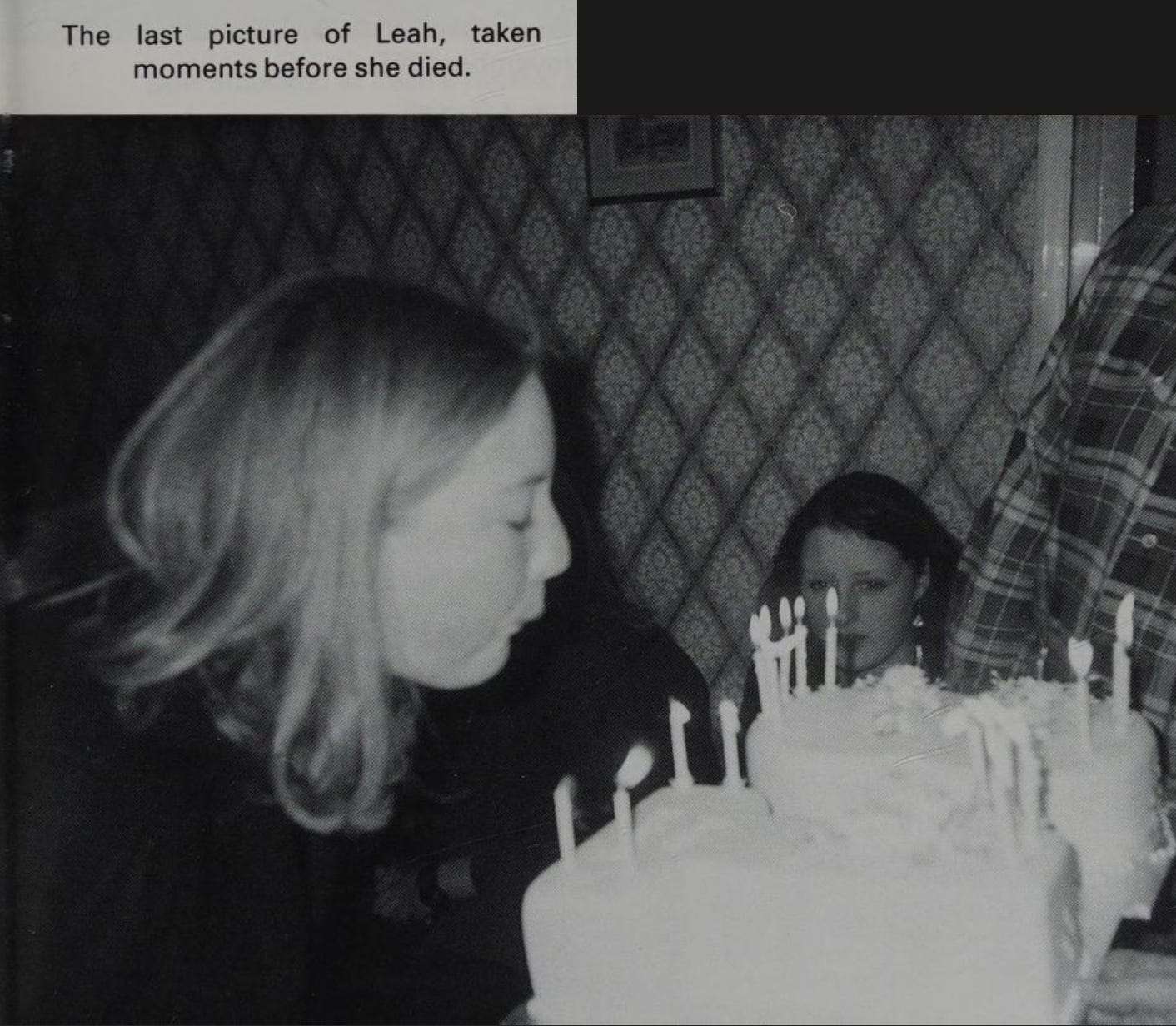
The caption above says the photo was taken “moments before she died”, but according to Paul, Leah was still conscious for at least half an hour after it was taken, and it was over four days later that her life support was turned off. Paul and Janet frequently equate Leah stopping breathing with ‘dying’, which supports the idea of ‘brain death’, which then justifies the decision to take organs from a living but ‘brain dead’ person. But why ‘moments’? Moments before she blew the candles out or moments before midnight, maybe. Why ‘died’?
Leah collapses
After midnight, things start to go downhill.
According to Sarah Cargill (who sounds rather uncomfortable) in the BBC’s Homeostasis video, and in the book on page 161, “at about 12 o’clock Leah asked me to go upstairs with her because she wanted to get some water”, but then on the way upstairs Leah collapsed saying that her “legs felt funny”. Sarah says she “took Leah into the bathroom, where she drank some water, but then she said that her head was hurting and she couldn’t feel her legs”. Sarah was panicking, and sent William downstairs to get Janet.
In the book (p19), Paul tells us that “Half an hour [after the photograph was taken at midnight] we were still in the kitchen, still watching The Bodyguard … Suddenly William came diving through the door: ‘Mum, Leah needs you, she’s not well!’” The Bodyguard should have finished by 11.25pm, and if as the blurb stated, Leah collapsed half an hour after dancing with Paul, then the dance must have been at about the same time as the cake photo - but Paul said that after the dance, he went back to watch the rest of the film. Time and events are apparently flexible in the world of the Leah Betts story - or not intended to make sense.
Janet’s first reaction to William is to think “Here we go, she’s had too much to eat”, which is both a strange thing to assume at an 18th birthday party, and another bizarre contradiction. Anyone who has any experience of Ecstasy or MDMA (the active chemical in Ecstasy) will know that if Leah had dropped a pill at 7.45pm as Sarah says they both did, she would have neither wanted nor been able to eat anything after that, probably until the next morning. Janet was with Paul ‘guarding the food’, so she would have seen how much Leah had had to eat. So had Leah taken Ecstasy, or was she eating?
Still according to the book (p19), Janet went upstairs to find Leah “with her back to me, leaning over the washbasin”. Leah turned around and Janet saw that her pupils had dilated (a normal effect of MDMA), but trained nurse Janet, who used to give talks to kids about drugs, says it was like “a horror film” - “almost like the eyes of the devil”. Leah tells Janet she’s taken Ecstasy, then she collapses, kneels over the toilet and vomits. Janet sends William back downstairs to get Paul, a recently-retired police officer, who apparently “knew nothing” about Ecstasy. “Leah’s body started to go stiff and she began to twitch”, so they took her into their bedroom and put her in the recovery position, but “she was still conscious and talking to us”. Janet says that Leah was “very distressed and in great pain”.
Paul takes over in the book, saying how angry he was and how he wanted to go “downstairs to find the bastard who had given Leah the tablet. Someone had to pay.” Leah managed to tell him that she got the pill from ‘Stephen Smith’ and that this was “the fourth or fifth time she had taken Ecstasy”, and then she “started to hallucinate”, but he doesn’t say what he means by this. She began screaming “because of the pains in her head”. In Face in the Crowd, Paul says that this was when Leah told him about her history of trying drugs a few times and it “pricked my little bubble … my whole world had shattered” (because of her taking drugs, not her collapsing and screaming in pain).
Then, as Paul puts it in his inimitable style, “she just stopped breathing. I sort of looked at her, looked at Jan, looked back at her, gave her a little prod, and nothing happened … I immediately started artificial respiration, Jan dialled 999, and we just kept it up”. Put a pin in ‘prod’ and ‘screaming’ - these words seem to be used very carefully.
The 999 call
Janet went to dial 999 for emergency services (p21), “but before she had dialled the final 9, Leah stopped breathing. There were just a couple of snores, and then - nothing.” Snores?
The following 999 call was at 12.41am on November 12:
The call is remarkable in that Janet gives a lot of background detail about ‘our daughter’ being at a party, having drunk alcohol and taken Ecstasy, and how “we’ve given her water” before getting to “she’s stopped breathing”. Apart from a single note of panic in her voice, she sounds very calm given the circumstances. Janet is careful to say immediately after the transcript of the call (p21), that “although Leah had, in fact, not had any alcohol, I felt I had to cover that possibility”.
“We’ve given her water”
Now is an apposite time to make it clear just how much Leah Betts’ death has been (and continues to be) associated with Ecstasy in every single piece of media created about her. While she was still on life support in Broomfield hospital, most of the media was confidently reporting that her collapse was the result of a contaminated pill, although this was shown within a day not to have been the case - despite that, media like the Daily Mail still say it was, because lying is what they do. Leah’s blood samples had no traces of contaminants, so the Ecstasy was actually pure.
Dr John Henry testified at the inquest that she died as a result of consuming so much water that she suffered from hyponatremia and swelling of the brain, but because an effect of MDMA is inhibition of kidney function, which results in the kidneys not processing water as quickly as they would normally, Ecstasy was still tenuously blamed, and Coroner Malcolm Weir deemed her death accidental and “caused by non-dependent abuse of drugs”.
Giving evidence to the inquest, Dr John Henry put it thus:
If Leah had taken the drug alone she might well have survived. If she had drunk the amount of water alone she would have survived. It was the amount of water which was responsible for the swelling of the brain.
The statement above is a darkly impressive work of anti-logic. The water caused the swelling of the brain that caused ‘brain death’, but if she’d had only the water she would have survived, whereas if she’d only had the drug and not the water she only might have survived? Presumably he said it with such confidence that no one asked him to clarify how he reached that conclusion.
If we are to follow and believe the official story, this is the point at which the media (with Dr Henry’s help) pulled the most egregious of sleights of hand, glossing over the fact that Janet clearly states that an unspecified “we” gave Leah water, and that this water was the reason she died. Instead, the sole focus was on Ecstasy as if it were the primary cause for her water intoxication, rather than consuming a huge amount of water. The media, with the Betts playing the leading roles, created an emotionally-charged, magical world in which it was more logical that it was a pill - that poisoned apple - that caused it. We were all invited to believe a fairy tale rather than think seriously about what happened, and many people went along with it, apparently including the police and coroner.
There was a sad example of what death from hyponatremia looks like in January 2007, when Jennifer Strange took part in an idiotic contest on a Sacramento radio station to ‘Hold Your Wee for a Wii’. She drank “almost 2 gallons [7.6L] of water in over three hours” and died a few hours later, without any drugs impairing her kidney function. Callers including a nurse called in to warn them that it could be fatal, but the cretinous hosts joked that the contestants had signed waivers so “we’re not responsible”. Strange complained of pain, but the hosts just blithely quipped that she looked pregnant. In 2009 the parent company of the radio station that ran the contest was ordered to pay the Strange family $16.5m in compensation1.
For such a thing to have happened to Leah, she must have either already consumed a lot of water before the photograph of her blowing out the candles was taken, or been ‘given’ a lot of water between midnight and the 999 call at 12.41am. It’s impossible that no one would have noticed, least of all Sarah who helped her go upstairs to the bathroom around midnight and didn’t comment on her having a distended stomach from all the water. In the Homeostasis video, Sarah (looking even more uncomfortable) says that they knew that you were supposed to drink water on E, and that during the party Leah “always had a glass of water in her hand” - but that’s a far cry from drinking enough water to cause hyponatremia.
Hidden at the end of the book in the Common Recreational Drugs chapter (p205), Janet says:
Contrary to what you may have heard or read, Leah did not drink gallons of water. She had had a few glasses of Coke, but this was sufficient for her brain to swell.
What to make of that? It makes no sense (a few glasses of Coke don’t make your brain swell), and it seems to contradict what Dr Henry stated, and what Sarah said, and even what Janet herself said on the 999 call. It makes most sense if the purpose of the book was either to confuse the reader, or to show outright that they are lying one way or another - because then it’s your fault for still falling for it.
Trying to resuscitate Leah
While Janet was on the phone, Paul was giving Leah mouth-to-mouth resuscitation, but he says that “one of the silly little things that upset me was that Leah … regurgitated a bit, and I then had to stop … I couldn’t cope with it”. Or as Janet kindly puts it (p21), “Paul has a real aversion to sickness. He looked so distraught. I emptied Leah’s mouth and took over”. Paul freely admits that Leah would have died if Janet hadn’t taken over, but this huge failure on his part is characterised by him (p24) as a “stupid quirk of mine”, and Janet seems sympathetic. Paul really can do no wrong in this story.
Then the ambulance and some police arrived, and the paramedics took over from Janet and Paul. At this point, Paul went downstairs and according to Janet (p22) “in his words, went apeshit. ‘Which one of you bastards gave Leah that tablet? I need to know. My daughter is dying upstairs!’” In Girl Next Door, he says “I would have committed murder that night”. He is escorted out by a policeman and told to go up to Leah, who was by now strapped into the ‘cradle’ to go in the ambulance. Janet says that her breathing was still being done for her, and that “she was, although we did not know it, already dead.” Again, Janet must mean ‘brain dead’, because just a few paragraphs earlier she says that “Leah’s heart never stopped beating, although her breathing had”. Paul even says later that Leah “probably died in my arms”.
Janet went with Leah in the ambulance to Broomfield hospital. Paul is soon put in a car to the hospital; the police set about searching and arresting some of the partygoers for possession of drugs. Although Leah took class A drugs and then somehow consumed a huge amount of water in Paul’s house, Paul is apparently never held responsible for anything that happened that night.
Leah in Hospital
On the first day Leah is in hospital, Dot’s partner Chris appears again, for the last time in the book. Janet says (p25) that Paul called Chris, and
Chris was quite emotional. ‘I’ve just got through all this with Dot,’ he said. ‘I can’t take all this as well.’ Poor Chris. He only came to the hospital once, stayed for a short while and then left. We could quite understand why. Not everyone can handle such a situation.
This apparent self-aggrandisement is quite astonishing, considering that Leah had lived with Chris for much longer than Paul and Janet, but Leah fell into a coma on Paul and Janet’s watch. It doesn’t say what happened when Chris spent that ‘short while’ in the hospital, and he doesn’t appear again in Paul and Janet’s story.
Sarah came to the hospital, apparently wracked with guilt because she had been a participant in the drug-taking that was being blamed in the nation’s media for Leah’s collapse. “Sarah stayed at Leah’s bedside all day long every day” (p26) while Leah was in hospital, talking to Leah and playing her Oasis tapes (which Janet and her daughters also did).
The media get involved
The character of Andy Hamill appears while Leah is in hospital, who is described as the Betts’ friend, and who became (p27) their “PR man … handling all the hundreds of press calls coming into our home”, which is a little odd considering he was “a student at Reading University” at the time. It’s not clear what their relationship was before Leah fell into a coma, but he is thanked in the Acknowledgements (p225) for his “invaluable assistance” dealing with the press and “arranging our daily timetable”.
Two of the Betts’ other friends, Alan and Jill Rose, are introduced as having gone to their home to put all the furniture back, the day after the party. Alan happened to run (p27) “UK Transplant Limited, an organ donation organisation”, but the “thought of coming to see Leah under similar circumstances was too much for him, so he didn’t come into the hospital”. It’s a curious detail to add, in contrast to the earlier casual admission that some of Paul and Janet’s unnamed ‘friends’ were at the party taking photographs of Leah.
Police liaison officer Peter Laurie and PR manager of the hospital Stephanie Martin tell the Betts (p27) that “the press have got hold of all this. There’s obviously great interest.” Why would that be obvious, and how did the press get hold of this? These questions go unasked and unanswered. As with many things in the Leah Betts story, things just happen. Laurie says it would be better to give a press conference in the hospital than “finding them all at your front door”, and so begins the Betts’ relationship with the media.
Janet says (p28) that “it was at this moment Paul had an inspired idea … ‘A picture of Leah … could say more than I ever could’”, and luckily “Dr Jo Davis remembered there was a Polaroid camera in the operating theatre”, so Paul took the famous photo of Leah on life support (which is now credited to Press Association).
Paul and Janet gave this address to the assembled media:
Leah gets baptised and declared ‘brain-stem dead’
Paul and Janet stay in the hospital with Leah. Janet’s daughters and mother spent most time with them there, but William and some ‘other friends’ also “popped in and out”.
Janet says (p30) that “Dot had chosen not to have Leah baptised. She felt baptism should be the individual’s choice”, but Janet and Paul get their vicar Don Gordon in to baptise an unconscious Leah anyway. “It was such a relief for us to know that, spiritually at least, Leah was going to be OK.” Paul gets a faith healer to come and sit with Leah, and Janet claims to have had a vision of Leah in a white robe, floating down a tunnel towards a light, and “reaching back to me and smiling”.
The doctors carried out two tests to establish whether Leah was ‘brain-stem dead’ (p32), and they confirm that she is. Paul has a crisis of faith: “I was … angry that God could let this happen. There was my daughter. She was warm. She was beautiful and unmarked.” On the next page, Paul says that “Leah looked alive, perfect. It wasn’t like she had been in an accident, there were no marks on her.” Paul sounds more like he’s describing a used car than his dying daughter, but there it is.
According to Paul (p33), as a result of the second test indicating brain-stem death “the decision whether or not to leave her on the respirator was taken away from us”. He says:
Jan [told consulting physician Dr Alasdair Short]: ‘My God, I don’t know if we can make this decision.’ We were told, politely, that it was not our decision to make, but that, before the machine was switched off, we could have all the time we needed to say our goodbyes to Leah.
If I were asked if I would have wanted the machine to be left on, I would have said yes.
That’s quite a claim from Paul, that the hospital didn’t offer to keep Leah on life support. One can’t help wondering whose decision it was if not his, and whether Paul and Janet are omitting some important details. Nonetheless, Paul and Janet accept the verdict of ‘brain-stem dead’, and in a single paragraph on page 33, without having mentioned organ donation before (apart from their friend Alan Rose being head of UK Transplant Ltd), Paul tells us that
a few weeks earlier, Leah had … [answered] an appeal on BBC Essex … for people to carry donor cards. … [Leah] was told that, at 17 years of age, she was not old enough to carry one. She was very disappointed. Now, so soon after that disappointment, her body was about to be taken into an operating room for organ donation.
We had told the medics of Leah’s wish to become a donor.
Leah’s gruesome organ donation
Good news - she won’t be disappointed, because she’ll get to donate her organs! The story may have seemed unhinged up to this point, but once the organ donation plotline is added, it becomes truly macabre. Leah had been 18 for nearly two weeks when she collapsed and she didn’t have a donor card, so the decision to donate her organs was made without her consent, apparently at the request of Paul and Janet, who say they were honouring her wishes.
Once the decision is made to donate Leah’s organs, the narrative moves very quickly to Leah being “put into a room on her own before being taken into the operating room” and the family gathering to say their goodbyes. For some reason (maybe him ‘spying’ on her?) “the nurses were reluctant to allow William to be alone in the room with Leah but he insisted, almost pushing one of the nurses out of his way”.
Then follows a strange moment:
While William was in the room, we were aware of Dr Short becoming very angry with someone on the other end of a telephone line in the background. Apparently, the Home Office pathologist needed tissue samples and could they take them before the organs were being donated? Dr Short was shouting into the telephone: ‘Do you really think I am going to put this family through all this for another 24 hours because you can’t take your tissue samples?’
That Home Office pathologist must be Paula Lannas, who gave evidence at the inquest - she was also the pathologist on the Rettendon Murders case, and was later investigated twice for “demonstrating a continuing pattern of inadequate and unsatisfactory examinations and breaches of accepted forensic pathology practice”, although the cases against her ultimately collapsed. It’s not clear why the samples hadn’t already been collected or what Short meant by “putting the family through all this”, but it suggests a sense of urgency to get on with the organ donation.
The events of the book sometimes have a dreamlike quality, and this is one of those times: the doctors got the ‘brain-stem death’ tests back, and suddenly they’ve given up on keeping her alive and instead decided to remove her organs as soon as possible. It all just happens.
There’s another incidence of Paul being psychotically passive-aggressive, as Janet says (p34) that “Paul was desperate that Leah should not be alone at the time she physically died, but he could not face going into the operating room. … because of my nursing experience of operating theatres, I decided to do this one last thing for Paul, and Leah.” So Paul emotionally blackmailed Janet into being in the operating theatre with Leah while Leah’s organs are removed and she ‘physically dies’ - how unbelievably dark.
Wendy, Cindy, Emily and Paul (but not William) say their goodbyes to Leah, and she is wheeled into the operating theatre. Once her kidneys and liver have been removed, Janet is allowed in to be with Leah as “the aorta, the large artery of the heart, was about to be clamped” and her heart removed. This happens at 6.03am, and Janet describes (p35) how “blood poured down a tube into a bucket by my feet. It was Leah’s life blood draining away right in front of me and it haunts me to this day.” This happened purely because Paul insisted that someone other than him should be with Leah when she died. It’s almost fetishistic in its sadism.
Janet leaves the operating theatre “very distressed”, then says that “if I had said to the doctors, ‘You are not going to do this’, they would have had to stop. But I didn’t.” It’s a bizarre contradiction of what Paul said before about it not being their decision; Janet is made both powerless and guilty. Despite all that, she assures any other relative in a similar situation to agree to donate their relative’s organs (p36): “You won’t ever regret your decision.” ‘Just don’t ask to be in the room while they do it’, she might have added. Janet says later (p129) that she has a recurring nightmare of William, as a baby, tied to a table as a dark shape prepares to “take a knife to him”, but she is “powerless, although I had not been tied up”.
Only four hours later, the Betts spoke to the press:
Janet, Paul, ‘our other daughters’ and William went to the chapel of rest (p36), to see Leah. Janet describes it as follows:
[Leah] looked so beautiful, but it was so cold. If it had been a respectful thing to do, and if it had crossed my mind at the time, I would have photographed her there.
Would it ever be respectful to photograph your step-daughter’s corpse? It just didn’t cross her mind at the time.
Thereafter, Leah’s wish to donate her organs becomes a key theme. Paul and Janet take every opportunity to say how proud they were that Leah’s organs had helped “six or seven” people to go on living and to be able to see, in the case of her corneas. Paul even says in their press conference that they felt “comforted” that their attempts to revive Leah, although unsuccessful, kept “her body and her organs operative” until she got to hospital, so those organs could be donated to other people. It was completely insane, and yet no one seemed to notice at the time.
On the evening of the day Leah died, Paul and Janet appeared on live TV in a Norwich studio, and the following morning again from Liverpool for This Morning with Richard and Judy. They went on to make numerous appearances thereafter, and in the book (p87) Janet recounts how Anthea Turner told them not to be shy about asking for donations to their appeal in exchange for appearing on TV.
Leah’s funeral
Leah’s funeral was held on December 1 1995. According to Paul, “Leah always wanted to be buried with her mother” (who says that?) and, like donating her organs, she got her alleged wish. In Girl Next Door, Paul says something breathtakingly callous about feeling “cheated” because after Dot “kept Leah from him” for so long, she “got her back” in death by being buried together.
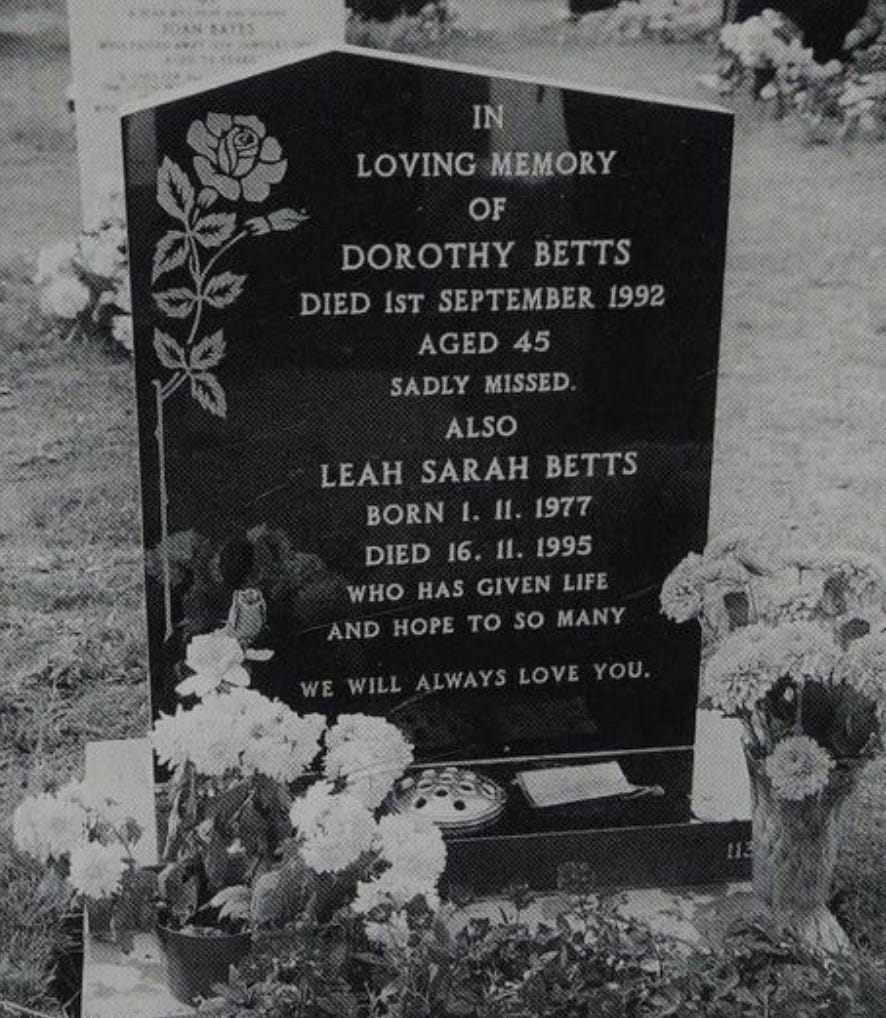
In Francis O’Neill’s podcast, Sarah Newlyn pointed out that for Leah to be buried with Dot, the grave must have been dug double depth in anticipation of a second coffin being added (usually done for a spouse) and a space had to be left under Dorothy’s text on the gravestone. Very strange for a mother’s grave to be intended to also accommodate her daughter.
Leah’s funeral was, as her friend Lucy Betteridge described it, “a circus”, overrun by TV film crews and photographers. Leah’s coffin was brought into the church to the sound of Wonderwall by Oasis. Betteridge describes it as “tacky”, with speakers outside so that everyone who hadn’t been able to get in the church could hear the service. Paul and William both read bizarre and tasteless eulogies, neither of them mentioning Leah by name, instead telling absolutely awful stories that are clearly clumsy metaphors for organ donation.
Paul’s eulogy (p40) was about a “pretty little ship” that was caught in a storm, and whose captain (i.e Paul) took the tough decision to allow his broken ship to be used for parts of other ships, but who took great pride in how his “pretty little ship” would live on in the other boats. It’s an utterly inane analogy - why couldn’t he fix his own “pretty little ship”, since it’s a boat and not a person? It’s not only a poor analogy, it ends like this:
He then turned back to his little ship and whispered the words from the title of a famous song: ‘I WILL ALWAYS LOVE YOU’.
That’s a reference to The Bodyguard, which they were watching (somehow for longer than it was on TV) on the night Leah collapsed - and he read this out at Leah’s funeral. They also played the Whitney Houston song at the end of the service. ‘Tacky’ was being very generous indeed, it seems. Not only that, but on Leah’s part of the gravestone she shares with her mother, ‘WE WILL ALWAYS LOVE YOU’ is the final line. The gravestone also says that Leah ‘HAS GIVEN LIFE AND HOPE TO SO MANY’, because they had to mention organ donation again. Another strange thing about the gravestone is that Dorothy doesn’t have a date of birth, only an age and a date of death:
William’s eulogy (p56) is shorter but equally nonsensical, about a rose that was strangled by a weed and died, but out of it came six seeds. It ends:
The father and the mother of the beautiful rose looked at their loved one, then looked at the six other roses and said, Thank you.
How does a plant have a father and mother? Plants dropping seeds is as bad an analogy for organ donation as a boat being broken up for parts, it’s all immensely tasteless and inappropriate and yet these were apparently read out at a real funeral by the deceased’s father and half-brother. If it’s real then it’s grotesque, but perhaps the point is to be so tawdry and crass that it should be obvious that it’s all a sick joke.
Another sick joke might be Paul’s insistence on using Wonderwall as the song at the funeral; its refrain of “Maybe, you’re gonna be the one that saves me” could be interpreted as an appeal to potential organ donors. Wonderwall and I Will Always Love You were two of the biggest hits of 1995, and Paul (or whoever was writing the script for this charade) clearly wanted to associate Leah with them.
Despite all that, the funeral is also the only point in any of the available videos at which any genuine-sounding emotion is expressed about Leah. It’s in an audio recording of a eulogy that must be from one of Janet’s daughters, who otherwise don’t feature in any of the documentaries:
The ‘Sorted’ campaign
After Leah’s death, Paul and Janet became full-time ‘anti-drugs’ speakers, touring schools to attempt to scare children into never trying drugs. A video was made called ‘Sorted’ (unfortunately not available online), which they took with them and showed to bored schoolchildren up and down the country. Most of the book consists of them recounting their tedious adventures learning about The Dangers Of Drugs, from various social and religious organisations.
It’s remarkable how little either of them actually seem to know about drugs, especially Janet, who was apparently giving talks like this even before Leah died. Janet says at one point that young people were taking heroin to help with the comedowns from Ecstasy and crack, which is ludicrous. Their only real expertise on the subject is in having lost ‘their’ daughter to Drugs, which is something Paul isn’t afraid to shout at children in lieu of offering any useful advice or critique. Not that it seems to have mattered - they have lots of anecdotes of ‘tough kids’ coming up to them after their talk to tell them how much they learned and how they will never take drugs.
The ‘Sorted’ billboard
On the day of Leah’s funeral, a billboard campaign was launched, also using the word ‘Sorted’. The billboard was created pro bono by media buyers Booth Lockett and Makin, advertising agency Knight Leech and Delaney, and youth marketing consultants FFI.
Those three companies might have simply found a noble cause they cared enough about to work for free, or they might have foregone the usual ~£1m fees on behalf of their client portfolio, which included brewers Löwenbräu and energy drink Red Bull, who both saw Ecstasy/MDMA as a major threat to their profits amongst potential drinkers. People on MDMA don’t need to drink much except water and they don’t want to eat; it makes them very bad consumers.
This is Shutterstock’s image of that billboard:
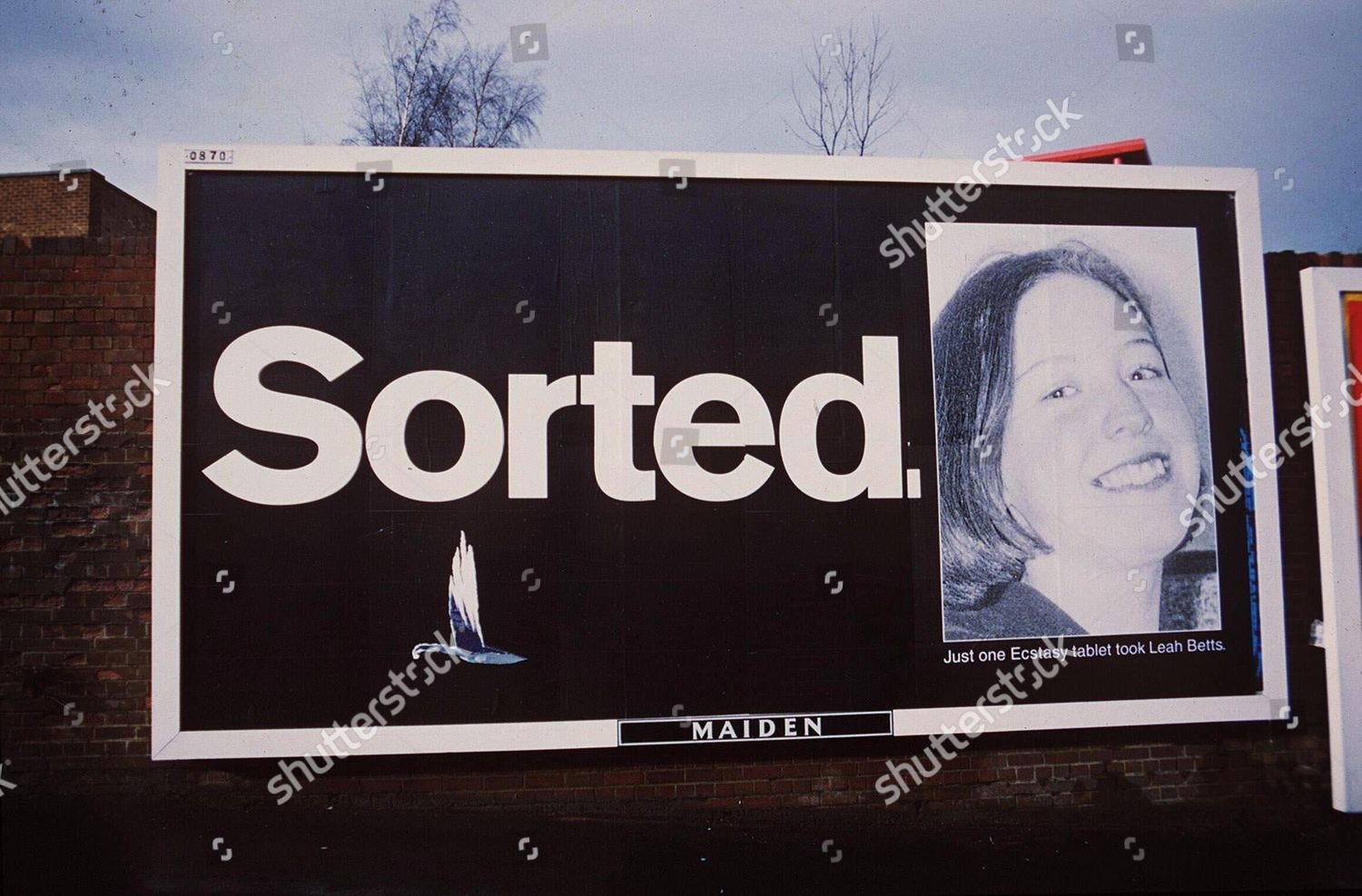
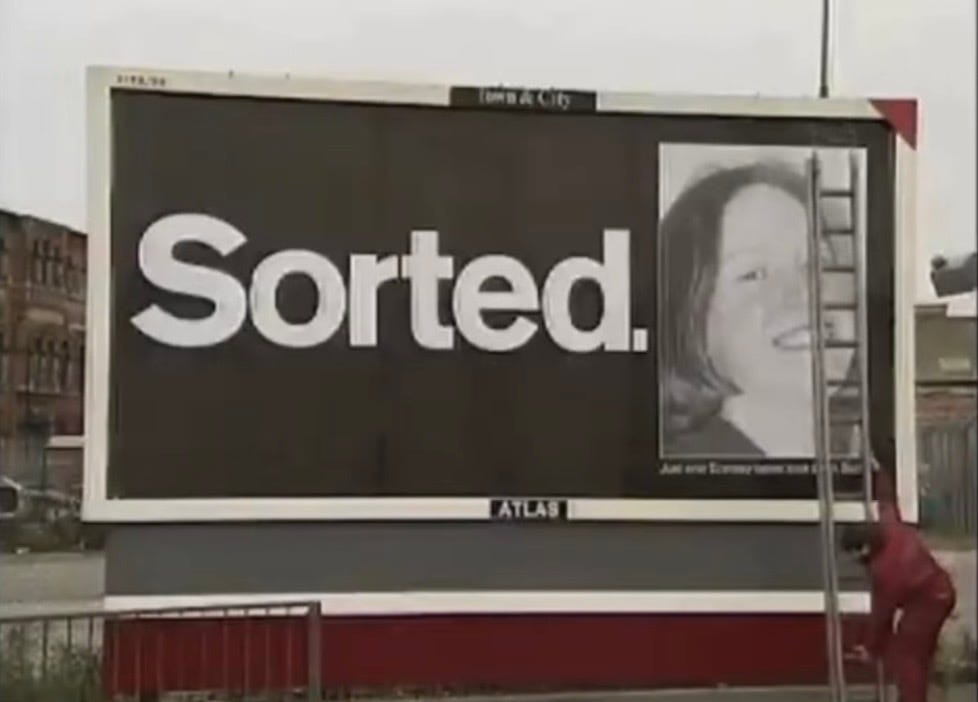
When I first saw the billboard I couldn’t stop looking at it, trying to work out what it’s even saying. It’s stark and brutal - just the word ‘Sorted’ and Leah Betts’ face, with the cryptic text “Just one Ecstasy tablet took Leah Betts” under her photo. In the context of getting drugs, ‘sorted’ means you’ve found some, so Leah was ‘sorted’ - but now she’s ‘sorted’ by being dead? Clearly it’s saying “don’t do Ecstasy”, but why publicise it so aggressively? What’s it advertising? What action is it trying to encourage?
When Paul Delaney of Knight Leech and Delaney approached the Betts with the proposed billboard campaign, Janet says (p44) that he wanted to help because “he was a dad and he didn’t ever want to go through what we had gone through”, but that’s for the birds. This was business. Even if Leah Betts was a real girl who really died, the Leah Betts story exists in a fantasy realm where Ecstasy causes death by water intoxication, so anyone using Leah’s image is appealing to the emotional story attached to that fantasy realm. They’re invoking the tragic story that everyone was familiar with by then, of a girl who made a choice to take the risk of taking drugs, and ended up dead as a result. Besides the context of finding drugs, ‘sorted’ was also contemporary slang for ‘resolved’ or ‘decided’, so what is the billboard offering as an alternative choice to the Ecstasy that “took” Leah Betts?
The full stop after ‘Sorted’ is tall and thin - similar in proportion to a beverage can. The suggestion could be that in a real-life situation somehow similar to the Leah Betts story, the correct decision about what to consume is something in a can, because of the cautionary tale of Leah choosing Ecstasy. Advertising and propaganda relies less on explicit messaging than on suggestion by association.
But there’s more than just that. Why the text “Just one Ecstasy tablet took Leah Betts”? Why not “Just one Ecstasy tablet killed Leah Betts”, or “Leah Betts just took one Ecstasy tablet”? Just one Ecstasy tablet took Leah Betts has a nursery-rhyme sort of rhythm to it, and understood in that flexible poetic context, it could mean either of those interpretations (“it took her” or “she took it”). Alluding to the mythical world of nursery rhymes, fantasy and fairy tales gives the story the ‘moral’ weight of a cautionary tale, and ties in to the storytelling tropes present throughout the Leah Betts story.
There’s another possible hidden message to the billboard, revolving around the strange shape under the O of Sorted. It looks like an abstract representation of a bird, maybe with something in its mouth, flying away from Leah’s photo, and it’s drawn in the billboard’s colour scheme of black background, white text and blue-grey image of Leah:
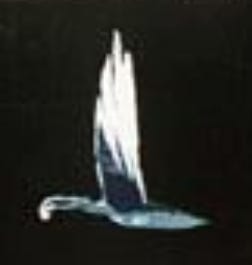
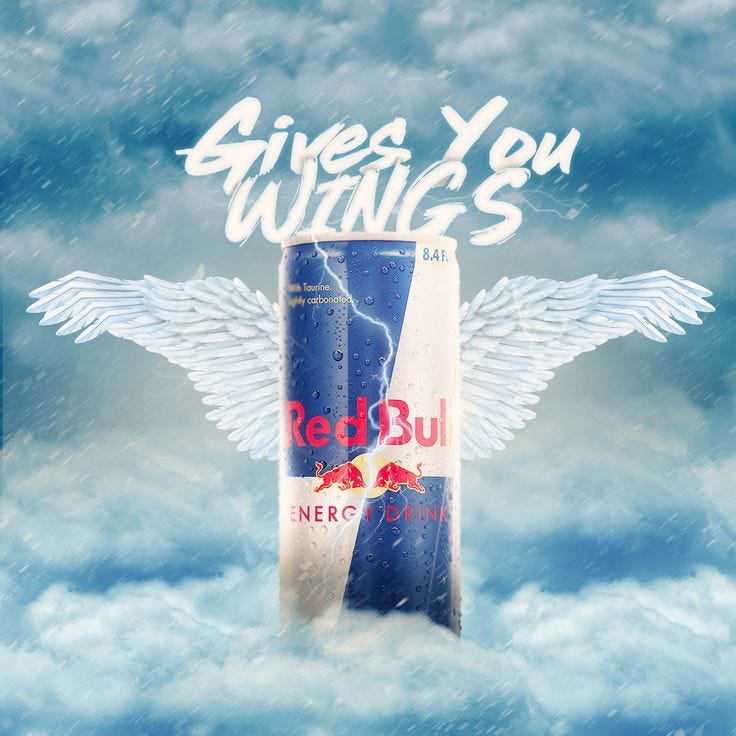
It has no clear meaning, but the billboard was designed to be seen repeatedly and to create subconscious connotations. Creating a subconscious link between the drug-related story of Leah Betts, a can shape, and a bird in flight, might have been a precursor to Red Bull’s ‘Red Bull gives you wings’ campaign, launched in 1997. Red Bull targeted the clubbing market, implicitly as a competing stimulant to illegal drugs. It’s only speculation, but nothing is done by accident in advertising, so there was presumably some reason for it being there.
That said, the poster also appears briefly in another location in Face in the Crowd: Paul Betts (in which Paul says of the campaign, “I became quite proud [of Leah], because I thought: that little cow is actually doing a bit of good”) and that billboard doesn’t feature the abstract bird shape, but it does have the elongated full stop:
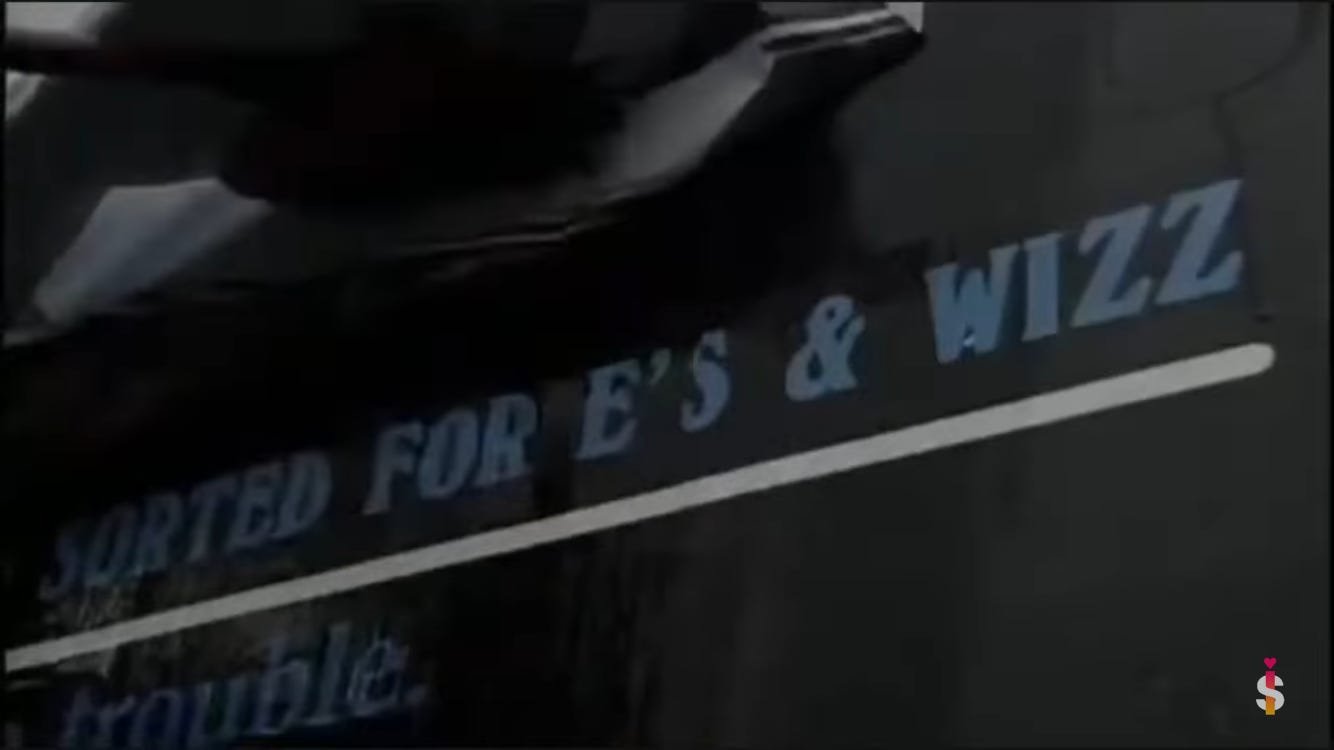
But just in case you thought they were being serious for a minute, that video also shows very briefly that the ‘Sorted’ poster is being pasted over a poster for the 1995 Pulp single Sorted for E’s and Wizz, a melancholic song about drug use and rave culture.
The billboard design appears again on a flyer in Girl Next Door (made in 2000), in which there is no abstract bird and a full-width full stop:
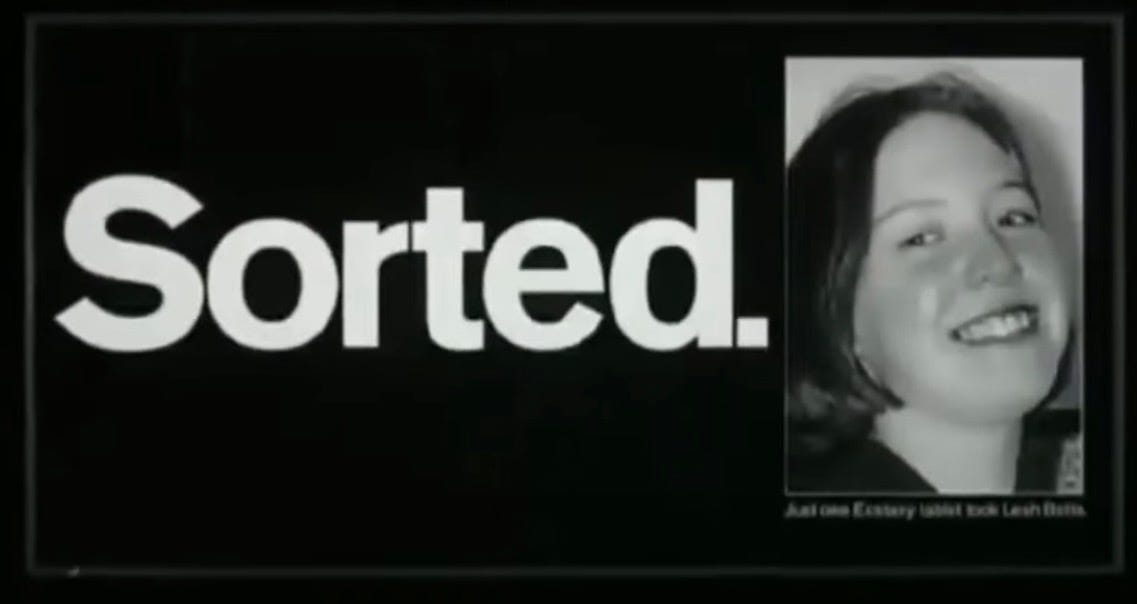
So what accounts for these discrepancies? It seems unlikely they were simple mistakes, because such advertising campaigns are meticulously designed. Part of the campaign really might have been to gaslight the public into thinking they remember something that they later can’t see. Either way, it would have served to keep Leah Betts in the the public consciousness in preparation for the real payoff, the expansion of government powers in the name of Fighting Drugs.
The Act of Parliament
In 1997, Parliament passed the Public Entertainments Licenses (Drug Misuse) Act, which expanded local councils’ powers to revoke venues’ licenses if there was any evidence of “the supply or use of controlled drugs at the premises or at any premises nearby which are controlled by the holder of the licence”.
According to Janet (p145), Conservative MP Barry Legg proposed the amendment, which supported the efforts of the ridiculously-named NARDS SP (National Association of Registered Door Supervisors and Security Personnel), of which Paul Betts was at some point made vice-president, to create standards for door staff and to get them to work more closely with police. Leah Betts, whose Ecstasy tablet allegedly came from a bouncer at Raquel’s in Basildon, was used as an example of the dangers of unregulated ‘door supervisors’.
The Act was intended to crack down on drug use in licensed premises, ostensibly because of their dangers but effectively protecting taxable alcohol sales. This article from Spring 1996 on the close connections between the alcohol industry and government, is still relevant. The 1997 Act came after the 1994 Criminal Justice and Public Order Act, which explicitly targeted unlicensed raves.
Dr John Henry
Dr John Henry of the Poisons Unit at Guy’s Hospital, London, was the toxicologist who produced the statement about Leah’s death from water intoxication being caused by Ecstasy. On closer inspection his statement was very carefully worded to draw the wrong conclusion from the available facts, but coroner Dr Malcolm Weir agreed with him and it has been used to erroneously back up the ‘death from Ecstasy’ narrative ever since.
Janet says (p77) that in 1997 Dr Henry “was granted funding to take his research further”, and also that (p207) he is
certain that a proportion of Ecstasy users will become suicidally depressed in the years to come, and that that proportion could be as high as 50% of users. Dr Henry’s findings on all animals tested so far have been the same, and he states that he can see no reason to believe they will be any different in humans.
How did Dr Henry and his team establish that these animals were suicidally depressed? The mind boggles, but he continued to get funding for it after providing the media with the story they wanted about Leah Betts. Maybe the two facts were unconnected, but what’s good for the goose is good for the gander.
Dr Henry died in 2007, from complications arising when his transplanted kidney (one of the earliest successful kidney transplants in 1976) failed and had to be removed. In an obituary, the Media Science Centre paid tribute to him as a ‘media friendly scientist’ who was always willing to provide an expert opinion to journalists “no matter what time of the day or night and no matter how controversial the story”. He gave a widely-reported first opinion on the Litvinenko poisoning case that was later called into question, and did the same with the case of Viktor Yushchenko’s mysterious acne, which Dr Henry attributed to dioxin poisoning.
He was a member of Opus Dei from age 20, and “campaigned actively against so-called recreational drugs”.
Janet and Paul’s (and Ivan’s) book
The Party’s Over: Living Without Leah, is an enigmatic work. It’s ghostwritten by Ivan Sage, who was a reporter at the local newspaper and apparently decided to contact Paul and Janet Betts to write a feature on them a year after Leah’s death, which turned into him writing an entire book giving their side of the story. Apart from the first chapter which is openly credited to Sage, the rest of the book is told mostly from the points of view of Janet and Paul, but also of other protagonists including William, Leah’s friend Sarah Cargill and Don Gordon, the creepy vicar from Paul’s church. The narrative voice throughout remains very similar, suggesting Ivan Sage wrote most if not all of it, possibly with input from the protagonists - or maybe Ivan and the protagonists were all working from a script. It’s hard to say.
Taken at face value, the book seems to be badly written, confusingly worded, and its chronology is all over the place - if it came out today, it might be accused of having been written by AI. But the book may not be something intended to be taken at face value.
The enigma lies in whether the book is simply terrible, or whether it is actually something like a coded message or a puzzle, perhaps telling an entirely different story to the one it appears to be. Certain phrases and imagery repeat too often to feel coincidental, like doors or gates being opened - for example, Paul says that his and Janet’s respective previous marriages failing was “what led to the gates being opened”, and describing the house on the night of the party, Paul says “the front door was wide open” for no apparent reason. He uses the phrase “we’ve cracked it” twice, firstly to describe his dance with Leah and later in hospital, when he strokes the sole of Leah’s foot and her toes curl up (he thinks this means her brain must be alive, but he’s told it doesn’t) and in neither instance is it an appropriate phrase to use.
There are confusing moments like Dr Short talking on the phone to the Home Office in the hospital, that hint at more going on than we are being told. After Paul mentions (p10) how Leah had been the subject of an “emotional tug of war” between him and Dot, he says:
I tried to put the record straight with Leah when she was older, but she believed in her mum and I had sufficient respect for her not to burst her bubble. The whole thing was like a bombshell to Leah a few years later when she began to understand more and ask more questions.
He doesn’t say how much older Leah was or what any of that is in reference to, like what ‘whole thing’ was a ‘bombshell’ or what ‘questions’ Leah asked.
There are numerous references to fairy tales (mostly Cinderella and Snow White) and Janet recounts (p10) a story about how she would sit Leah on her lap and read her Cinderella:
When it got to the part where Cinderella wanted to go to the ball - ‘What you? … YOU go to the ball??!!’ - I would prod her tummy and she would scream with laughter.
When Leah is experiencing the brain-swelling effects of hyponatremia (p20) Paul and Janet both talk about Leah’s terrible screams, and when she eventually collapses Paul says he ‘gave her a little prod’ after she stopped breathing. This odd choice of wording can’t be accidental, tying Leah’s traumatic collapse to the story of Cinderella. As in Cinderella, Leah lived (although in reality she didn’t) with her father and stepmother, and everything went wrong after midnight.
Leah is described repeatedly as cold and pale after she dies (‘physically dies’, not ‘brain-stem dies’), which, coupled with the poisoned apple motif, is clearly invoking the image of Snow White. The photograph of Leah in hospital invokes both Snow White and Sleeping Beauty. The Girl Next Door documentary lingers on a home video of Leah dressed in a red hooded jacket as a child, looking like Red Riding Hood.
There are enough strange occurrences in the book and the televised story, to make one see references to Freemasonry if one is looking - for example the number 11 seems to be important, and the number 21 (which can also be 3, so pairs of 21’s can be 33) appears for no particular reason:
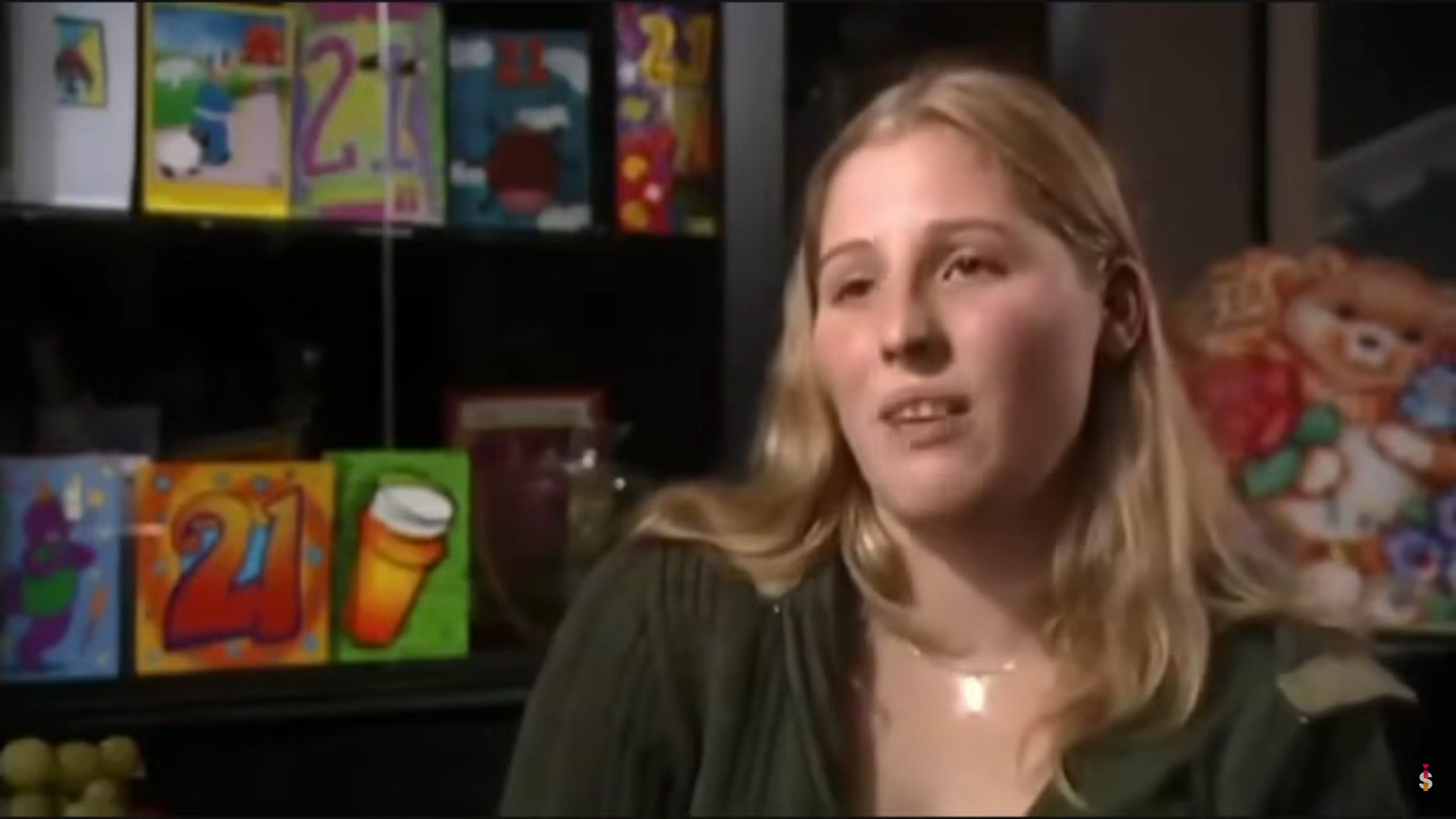
These kinds of plausibly deniable allusions might be the closest estimate to what the purpose of the whole Leah Betts story was. Freemasonry is associated with the cultural and financial elite, so it’s not a big stretch to imagine members making a mutually beneficial agreement between themselves, at the expense of some working-class young people. Carlton Leach, associate of one of the victims of the Rettendon Murders, said on a podcast that he is a Freemason (the interviewer volunteers that he is too), and that there had been instances of criminals getting away with crimes because they were in Masonic lodges with policemen, and the Masonic code counted for more than the law.
If that sounds conspiratorial, that’s because it is. But what else is one to think, when an official story makes no sense, and seems written specifically to leave one with more questions than answers? If Leah Betts really died, why was there no serious investigation into how she ingested enough water to die? Forced ingestion of water is a recognised form of torture, often leading to death - why would anyone assume that Leah did that to herself by accident, when not even any of the witnesses actually say she did? Consulting physician Dr Alasdair Short doesn’t seem to have found it suspicious that Leah was suffering from water intoxication, and ‘media friendly scientist’ Dr John Henry was quick to blame Ecstasy. The only people whose story was told through the media and whom the inquest heard, were the ones who should have been the prime suspects in her death, but from the start they were presented as tragic victims and also allowed to blame Ecstasy.
Something is hiding in plain sight in the Leah Betts case - either a horrific murder that went unacknowledged and unpunished, or a gigantic lie that was used to manipulate public opinion to benefit private interests. Obviously one hopes it is the latter, but it’s still a lie that an awful lot of people believed and probably still believe, and it was used to justify the undoubtedly real Rettendon Murders (Paul Betts called the murders “the best Christmas present I could have had”). We simply allowed the media to create a fairy tale reality for us and didn’t think about the practicalities, and as a result we didn’t realise that Leah Betts (and Anna Wood in Australia) were events concocted for the specific purpose of eliciting a response that we probably didn’t even hear about. Francis O’Neill came up with the excellent term ‘farce flag’ for such events.
There’s a bigger question about the Leah Betts story, that encompasses the media’s role in telling the story: why did they all choose to focus on a girl whose death was ultimately not caused by Ecstasy but hyponatremia, when people have really died from dehydration on Ecstasy? Why choose a story with a gaping hole in the middle? If the story isn’t true, why include such an obvious hole? It feels like a kind of mockery or humiliation (or a Revelation of the Method) - “we’ll present a story that makes no sense, and you’ll believe it, because if you question it, we’ll make sure people call you crazy, stupid or insensitive”. Leah Betts is just one example of this - it’s what they exist to do. They’re the fitters of the Overton Window, after all.
The story of Leah Betts has been getting under my skin since I first started looking into it, and I do hope that we could find some answers to these questions at some point. A first step will be to update the Wikipedia page to reflect what Paul, Janet and others actually said. After that, it will be a case of waiting to see who comes to change it back.
It’s interesting that the original story of Jennifer Strange was reported when it happened in 2007, but it has been kept in the news by recent reporting in the last 18 months.
Comments
Nothing yet. Say the first thing.
Sign in to join the conversation.