
The technology consultancy model has two load-bearing assumptions. The first is that clients pay for time: days booked, rates applied, hours billed. The second is that delivery capacity is a pyramid: a wide base of juniors and mid-level consultants doing the volume work, funnelling experience upward into a narrow tier of seniors who carry the judgment and hold the expertise.
Both of these fundamentals are now under stress.
Stronger LLM models do the volume work the base of the pyramid existed to absorb. When a build estimated at ten days takes six, the billable hours fall and the training ground that produced the next generation of seniors thins out at the same time. Smaller, AI-augmented competitors would price against that compression directly, and a consultancy or system integrator running one hundred per cent time-and-materials on a consultant pyramid is left exposed. This exposure widens with every model and every better agentic AI tool that ships.
This article presents a blueprint for the consultancy built the other way: AI-first, structured around agents and human judgment rather than billable hours and headcount. The article has three sections:
1. The Agent Catalogue: the agents every tech consultancy must build in-house.
2. The Agent-enabling architecture: the platform that must be in place to transform the consultancy’s internal and external work.
3. The Engagement Model: rebuilding it around agents and human judgment and expertise.
Each section is independent and can be read on its own, but it is best to follow the sequence.
The article is grounded in a Microsoft-focused practice as an example, but the pattern is easily transferable to any technology consultancy operating on a comparable enterprise platform.
The choice is not between having agents and not having them. It is between building them deliberately and watching a competitor build them first. The catalogue below is organised by practice area, naming the agents each practice needs and the shape of the build surface for each section.
Presales is the highest-leverage place to start: the cycle is repetitive, document-heavy, and consumes disproportionate senior time. The RFP Triage Agent reads every inbound bid against client profile, CRM, and past bid history, producing a go/no-go with a complexity score. Once a pursuit is approved, the RFP Response Drafter generates section drafts mapped to each requirement, drawing on the proposal library and methodology assets. An Estimate Reviewer benchmarks the draft estimate against actuals from comparable engagements and flags variance before it reaches the client. A Quality Reviewer runs the rubric across the assembled proposal and returns a scorecard with specific remediation, surfacing the gaps that historically slip through. A Templates and Standards Checker enforces the approved template library on every presales artefact, replacing the inconsistent check that seniors skip under time pressure. A Demo Maker configures the prospect-tailored Dynamics 365 or Power Apps demo and the test data behind it, removing one of the highest-cost, lowest-reuse activities in presales. A Proposal Library Curator closes the loop, classifying and tagging every submitted proposal with win/loss metadata into the searchable corpus. The build surface is consistent across the section: specialised agents over an AI Search index of the proposal and methodology library, with MCP into CRM.
Design and architecture is the next layer down: less volume than presales, but the artefacts are denser, the standards more numerous, and the cost of an undetected gap higher. The Solution Design Drafter assembles a draft from functional requirements, workshop transcripts, current-landscape artefacts, and the architecture corpus, so the architect reviews and revises rather than starts from blank. The Architecture Reviewer runs the design against the Well-Architected Framework and the consultancy’s internal standards in parallel, returning an alignment report with gap analysis. Standards coverage becomes systematic instead of memory-dependent. The Solution Security and Compliance Reviewer runs the design and the deployment topology through STRIDE threat modelling and the Microsoft Cloud Security Benchmark, producing a gap list before the design is signed. The Architecture Deliverables Generator turns the approved design into the full deliverable set: solution overview, ADRs, deployment guide, and operational runbook structure. The build surface across the section is multi-agent: focused agents per design section or standard, evaluation agents (evals) per dimension, and a fan-in summariser, all sitting over RAG of the architecture corpus and the document template library.
Business analysts produce documentation from work already done in the room, with the agents operating in the gap between the workshop and the written artefacts. The Process Discovery Agent turns workshop recordings, transcripts, and facilitator notes into structured process flows with roles, decision points, and exceptions, and suggests probing questions for the BA during the session itself. The Product Backlog Agent converts approved process flows and functional requirements into a structured backlog of user stories, acceptance criteria, and story-point estimates, writing them directly into Azure DevOps or Jira. The Workshop Assistant runs alongside the BA in the room, drawing and noting on Miro or Microsoft Whiteboard from live transcription, and producing a structured summary of decisions, action items, and open questions before the session ends. On legacy-heavy engagements, the Business Rules Extractor mines process documents, legacy configuration, and user manuals for a structured rules catalogue mapped to process steps. As the build approaches go-live, the Adoption and Training Content Agent generates role-based training manuals, in-app guidance, and adoption collateral from the built configuration and the process documentation, producing the artefacts that historically slip. The build surface is agent skills with MCP into Teams, Zoom, Miro, Whiteboard, and the live Dynamics 365 / Power Apps environment, with RAG over process documentation, similar projects, and training templates.
The agent coverage is the broadest in this area. The Developer Agent sits inside the IDE (or CLI) on every task, producing implementation guidance, code drafts, and configuration recommendations against the requirement and the codebase context. The Environment Health Agent runs scheduled or on-demand checks across Dynamics 365 and Power Platform environments, reporting on licence usage, solution-layer conflicts, deprecated APIs, and DLP policy drift, work that is otherwise deferred until it becomes a problem. The Legacy Customisation Analyser kicks in at the start of a new phase on a live solution, producing visual and detailed code maps, a legacy component inventory, and a modernisation roadmap with effort estimates and risk flags. The As-Built Documentation Agent reads live environment configuration via API alongside Azure DevOps or Jira at every build milestone, producing structured as-built documentation with visuals and replacing the weeks-long manual effort at handover. The Deployment Agent validates the solution package against the pipeline configuration and the target environment, returning a validation report, automated release notes, and a go/no-go recommendation. The Documentation Writer keeps technical documentation current change by change, against the code diff and related requirements, instead of letting it accumulate as technical debt. The Code Reviewer runs on every pull request, with focused reviewers per dimension (coding standards, security baseline), so review does not become the bottleneck at delivery pace. The build surface is agentic coding with skills and MCP into the environment, GitHub or Azure DevOps, with RAG over standards and past reports.
When agents accelerate the build, testing becomes the new bottleneck unless it accelerates with it. These agents exist for one purpose: protecting quality at delivery velocity. The Test Case and Data Generator turns each user story into structured test cases with steps, expected results, and the test data to run them. The Test Automation Engineer converts approved test cases for stable features into Playwright and Power Apps automation scripts, wired into the pipeline. The Regression Coverage Analyser reads each pull request and configuration change against the existing regression suite and requirements traceability, returning a coverage gap report: which changes lack coverage, which suites to run, which to update. The UAT Coordinator generates UAT scripts in business language from acceptance criteria and business scenarios, tracks execution, and consolidates results and defect summary across the cycle. The Defect Triage Agent reads every defect against environment logs and related code or configuration, classifying severity and area, identifying the probable root cause, and suggesting the owner. The build surface is agent skills with MCP into Azure DevOps and Microsoft 365, with RAG over existing test patterns, the test corpus, and past defects.
Data migration is the discipline where a missed step at cutover invalidates everything that ran before it. Four agents flatten the work and protect the cutover window. The Schema Mapping Agent produces the field mapping document with transformation logic and exception flags between source and target schemas, removing manual cross-referencing. The Data Quality Profiler runs the source data extract for null rates, duplicates, format inconsistencies, and referential integrity, replacing the manual profile that is typically incomplete under time pressure. The Migration Runbook Generator produces the step-by-step runbook with rollback procedures from the migration design and test migration results, keeping the runbook consistent with what was actually tested. The Cutover Coordinator Agent runs the cutover itself: step-by-step execution guidance with real-time exception handling, coordinating across live systems. The build surface is multi-agent under Microsoft Agent Framework, LangGraph, or Foundry, with MCP into source, target, and live systems, plus RAG over mapping standards, past migration artefacts, and runbooks.
The administrative work of delivery consumes PM time that should be spent on delivery leadership. These agents reclaim it. The Status Report Drafter runs on the weekly cadence, assembling the draft report in the standard format from Azure DevOps, the issue log, milestone status, Teams or Zoom records, and timesheets, replacing two to three hours of manual PM work per engagement per week. The Risk Register Monitor runs against the live register and delivery metrics, updating risk ratings and escalating above threshold, so risk assessment stays current instead of being deferred under pressure. The Portfolio Health Check rolls up project repositories, Teams, and SharePoint across the consultancy into a single dashboard for project health, margin, and forecasting, replacing the manual scramble before the portfolio review. The build surface is agents and multi-agent collectors with MCP into Microsoft 365, SharePoint, Azure DevOps, and the timesheet system, or RAG over OneLake.
These agents build and maintain the corpus every other agent reasons over. They are the most overlooked and the most foundational. The Lessons Learned Synthesiser runs at project close or major milestone, assembling delivery artefacts, retrospective notes, and the issue log into a structured lessons-learned document and a contribution to the corpus, replacing the retrospective everyone endorses and skips when the next engagement starts. The Onboarding Agent generates a personalised onboarding guide with curated reading and a project context summary from methodology assets and past delivery artefacts, cutting time-to-productive when a new hire joins or a consultant moves projects. The build surface is RAG over the full knowledge corpus, with AI Search indexing for corpus contribution, and MCP into project context.
This is not a complete list. These are the essentials, the must-haves that lead to more specialised agents and, eventually, to the full agent ecosystem the consultancy runs on.
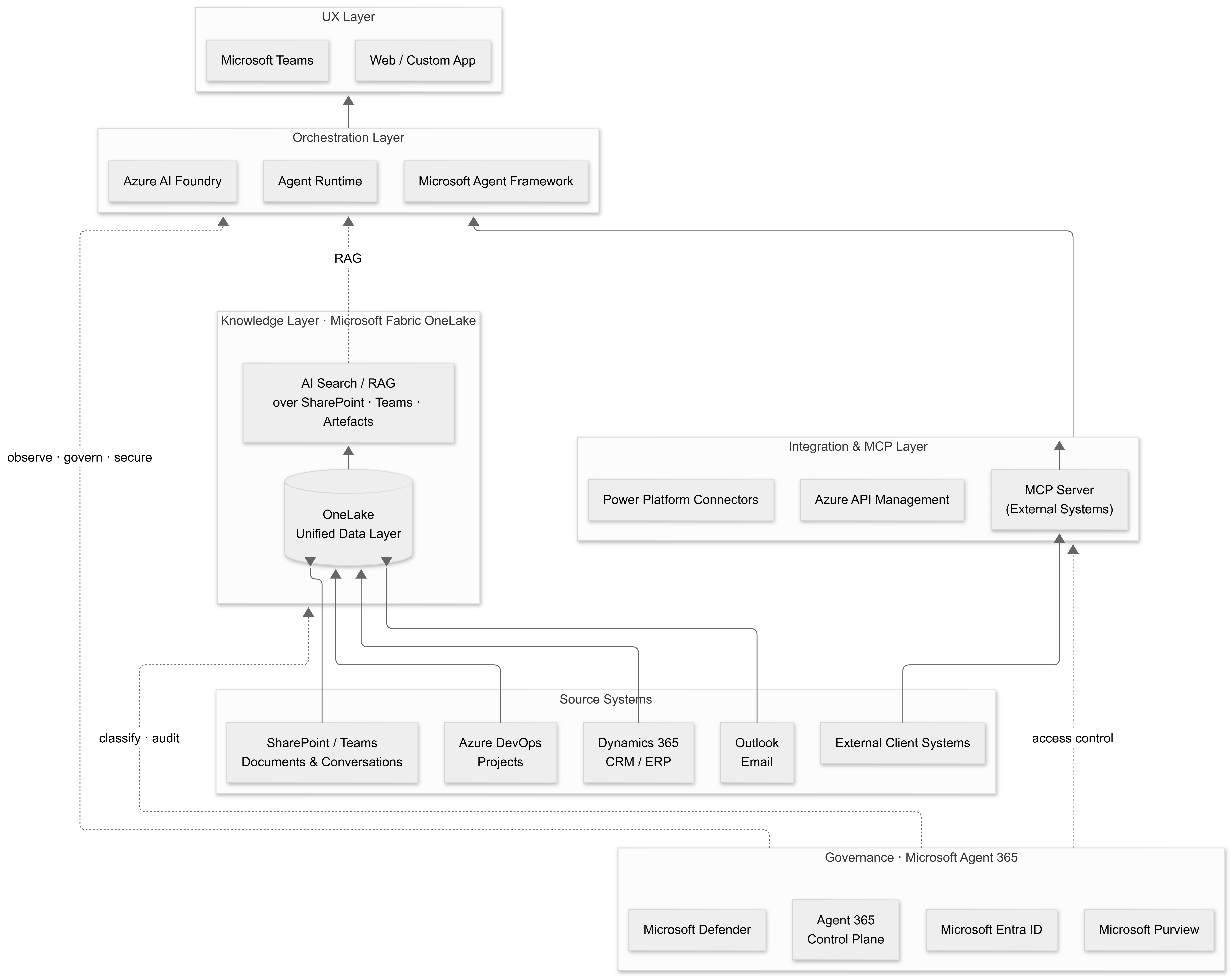
An agent catalogue without the infrastructure underneath it is a wish list. The agents above are only as deployable as the platform they run on. That platform has four layers: knowledge, orchestration, integration, and governance. They must be built in sequence, since they are inter-dependent.
The knowledge layer - as a single governed data foundation - is where every past proposal, architecture document, delivery artefact, methodology asset, and lessons-learned record lives in indexed, queryable form. This is what RAG-based agents reason over. Without it, agents produce generic output that does not reflect the consultancy’s specific practices, clients, or standards.
Microsoft Fabric’s OneLake is the single data layer in this design, a governed lakehouse that consolidates content from across the operation: CRM, the timesheet system, project repositories, Jira or Azure DevOps, SharePoint and the document library, Teams or Zoom for conversations, Outlook for client communications, and any external systems connected through the integration layer. Any comparable governed data lakehouse fills the same role. The point is consolidation: agents query one unified foundation rather than a fragmented set of disconnected repositories.
AI Search / RAG sits above OneLake and provides retrieval: vector search, hybrid retrieval, and metadata filtering that lets agents scope queries to specific practice areas, client segments, or document types. The ingestion pipeline, the work of chunking, tagging, and indexing content as it enters the lakehouse, is the unglamorous prerequisite most consultancies underestimate. It requires a taxonomy, a tagging convention, and a refresh cadence. Those decisions, made once and applied consistently from the start, are the foundation for every agent that follows.
Three responsibilities sit in this layer. The agent runtime handles model binding, tool execution, state management, and the conversation loop; on the Microsoft stack, Foundry Agent Service is that runtime. A multi-agent orchestration framework handles agent-to-agent communication and the logic for multi-step workflows (including sequential, concurrent, hand-off, and fan-out/fan-in patterns). Microsoft Agent Framework fills that role on the Microsoft stack as an open-source SDK and runtime, and any comparable framework such as LangGraph fills it elsewhere. A development and deployment surface provides the model catalogue, prompt management, evaluation framework, and the pipeline from development to production; Microsoft Foundry is that surface here. Building agent infrastructure outside a governed development surface and attempting to control it through custom tooling is technically possible and practically expensive.
Agents that reason only over a static corpus are useful but the ones that can also read and write live systems are in a different category of useful.
The Model Context Protocol (MCP) is the standard connection layer for agents reaching external systems: client CRMs, ERP systems, partner platforms, and any third-party source not already in the lakehouse. An MCP server registered with the agent runtime lets agents call external tools without custom integration code for each connection.
Within the Microsoft ecosystem, native integrations are the priority: Microsoft 365 (Teams, SharePoint, Outlook) for delivery and communication data, Azure DevOps for project and pipeline data, Dynamics 365 for CRM and operational data, and Power Platform for low-code workflow integration. Azure API Management governs the API-based connections: rate limiting, authentication, and audit logging for every agent-to-system call. Power Platform connectors surface agents directly in Teams or Power Apps without custom development.
Governance is not optional when agents produce output that reaches clients, or when those agents operate with access to sensitive client and commercial data.
Microsoft Agent 365 is the control plane for every agent across the operation, and critically, it governs agents regardless of where they were built, whether on the Microsoft stack, open-source frameworks, or third-party platforms. This provides a single place to register, observe, govern, and secure agents, holds whatever product fills the role. It has three capabilities that are non-negotiable at scale. First, observability: a unified agent registry, performance analytics, and visual mapping of agent connections and activity. When thirty-odd agents are deployed across seven or eight practice areas, this is where usage, performance, and failure are monitored centrally. Second, governance: agent onboarding workflows, lifecycle management rules, and integration controls enforcing least-privilege access. An agent that can read commercial proposal data must not be reachable by consultants working on a competing bid. Third, security: identity protection via Microsoft Entra, threat detection through Microsoft Defender, and data compliance via Microsoft Purview.
Human-in-the-loop controls are configured at the agent level in the development surface: agents can require human review before client-facing output is delivered. A status report drafted by an agent is reviewed by the PM. An architecture recommendation produced by an agent is reviewed by an architect. The agent produces the output. The consultant is accountable for it.
The sequence of agent building and deployment also matters. Agents that do not depend on the corpus, the quality reviewers, the standards checkers, the test case generators, can be deployed while the ingestion pipeline is still being built. The agents that produce output specific to the consultancy’s practices and clients will not perform until the lakehouse is indexed and searchable. That same infrastructure is what makes a different commercial model possible.
A consultancy running every project on T&M was once considered ideally placed: predictable revenue, high utilisation, low commercial risk. That same profile is now the biggest structural risk in the business. The reasoning is straightforward: AI has compressed delivery time across every discipline that fills consulting timesheets, from drafting deliverables and producing backlogs to configuration, coding, testing, and reporting. When the work takes a fraction of the time, a T&M consultancy bills for a fraction of the days. The efficiency gain does not become better margin. It appears as less revenue on the top line.
Keeping this in view, the commercial response is not optional: the model has to move from T&M-only to a portfolio that includes fixed-price and outcome-based engagements. Fixed-price was long dismissed as too risky when delivery effort was the primary unknown. AI-augmented delivery changes that calculus, because the consultancy now controls a far larger share of the delivery variables.
A two-person team, augmented by agents and operating across the full Microsoft stack, will out-deliver a five-person team of vertical specialists whose work does not connect. The corollary follows directly. The narrow specialist who cannot operate beyond their vertical loses to the AI-augmented generalist. The shallow generalist loses to the AI itself. The unit the platform era rewards is T-shaped: deep expertise in one domain, horizontal sight across the full stack. That is the profile to hire for and to develop, and it is not the profile a junior-heavy pyramid produces by default.
This capability needs to be grown internally. AI is different from every other technology a consultancy has rushed to build for clients: with a new platform, the consultancy learns the product and resells it; with AI, the practices, the prompts, the tooling, the patterns that work and the antipatterns that do not, are discovered only by running it on real delivery work. A consultancy that has not dogfooded AI across its own proposals, designs, and delivery cannot credibly sell AI-augmented delivery to a client, because it does not yet know what it is selling. The internal programme is where the external service offering is incubated.
That portfolio has three lanes. Fixed-price for defined, repeatable implementations. Outcome-based for engagements where value is measurable at go-live or at adoption milestones. T&M retained for advisory and genuinely exploratory work where the scope cannot support a fixed commitment. Each has its place. The failure case is the book that is one hundred per cent T&M, because that consultancy has no way to capture the commercial value of its AI-augmented delivery capability. A healthy book spans all of these, including resource augmentation. That is a fundamental requirement in this market, not an option to explore.
What makes the portfolio bankable is leverage. AI helps the novice get off the ground. It gives the expert wings and a jet engine. The AI-augmented delivery unit is a team where agents handle the volume work and consultants direct, review, and make the judgment calls. On a Dynamics 365 Field Service implementation that runs four people over three months, the artefacts that historically slipped now arrive in days instead of weeks: migration mapping, role-based training, adoption collateral. The same four-person team either carries a wider scope or optimises the documentation, data migration, and training tail that used to push go-live. Call it the leverage ratio: the delivery output one consultant can direct once agents carry the volume work. The ratio you can defend in a fixed-price model is the one you have measured on your own delivery, not one a vendor quoted. It rises fastest where agents run unattended and in parallel.
With that leverage established, fixed-price becomes a differentiated offer rather than a risk transfer, and the sales conversation changes with it. A practical structure has three parts: a fixed-price component tied to defined go-live criteria, a value-share component tied to adoption metrics at ninety days, and a managed-service component for ongoing platform operation. The old conversation is a negotiation over days. The new one starts from outcomes: what does the client need to achieve, and by when? The consultancy prices the outcome using its internal cost model, built on AI-augmented team configurations and leverage ratios. That is a stronger position: the price reflects expertise and delivery certainty, not available staff. The consultancy that can have that conversation credibly, because the infrastructure sits behind it, wins the engagement against the one that cannot even frame its response.
Diagrams, architecture visuals, and process representations used to be expensive to produce, so they were produced sparingly. AI now generates visuals for complex flows, process representations of user stories, mockup screens against those stories, tailored training manuals, and better release notes. These are not cosmetic. They are the artefacts that carry user adoption, and they are now cheap enough to produce for every engagement. The same shift ends the era of multi-week workshops that produce nothing tangible. Every workshop should run against live mockup screens and an AI-assisted digital whiteboard, so requirements are visualised in the room rather than written up weeks later.
If volume work and artefacts are commoditised, the premium has to come from somewhere agents cannot reach. Three sources hold it: vertical expertise, judgment under ambiguity, and accountability.
The first is vertical expertise. A consultancy that has spent a decade implementing Dynamics 365 in manufacturing knows production planning constraints, shop floor integration patterns, quality management requirements, and the process variations between discrete and process manufacturers. That depth, in any vertical, covers the workflows and their dependencies, the compliance requirements, the data sensitivity classifications, and what adoption looks like for the people who have to use the system. None of it sits in public documentation, so no general-purpose model can reproduce it. It lives in the implementation artefacts, the lessons-learned records, the presales estimates, and the judgment calls senior consultants have made across dozens of engagements, and that is what commands a premium. When a new client engages a consultancy with that depth, the project accelerates from day one: the consultancy already knows the business processes, the jargon, what breaks and why, and which configuration decisions cause problems at go-live. That is measurable delivery compression, chargeable at a premium because no generic provider can replicate it.
The second is judgment under genuine ambiguity. Agents optimise within a defined solution space; the premium work is defining the space, when requirements contradict each other, constraints are unstated or changing, and the right architecture depends on organisational factors that are in no brief. This is the work where a senior architect who has watched the same problem resolve badly three different ways at three different clients earns their rate. The agent surfaces the options. The architect makes the call. The same holds in strategic advisory: reading the political dynamics between a CFO and a technology sponsor, recognising that the implementation lead is resistant for reasons that have nothing to do with the technology, positioning a recommendation to survive a leadership change. These skills take years to develop and cannot be derived from a document corpus. They are billed at a premium because they are genuinely scarce.
The third is accountability. The agent produces the output. The consultant signs it. When the architecture recommendation is wrong, the architect is accountable. When the migration runbook misses a step, the migration lead is accountable. In an AI-augmented model, accountability stays with people, and the premium reflects it: the client is paying for the confidence that real human expertise stands behind the output. A consultancy that deploys AI-generated output without clear human accountability is not reducing risk; it is increasing risk and transferring it to the client without their knowledge. Clients who understand AI-augmented delivery will pay for the human judgment layer explicitly, because they know it is the layer that absorbs accountability.
The practical implication runs through all three. Senior consultants spend a larger share of their time on the work that cannot be systematised: vertical advisory, architecture judgment, client relationship leadership, change management. The commercial model reflects that separation: outcome-based pricing for the delivery, premium advisory rates for the human judgment that directs and validates it. That is a better business than the one billing senior consultants at eighty per cent utilisation on tasks that should have been automated two years ago.
Apply AI to the consultancy before selling it to the client. That is the whole argument, and it resolves into three moves. Build the agent infrastructure and the IP corpus that make fixed-price and outcome-based engagements credible. Reprice the go-to-market from a negotiation over days to a conversation about outcomes. And let each practice build AI capability inside its own delivery first, with a single AI lead to cross-pollinate across them rather than install it from above. A lead airdropped to sprinkle optimisation across the firm fails consistently. Capability grows from the delivery work, or it does not grow at all.
The reason to move now is the corpus and competition, since both will compounds. A consultancy that begins indexing its proposals, designs, and delivery artefacts today holds an advantage within twelve months that a late mover cannot buy back. T&M-only was the safe choice in 2016, not now.
There are no shortcuts, and the window to pivot will not be open forever.
No posts
Comments
Nothing yet. Say the first thing.
Sign in to join the conversation.