
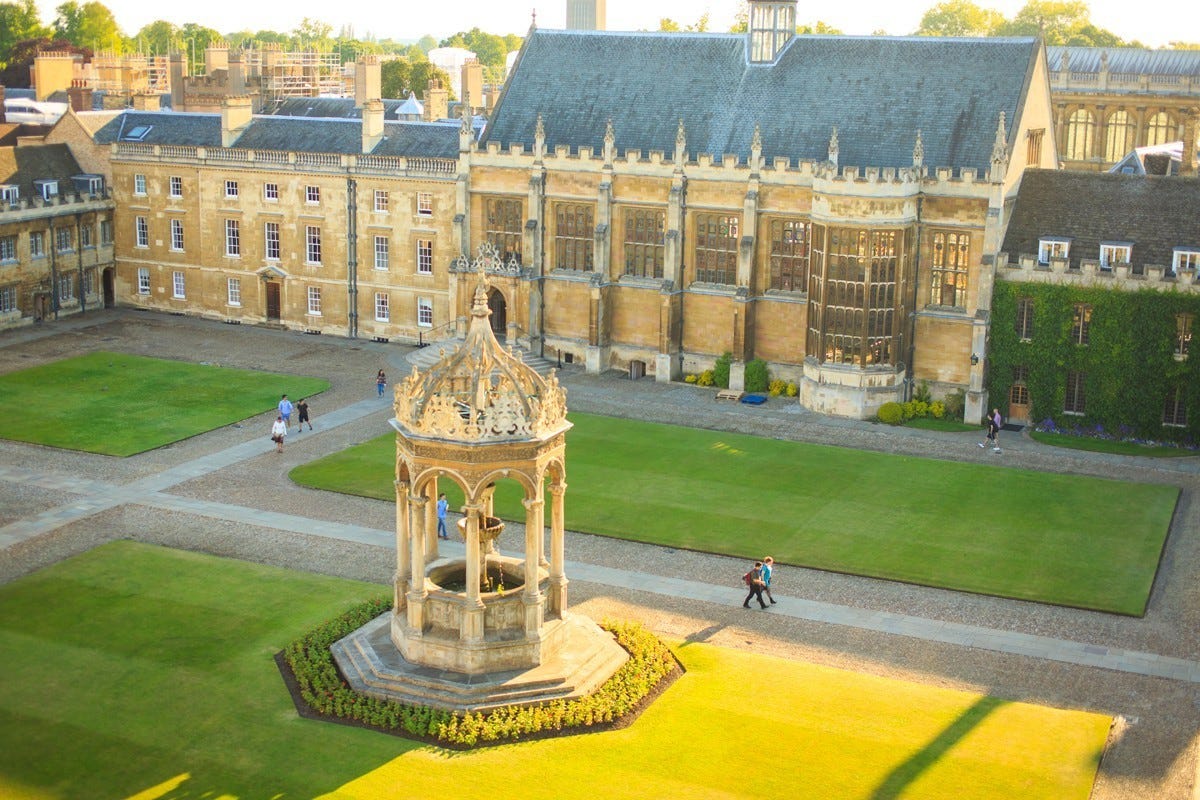
How Trinity College turns confiscated land, imperial finance and private wealth into authorised knowledge.
Trinity College says its endowment exists to support “the advancement of education, learning, religion, and research”. It says the money attracts “best-in-class Fellows”, funds “groundbreaking research” and delivers “global impact”. It says a £2.5 billion portfolio of global equities and British property will “sustainably serve future generations in perpetuity”. (Trinity College Cambridge, “Endowment”, figures at June 2024)
The phrase is unusually honest.
The object is perpetuity. The College must preserve the property, preserve the authority created by the property and preserve its power to decide what knowledge receives money. “Sustainability” describes the continued life of the fund. It does not describe the continued life of the people, land or relationships from which the wealth came.
Trinity’s own website gives the origin in one sentence. Henry VIII founded the College in 1546. “Most of this endowment was derived from land and endowments that had belonged to dissolved monasteries.” The new College began richer than King’s Hall and Michaelhouse combined. Their joint endowments amounted to less than a quarter of Trinity’s. (Trinity College Cambridge, “Brief history of the College”)
Property taken by the Crown became an academic endowment.
The confiscation disappears inside the noun.
An endowment is property organised so that the institution can spend its income while preserving the underlying capital. The original act can recede into history. The rent continues.
Trinity’s current portfolio produces about £45 million to £55 million each year and pays roughly 75 per cent of the College’s annual expenditure. The portfolio contains global equities, listed and unlisted companies, venture capital and British property. Trinity names the Cambridge Science Park and Felixstowe Docks among its holdings. It gives around £10 million of the annual income to research and other programmes outside the College. (Trinity College Cambridge, “Endowment”, figures at June 2024)
The chain is straightforward.
Land becomes rent. Rent becomes investment capital. Investment capital buys shares and more property. The returns pay Fellows, researchers, students and buildings. Those people and buildings produce knowledge bearing the authority of Cambridge.
Trinity describes the final payment as charity. The description leaves the first acquisition behind.
The University of Cambridge has already admitted that the collegiate university “benefited both directly and indirectly from enslavement, the slave trade, and imperialism more broadly”. Its inquiry found that Cambridge institutions invested in Atlantic slavery, received gifts based on income from the trade, educated the sons of slave-estate owners and provided intellectual support for the pro-slavery movement. It concluded that the economic legacy continues. (University of Cambridge, “Legacies of enslavement: report and response”, 22 September 2022)
Trinity appears in the financial record. Cambridge says several of its institutions, including Trinity College, owned East India Company bonds from 1660. The Company traded enslaved people as well as land, textiles, commodities and political power. Cambridge’s account does not provide the size of Trinity’s holdings. It records the instrument and the institution. (University of Cambridge, “Legacies of enslavement: report and response”, 22 September 2022)
The human network also sat inside the College. Stephen Fuller, a former Trinity Fellow, served as Jamaica’s agent in Britain from 1764 to 1794 and became one of the most prominent organisers of the pro-slavery cause. Sir Charles Davers, a Trinity-educated parliamentarian, supported that movement. Trinity fellows included people with direct financial interests in slave companies and plantations: Richard Loving owned Royal African Company stock; the Reverend Richard Smith part-owned a mortgage on the Mapps plantation in Barbados while serving as a Trinity Fellow; and Benjamin Bosanquet came from a banking family connected to maritime insurance for slave traders. (University of Cambridge, The University of Cambridge in the Age of Atlantic Slavery, 2025)
Cambridge educated the heirs of people who owned and traded human beings. The colleges collected their fees. The fellows supplied law, theology, administration and political argument. The endowments held the securities.
The university was part of the operating system.
In March 2023 Trinity announced that it would appoint a four-year Legacies of Slavery Research and Teaching Fellow. The College said the researcher would examine how Trinity “was linked to, benefited from or challenged the slave trade and other forms of coerced labour”. It identified fees, bequests and College investments as possible routes through which the money entered. It also announced £1 million for Caribbean scholarships over five years. (Trinity College Cambridge, “Trinity College to investigate legacies of slavery”, 17 March 2023)
The language contains its own escape route. Trinity will investigate whether it benefited, while Cambridge has already documented Trinity’s East India bonds and Trinity-linked defenders and beneficiaries of slavery. The research programme turns an institutional account into a question that the institution controls, funds and schedules.
The £1 million scholarship commitment equals 0.04 per cent of the £2.5 billion portfolio described on Trinity’s website. The endowment remains intact. The College retains the land, investments, annual income and authority to decide what repair looks like.
It studies the provenance of its power using the power.
Trinity’s history says the College assumed leadership in seventeenth-century natural science “that it has never lost”. It describes itself as a home of scholars, scientists and mathematicians. It says its endowments allowed it to foster new subjects and attract gifted scholars from around the world. (Trinity College Cambridge, “Brief history of the College”)
This is more than institutional pride. It is a theory of authority.
The story runs from Newton to the present as a continuous accumulation of truth. Money appears as support. Science appears as discovery. The institution that selects the questions, pays the salaries, owns the laboratories and confers the titles disappears from the account.
Selection is the missing verb.
An institution with a large permanent fund can decide which account of the world gets time, equipment, publication, students and continuity. A different account can be dismissed as unscientific before anyone gives it those things. The winning framework then points to its funded output as proof that it alone produces knowledge.
This is how a situated worldview begins to call itself reason.
The split from vitalism matters here as a rupture in conscience.
Vitalism covered different theories in different periods. The conceptual loss was larger than any single theory. Matter became inert. The organism became a machine. Life became something that could be completely known by breaking it into measurable parts. Relationship, purpose, consciousness and obligation became suspect because they could not be handled in the same way.
The method then became an ontology. What could be measured became what was real. What could be isolated became what could be understood. What could be manipulated became what could be used.
Other scientific traditions and other accounts of life did not merely lose arguments. Western institutions removed their authority, resources and standing. “Woo” became a disciplinary word. It placed an idea outside the border without requiring the institution to examine the political work performed by that border.
Mechanistic knowledge suited an extractive order. Land could become acreage. Plants could become chemical feedstock. Bodies could become labour. Human variation could become ranked data. Atoms could become weapons. The scientist could call each object neutral because the moral relationship had been removed before the measurement began.
The same institutions then placed ethics after discovery. Conscience arrived as a committee once the grant, laboratory, patent, weapon or classification system already existed.
Isaac Newton spent his Cambridge academic life at Trinity. The College uses that history as evidence of an inherited scientific authority. In 1988 it gave his name to a trust that directs money across the University. (Trinity College Cambridge, “Brief history of the College”; Isaac Newton Trust, “About the Trust”)
The Isaac Newton Trust says it promotes “education, learning and research”. It says its grants form an important part of Cambridge’s research strategy. It funds early-career researchers, research posts, seed projects and doctoral programmes. It also funds projects intended to attract larger external grants. (Isaac Newton Trust, Trustees’ Annual Report and Financial Statements 2024–25, pp. 2–5)
Newton’s name makes this look like the natural continuation of scientific excellence. The accounts show a financing mechanism.
Trinity gave the Trust £2,457,441 in the year ending June 2025. Other donations came to £14,292. Trinity was therefore responsible for more than 99 per cent of its donation income. The Trust calls Trinity its “main donor”. Trinity also supplied £12 million for a five-year doctoral programme. Trinity’s Council appoints one or two Trinity Fellows as trustees, receives the annual report and remains embedded in its administration. (Isaac Newton Trust, Trustees’ Annual Report and Financial Statements 2024–25, pp. 3–6, 19 and 29)
The Trust also holds £7.6 million in the Cambridge University Endowment Fund. It receives income from investments and has agreements with Cambridge Enterprise for a share in the exploitation of intellectual property. Research produces patents and other rights. Those rights can return income to the machinery that selects more research. (Isaac Newton Trust, “About the Trust”; Isaac Newton Trust, Trustees’ Annual Report and Financial Statements 2024–25, pp. 4 and 24)
Money selects knowledge. Knowledge produces property. Property funds more selection.
Newton supplies the halo.
The Isaac Newton Trust has match-funded Leverhulme Early Career Fellowships for Cambridge since 2007. In 2024–25 it approved 15 new fellowships and recorded £816,846 in net Leverhulme fellowship commitments after write-backs and refunds. Its formal priorities include matching “prestigious external fellowships”, most notably those awarded by the Leverhulme Trust. (Isaac Newton Trust, Trustees’ Annual Report and Financial Statements 2024–25, pp. 3–5 and 20)
Leverhulme pays the first year of an Early Career Fellowship and half of the salary in years two and three. Cambridge must guarantee the balance before an application enters the national competition. At Cambridge, the Isaac Newton Trust undertakes to provide that match up to £28,000 a year in years two and three. (Isaac Newton Trust, “Leverhulme Early Career Fellowships”)
Nathan Cofnas held a Leverhulme-funded post in Cambridge’s Faculty of Philosophy from 1 September 2022 to 31 August 2025. A 2026 court judgment records his research area as “the biological basis of moral norms”. During that institutional period his public work promoted hereditarian accounts of race, intelligence and hierarchy. Cambridge gave the work a salary, an address, teaching opportunities, examining authority and the descriptive power of “Cambridge researcher”. (County Court at Cambridge, Cofnas v The Master, Fellows and Scholars of Emmanuel College, judgment, 13 March 2026; Nathan Cofnas, curriculum vitae, May 2025)
Two old fortunes meet at this point.
Leverhulme brings wealth preserved through Unilever, descended from Lever Brothers and its colonial extraction. Trinity brings wealth preserved through confiscated land, imperial securities, property and accumulated investment returns. One external trust awards the fellowship. The Cambridge system guarantees and routinely matches the salary. The University converts the funded position into academic authority.
The formal project title does not contain the whole public function of the post. A salary buys time. An affiliation buys credibility. Teaching and examining confer power over other people’s education. The Cambridge name travels into newspapers long after the fellowship ends.
Trinity still commemorates Sir William George Pearce as its most generous benefactor. Pearce inherited the chairmanship of Fairfield Shipbuilding and Engineering from his father. He left the residue of his estate to Trinity. The contemporary biographical record valued it at more than £150,000 and called it probably the largest addition to Trinity’s endowment since Henry VIII founded the College. (Trinity College Choir, “Commemoration of Benefactors”, 17 March 2017; Dictionary of National Biography, “Pearce, William George”, 1912 supplement)
This is another standard conversion.
Inherited industrial ownership becomes personal property. Personal property becomes a charitable bequest. The bequest enters an endowment. The endowment loses the history of the ships, contracts, materials, labour and imperial system that produced it. Trinity remembers the giver. It does not put the industrial supply chain into the annual commemoration.
The person becomes generous. The institution becomes deserving. The workers become background.
Trinity says its endowment funds “groundbreaking research”. The word sounds as if important questions announce themselves.
They do not.
A funding system establishes importance by repetition. It gives a field permanent posts, laboratories, journals, conferences, prizes and students. The resulting volume becomes evidence of maturity. Approaches outside the system receive little money, produce less institutional output and are then judged by the absence the system created.
This matters in physics, biology, psychology, economics and philosophy. It matters wherever a narrow model of matter or human life can present itself as the whole world. It matters when the model makes extraction, ranking or control appear technical rather than political.
The issue is larger than whether one theory is right or wrong. Trinity has the material power to decide which disputes become disciplines, which remain curiosities and which are dismissed as “woo”. Its money does not sit outside the production of truth. It determines who receives the institutional conditions required to speak as an authority.
Trinity’s public language can now be read in full.
“Endowment” means property separated from its provenance.
“Perpetuity” means the institution’s claim to the returns never expires.
“Independence” means accumulated private wealth can direct research without democratic control.
“Groundbreaking” means selected, financed and institutionally reproduced.
“Public benefit” means the institution chooses how much of the income to distribute, to whom and on what terms.
“Sustainability” means preserving the capital that preserves the institution.
“Excellence” means the authority produced by centuries of unequal access to money, time, publication and appointment.
“Academic freedom” means little if private wealth determines who first receives an academic life.
The College does not hide this structure. It publishes the pieces on different pages. The history page describes the confiscated monastic land. The endowment page describes the £2.5 billion portfolio. Cambridge’s enslavement inquiry records the East India bonds. The Isaac Newton Trust accounts record Trinity’s donations and its role in selecting research. The fellowship terms explain how private trusts assemble a Cambridge salary.
The laundering happens in the gaps between the pages.
Trinity’s founding endowment came mainly from land and property taken from dissolved monasteries.
Trinity held East India Company bonds from the seventeenth century.
Trinity fellows and students participated in the financial, political and intellectual machinery of enslavement and empire.
Trinity now controls a portfolio of roughly £2.5 billion that produces £45 million to £55 million a year.
Trinity established the Isaac Newton Trust and remains overwhelmingly its main donor.
The Trust match-funds Leverhulme Early Career Fellowships and helps decide which researchers receive Cambridge posts.
Cofnas held a three-year Leverhulme-funded Cambridge research post while promoting hereditarian racial hierarchy.
Trinity’s wealth and scientific authority did not develop on separate tracks. Property financed scholarship, and scholarship legitimised the order that protected property.
The endowment converts historical seizure and extraction into present control over knowledge.
The Newton story presents that control as the inheritance of genius rather than the exercise of wealth.
Research funding does more than support ideas. It creates the people who are permitted to embody institutional truth.
Trinity says the endowment will serve future generations in perpetuity.
It does not say whose future. It does not say whose property. It does not say who gets to define knowledge.
The accounts answer all three.
Trinity College Cambridge, “Endowment”, https://www.trin.cam.ac.uk/about/endowment/
Trinity College Cambridge, “Brief history of the College”, https://www.trin.cam.ac.uk/about/historical-overview/in-brief/
Trinity College Cambridge, “Trinity College to investigate legacies of slavery”, 17 March 2023, https://www.trin.cam.ac.uk/news/trinity-college-cambridge-to-investigate-legacies-of-slavery-1-million-to-support-caribbean-scholarships-plus-new-academic-post/
University of Cambridge, “Legacies of enslavement: report and response”, 22 September 2022, https://www.cam.ac.uk/stories/legacies-of-enslavement-inquiry
University of Cambridge, The University of Cambridge in the Age of Atlantic Slavery, 2025, https://www.cambridge.org/core/services/aop-cambridge-core/content/view/6BC358D69084C40CBF93B4A5FC1CE3AB/9781009652544AR.pdf/The_University_of_Cambridge_in_the_Age_of_Atlantic_Slavery.pdf?event-type=FTLA
Isaac Newton Trust, “About the Trust”, https://www.newtontrust.cam.ac.uk/about
Isaac Newton Trust, “Leverhulme Early Career Fellowships”, https://www.newtontrust.cam.ac.uk/ECFs/LeverhulmeECF
Isaac Newton Trust, Trustees’ Annual Report and Financial Statements 2024–25, https://register-of-charities.charitycommission.gov.uk/en/about-the-register-of-charities?p_p_id=uk_gov_ccew_onereg_charitydetails_web_portlet_CharityDetailsPortlet&p_p_lifecycle=2&p_p_state=maximized&p_p_mode=view&p_p_resource_id=/accounts-resource&p_p_cacheability=cacheLevelPage&_uk_gov_ccew_onereg_charitydetails_web_portlet_CharityDetailsPortlet_objectiveId=A18319687&_uk_gov_ccew_onereg_charitydetails_web_portlet_CharityDetailsPortlet_priv_r_p_mvcRenderCommandName=/full-print&_uk_gov_ccew_onereg_charitydetails_web_portlet_CharityDetailsPortlet_priv_r_p_organisationNumber=5203734
County Court at Cambridge, Cofnas v The Master, Fellows and Scholars of Emmanuel College, judgment, 13 March 2026, https://bfsp.uk/wp-content/uploads/2026/04/Cofnas-v-Emmanuel-College-judgment.3.26.pdf
Dictionary of National Biography, “Pearce, William George”, 1912 supplement, https://en.wikisource.org/wiki/Dictionary_of_National_Biography,_1912_supplement/Pearce,_William_George
Trinity College Choir, “Commemoration of Benefactors”, 17 March 2017, https://trinitycollegechoir.com/wp-content/uploads/2021/12/2017-03-17.pdf
Comments
Nothing yet. Say the first thing.
Sign in to join the conversation.