
One of the best-written novels I read last year was Eric Puchner's fever-dreamy dramatic saga, Dream State. The story eventually took a few weird turns that weren't really for me, but I loved and admired his writing all the way through.
When I went through my reading notes and thought more about why, I noticed several specific reasons, and a big one is his interesting use of verbs and verb phrasing. I love an unconventional verb, and Eric's work is punctuated generously with them.
Incorporating unexpected (but relevant/resonant) action words into your prose can make it absolutely prickle with life. It's amazing how a simple description can become a vividly animated flash-frame with a single startling verb.
Here are a few examples:
- pine needles, a faint crawfish-y smell from the lake, a hint of sweetness from the cherries bubbling in the trees
- the sky bristled with stars
- only the splash of waves, slurping the dock
- she coiled a pair of brown socks into a cinnamon bun
- Garrett, whose inpatient memories still drunk-dialed his dreams, did not relish the idea.
- her hair, tinseled with gray
I also found this:
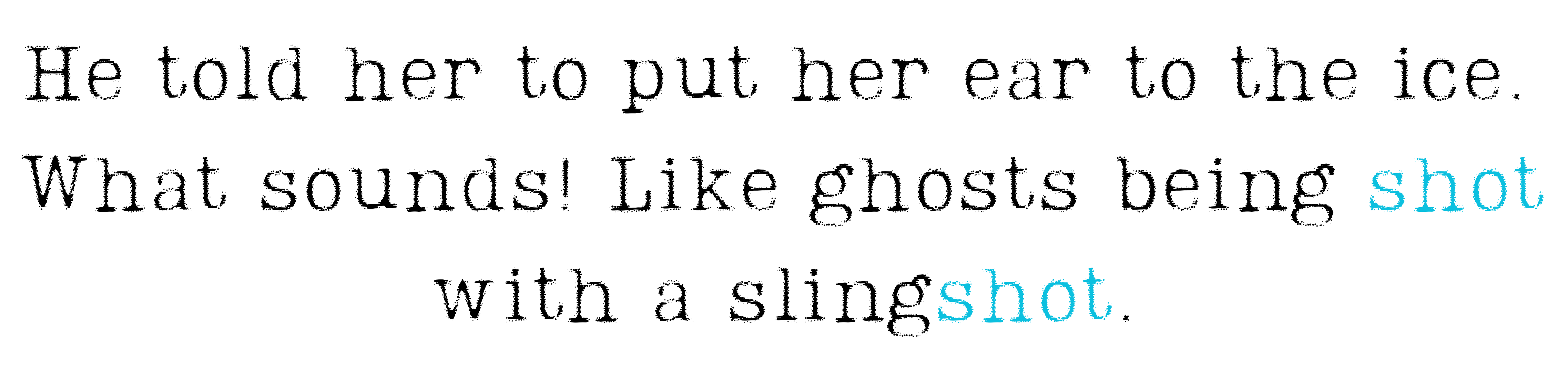
I love this simile and its image / sound / texture, and the action it conjures, but I’m also a poet by nature (and heart) who cheekily disregards lines between poetry and prose, and my instinct here illustrates it:
I would have changed the verb to avoid the repetition.
Repetition in the one context can be powerful, and in another can have a dulling, watering-down effect—which is what I think happens here. The rest of the prose is beautiful. There are 429 pages of it! Does one bad apple really ruin the bunch? No, of course not—the rest of the apples are still good. But why not make the bunch the best it can be by swapping the bad one out?
So! I would have changed the verb. Let’s talk about it.
I’m going to try to break down exactly how I’d do that if this were my line to tinker with.
So first, I’m going to consider what we’re dealing with here: When you’re shot with a slingshot, what happens? It’s like a thud. It’s like a whip-thud. There’s a velocity to it, a pressure > release, a strained delay and a violent sailing aspect to whatever hits you. The air gives it a sort of space or breath. Because we associate slingshots with lost boys/Lord of The Flies type energy, the classic projectile most of us imagine for a slingshot is probably a small to medium sized rock. A rock is sharp and very solid, so there’s a thud or crack when it nails a target.
SO: We probably need a relatively small but very dense, somewhat rough thud/crack that has punch, relief and flying in it. And then there’s the matter of the target, which is ghosts. Flickery, gauzy, in-betweeny, with a whooshing, shushing presence, a shimmery, not-quite-there-ness. Not “shot”, but. . .
~:~
This, friend, is the perfect opportunity to use one of the hands-down best tools of the trade: THE THESAURUS.
People like to sniff haughtily and look down their noses at thesauruses, like their only reason for being is so we can bullshit each other better, but the reality is the opposite and most writers know exactly what they really are: treasure chests of words. I use the in-house (Apple) one on my laptop and when that doesn’t have my word (because as you can see, I’ve already broken it down and figured out exactly the word I need, so now I’m treasure-hunting for the word itself knowing I’ll recognize it when I see it), I go to the internets which has a million more treasure chests to rifle through.
And then I bop around, excitedly rifling, until I find it. And I mean it when I say excitedly: looking for my word is honestly one of the most exciting, giddy experiences I have while writing. It’s one of my favorite feelings, bested only by the feeling of finding it.
The English language is extraordinary, and extraordinarily rich. We actually do have all the words we need to say exactly what we're trying to say. We just have to figure out which ones we need to say it, and in what combinations and arrangements. This is the process. This is the way!
If this seems like a lot of work, that’s because it is! When poets talk about how difficult it is to write poetry, where each word matters ever-so-much-more because the form itself is defined by our deliberately using so few of them, this is one of the many reasons why.
We can use the medium of language however we like, regardless what we’re using it to create, but the first and only real rule of using words well is this: USE THEM WITH PURPOSE. Know why you’re using them in the ways that you are.
This is the crafting part of the process—the part that comes after all wildness and weirdness and exploring, and if you don’t follow this one basic rule your writing will never reach its full potential or have its full potential impact on your readers. And if you don’t do the first part of the process (Start wild! Follow the weird! Experiment and play!), you’ll have nothing interesting to work with when it’s time to sort through it and do a little thinking.
But during the crafting phase: respect the medium. Make deliberate choices, down to the word.
So what’s the verb I’d land on?
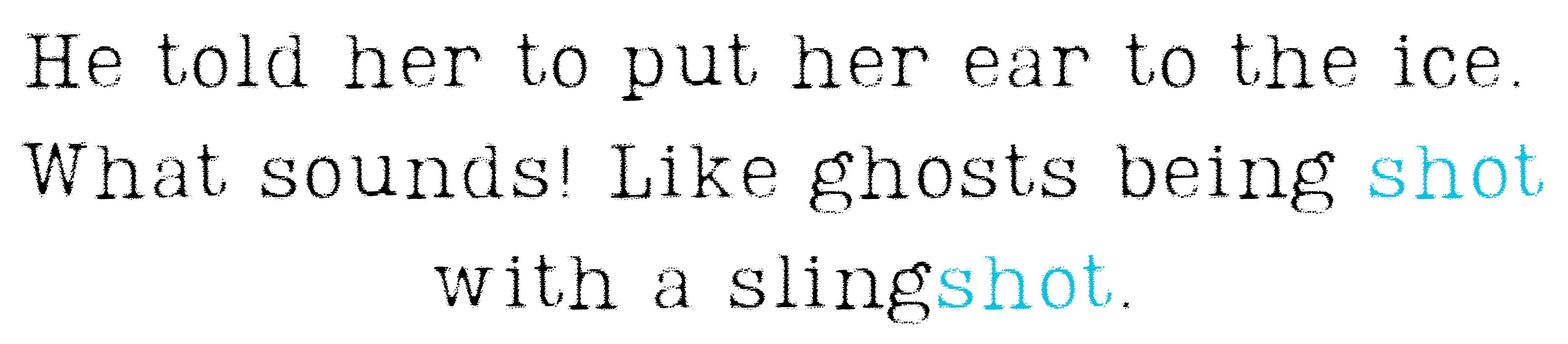
I’m not telling, because this is excellent practice, and because there’s no right or wrong choice here—only choices that sing and choices that don’t. You know them when you see them. Go find one yourself!
🏴☠️
First one to the treasure gets the prize. Just kidding! The practice is the treasure. Everyone gets the prize.
Love & light from the margins,
ali ✨
Star in the Margin is free and open to all, but does require lots of time, love, and energy! If you’re into the vibe and want to cheer me on. . .
Related reading:
Proof of Magic
·
October 6, 2025
One of the most widely quoted lines from Stephen King’s first and so-far-only book of nonfiction, On Writing, is: Books are a uniquely portable magic. I love this quote as much as everyone else, for the simple yet extraordinary truth of it. You don’t even have to be an avid reader or writer to get it, either; anyone who’s ever been moved or transported …
The Enchanted Classroom
·
Feb 2
This week, I thought I’d reach back to my "Ten Best Reads of the Year" broadcast to show you how ✨margin-starring✨ works on my end when I’m reading. I always say we should be actively participating by collecting inspiration and instruction from what we read (not just books, but
Comments
Nothing yet. Say the first thing.
Sign in to join the conversation.