
Q: What can we do to get some relief when we’re flustered, frustrated, or feeling stuck?
There are so many kinds of difficult feelings we negotiate on a daily basis, and many of the most charged (and thus most combustible) ones have one thing in common: they’re crowded. Anger, resentment, overwhelm, despair—they crowd us out. Without intervention they can easily overtake us, hijacking our bodies, our attention, our feelings, energies, thoughts, options.
What all of them need is: S P A C E
There are lots of different kinds of space we can make to give these emotions the breathing room they need to shift, stretch, and soften, making way for something else—compassion, tolerance, understanding, perspective—to step in and take the helm, to right the ship, clean up the vibe. Point us in a more constructive direction.
The more we make the merrier and less ruffled we’re likely be as we go along.
As promised last week, here are a few ideas about how.
Tidy up, wipe something down, declutter. Spring cleaning! Purge stuff you no longer enjoy, use, or need. Reorganize or redecorate to make your space to feel more open, pleasant, and aesthetically pleasing to you. Pay attention to your breath and the space it makes inside your body. Notice both your body in space and all the negative space around and beyond your body. Drive with the windows down. Go outside. Rearrange the furniture, even if you just end up putting it all back. Wash your sheets! Clean your car. Take a street you don’t usually take home from work to let your familiar route and world unfold and expand from the inside out.
Move your body or allow it to pause in stillness. Shake, stretch, dance, jump around. Breathe big, hold it in, count to ten, whoosh it out. Make extra noise or be extra-quiet, depending on the kind of space you need. Lay fully down on the floor, run as fast as you can, forward fold and let go, hanging out in ragdoll for a few breaths. Sing, scream. The car is great for screaming! (Plus the absurdity of screaming in the car always makes me laugh afterwards if I really gave it my all, which I consider a bonus.) Get enough sleep. Go for a walk, do a little cartwheel for no reason. Don’t be shy – I mean, how would you feel if you saw someone do a random cartwheel down your street? Just saying.
Or do gentler, more calming things with your body. Take a bath. Hug a pillow. Rest. As Mary Oliver famously put it in her iconic poem “Wild Geese”: You do not have to be good / You do not have to walk on your knees . . . / let the soft animal of your body / love what it loves.
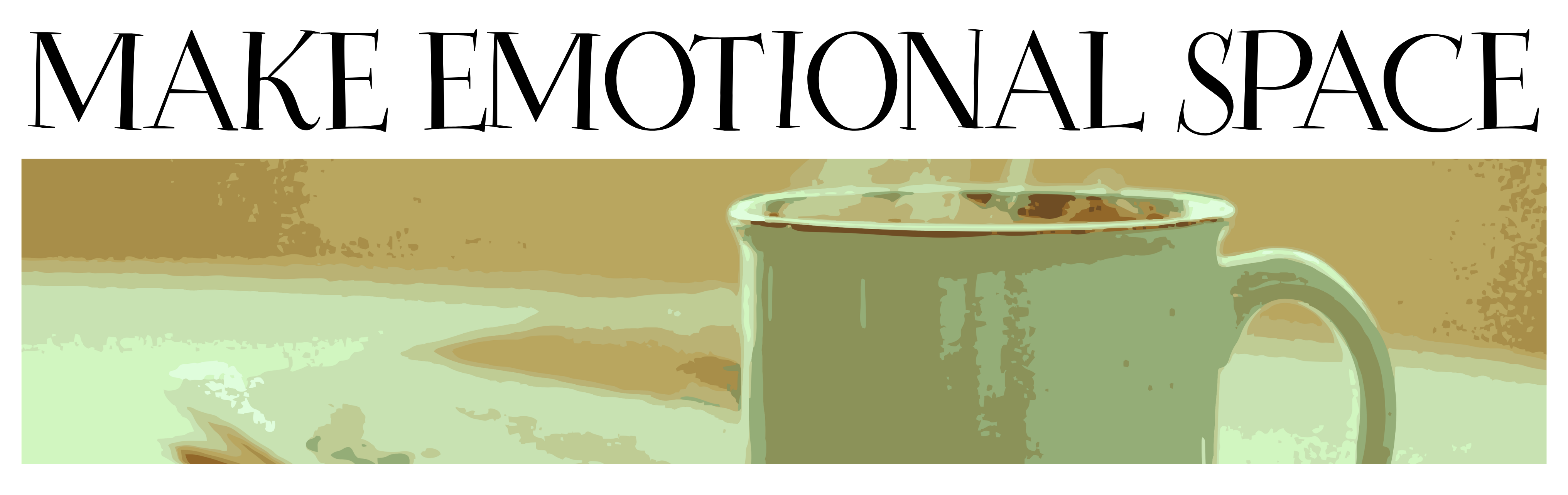
Settle down with a good book (I find fiction works best here!) and a cup of tea. Take a moment for a little self-compassion practice. The more compassionate we are to ourselves, both in prickly moments and smoother ones, the more openness we’ll bring around with us, into whatever is happening. Place a hand on your heart and breathe deeply into your hand, offering yourself some words of kindness. You’re going to be okay.
Keep a few reliable laughs in your mind’s pocket, too, like little charms to remind you not to take things too seriously. Laughter is an often effortless emotional space-maker. It has a wonderful way of rinsing off the moment, opening up a new one. And, bonus: It’s contagious!

Try this sensory-focusing exercise: Choose one of your five senses to start with, and pick out 3-5 things in your immediate experience that you notice with that sense. For example, if you start with touch: My socks feel soft around my feet. My breath is cool passing through my nostrils. My left shoulder has some tightness, some pressure. Repeat for each of your five senses, taking a few moments with each. For sight, I like to pick a color and then notice 3-5 things that color in my immediate environment. Your mind will be like a puppy who will keep bouncing off after some shiny thought or feeling, and that’s no problem. When you notice you’ve become distracted, picture the distracting thought/feeling as a cloud passing through the clear sky of your mind, and gently bring your awareness back to the sense at hand.
It doesn’t matter how many times you have to do this—what matters is the doing it.
This simple practice relaxes and settles both the mind and the body and is excellent for steadying attention and making mental space. The more you notice, the more you’ll make.
Take a break from your creative project and do something completely different, then return to it and let new ideas and energy percolate in. Play creative games. Have fun! Fun is an excellent space-creator—so is novelty. Try a medium swap-out: make something with a medium you don’t usually work with, and/or try to re-create part of your current project using a different medium (paint the song you’re composing! Curate a playlist for the scene you’re writing. . . ) than the one you've been using. Visit a gallery or museum either physically or virtually, attend a performance, engage in any creative activity that might spark new ideas or inspiration by jazzing you on the wild what-alls that other artists are up to.
There are interesting makers of things all around us. Let’s seek each other out and jazz each other up on what we’re making, noticing new pathways and possibilities that bloom open where our imaginations meet.
One of my very favorite meditations (which I think I made up by mashing a few different ones together) I’ll call Balloon Levitation. It’s easy! Sit comfortably, eyes closed, straight spine, proud heart. Take a big breath into your belly, allowing it to expand in all directions as if filling up a balloon. When you get to the tippy-top of your inhale, imagine tying the neck of the balloon off to seal it, then, exhaling slowly, let the balloon float right out the top of your head. Watch it drift up and away.
At the bottom of your exhale, begin filling a new balloon, and start the process again.
If you do this enough times, you may start to feel yourself floating—right off your seat! (Talk about space!)
When you reach the end of your rope, tie a knot in it and hang on.
Franklin D. Roosevelt
To shine and expand and keep our better angels at the ready and inner Hulks in check, we need room to think, feel, move, and breathe. Did you know that the surface area of the human lung is equal to half of a tennis court? This is crazy, but the airways that run through them purportedly total around 1,500 miles—the distance from Boston to Miami. The more areas of our lives we can breathe that kind of magically expanding space into, the bigger the margin we’ll have when we need to stretch or adjust our perspective or response--to the little things, the big things, to All The Things. (And so we can get back to starring it!)
And when in doubt, remember, remember:
🎈
And if that doesn’t do it. . . there’s always dancing. 🕺🏻
How about you? What kind(s) of space would be helpful for you to make and hold for yourself right now or in the coming days, weeks, season? Do you have any trusty strategies that I haven’t included? Tell us, tell us!
Whatever you’re working with, I hope this helps. 🩵
Love & light from the margins,
ali ✨
Star in the Margin is free and open to all, but does require lots of time, love, and energy! If you’re into the vibe and want to cheer me on. . .
Related reading:
How to Get Unstuck
·
July 21, 2025
Q: What’s the cure for a maker-of-things who feels stuck, blocked, or uninspired to make the things?
Comments
Nothing yet. Say the first thing.
Sign in to join the conversation.