
Hello again to my bi-monthly friend-vestor update.
I’m going to title each update with the #1 song on my On Repeat playlist. That’s this one right now. Will probably make a playlist out of it later.
As I (re) start this journey, I want to walk you through how I come up with ideas. Hopefully you will take this, adapt it, make it your own, and use it in your life.
Not just for startups, but for anything that concerns the act of creation.
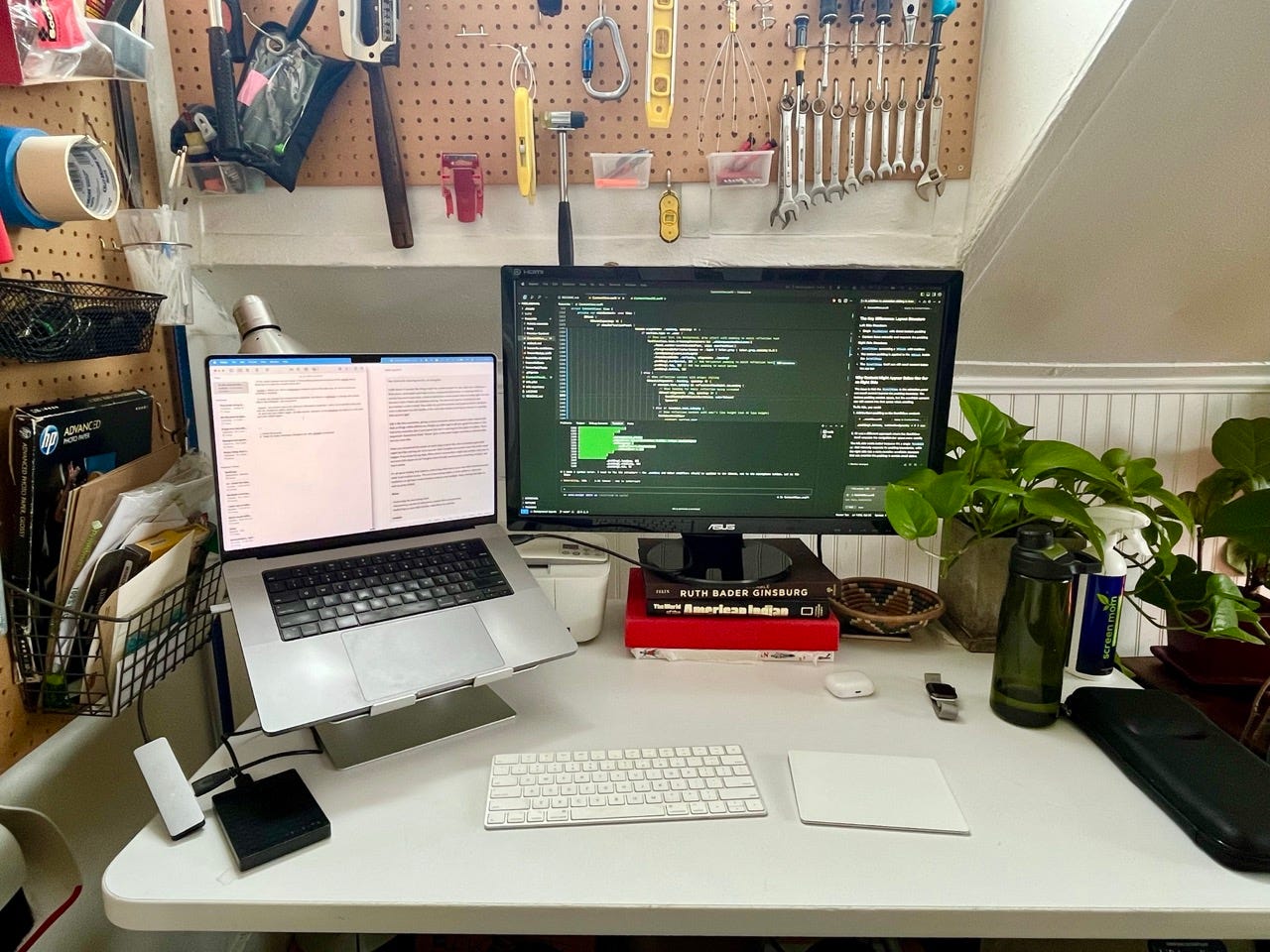
There are three sections. The “Why”, the “What”, and the “How” using what I’ve been up to the last 2 weeks as a lens.
Warning this is all quite long. But hopefully you get a peek under the hood.
Not to go full Simon Sinek on y’all but you do have to start with the Why.
Many first-timers get this wrong because they don’t know why they do things.
Take a second and read that again. If there’s one thing you take away from this entire update, it should be that.
I can’t tell you how much time I have wasted believing I could do something that I couldn’t fully commit to.
Like working an online grocery store, a political tech mobile app, a chrome extension for researchers to share highlights across websites, a graph analysis tool for intelligence agents, or a realtime multiplayer game (these are all things I built or helped build).
I’m not saying I regret these. I don’t.
I’m saying that I could have made better decisions in doing those things so those ventures became successful.
And btw, the why isn’t “I was in media. So I should do a media startup.” or “I order food. I love restaurants.”
I mean the deep emotional shit that drives you to do things.
How do you find it? I would start with Elad Gil’s “startups are an act of desperation” which lays out some of the general buckets.
If none of those speak to you, just start doing things but then reflect on them each week. What gave you energy? What didn’t? Some people are motivated by building a beautiful product. Others by the thrill of closing a sale.
Then, ask yourself why. Knowing this will help you make better decisions.
Why will you make better decisions?
Because the bottleneck for doing something at the early-stage is energy. When you do too many things that drain you, you lose it. And then you shutdown.
This isn’t private equity or consulting where you have a gun to your back and cash in front of you.
You need to find what pulls and pushes you when there is nothing.
Maybe a bit personal of an example, but I’m pretty solidly a variation of 4 – time desperation.
I went through something pretty horrible earlier in my life and that to this day makes me really feel like there’s not much time left.
I get antsy. It’s an in my bones type of feeling. It has its pluses and minuses.
The other side effect is that I feel quite deeply in my soul that I want to make people feel really good about themselves. Probably because my high school self felt like no-one really cared about me, and this is my reaction to “heal” that inner child.
It comes out in a lot of silent things. Here’s one that almost no-one knows still minus Maxime Lavech Du Bos (yes, what a frickin amazing name 🤌) and Mimi Sax for catching me but I told them not to tell anyone hehe.
On Valentine’s Day in grad school I woke up at 6am and bought 500 Hershey Kisses. I put 5 on each person in my section’s desk and wrote Happy Valentine’s Day on the board (before Trevor Fetter arrived early to class and erased it). That to me felt like the best day of spring semester RC at HBS.
The point is – it takes a lot of observing yourself at the end of the day and asking “what made me feel good” and “why did I do that” to learn that.
How does it make me make better decisions?
It means I get energy from solving emotional and social “jobs to be done”. That subset of problems I could spend forever on. It means I will probably excel at serving users who appreciate that aspect more (sorry insurance-tech).
And for everything else I should do it just well enough, and then hire someone else.
Knowing this helps me make better decisions that leverage (and compound) my energy.
It guides my decision-making in the what.
If you haven’t heard, the cannon is titled the idea maze. It’s a beautifully short piece that gives the high level on how to navigate your idea. The tactical is here in Balaji’s original notes.
I’ll let the main part speak for itself:
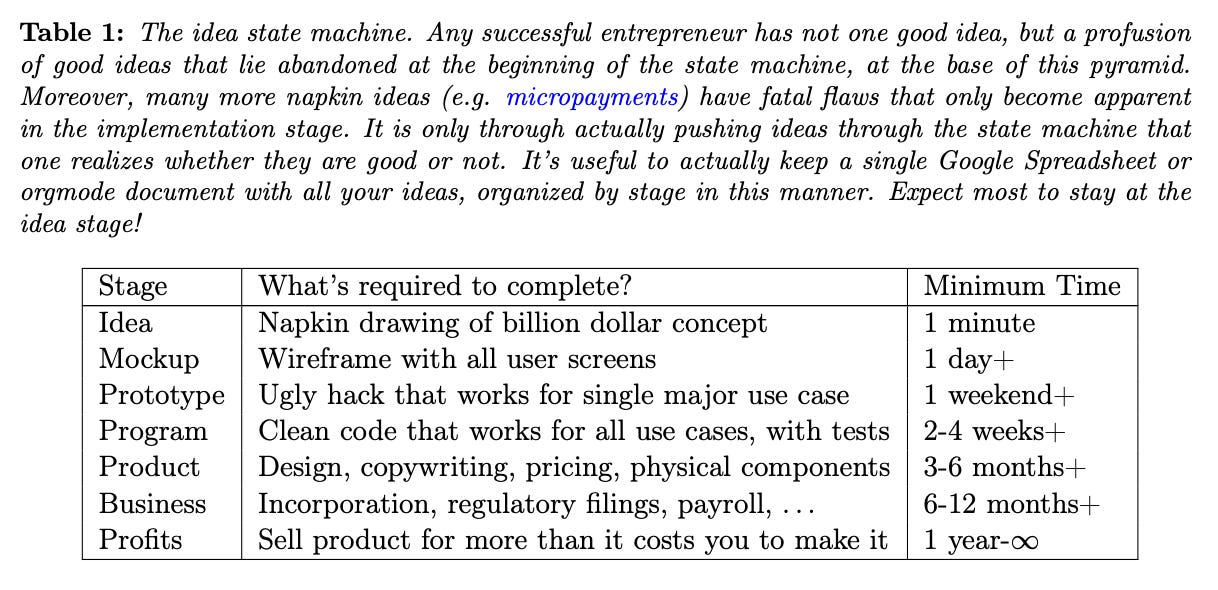
I have lists and lists of these ideas. On Apple notes, on spreadsheets, in Notion.
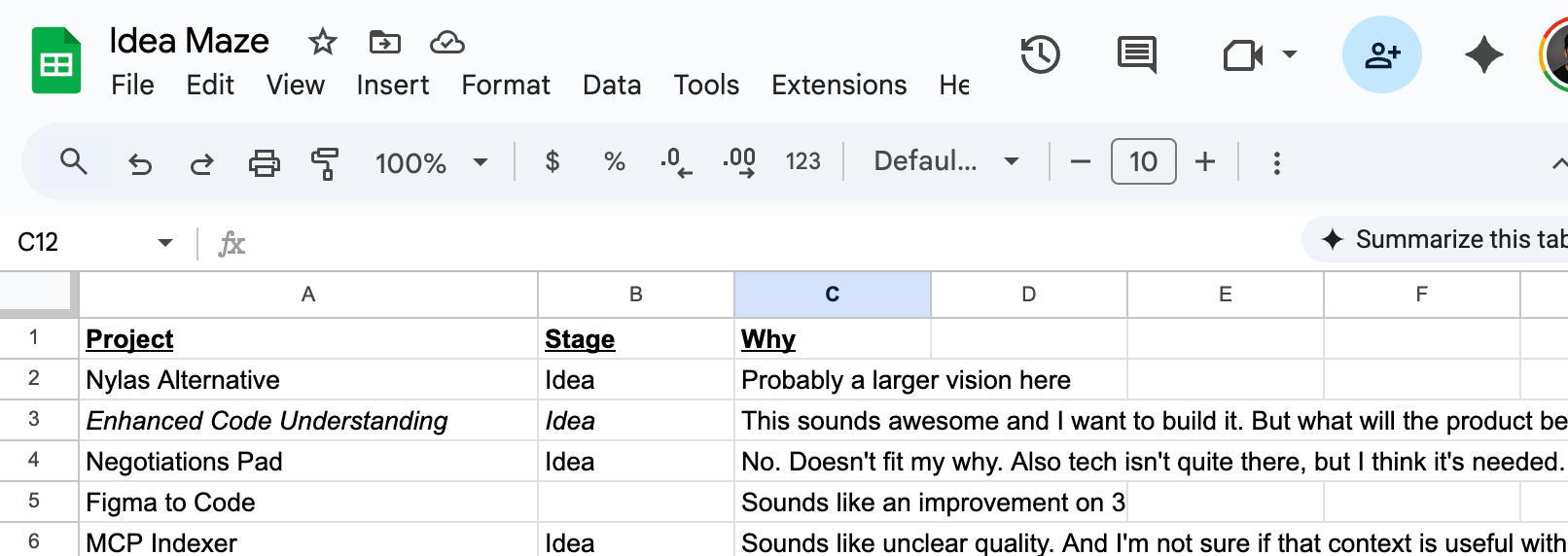
A lot of people get stuck here – “waiting” for the right idea to hit them. A truly insane notion imo. Like expecting lighting to hit you.
Be petty as fuck.
Imagine even the smallest of annoyances (whenever I get a text code in Messages on my Mac, in Chrome it never pops up “do you want to autofill” but in Safari it does UGHHHH). Write that down. Write it all down.
Maybe you talk to a bunch of friends and that turns into a notification blocker, like Motion. Then you find people want to just be better with their time and you turn it into a scheduling assistant and raise $13M, like Motion. Maybe you’ll get a lot of data on specific workflows and build AI employees and raise another $13M, and then $36M, like Motion.
These guys were in my YC batch. Kings. A great example of how being petty can make you see things that others walk over.
If you want to be academic about it, Paul Graham calls it a schlep blindness and talks about Stripe. Great read.
Some free petty starting points:
My Apple Notes is a dumpster fire, why isn’t AI organizing them?
Why do I have to find my photos, edit them, then post to IG? Like each one this takes so much time.
I want to reply to everyones message but some of it’s so fucking basic can I have a bot reply in my tone?
Or for what I’m looking at in DevTools:
Why do I have to know what context to tag?
Why do I have to connect to each MCP server to my instance?
Why do I get better results when I make it plan and then I review and then click “go”? Why can’t it have many versions of itself review itself?
Why do I waste time sitting there while it codes? It’s a lot of time in aggregate but between each run not enough for me to do anything significant.
Daydream.
This is probably the single most underrated skill.
Too many people focus on Horizon 1 or 2 problems, but not Horizon 3. That’s 10 years.
I like to think “what will my kids laugh at that we do a lot of today.”
Like my kids should laugh at the fact that everyone carried a tablet in their pocket with them, and like 50 times a day picked it up and just looked at it for a second then put it back.
This is (one of the) ideas behind the Meta glasses.
This skill is very important, and the best piece of advice here is to consuming creative content. Usually completely out of your field. Movies, YouTube, etc. Being in weird worlds.
Force yourself to rabbithole and then realize no-one is building that future so you better go do it.
Ok so you want to test an idea and see if it deserves moving up “the maze” referenced above.
Don’t listen to what someone says, listen to how they say it.
Sounds crazy but when I talk to a user I usually don’t listen to anything they say.
I listen for how they say it. The emotion.
When you talk to a potential user, you’re not listening for “yeah this sucks”, you’re listening for “yeah it’s annoying to create the pipeline but FUCK SHIT FUCK then GUILFOYLE has to make me write documentation for the whole damn thing”.
Bingo.
It usually won’t look like that, but you should listen for annoyances and dive into those to measure intensity. Those are problems worth solving.
Why? Because intensity matters in choosing a problem. It’s why people cast votes based on late-term abortion instead of littering, the latter of which is much more widespread.
Talk to all your maybe-would-be competitors
That’s right.
You can speed run learning by talking to people who have gone through the journey. It can save you probably 6 months to 1 year of time.
Here are some of those folks I talked to these last 2 weeks (8 total, a selection):
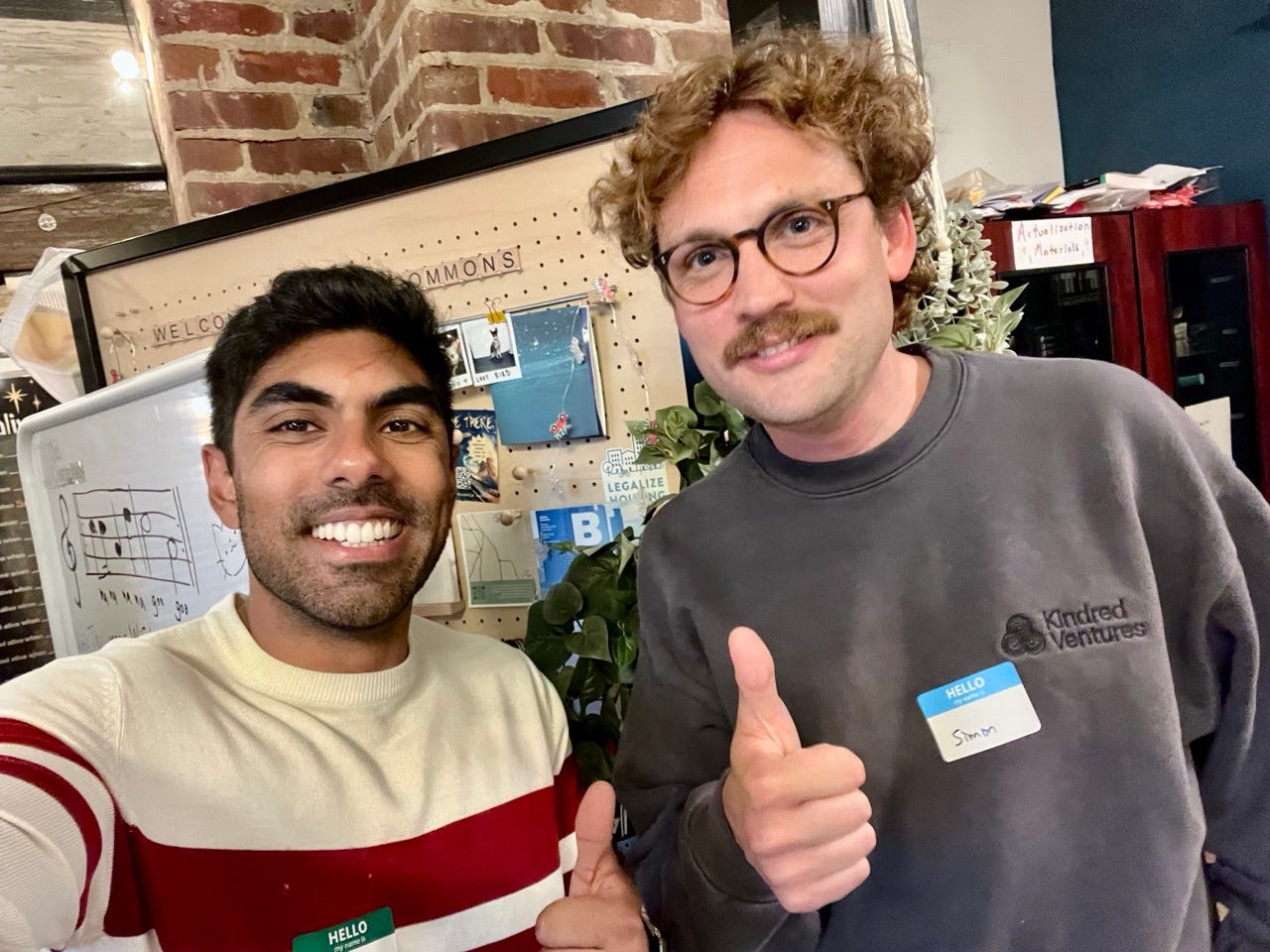
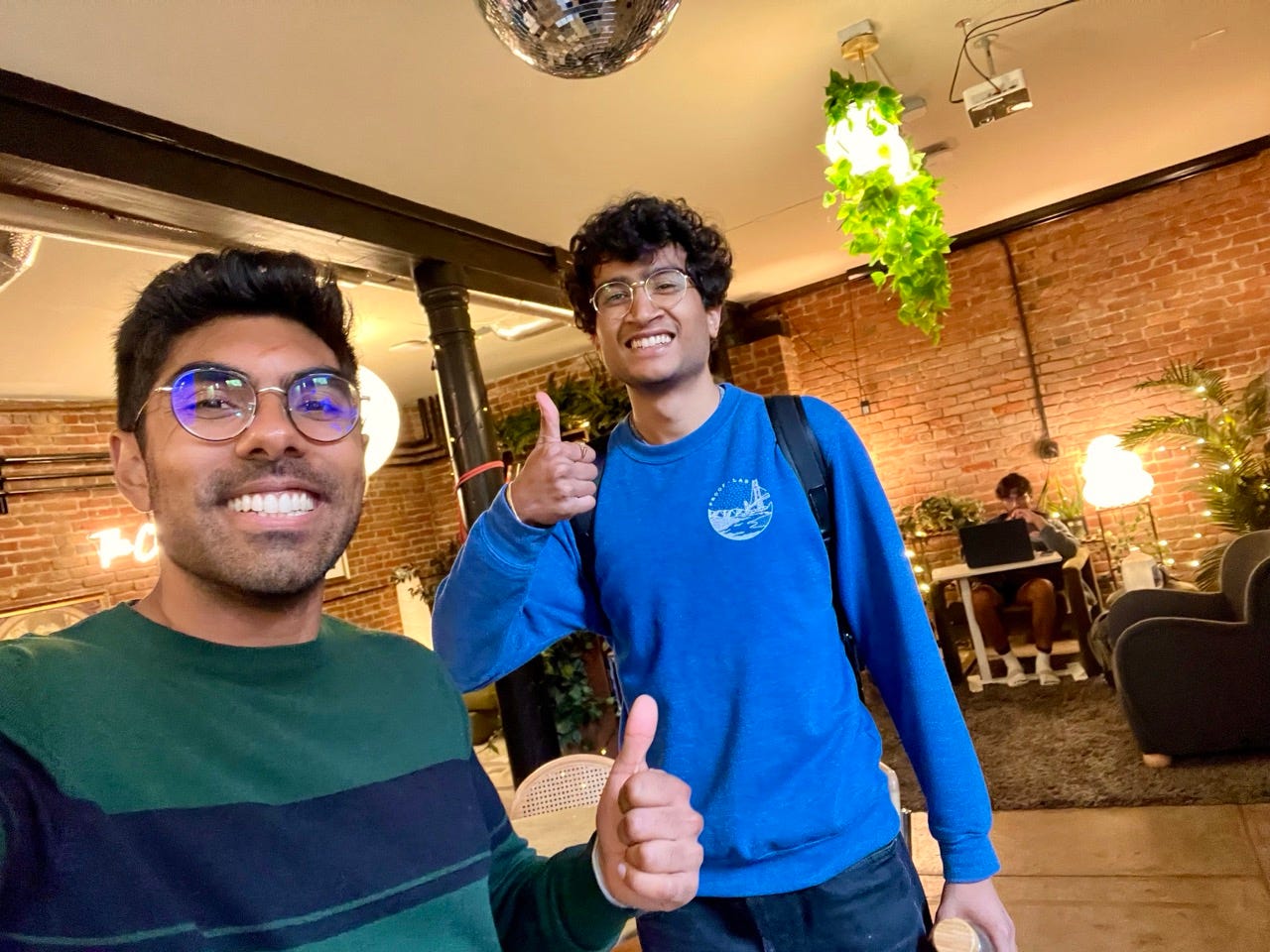
Simon Spurrier from Engine Labs, they’re #2 on tbench.ai beating out Claude Code. Learned a lot about the current state of codebase context understanding.
Anirudh Kamath from Smithery who’s processing like 20K MCP calls a month. Learned a lot about MCP usage and viability.
Samraaj Bath of ion.design who’s built an AI Product Designer. Learned a lot about the buying journey of selling a Figma to Code tool.
Farza Majeed of Tidbit who built Freewrite. Learned a lot about (actually random shit and his new thing, that was just straight fun).
These are all ideas that I had in my little Google sheet above.
Why would they talk to me?
Because even though I had a “similar idea” to them, I am trying to iterate it to find something different. And in this game, different is better than better.
So I went in saying what I’m doing, which is “Smithery.ai is so fucking cool. Like actually I used it and it’s awesome. But why aren’t you building an indexer? Why do I have to choose my MCPs?? Can’t I just connect to you and you route it?? Isn’t that a better path!”. And then you have a great chat and learn a ton about where the actual problems lie.
Maybe I disagree with some decisions and take a different path (think Claude Code launching after Cursor) based on my bet/beliefs/capability but that’s ok.
This comes down to a fundamental way of thinking in this world: the only form of real progress is learning. Every decision represents a reaction to a learning.
So go and chat with those who have learned and you’ll probably learn something.
Last hack
You should feel like you’re in a time distortion field
This is how I measure how much progress I have made. There is a time distortion field that emerges when you learn a ton and iterate a ton. This is what it looks like:
At Brev.dev (co-founder, Seed), 1 week felt like 1 month.
At Pulley (PM, Series B), 1 week felt like 2 weeks.
At GitHub (PM, Copilot team), 1 week felt like 1 week.
And at HBS, 1 week felt like 2 days.
I know I’ve hit the right stride when 1 week feels like 1 month. I feel tired and aged. And a whole lot tad wiser.
To get there I start every day with this: What is the most impactful thing I can do today?
Like I literally delete the last day, and then put down things and choose one and some secondaries if I get the other done.
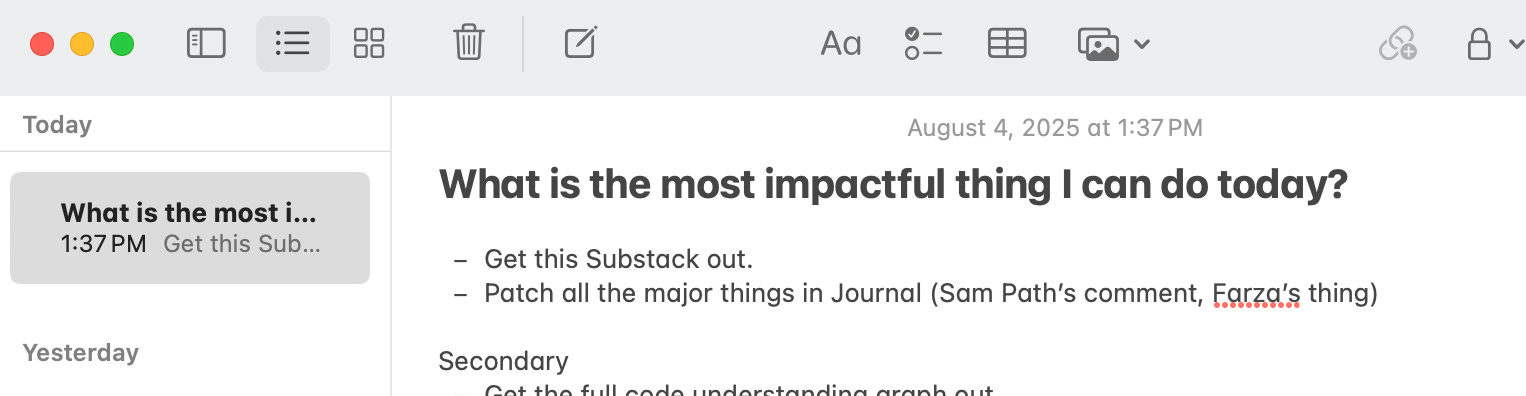
If I don’t know (now every 2-3 days, I don’t. For the first week, every day) then I free write (previously in Notion, now using my Journal app) and ask ChatGPT to reflect.
Anyway. Last week have felt like 2 weeks.
Time to make this week feel like a month :)
As in YC, here’s the short update. My goal is to publish something each week and learn something each day.
Learn: 7/10 – some were quite major so I’m proud of this
Publish: Week 1: Journal app. Week 2: Updates (Global search, Ask a Question using all entries). Fell off on Week 2 wanted to get out more not related to the Journal app :/

I’ve fully gone through 2 ideas, goal this week is to tear through 2 more. One requires building and showing so will do that. Sick demo incoming.
Onwards!!!
No posts
Comments
Nothing yet. Say the first thing.
Sign in to join the conversation.