
Learning is more complex than the two stages of “I don’t know” and “I know.”
I like to think of it as four.
Not being precise about what stage you’re in has many symptoms– stop-start problems, denying importance, naive overconfidence and a bunch of other coping strategies that slow learning down or halt it entirely.
Each stage requires a different strategy. Here are the stages:
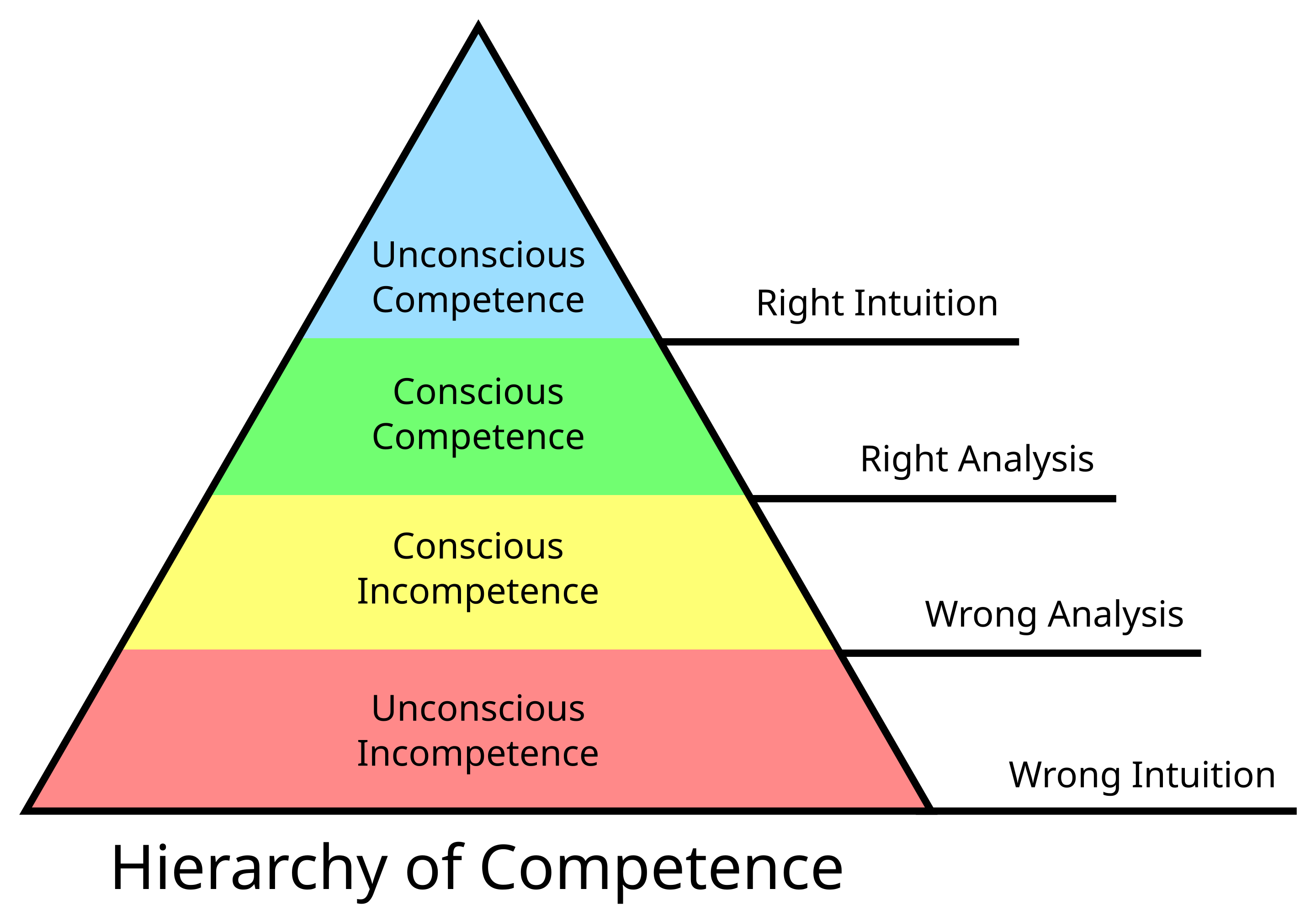
Unconscious incompetence: not knowing, and not recognizing that you don’t know.
Conscious incompetence: not knowing, but knowing you’re bad at it.
Conscious competence: knowing, but takes effort.
Unconscious competence: knowing, and it’s second nature. you’re an expert.
This lesser known framework is called the four stages of competence, created at NYU in 1960 and derived from the more popular Johari window. It’s been quite valuable for unblocking my own learning.
Let’s dive into the first two stages – incompetence – starting with a short TLDR version of the rest of this article.
Unconscious Incompetence – “I don’t know what I don’t know”
You’re unaware of your own ignorance. The key is motivation: discovering why the topic matters enough to learn about it. Without that, you’ll stay stuck in denial or apathy.
Conscious Incompetence – “I don’t know”
You now recognize your gaps and feel uncomfortable fumbling through them. The goal here is framing: zooming out to understand the structure of the field before diving into details, ideally guided by mentors just one step ahead of you.
The titles speak for themselves, but within each I find there are more precise symptoms that tell you why you’re in that stage, high-level goals for what you need to learn to get to the next stage, tactical strategies on how to get there.
So back to the long form version :)
This is the stage before knowing. It’s almost like being in denial, except you don’t have enough information so you make assumptions about its value and your relation to the subject (like Linear Algebra when we first heard that term in high school. What’s that? Can’t be that important. And can’t be that hard, it’s linear right?)
The challenge when you’re in this stage is creating motivation.
Let me explain.
The symptoms of being stuck here are stop-start problems, productive procrastination, naive over/under confidence, and denying the value of the subject altogether.
It’s characterized by a lack of urgency or momentum to even understand. The hallmark indicator is not knowing the value of something. And that’s because you’re not sufficiently motivated.
The goal when here is to find or create motivation so you can understand your scope of incompetence. To become more conscious about what you don’t know, so you can then make a decision on whether or not to learn it.
This is a common misunderstanding.
People think the goal at this stage is to learn, or to decide whether something is worth learning. Both of those assume your are consciously incompetent.
But you’re not. Those are later goals.
You’re jumping the gun. And if you try to directly learn or decide prematurely, you’ll waffle and start experiencing the symptoms mentioned above.
Instead, focus on motivation.
The strategies for how to get this motivation involve looking inward. You have to understand more about how you tick so you can latch the subject to something you’re excited about.
I’ll give you an example – coding. My high school offered computer science classes and I didn’t take them. I thought to myself “this is probably too hard” and “I want to eventually study economics, so this is useless” but in retrospect, that was an excuse for saying “I don’t know if this is important to what I want”.
So I took jazz instead.
Then I went to college. And on the second floor of my dorm I met Tyler Heintz who built a website called majorswag.com. And they were making mad money.
I really wanted to make money too.
I remember my roommate showed me a picture of a Porsche and said “see any economics PhDs driving this? Exactly. Time to take a CS class.”
Fast forward 6 months and I got an A+ and ranked 40/1800 in our introductory CS class (I’m more proud of that than a lot of the other things I’ve done).
Now motivation ends up changing which is what makes this stage tricky. The act of creation is now much more interesting to me. But the point remains.
Motivation is all you need.
So as cheesy as it sounds, the only thing I can recommend here is daydreaming and journaling :) Being creative about the possibilities and latching it onto what motivates you will get you to the next level.
This is the stage we usually think of as the beginning. It’s not quite traditionally what we think of as “learning”, it’s the stage before. And the non-obvious part is that to become consciously competent, you must zoom out, not in.
The symptom of being in this stage is feeling exceedingly stupid. Uncomfortable. You feel like you’re fumbling all the time and it’s hard for you to explain what you’re doing.
It’s very distinct to feeling in flow. Perhaps the opposite actually.
The goal of this stage is to learn the framing of the subject. If you know where the outline is and how it is defined, you can fill in the rest more easily.
This is counterintuitive. To become an expert you have to zoom in right?
Most people stumble here. They go down dead-ends, drawing into the abyss and then “finally” stumble upon a part of the outline, erase, and move back to there.
The problem with zooming in prematurely is it’s not very effective in getting you from incompetence to competence. To be competent is to make inferences from facts based on the connections between them. It means associating new information with generalizable rules. But you first need to learn the generalizable rules.
This requires learning higher-level framing. To move beyond the how, and into the what and the why.
It’s like learning radix sort without learning what a sorting algorithm is and why it’s important. Or learning what a post-money SAFE is without knowing what venture capital is and why one might take it.
Now there’s some back and forth, it is much easier to absorb those rules with examples. But I find most people bias to focusing in too soon.
I have a few strategies here. The first is to find mentors that are exactly one step ahead of you so they can frame what decisions matter and what learning is most relevant.
Why one step? Because true experts are unconsciously competent. The knowledge is so second-nature to them that they make assumptions on what you know rather than explaining it out.
This is why most professors are quite awful at teaching introductory classes.
I’ve found the best mentors are founders who have just raised a Series A instead of someone who IPO’d. An operator at a Series B company in developer tools. Reach for those who just learned, and then cycle through mentors when you reach the next level.
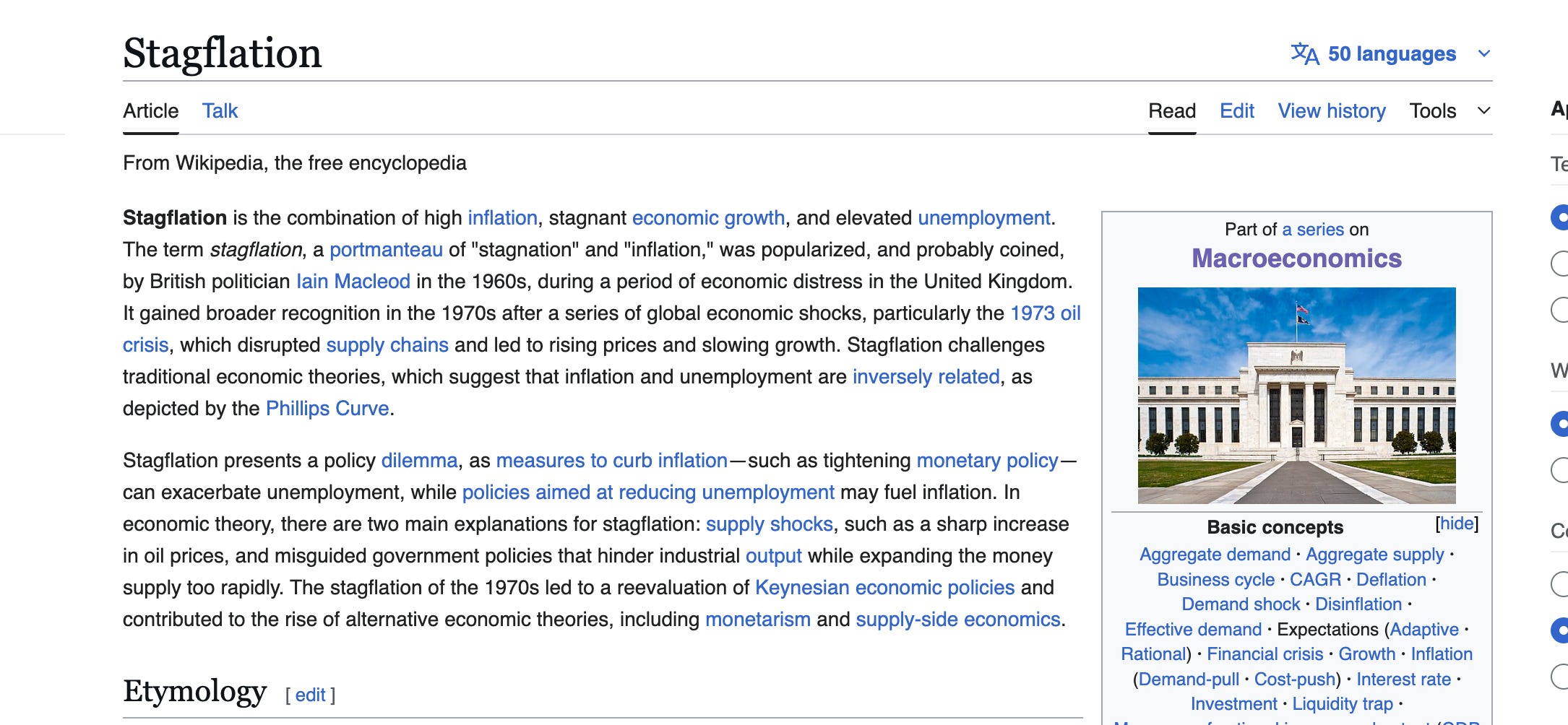
The other strategy is Wikipedia. Generally things are organized very well so you can move recursively up the subject tree.
I’ll never forget when I first read the word “Stagflation” and looked it up in 7th grade. I looked it up and I saw this “series” thing to the right.
I was hooked. I could then finally make sense of all this information I had.
Especially in this era where intelligence is on demand, it only makes more sense to ask higher-level questions before diving in.
And that’s the next strategy, ChatGPT or Claude prompting. But asking questions that are higher-order: “what are other related concepts and how would we classify that”. “How does one normally think through this decision”. I tend to do this a lot now.
And the other one of course, is traditional education. Although they do a poor job of telling you why you should learn the subject (why motivation is so important as the foundation to get to this level), schools are great at telling you the generalizable concepts.
Harvard Business School is (in theory, and in practice I’d say still a good portion of the time) meant to teach you what questions to ask rather than how to do the thing.
And introductory courses or even just course catalogs in undergraduate are an amazing starting point. CS61A (that intro CS course at Cal) is public.
Ultimately, conscious incompetence is about humility — zooming out far enough to see the map before charging ahead. The forest from the trees. Once you understand how it fits together, the details fall into place naturally. Only then are you ready to start the work of doing, not just knowing.
The reason this is longer is the foundation of the pyramid is much more important. Part II is much shorter, it’s on the final two stages of competence.
Conscious competence – “I can do this”
Unconscious Competence – “I did it. It’s obvious.”
Hope you enjoyed!
No posts
Comments
Nothing yet. Say the first thing.
Sign in to join the conversation.