
Amsterdam is one of those cities people think they already understand before they arrive.
For decades, the Dutch capital has marketed itself internationally as a place of queer freedom: rainbow crosswalks, canal-side Pride celebrations, and a reputation for tolerance so deeply ingrained it borders on mythology.
As a queer American immigrant living in the Netherlands, I’ve learned how quickly that branding can flatten the city into something overly simple. Amsterdam can absolutely feel liberating and affirming for LGBTQ+ travelers—but it is also a place shaped by protest movements, grief, nightlife workers, activists, refugees, artists, archivists, and generations of queer people whose stories often remain invisible unless someone intentionally points them out.
That tension is what drew me to LGBTOUR Amsterdam, the queer storytelling project founded by Sanne Pols.
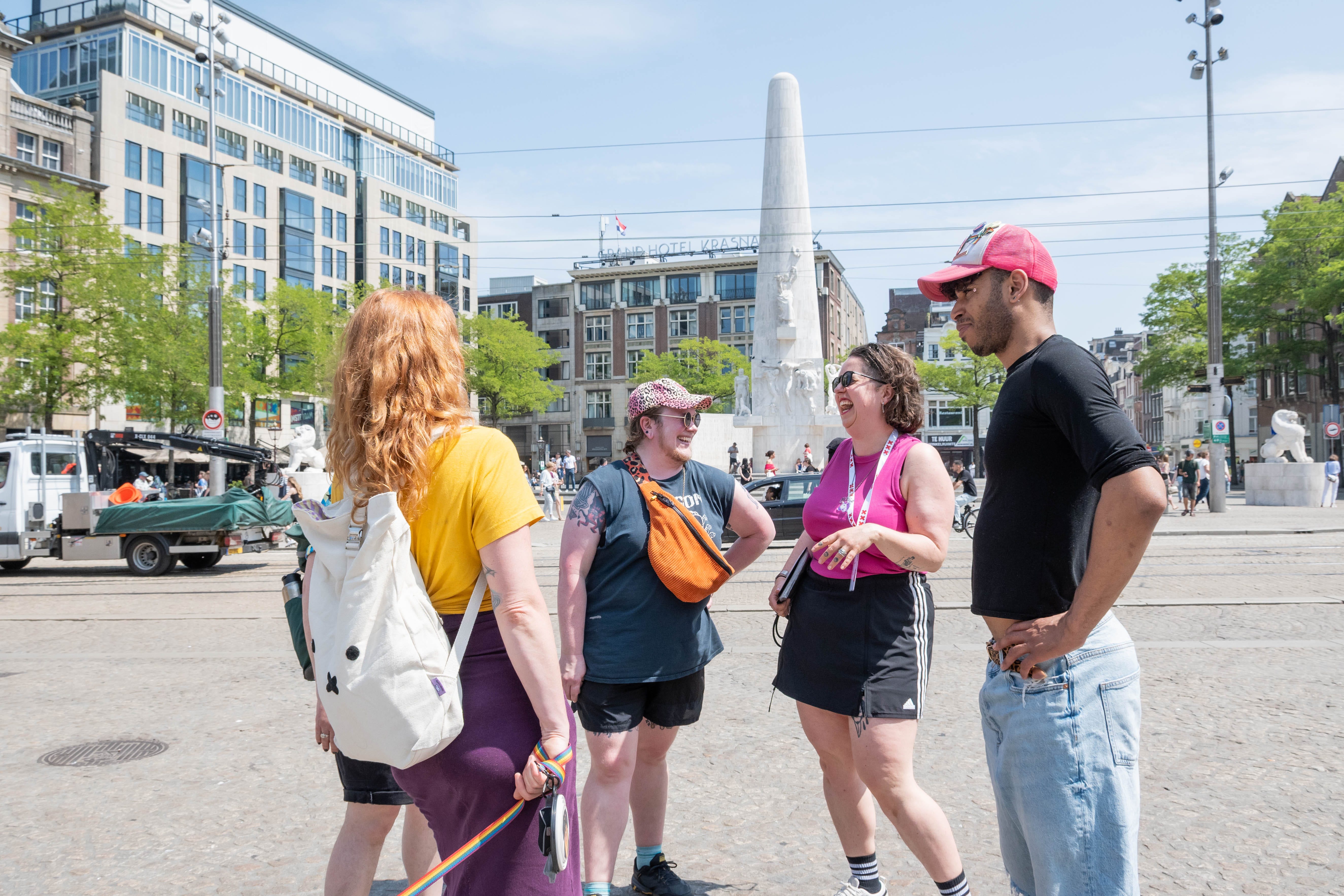
Part walking tour, part oral history, part communal space, LGBTOUR moves through Amsterdam via conversations about queer nightlife, protest, identity, sex work, belonging, and survival—often through intensely personal storytelling.
When I spoke with Sanne, what struck me most was that she rarely described herself as a historian or educator. Again and again, she returned instead to emotion, intuition, discomfort, and connection.
“I’m connected first with emotion,” she told me. “That’s always up front.”
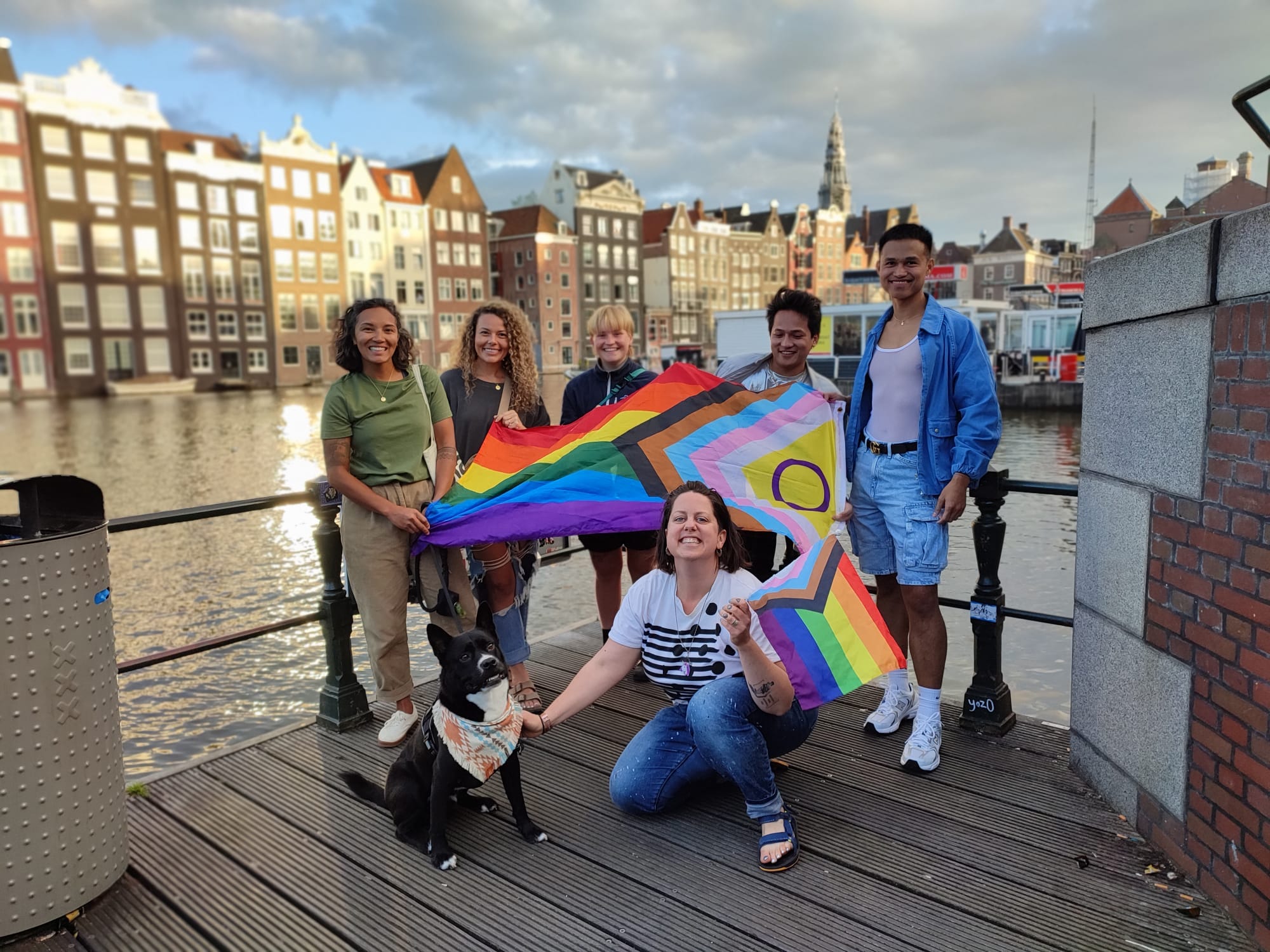
“I thought I was straight”
Sanne moved to Amsterdam from the south of the Netherlands after finishing journalism studies and ending a long-term relationship with her boyfriend. At the time, she still thought she was straight.
Then she met another woman in her master’s program.
“In the beginning, I found her really annoying,” she told me, laughing. “She was in my head all the time, and I didn’t understand why.”
The two were part of the same student group, and Sanne remembers suddenly catching herself putting on makeup before group meetings and internally asking: “Sanne, who are you doing this for? What is going on?”
At first, she tried to rationalize it away. “I thought, ‘okay, I live in Amsterdam now. I’m single. I can kiss a girl and have a fun story for my straight friends.’”
Then they kissed underneath the rainbow flag outside the first lesbian bar she had ever visited.
“And it wasn’t just some good story like I thought it would be,” she said. “I remember thinking, ‘this isn’t funny. I have all these feelings. I don’t understand what’s going on.’”
The relationship that followed changed not only how she understood herself, but how she moved through public space.
“For a long time, I had this privilege of being ‘in the norm,’” she said. “When I walked hand-in-hand with my boyfriend, nobody reacted. Suddenly people felt like they could voice opinions on my relationship.”
Rather than trying to ignore those experiences, Sanne turned toward them.
“I thought, ‘I don’t want this to become normal to me,’” she said. “‘I don’t want to forget about it. I want to see if I can do something positive with it.’”
She began working on personal storytelling projects centered around authenticity and identity, eventually winning a national prize in 2015. Later came DE&I trainings for corporations—work she described as “less fun, very hard work”—before she realized what she missed most was genuine human connection.
In 2017, she launched LGBTOUR Amsterdam.
“I already had these favorite pink routes through the city,” she said. “And I realized I could meet all these queers and allies from around the world and speak about pride, protest, coming out, all these things—through the city itself.”
Very quickly, she said, the tours developed their own emotional rhythm. “There’s laughing, crying. On every tour, someone takes part in that. Including me.”
Queer storytelling as preservation
Over time, Sanne says, the tours became less about trying to explain all of queer Amsterdam and more about creating space where people felt emotionally safe enough to be honest.
“For me, LGBTOUR is like a lifelong education,” she said. “The tours reflect how I’m doing, what’s top of mind in my life at that moment.”
As she became more comfortable as a guide, she also stopped pressuring herself to make the tours comprehensive.
“It’s a tour of two hours,” she said, laughing. “I can’t put everything into it.”
Instead, she follows the energy of the group.
“With my ADHD, I will never get a story straight in my head,” she said. “Something else happens, or I get distracted, or I forget where I was.”
For a long time, she saw that as a weakness.
“I punished myself for that in the beginning,” she admitted. “Because I can’t do what some other tour guides do, giving a lecture in this structured way, telling stories from a script.”
But eventually, she stopped trying to perform a version of professionalism that didn’t fit her.
“Now I let it go,” she said. “And I enjoy myself much more. The guests do too.”
Listening to her describe the tours, I found myself thinking about how different this approach feels from the way queer tourism is often marketed internationally. So much LGBTQ+ travel advertising reduces queer experience to nightlife, spectacle, or rainbow symbolism. But Sanne is trying to create something slower, more raw, and emotionally porous.
The tours, she explained, constantly absorb whatever is happening in the wider world.
Earlier in LGBTOUR’s history, she regularly hosted Russian travelers. After Russia’s invasion of Ukraine, that largely stopped. More recently, she says many trans travelers from the United States have stopped traveling altogether because of fears around politics and safety.
“The groups reflect what’s happening in the world,” she said.
Amsterdam itself has changed, too. City regulations have altered some of the historic walking routes she used to guide through freely. But the biggest shift, she said, was personal.
Two years ago, Sanne lost her partner.
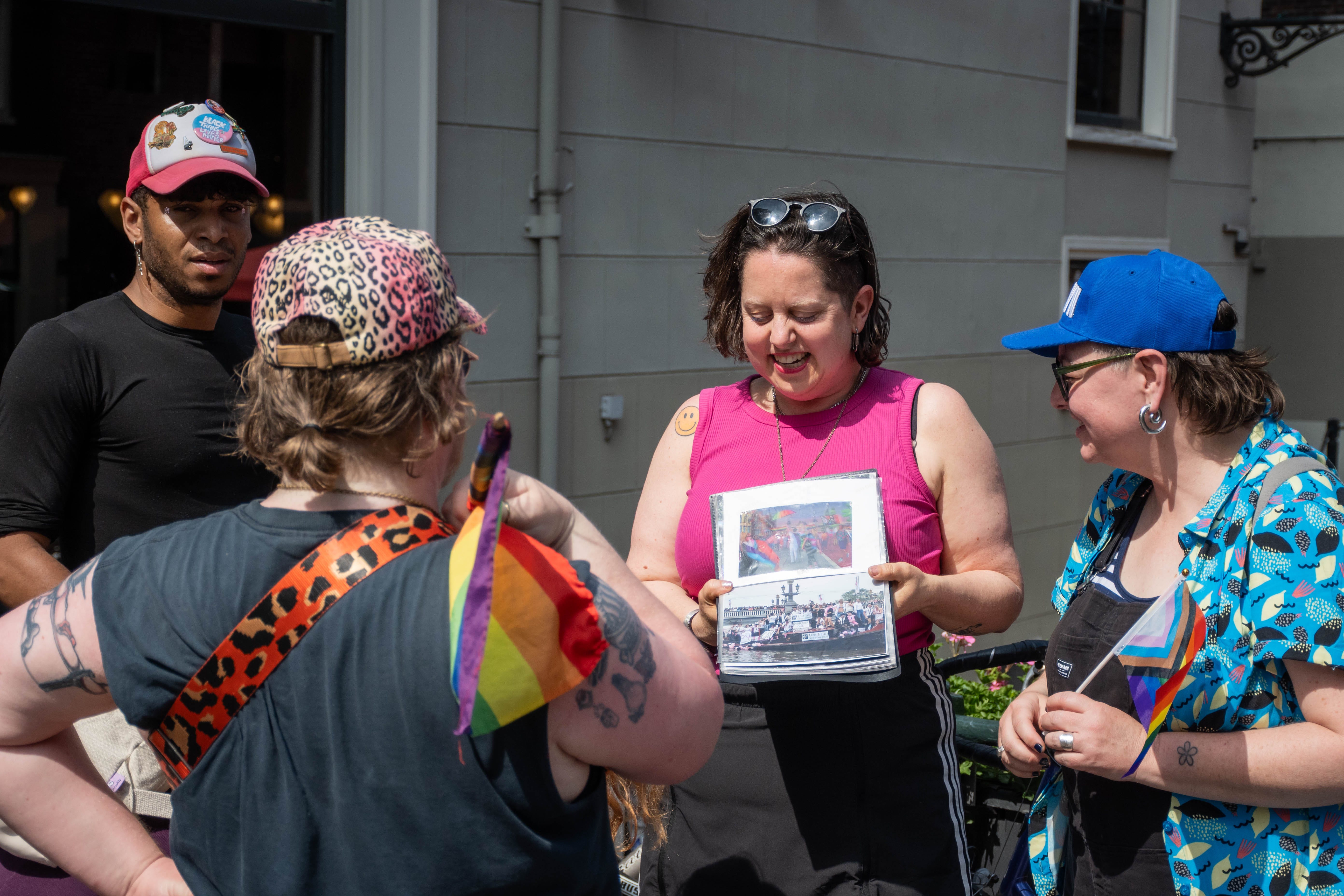
At first, she removed their picture from the tour photo album that she always shares with guests and tried to continue working normally. But grief followed her into the tours anyway.
“What ended up happening was that I started coming with this deep queer grief into the tours,” she said.
Unexpectedly, the emotional dynamic changed.
“It was not only me taking the lead anymore,” she said. “I had to lean a little bit on the group.”
And then, she said, queer grief itself became part of the experience.
“When grief is the topic, the connection becomes even more intense.”
Now, Sanne proudly has her late partner’s picture back in the photo album she shares with her guests, and it offers groups the opportunity to open up about queer grief during their tours.
That part of our conversation stayed with me long after the interview ended. Queer tourism so often emphasizes celebration and freedom that it leaves little room for mourning, exhaustion, or vulnerability, despite the fact that queer history is filled with all three.
Sanne doesn’t separate those things from one another.
“I’m following my discomfort”
That emotional honesty, Sanne believes, is part of what differentiates LGBTOUR from more conventional city tours.
Sometimes she laughs at herself while guiding. Other times she cries while telling difficult stories from queer history.
“I can feel the energy from the people on the tour,” she said. “Even when I’m thinking about what we’ll do next, I’m feeling what they’re feeling.”
That openness also changes how guests respond to one another.
“I see this relaxation happen,” she said. “Like, ‘Oh, okay, we can really be ourselves here.’”
As an immigrant myself, I recognized that feeling: the relief of entering a space where you no longer have to simplify yourself for strangers.
At the same time, she’s careful not to present Amsterdam as some perfect queer utopia.
“People sometimes want this one story of how great Amsterdam is,” she said. “But nothing is black and white.”
That tension becomes especially visible with visitors who arrive expecting affirmation rather than complexity.
“Yes, you’re in one of the queer capitals of the world,” she said. “But it’s also not perfect.”
Sanne regularly discusses topics many tour companies would likely avoid entirely: sex work, queer nightlife, cruising culture, trans spaces, neurodiversity, political tensions within LGBTQ+ communities, and the changing landscape of lesbian bars globally.
“I give my opinions very strongly sometimes,” she admitted, laughing. “For example, about sex work and stigma.”
Then she asks guests what they think.
“I’m not trying to be the one with all the answers,” she said. “I’m searching for conversation.”
Again and again, she returned to one phrase in particular: “I’m following my discomfort.”
“When I share stories that maybe are uncomfortable for me, it feels like reclaiming,” she said. “Wherever I feel uncomfortable, I want to go to.”
Queer tourism and community responsibility
As LGBTOUR has grown, Sanne has slowly expanded beyond herself, bringing on additional guides and building something closer to a collective.
“No one is like me,” she said. “Which is a good thing.”
Some of the guides were former guests she instinctively connected with during tours. Others arrived through Amsterdam’s queer community networks.
The expansion also allowed her to stop forcing herself into experiences that didn’t fit her personally—especially nightlife tours.
“I tried to do them myself,” she said, laughing. “But it was too overstimulating for me as an ADHD person, going into all these bars and doing small talk.”
Now, newer guides lead many of those experiences instead.
When our conversation turned toward Amsterdam Pride and tourism more broadly, Sanne repeatedly emphasized intentionality over consumption.
“There will be a thousand things you cannot go to,” she said of WorldPride visitors. “So first ask yourself what you actually want.”
She encouraged travelers to look beyond the Canal Parade and seek out grassroots events, trans-led programming, Black Pride events, volunteer-run spaces, and community organizations.
“The most meaningful community events are often not during Canal Pride itself,” she explained.
She also spoke candidly about allyship and tourism ethics.
“You can’t just say, ‘I’m an ally,’” she said. “You have to work for it.”
For visitors wanting to support Amsterdam’s queer communities materially, she recommends spending money intentionally: booking queer-led experiences, supporting volunteer-run venues, attending community-based events, and recognizing where tourism money actually goes.
She told me that 50% of tips from LGBTOUR guests are used to help cover tours for queer refugees and others who otherwise could not afford them.
“So you can actually see how your money contributes to something positive,” she said.
Oral history against erasure
Toward the end of our conversation, Sanne told me about guests who joined tours immediately after coming out and leaving religious families behind.
“We were both crying,” she said.
At the time, she handed out Dutch candies during tours, each printed with a Dutch word. Some guests later tattooed the words from those candies onto their bodies.
“It was liberation,” she said. “Finally being yourself.”
She also described asking older American guests about their first experiences with Pride.
“One woman suddenly said, ‘I didn’t even know I was at Pride, and Harvey Milk was there,’” Sanne recalled. “And everybody was like, ‘Oh my god!’ Suddenly history came alive.”
Then she said something that felt, to me, like the emotional center of the entire conversation:
“Oral history for minority groups is one of the most important things, because we are constantly being erased.”
That idea feels central not only to LGBTOUR, but to queer travel itself.
The most meaningful queer travel experiences rarely come from rainbow branding or curated checklists. They come from conversations. From hearing someone explain how a particular street corner changed their life. From understanding the grief, protest, intimacy, joy, and survival embedded in places tourists often flatten into symbols.
Amsterdam may market itself as a queer utopia. But what Sanne offers is something much more human: a way of walking through the city that leaves room for contradiction, vulnerability, memory, and connection all at once.
And maybe that’s the real value of queer travel at its best—not just seeing a destination differently, but understanding queer history as something still alive and being carried, person to person, in real time.
Walk queer Amsterdam differently
If you’re planning a trip to Amsterdam and want something deeper than a checklist of “must-see” queer landmarks, LGBTOUR offers something increasingly rare in modern travel: the chance to experience a city through conversation, memory, and lived experience instead of branding alone.
Sanne’s tours are funny, emotional, challenging, deeply human, and shaped as much by the people who join them as by the streets themselves. Whether you’re visiting Amsterdam for the first time or think you already know the city well, walking it alongside someone actively preserving its queer stories in real time changes the experience entirely.
And if you’re visiting for WorldPride this year, LGBTOUR is also launching a new Canal Pride experience that offers guests a reserved place to watch the parade with their group—including access to bathrooms, drinks, food, and a much less stressful way to experience one of Amsterdam’s busiest days.
Learn more about LGBTOUR Amsterdam and book a tour before your next visit to the city.
Comments
Nothing yet. Say the first thing.
Sign in to join the conversation.