
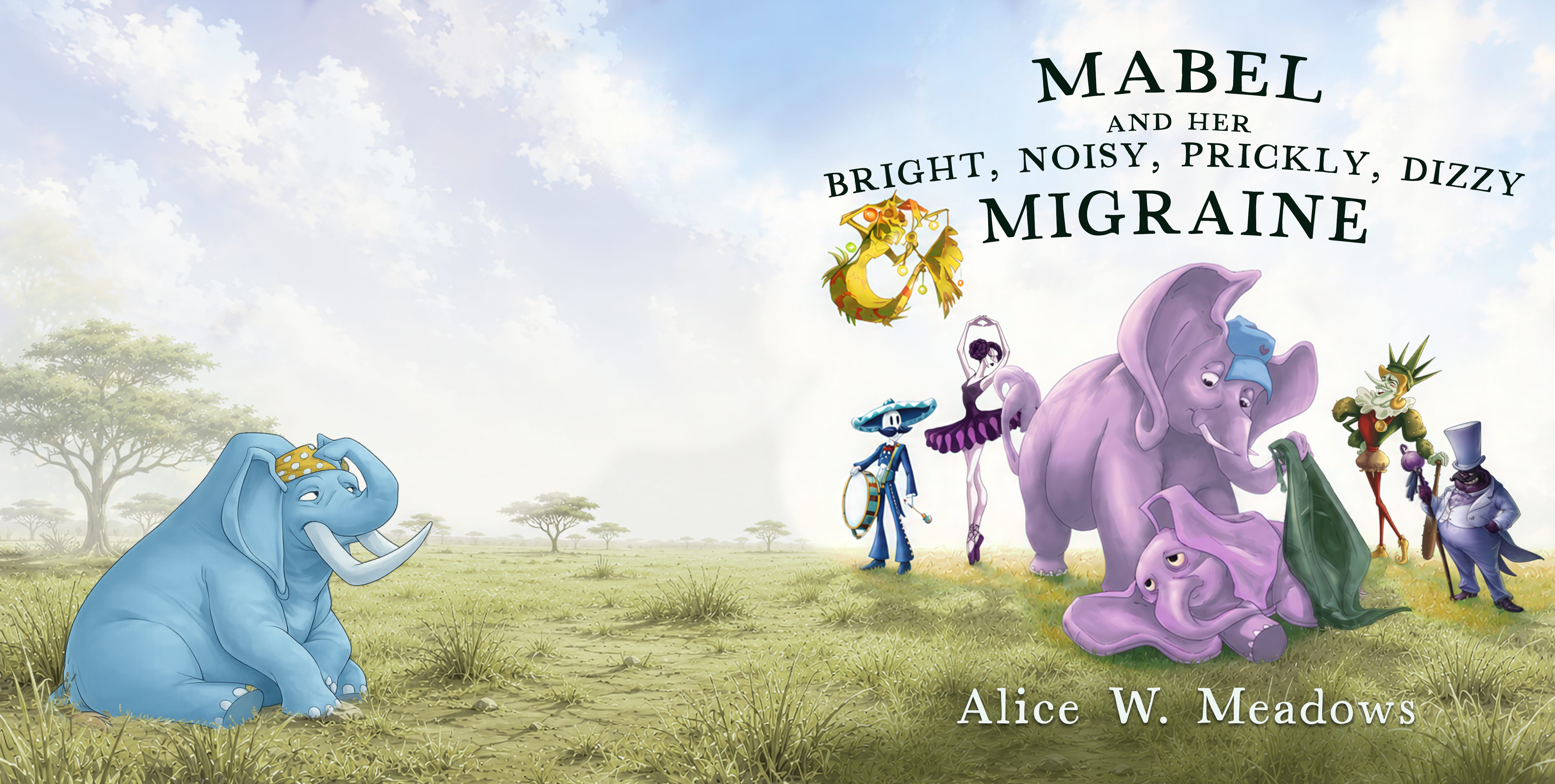
Sixteen months ago, I wrote Part I to this story, and a lot has happened towards making my personal struggles with migraine public.
Mabel and Her Bright, Noisy, Prickly, Dizzy Migraine is finished and available for preorder on Amazon, Bookshop.org, and wherever books are sold. Publishing date is September 15, 2026.
Mabel is a young elephant who suffers a migraine attack while on a hike with Mama and Papa. We experience migraine with Mabel, at a child’s level, through various characters who visit her on the trail. These silly characters give Mabel the language to tell her parents about the complex neurological feelings she is having. And I hope the book will open communication between young children and the adults who care for them. It’s not a simple thing to describe migraine when you’re a kid and be believed.
Science & Soul’s post this week brings together three great thinkers on the topic of suffering: Viktor Frankl, Carl Jung, and Buddha. Out of many possible taglines for these thinkers, the author chooses, “Your Greatest Suffering May Be Hiding the Meaning That Saves You.” As a lifelong migraine sufferer, I am always interested in how others pull meaning from their painful experiences, and it starts with the question posed in this post: “What is this [pain] trying to teach me?”
For me, it was a long journey getting to this question. For decades I railed against my pain, asking, “Why me?” Or, “When will it end?” At times I held onto such bitterness over the unfairness of it all. I was overcome by how much of my life I missed out on because migraine had me in its grip. Migraine was the enemy. I feared it. Dreaded it would attack when I had an important family or work event. Knew it would hit me on vacation. How unfair is that?
Pain was just pain. Something to get through as best as I could with medication, rest, and resolve. And resentment. Tallying the headache days in my migraine journal like the grim reaper.
Life went on like this for decades. In 2012, I reached a turning point. I was ready to stop taking medications that didn’t seem to work. Stop seeing doctors who don’t seem to have answers. I resigned myself to the suffering, but not in the way Viktor Frankl discovered, by choosing our response to circumstances. I gave up. Until our youngest daughter, then in college, urged me to see Dr. Jessica Ailani, a headache specialist at Georgetown University Hospital. Dr. Ailani is amazing (and wrote a wonderful endorsement for my book). I knew I had to become an advocate for myself as a patient. Advocating for my health with Dr. Ailani made me feel better.
I don’t believe there is a good kind of pain or that any suffering happens for a reason. And when I am in pain, it can be hard to reach beyond a small personal circle to help others. Making commitments to tiny tasks, let alone a large goal like writing a book, is daunting. I discovered I can accept my suffering and not let it rule my life. I’ve learned to work with migraine instead of railing against it. I am trying to practice Viktor Frankl’s method and view migraine as a gift. I have an enormous amount of lived experience that I can share as wisdom with others. My new perspective and advocacy training with Miles for Migraine inspired me to write a book about migraine for young kids. My younger self is cheering because finally there is a book that can help kids put into words the strange sensations that come over us when migraine attacks.
Advocacy transforms private pain into public good. It says, “If I have walked this road, maybe I can make it less lonely for the next person.” Because migraine wants to alienate us from the people and things that bring us happiness. We can allow that, or we can choose to fight back by using what we have learned in the suffering to lessen the suffering of someone else. And it is a choice.
I choose to write books that help children feel seen
I choose to give parents words for conversations they don’t know how to begin
I choose to help teachers recognize that an invisible illness deserves visible compassion in the classroom
I choose to advocate for better understanding of a disease that affects over 1 billion people globally (40 million Americans)
Love, Alice
No posts
Comments
Nothing yet. Say the first thing.
Sign in to join the conversation.