
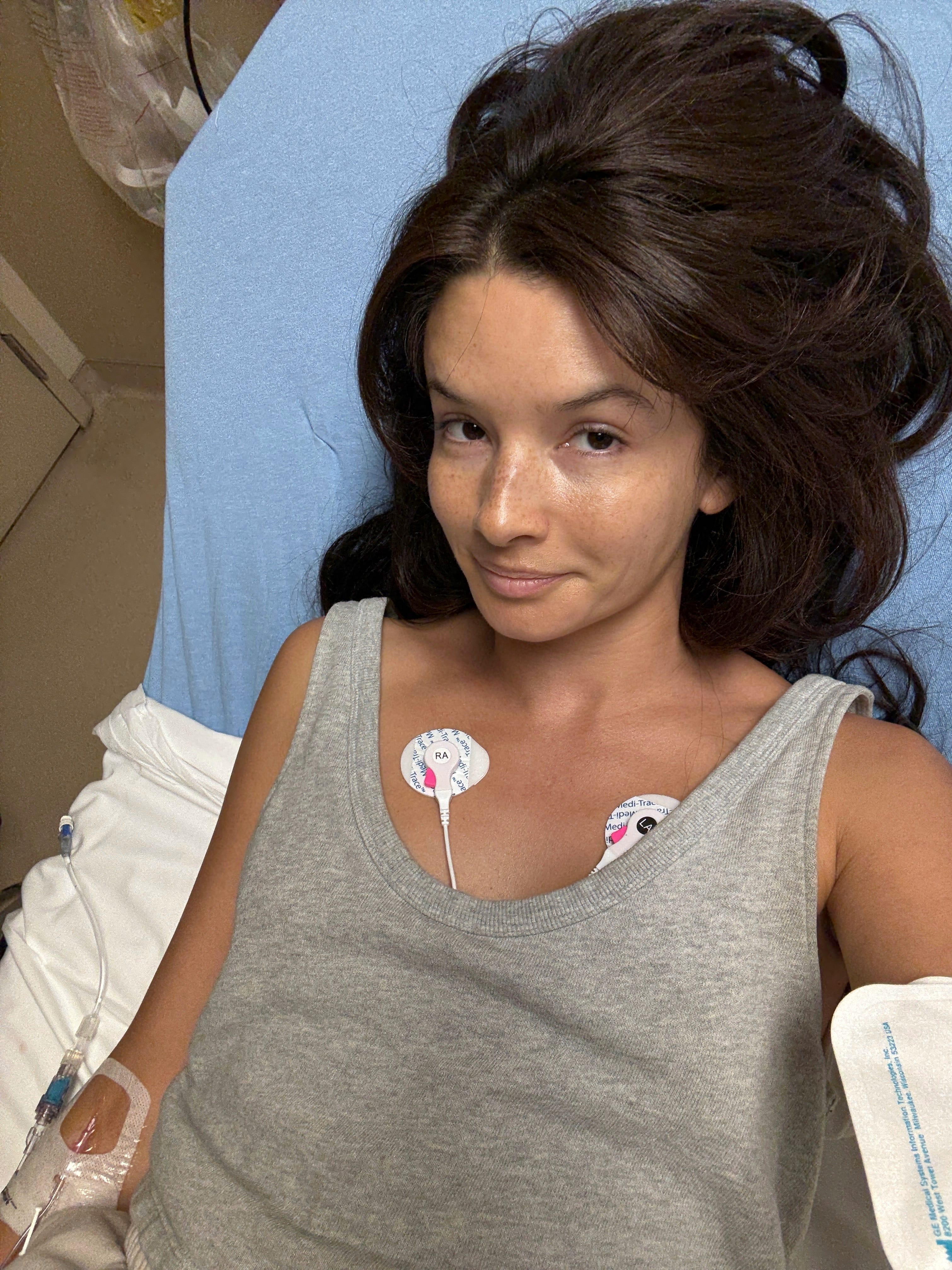
“What would happen if I didn’t?”
The nurse blinked at me.
“I’m on board,” I clarified, glancing at the bag of blood he wanted to put in my body. “But I’m curious… If I hadn’t happened to have a routine check-up, how might I have learned I needed a blood transfusion?”
“You probably would’ve found out the way most people do,” he said. “The hard way. Lotta people faint and get into a car accident, or their organs just shut down because they’re not getting enough oxygen.”
I signed the form giving my consent. Hook me up.
When I first saw the notification from my doctor’s office saying I needed to go to the ER immediately, along with a string of missed calls, I almost didn’t take it seriously. I felt fine. Words like hemoglobin and hematocrit meant nothing to me, nor did the numbers and decimals following them. Still, I called back, mid-curling iron hold. I was supposed to do a photoshoot that day.
“Is this like a ‘Go to the ER sometime this week’ sort of emergency?” I asked the nurse practitioner. “Or like ‘Get to the ER right now’?”
“This is a get-to-the-ER-right-now,” he said. “Tell work you can’t make it.”
So I did. And this is how I wound up getting two emergency blood transfusions, along with the findings of “severe anemia,” “dysfunctional uterine bleeding,” and a “uterine mass with internal flow.”
I’ve been slowly bleeding to death for years. I’d had no idea anything was wrong.
I am always tired. I don’t know anyone my age who isn’t. Such is getting older, I figured, and I don’t even have kids. What right do I have to complain of fatigue?
If I hadn’t happened to have a routine annual wellness exam, particularly bloodwork, I may have just dropped dead one day. Or fainted at an inopportune time—when is an opportune time to faint? Perhaps only a post-mortem autopsy would’ve revealed to my loved ones that my fatigue wasn’t just run-of-the-mill, middle-aged tiredness. Rather, I am among the 30.7% of women worldwide who suffer from anemia.
Anemia is a blood disorder in which not enough red blood cells carry oxygen throughout the body. More commonly put, anemia is an iron deficiency. Iron is crucial for binding to oxygen. This combo forms a protein called hemoglobin that transports oxygen from your lungs to all your other vital organs.
The average hemoglobin level for adult females is between 12.3 and 15.3 grams per deciliter (g/dL). Anything below 8 is cause for an ER visit. Hemoglobin levels below 5 can lead to heart failure and death.
Mine was 5.8.
If you’re a female of childbearing age, and you live in the U.S., you could also be among the 35% of American women who experience iron deficiency. Who think being tired is just part of life. Who think heavy periods are just part of being female. Who have no thought at all that they could be 0.8 g/dL away from death.
It’s only been in recent years that I’ve decided to act like an adult and have an annual physical. Truth be told, I skipped last year’s—and I wonder if I might’ve caught my anemia sooner. One of the first things my ER doctor said to me was that my blood levels had been declining for a long time. The likely culprit? Heavier periods.
Just like I am always tired, I have always had heavy periods. They last six to seven days, are accompanied by bed-bound cramps, and let’s just say that I’ve always thought the “lasts up to 8 hours” claim by Tampax Ultra was laughable. Mine last 1-2 hours if I’m lucky. That LeakGuard Braid™ has nothing on me.
It is only in retrospect that I can piece together my body’s subtle clues that something is the matter, and has been for quite some time.
The random dizzy spells. (But I’ve always had vertigo.)
The head rushes. (But I’ve always had low blood pressure.)
The shortness of breath. (But I’ve never been one for much cardio.)
More recently, within the past year, I’ve noticed the heart palpitations. (But it’s probably just the heat.)
The sudden, seizing foot cramps. (But I’ve been meaning to get orthopedic inserts.)
The periods that are closer together and…gloppier than they’ve ever been. (But I suppose I am reaching perimenopause.)
I used to have a 35-day cycle. Now, I have two or three weeks in between menses. Combined with my heavier flow, I basically pour out blood almost a third of the year. That’s a lot of blood loss. I wasn’t without symptoms, come to think of it.
Like many, I’m an expert at minimizing my problems. PSA: Don’t minimize yours.
When the ER nurse discharging me said, “Come back if you bleed through a super-plus tampon or heavy pad within an hour,” I wondered if I should even leave. Bleeding through within an hour is my norm, especially on days one, two, and three. Only days four through seven allow me to use a super-plus tampon for a whole six to eight hours. It was day one.
Sure enough, I’d already bled through my pad, period underwear, and sweatpants, just sitting in that hospital bed. I thought it absurdly poetic how a bag of blood dripped into my right arm while perhaps another bag’s worth of blood dripped from between my legs. Does anyone else think such things? I wondered.
Other thoughts that swam through my mind included, I wonder whose blood is now inside me. Were they young? Old? Would their ancestry show up in a 23andMe test? Did they get a Nothing Bundt Cakes coupon to redeem after? I tried desperately not to think of hepatitis, infection, and allergic reactions—all warnings I consented to before starting the IV drip. When I started feeling anxious, I turned on Rick and Morty. Pickle Rick kept me company when Ryan left to feed our cat.
At least the cause of my anemia seemed clear. I just had to bleed less.
Enter TXA: tranexamic acid, my new best friend.
TXA is often given to trauma patients, women hemorrhaging after childbirth, and those like me who have chronically heavy periods.
The ER discharge papers I handed my primary care physician the next morning said I had severe anemia, heavy periods, and a walnut-sized uterine mass that was also bleeding, in addition to my uterine walls. Transabdominal and transvaginal ultrasounds had confirmed that.
My doctor said the next step was to see an OB/GYN for a hysteroscopy—STAT!—and to take TXA to slow my bleeding in the meantime. She warned that blood clotting is a risk. While my legs feel a bit tingly-numb by the end of the day, I feel lucky not to have one leg more swollen or tender than the other, because lemme tell ya… This TXA shit is the bomb! It makes Tampax Ultra live up to its 8-hour claim, or, as I texted one friend, “I keep thinking, ‘This is what it must be like to have a normal period!’”
My upcoming hysteroscopy should determine the next course of action for my unidentified uterine mass. It could be a fibroid, maybe more than one. Could also be a polyp. Only further exams will tell. In the meantime, I am following doctors’ orders and massively upping my iron intake.
Did you know a half cup of tofu has more iron than three ounces of beef? I didn’t. While I’ve been eating far more beef than I used to (thanks to my lovely fiancé, who cooks it for me), I’ve also added a half-block of air-fried tofu to my lunchtime spinach salads. Chicken apple sausage with eggs and sauteed spinach is my go-to breakfast, and between those spinach-laden meals alone, I needn’t worry about constipation due to the iron supplements I am also taking, with orange juice—vitamin C helps our bodies absorb iron, while dairy inhibits it.
At the top of the iron-rich foods list? Oysters, with a whopping 6.9 mg per three. Happy hour flight, here I come. (Except on Mondays, per Anthony Bourdain.)
I get to recheck my hemoglobin levels later this week. I’m hoping for an 8 or higher, wondering what 12 will feel like. Maybe like I’m 25 again? One can hope.
As I had lain in my hospital bed, listening to the groans and cries of fellow ER patients far worse off than me, I felt overwhelmed by gratitude. I still feel overwhelmed by gratitude. I got to find out about my anemia the easy way. I am alive during the age of modern medicine. I have access to safe blood transfusions, and only because others are willing to donate. As someone with a phobia of needles due to an overactive vasovagal reflex—which is a whole other blog post—I can’t thank you blood donors enough.
I share this not for sympathy, nor to alarm people. Yes, I deliberately wrote a clickbait title because I hoped you’d read this, but honestly? Part of me wanted to say nothing publicly. As open as I’ve been about many facets of my life, it is very rare that I share about what I’m living through right now, in the moment, as it’s happening. So, why?
For all the posts on women’s health that proliferate my social media feeds, I have not seen any about the common ailment of anemia due to iron deficiency.
So my why is simple: If you’re a female, or you love a female, I want you to find out about anemia the easy way, too.
Anemia contributes to 1.8 deaths per 100,000 in the United States. As Alisha Haridasani Gupta writes in The New York Times:
Despite persistent calls from experts and researchers, there are no recommendations in the U.S. to regularly screen for iron deficiency among adult women and it is therefore rarely a part of blood work in annual checkups…
That iron deficiency is often overlooked might come down to “the normalization of women’s disorders,” Dr. Munro said. The associated symptoms—like feeling faint, fatigued or irritable—are often seen as a part of life as a woman, he added.”
But the tide may be changing.
This year, for the first time in its history, the International Federation of Gynecology and Obstetrics issued a recommendation that all women and girls who menstruate should regularly be screened for iron deficiency, not just for anemia and not just during pregnancy.
Get your annual check-up. Be sure to get bloodwork done. Ask specifically to check the levels of your hemoglobin and hematocrit. Since I find value in resources that help facilitate ease, I’ll share that I subscribe to One Medical, a membership-based primary care practice for $99/year. I get same-day appointments, walk-in bloodwork and other lab tests, and 24/7 access to virtual care. No, this is not an ad, and no, I am not affiliated with One Medical. I’m just one very thankful member.
I hope sharing my story helps to prevent yours. Stay healthy!
Comments
Nothing yet. Say the first thing.
Sign in to join the conversation.