
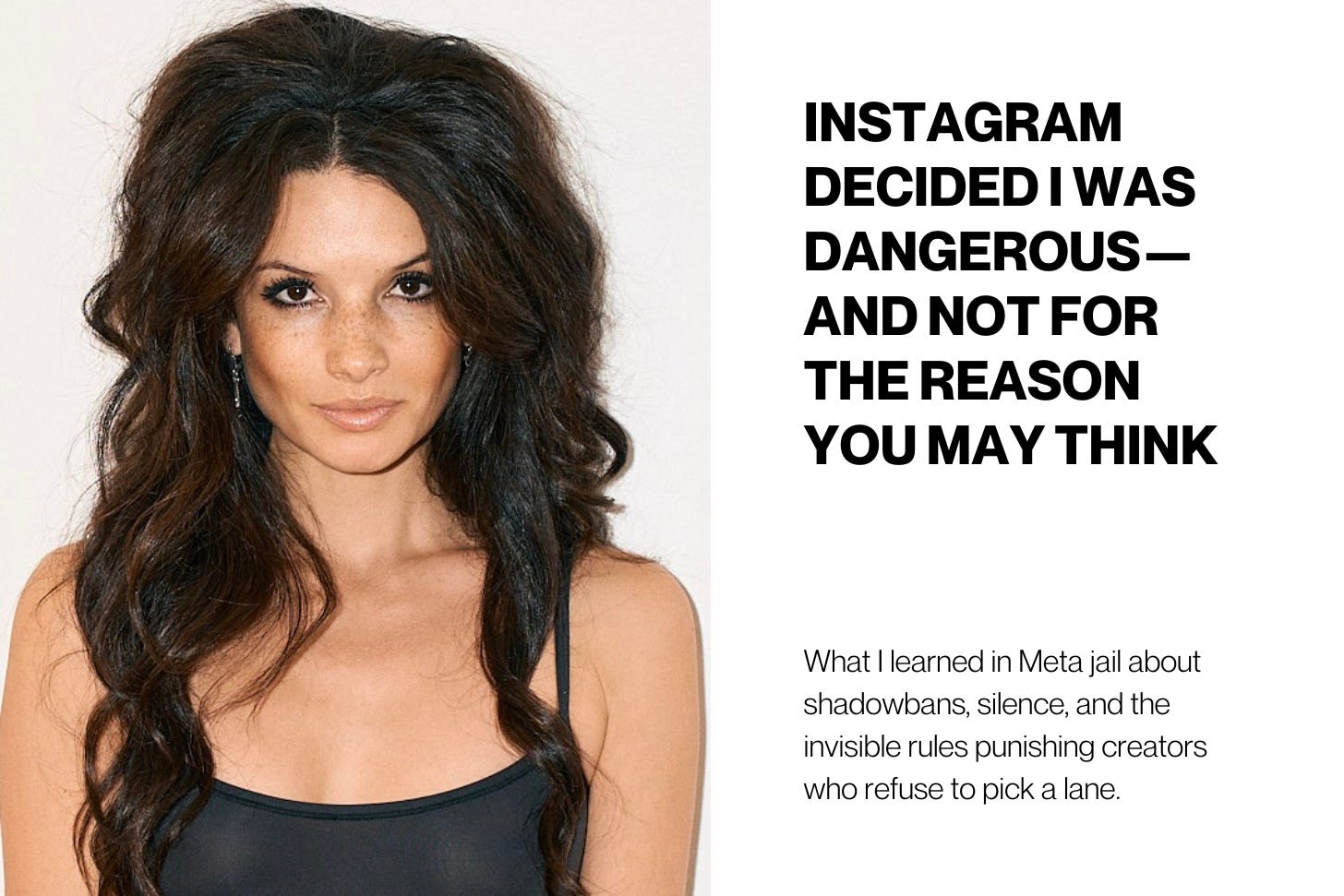
I’m fresh out of Instagram jail. May my penalties be your warning.
Algorithms are increasingly targeting social media accounts for restriction, suspension, and removal when they deviate from usual content lanes—especially if their deviation is toward a subject deemed high-risk, like politics, religion, and health. You know, things that matter.
This isn’t new, but punishments seem to be escalating. Algorithms actively boost accounts with niche consistency while suppressing those without it. This is now documented Instagram policy, not just creator suspicion.
“Accounts that publish across unrelated themes, such as travel one week, fitness the next, and product reviews after that, often experience weaker audience matching and less consistent distribution. In contrast, creators who maintain a narrow, coherent topic profile are more likely to be matched with relevant audiences.”
— Karina Gandola, NetInfluencer, December 2025
What’s an algorithm?
Whell… Allow me to introduce you to this undercover policeman. This shape-shifting traffic controller. This invisible referee whose calls make or break livelihoods without warning.
Bowling With Bumpers
Nobody asked for a bowling analogy. You’re getting one anyway.
I am not a tech expert. I’m guessing you may not be, either. So to explain how I got in trouble with Instagram in the first place, and why you are also at risk of being deplatformed if you’re a multi-dimensional creator, I’m going to walk you through how algorithms work using the analogy of…bowling. 🎳
Let’s say a social media platform is like a bowling alley. Your social media account is you as the bowler. Social media algorithms are the bumpers of your bowling lane.
If sharing a post is like rolling a bowling ball, the algorithm acts as the bumpers making sure your ball stays in your lane. You might not like bowling with bumpers. You might even choose to roll your ball into another lane on purpose. But if the Control Center of the bowling alley sees you doing this too much? They put the bumpers up for you. Training wheels and time-out bars all in one.
Now imagine your bowling lane has the ability to tilt, lowering to make your ball speed faster toward its pin targets with better accuracy. This tilting is the algorithm rolling in your favor. The faster you roll in your lane, the more points you score, winning you fans and followers. The Control Center likes this. Smash-hit bowlers draw more crowds, selling more tickets, merch, and snacks.
But the Control Center also has the power to raise your bowling lane in the opposite direction, slowing down your rolls.
Now, think of bowling lanes as topics. Say you’re a popular bowler who typically bowls in the Lane of Cooking. You throw down recipes like a boss, with a twist of the wrist that sends Parmesan and pepper flying. You consistently knock out pins, symbolic here of follower growth and high engagement in the form of likes, comments, saves, and shares. The Control Center rewards this. Your lane tilts further in your favor with every strike.
Your neighbor to the left is also a decent player. She’s a counselor who bowls in the Lane of Trauma Recovery, rolling out high-scoring posts related to nervous system awareness, releasing shame, and healing from PTSD. Every now and then, one of her balls crosses into your Lane of Cooking—she does love a recipe for Golden Milk Elixir at the end of a hyperstimulating day.
Generally, the Control Center doesn’t mind too much if players switch between two or three lanes, especially if they share fan overlap. Besides Cooking, your second favorite lane is Household Products. Your neighbor to the right bowls mostly in the Lane of Autism & ADHD with a bit of overlap into Weight-Lifting. Further down is a player in the Lanes of Motherhood, Homesteading, and Uncommon Animal Friends.
This bowling alley is open to spectators and players alike. Some spectators never play, but love cheering on their favorites. They also love loudly booing those they don’t like.
At the far left end of this bowling alley are the VIP Lanes.
Star bowlers get bumped up to this section once they’ve accumulated a certain threshold of fans. The Control Center never discloses the secret number, but a popular guess is around 100,000. No one has proof, but many observe that that’s when lanes really start tilting in players’ favor, smashing their balls into pins with increasing accuracy, gaining them even more visibility to accrue even more fans.
An even more exclusive section is reserved for the Celebrities of Bowling. The unspoken fan threshold to join their ranks is rumored to be somewhere around one million. They typically bowl in the Lanes of Music, Acting, and Sports, alongside other lanes of mass popularity, like the Lanes of Podcast Bro, Sexy Female, and News Media Corporation.
Players in the Celebrity Section get exceptional treatment, including cross-lane bowling privileges. They can hurl a ball into the Lane of Social Justice one throw, the Lane of Health Supplements the next, and the Lane of Bikini Vacations, all in a day’s work. Bumpers are rarely thrown up for the Celebrities of Bowling, nor do their ball replacement machines ever run out.
Oh yes… Some players run out of bowling balls. The little ramp that returns balls to players can be stopped at random by the Control Center, leaving them empty-handed and unable to score any more points. In our analogy, that’s a social media suspension or restriction. Violate the rules, known and unknown, and the Control Center may take away your ability to roll entirely.
The majority of bowlers play not in the VIP Section, but on the Mass Player Floor. Sometimes, when enough spectators boo certain players, or the Control Center decides a player has crossed one too many lanes—especially the ones ominously known as High Risk Lanes—players lose their bowling privileges altogether.
The Penalties of High Risk Lanes
You discovered the High Risk Lanes the hard way.
When a prominent political activist was assassinated, your usual cooking content was broken up by impassioned posts about gun control. Your bowling balls suddenly swerved into the Lanes of Politics, Guns, Violence, and Domestic Terrorism. To make things worse, this happened in summer, when you were on vacation at your family’s lake house. You’d posted a video critiquing gun violence from the dock in a swimsuit. Worst of all…you have breasts.
The bumpers combusted. These lane dividers fritzed out like a power line hit with hose water, trying to redirect your balls toward lanes you didn’t even know you were bowling in. One of the most egregious High Risk Lanes of all, a lane you never meant to cross, was the Lane of Suggestive Content.
There was no notification. Your first clue was the low view count on your Reel about the perfect Salade Niçoise. You have about 55,000 followers. Normally your summer salad videos reach around 12,000 views. This one had 3,600.
Your next Reel on Star-Spangled Cake had even fewer views at 920. Alarmed, you asked your sister if she could see your posts. She could. But her boyfriend couldn’t even find your name when he typed it into the search bar.
“Yeah, you’ve been shadowbanned,” he says.
Your stomach falls. Your mouth hangs agape.
The Control Center had noticed your lane-swerving, and toward lanes they—and only they—knew were in the Red Zone. Without so much as a warning, they determined you were now a High Risk Player.
High Risk Players had consequences. You’ve heard of players suddenly going missing from the alley, their stations vanishing as though they never were, their fans left confused and worried. You never thought it would happen to you. Surely it must be a mistake. You’re a rule-abiding player. You don’t post pictures of animal torture or pornography. You don’t even use swear words.
Your sister’s boyfriend tells you how to check your account status. Sure enough, the Limits to your reach line has an orange exclamation point beside it.
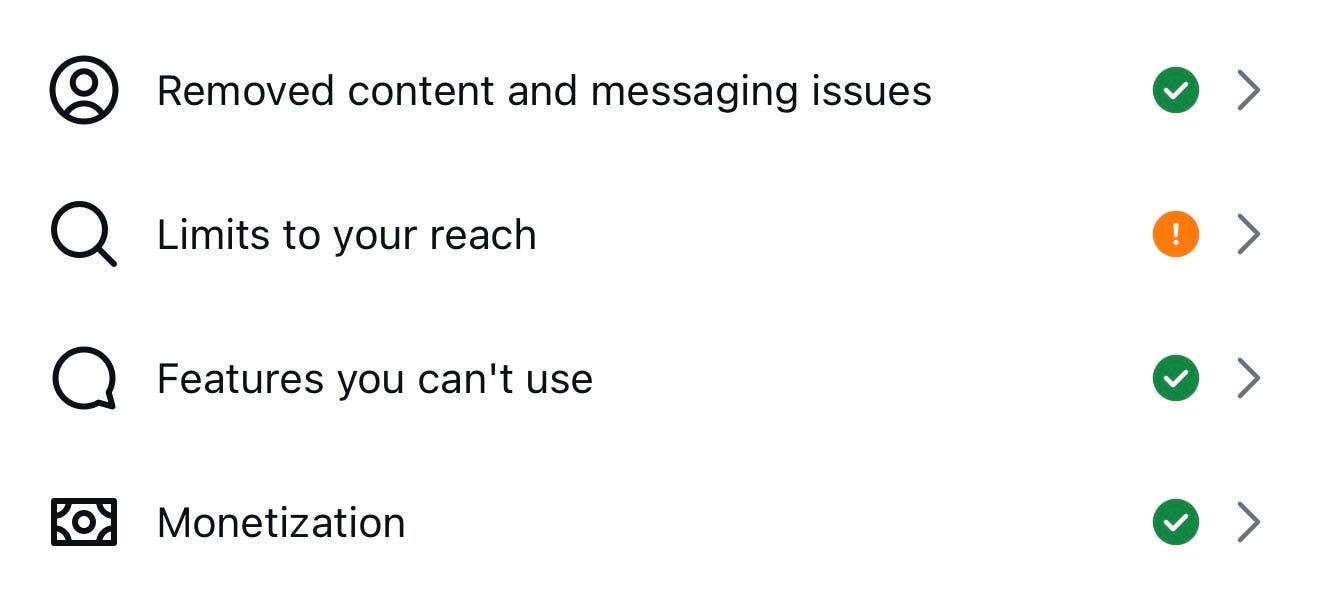
Adrenaline surges through you. Your reach can’t be limited now. You have a cookbook coming out in August, your very first. Your publisher’s marketing team has podcast interviews and collab posts all lined up. For the first time, you might actually earn an income from all the free recipes and product recommendations you’ve offered so generously over the past three years. You might even be able to quit your day job managing a local café.
Your fingers tremble on the glass of your screen as you tap to view more. People who don’t follow you has another orange exclamation point, confirming your content cannot be recommended to non-followers. Another tap reveals the offending posts: your Reel on gun control, a photo carousel fronted by a headline about the assassination, and a Reel you shared from the lake house bathroom when you were wrapped in a towel, fresh out of the shower.
Promoting Violence.
Misinformation.
Suggestive Content.
The labels stun you with their injustice and inaccuracy. You were only sharing what everyone else was. You certainly weren’t “promoting violence”—you were promoting anti-violence. Stricter gun laws. And “suggestive content,” really? Your sister’s account is basically all bikinis and lingerie. She’s a model and beauty influencer, posting clingy crotch close-ups in strings you wouldn’t even try on, much less share with strangers.
“Yeah, but she posts in her lane,” her podcaster boyfriend explains. “She doesn’t get political.”
“It’s not political to promote peace and safety,” you argue.
He shrugs. “If the opposite of peace and safety is violence…”
Seething, you delete the offending posts, feeling like a coward. It’s the only way the orange exclamation points turn to green checkmarks again.
The Penalties of Being Multi-Dimensional
Now say you’re a different player.
Say you bowl in the Lane of Country Music. You dream of headlining Stagecoach, and your vocal-banjo talents have started getting notice from the Control Center. Your last video went viral with over 10 million views.
But music doesn’t pay your bills. Copywriting does. You’re employed by a boring tech start-up to write copy for newsletters, banner ads, and fine print. You hate your job. But it lets you work remotely, which means you can spend more time with your daughter in the children’s oncology ward at the hospital. This job also provides your family’s health insurance, which ensures the lifesaving treatment she needs.
When a war between two distant countries escalates, your spectator fans demand that you choose a side. You haven’t spoken up about the conflict yet, and they notice. You know exactly which side you’d be eager to publicly support. But your employer has sent out a memo: the company stands unequivocally with the other side. Any employee who issues a public statement to the contrary will be deemed “not in alignment with company values.”
The threat is clear. If you post in accordance with your conscience, you’ll lose your job. Lose your job, lose your health insurance. Lose your health insurance, and your daughter might lose her life.
Of course, you can’t tell your fans any of this. It would out you to your coworkers. So you make an anonymous weekly donation to a nonprofit your employer would fire you for supporting, and you say nothing publicly.
Knowing you look like a selfish coward to your fans, you choose a different cause to publicly advocate for: immigration. Over the next several weeks, your posts weave pro-immigrant stances amid videos of new songs. This angers a significant portion of your spectators. You’ll never make it as a country musician with that stance. You’re afraid they’re right.
So you pivot again, this time to the Lane of Functional Medicine. Studies have linked inflammatory diets to cancer, and if there’s anything you might share that could help another family avoid the path yours is on, you’re happy to use your platform to do it.
But the Control Center has had enough of your inconsistency. Your spectators are now too diverse. Everything you post angers one section of the crowd, even as another cheers. Hateful comments land on your videos, accusing you of grifting, of being anti-science, anti-medicine. The fans who loved you for your pro-immigration stance are now furious at you for being an anti-vaxxer. You’re not. Yet somehow the lane bumpers have directed your bowling balls into the Lanes of Medical Misinformation, Far Right Ideology, and Flat Earthism.
Your bowling balls stop coming back. Your views drop from tens of thousands to hundreds.
The Control Center doesn’t like diversity—not unless it’s the Lane of DEI: Diversity, Equity, and Inclusion. But actual diversity, like the ability of a player to hold multiple viewpoints and bowl in multiple lanes? Pssh. Two or three lanes max.
Diverse bowlers might be willing to play by the rules if they knew what the rules were. You imagine a simple pop-up notification on how to keep your bowling privileges:
Pick up to three lanes.
If your lanes have little in common to our robot moderators, we will slow you down.
If one or more of your lanes is a hidden High Risk Lane, we will throttle you.
If two or more are High Risk, we may suspend you.
If all three are High Risk, we may evict you from the bowling alley without warning.
But these rules are not disclosed upfront. Many players suspect they’re kept secret so the Control Center can show indiscriminate favoritism to the VIP and Celebrity Players, rewarding those who bring in more money while punishing the un-famous.
This is how social media algorithms are like bumper lanes in a bowling alley. Thank you for coming to my TED Talk.
In All Seriousness…
I hate that I’m writing this. I want us to be able to care publicly about a multitude of things. That era seems to be over.
My release from Instagram jail is still fresh. Still inhibiting me from posting anything that might be remotely controversial to an algorithm, which is most of my interests. For over two months, my account was restricted from being shown to new followers for reasons Meta refused to name.
You might be thinking my adult work triggered this restriction. That’s what I first assumed. Yet my account status’s green checkmark confirmed it was still being shown to users under 18, so that wasn’t it.
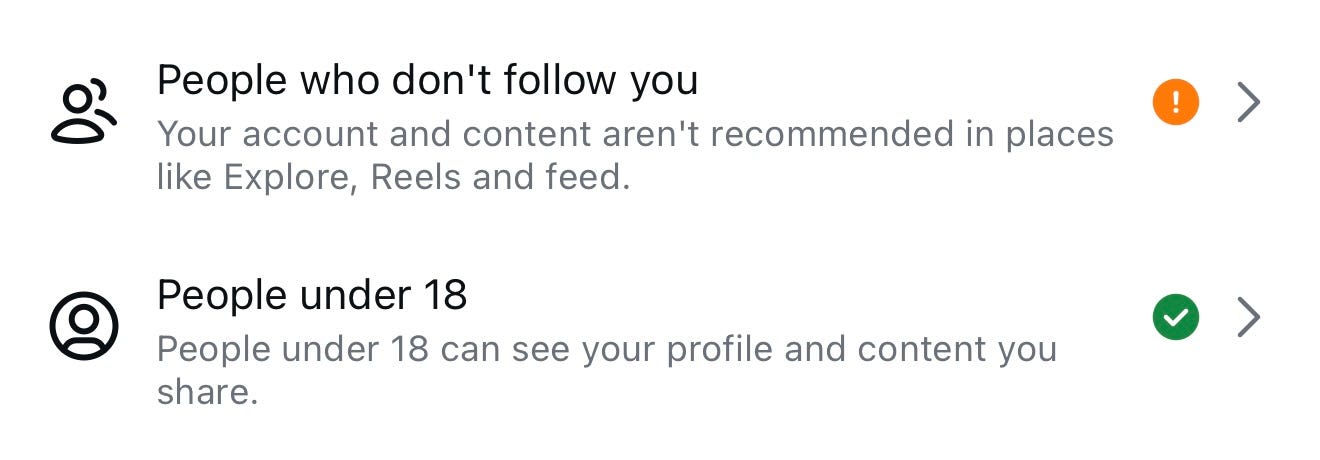
No reason was given for the limitations to my reach. Where there should have been a list of offending posts flagged for editing or removal, there was nothing but blank white space.
Meta Support was no help. Two human representatives seemed just as baffled by my restriction as I was, advising me to keep posting within community guidelines and wait a month or two for it to lift. Even they couldn’t tell which guidelines I’d violated in the first place.
So I hired a third party and did a ton of research to figure out why I’d been penalized.
What I learned blew my mind.
What the Research Shows
Social media companies are notoriously evasive about how they structure their community guidelines, and even more opaque about why they enforce some violations but not others. Here’s a smattering of what various investigations have found:
Women are banned and have content removed at nearly three times the rate of men, with banning alone falling exclusively on women and gender minorities. 2025 saw a particularly heavy-handed turn, with women aged 25-34 reporting they are now significantly less likely to post their true thoughts online than they were at the start of that year, citing fear of censorship and retaliation.
Instagram’s “borderline content” policy quietly suppresses women’s bodies at disproportionate rates, specifically harming freelancers, artists, dancers, educators, and activists—without ever notifying them it’s happening.
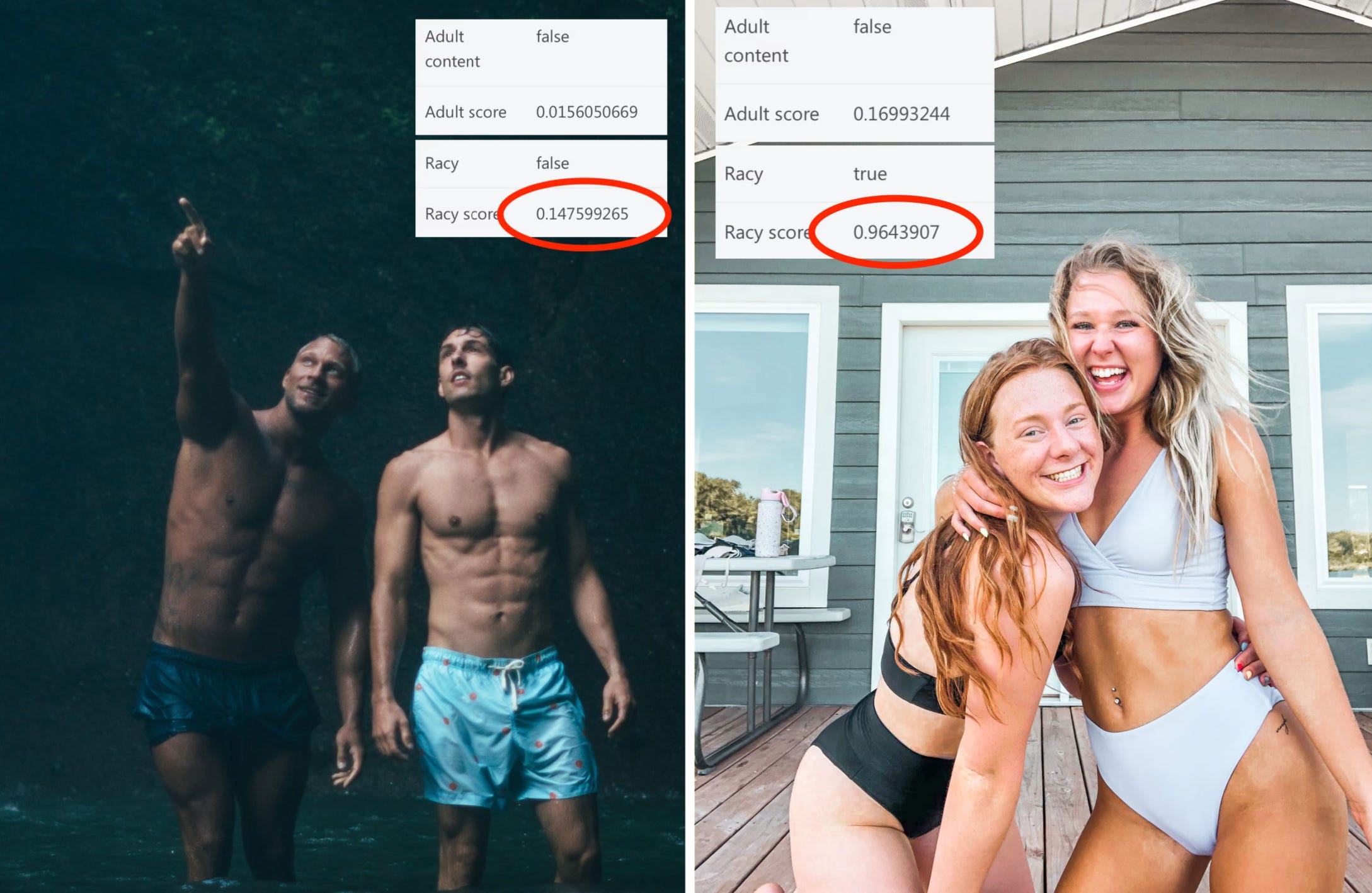
A Guardian investigation found that AI moderation tools are demonstrably sexist. In one test, a photo of two women in swimwear received a 96% “racy” score; the equivalent photo of two men scored 14%. The women’s post got 8 views in an hour. The men’s got 655.
Society has long demanded women’s nudity and sexualization in advertising, media, and entertainment. But not if women do it on their own terms and certainly not if they profit from it directly. The moment they do, suddenly it becomes a problem worth suppressing.
My background as a TV and film actress and mainstream model meant my body’s sexualization came with every casting I booked. I’m not complaining—I loved playing sexy dress-up. Yet as soon as my paychecks came not from a media corporation or advertiser, but from the audiences they served directly, I was banned from my bank. I was suspended from social media. It was okay for me to show my breasts in a movie or magazine but not okay for me to cover them in a bikini on my Instagram.
But let’s put the sexual double-standards of male and female bodies aside.
That’s Not What Triggered My Instagram Restriction
My research and third-party audit of my account explained why it wasn’t a single post, or even multiple violating posts, that led to my shadowban.
Rather, it was my combination of editorial-style photography (“promotional or monetized”), my feminine appearance (“sensual aesthetic,” especially due to my “voluminous hair”—I wish I were kidding), and my academic style of writing (“authoritative about sensitive discourse”) on subjects like religious trauma, political violence, and women’s health. This combination, rather than any sole qualifier, apparently told Meta’s AI moderation bots: This account is dangerous. Quiet her.
To top it off, my anti-tribalist stance and arguments for grace mean that I draw followers from all sides of party lines. The algorithm didn’t know where to put me. So it stopped me altogether.
Research in algorithmic bias and content moderation supports that my experience is not unique. Women face higher moderation and demotion risk when their appearance signals sexuality but their speech signals authority, critique, or controversy. Platforms suppress content that creates classification ambiguity, even when it violates no rules.
Like me, you might wonder why some accounts get away with it. Model Emily Ratajkowski’s feed is far more revealing than mine, and she posts about her memoir and political activism. The New York Times posts about politics and violence daily, and shows red carpet nipples in see-through dresses. Even relatively smaller accounts and celebrities—under 300,000 followers—seem to get away with it. Actress Abbey Lee can show her nipples one day and post about endometriosis the next. My page is mild by comparison, and especially mild relative to what the algorithm would file under Suggestive Content. (No shade on any of these—I’m a fan of them all.)
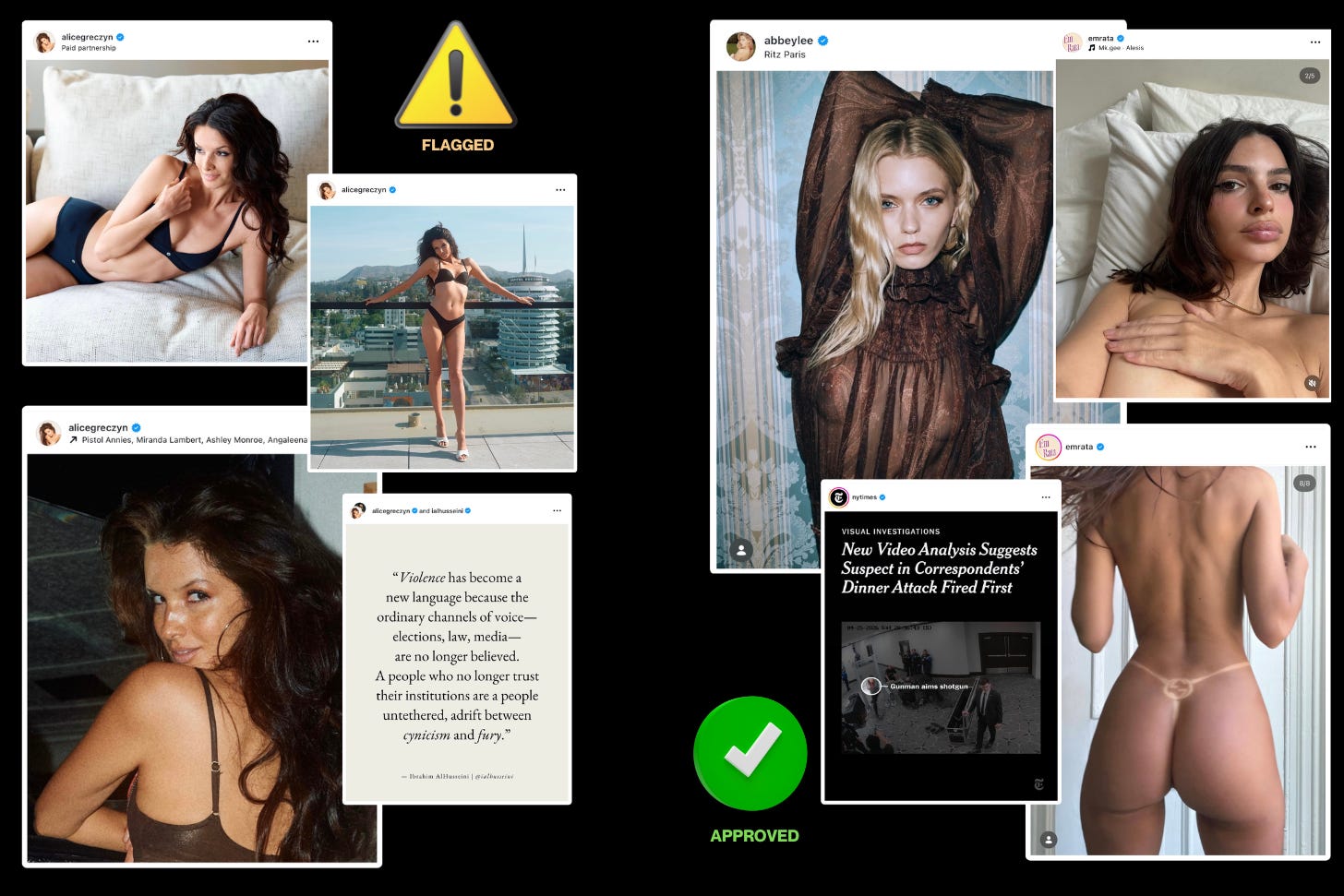
What these pages have in common are high follower counts. This makes them more immune to moderation scrutiny. Popular accounts keep users more engaged, and more engagement means more advertising revenue.
The flagrant inconsistency of community guidelines enforcement is well-documented. Celebrities, politicians, and business partners with millions of followers have been secretly exempted from Meta’s standard moderation rules. Meta’s own Oversight Board found this “misleading,” calling it “unequal treatment.”
Research doesn’t show a single explicit policy targeting women like me. But it consistently shows that algorithmic moderation inherits human bias, disproportionately flags female-coded language and bodies, and applies greater scrutiny to women who are both conventionally attractive and intellectually authoritative.
The world just can’t handle beauty and brains.
My own takeaway: I can write about religious trauma if I dress by the rules of purity culture again. I can post about political violence if I don’t also post about my heavy periods causing life-threatening anemia. I can share a bikini pic, but not if my caption is about recovering from shame.
The Silver Lining of Picking a Lane
All of this brings me to something I’ve written about at length before: silence.
I don’t speak for everyone who chooses to stay quiet about certain issues, especially those pertaining to human rights and social justice. But I’ve written about my own selective silence here and here.
Most of us have reasons for appearing to cherry-pick causes while ignoring others. These reasons are often more complicated than cowardice, or more presumptuously, quietly siding with the other. For many—like the country music singer in my bowling analogy—their selective silence results from a threat to their livelihood, with ramifications that threaten their families’ lives.
That was not a made-up scenario. It was an amalgamation of real situations people have found themselves in.
If there’s a silver lining to algorithmic lane-policing, it is this: narrowing the battles we pick may make us more effective at fighting them.
Algorithms boost the reach of people who post consistently in one lane. Audiences mirror this preference. The most effective public advocates pick their battles narrowly, passionately, and consistently.
I’ve never minded the merry-go-round rise and fall of followers. Depending on Instagram to earn my living is another matter.
With regret and more than a hint of annoyance, I’ll close by announcing that my main Instagram account will be narrowing in lanes. It’s already at risk of being permanently banned with multiple restrictions and a suspension in my history.
It saddens me that algorithms reward the incurious, narrow-laned thinking I am so deeply against. Fortunately, Substack doesn’t depend on algorithms. Not yet.
Here is where I can be the multi-dimensional person many of you know and value. I plan to organize Sections here so you can follow the sides of me that most resonate—think-pieces like this one, memoiristic narratives on topics from youth group to mental health, sensual storytelling—so that you may opt into or out of what you wish.
Instagram’s Control Center determined I’m a High Risk Player. I have bowled in the Lanes of Atheism and Childhood Abuse, of Purity Culture and Sexual Freedom, of Women’s Health and Political Violence. My core theme has always been freedom from fear and freedom from shame.
Here on Substack is where I can honor that fully.
Thanks for reading Unaccountable! Subscribe if you like thinking hard.
Comments
Nothing yet. Say the first thing.
Sign in to join the conversation.