
Maniucha & Ksawery unite the treasures of Ukrainian folk songs with the deep tones of a jazz-inspired double bass. Behind the duo is anthropologist and vocalist Maniucha Bikont and double ball virtuoso Ksawery Wójciński, who uses minimalist improvisation to bring Ukrainian song heritage into a new and deeply emotional space.
We met the polish musical duo just before their concert on a rainy afternoon, and spoke to them about musical fieldwork, uniting global roots and improvisation, and how going through hardship yourself can change how you interpret your own repertoire.
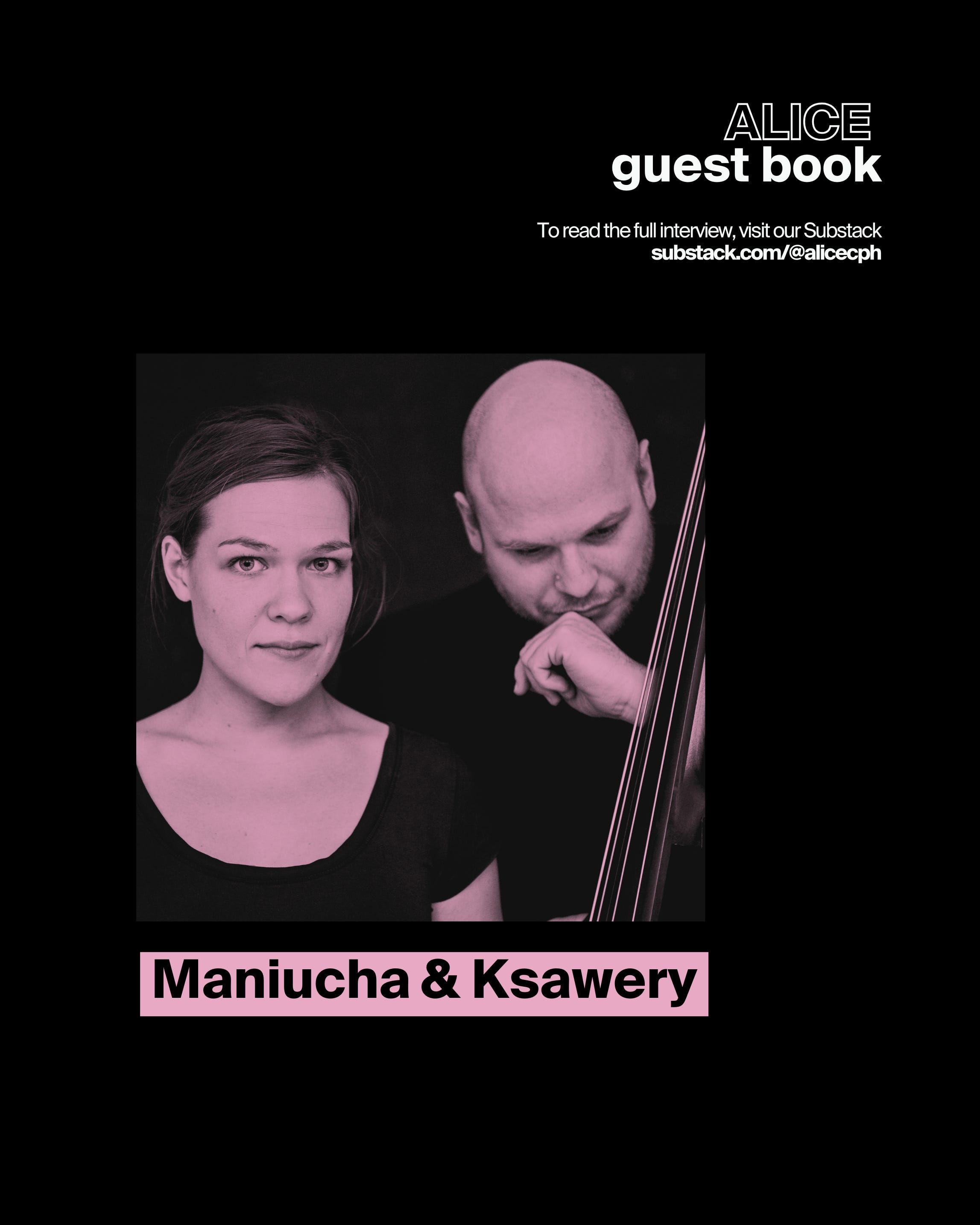
Maniucha, you have spent years collecting songs in the Ukrainian wetlands of Polissya. You went from village to village, meeting the elders of the villages and learning their orally transmitted songs. Could you tell us a bit more about doing musical fieldwork. What is the most important thing to keep in mind?
Maniucha: »If you want a brilliant recording for your archive, you can’t really participate in the singing situation, because it will ruin it. But I think it is really important to do it anyway. Because music is so much more than rhythm and melody. Hidden social rules run underneath the repertoire, like a river«
From these travels, do you have a memory that you’re especially fond of?
Maniucha: »A friend from Kiev’s grandparents knew this old woman who sings. That is usually how I get to people, through word of mouth. So I went to visit her in the village where she lives. It was on this green island, and there were houses, barrows, animals, and water everywhere. The air was really humid, and there were many mosquitoes. When the woman understood that I wanted to hear the songs she knew, she said: Let me milk the cow, feed the animals and call my friends. And then, this old lady, who’s in her 80s, and walking with a stick, she opened up her mouth. And right then, you could really feel the power of her voice. It was really loud, but gentle too, and I was like, ‘wow!’«
How did you transform experiences like these into your sound?
Maniucha: »I was expecting Ksawery to accompany me, sort of like a singer, just by using his bass instead …«
Ksawery: »Meeting and playing with Maniucha was my first entrance to traditional music. So, I couldn’t play in a traditional way. I could only add my experience based in jazz and improvised music.«
Speaking of, how did you meet?
Maniucha: »I was invited by one of Ksawery’s colleagues to feature on a song on an album by their band, HERA. In that band, people went their own ways over time, but we continued to work together.«
How was it for you, Ksawery, to improvise on the basis of this deeply rooted material?
Ksawery: »I had to adapt to it, and it wasn’t really smooth. First of all, the songs are traditionally sung without accompanying instruments. So I had to adapt, and find the harmony, the beat, and the rhythm, to make something new out of the original material.
How about you, Maniucha?
Maniucha: »I must say, it wasn’t really easy for me either. For a while, I kept on hearing the old ladies’ voices inside my head when we were rehearsing. It took me some time to really feel and understand that I was not singing with them, but performing with Ksawery. Following his breath, and him following mine.«
Maniucha: »When the war started, a lot of Ukrainians fled to Poland, and a lot of us got involved in helping them in different ways. In this period, I had a feeling that the meaning of the songs changed. Before, I thought these songs to be about love, adolescence, and the cycle of life. But in the context of war, I started paying attention to how they were about sorrow. About losing persons and losing your home.«
What do you mean, you discovered these things in the same songs?
Manicuha: »Yes! Just like when you read a poem, and the meaning it gives you change depending on how you feel. It was the same thing that happened here. I could suddenly hear different meanings appear within the same songs.«
Ksawery, do you have a favourite tune from your repertoire?
Ksawery: »I can’t answer that… I have so many!«
Ok, let me ask you something different. When you play live together, what do you enjoy the most?
Ksawery: »It’s the whole show, from beginning to end. Like taking a breath, and it’s gone.«
Maniucha: »I will add one song that’s special to me. When my father died, I understood how many songs from our repetoire, that are about longing for other people. And when I perform, there are certain times where I’ll be taken back to the loneliness that I felt after my father’s death. I actually changed the lyrics of one of our songs. It was originally about a mother who died, and I changed it to be about a father, to make it my story. Both of us, during our coorperation, have become parents ourselves. And that is very moving to me what these songs teach us about parenthood: Parenthood is to say goodbye, goodbye, goodbye to your kid.«
Thank you so much for sharing that. Lastly, I’m looking for a recommendation. Are there any shows on our current program that you would like to go to?
Maniucha: »Leyla McCalla! We once played on a festival together. Just like me, she has kids while also being on stage. She sings amazing, old songs, as well as her own material, and I really recommend her music.«
Ksawery: »Bulgarian Voices Angelite! I love the way they sing.«
You can read all the interviews in the guest book here on our Substack: substack.com/@alicecph.
No posts
Comments
Nothing yet. Say the first thing.
Sign in to join the conversation.