
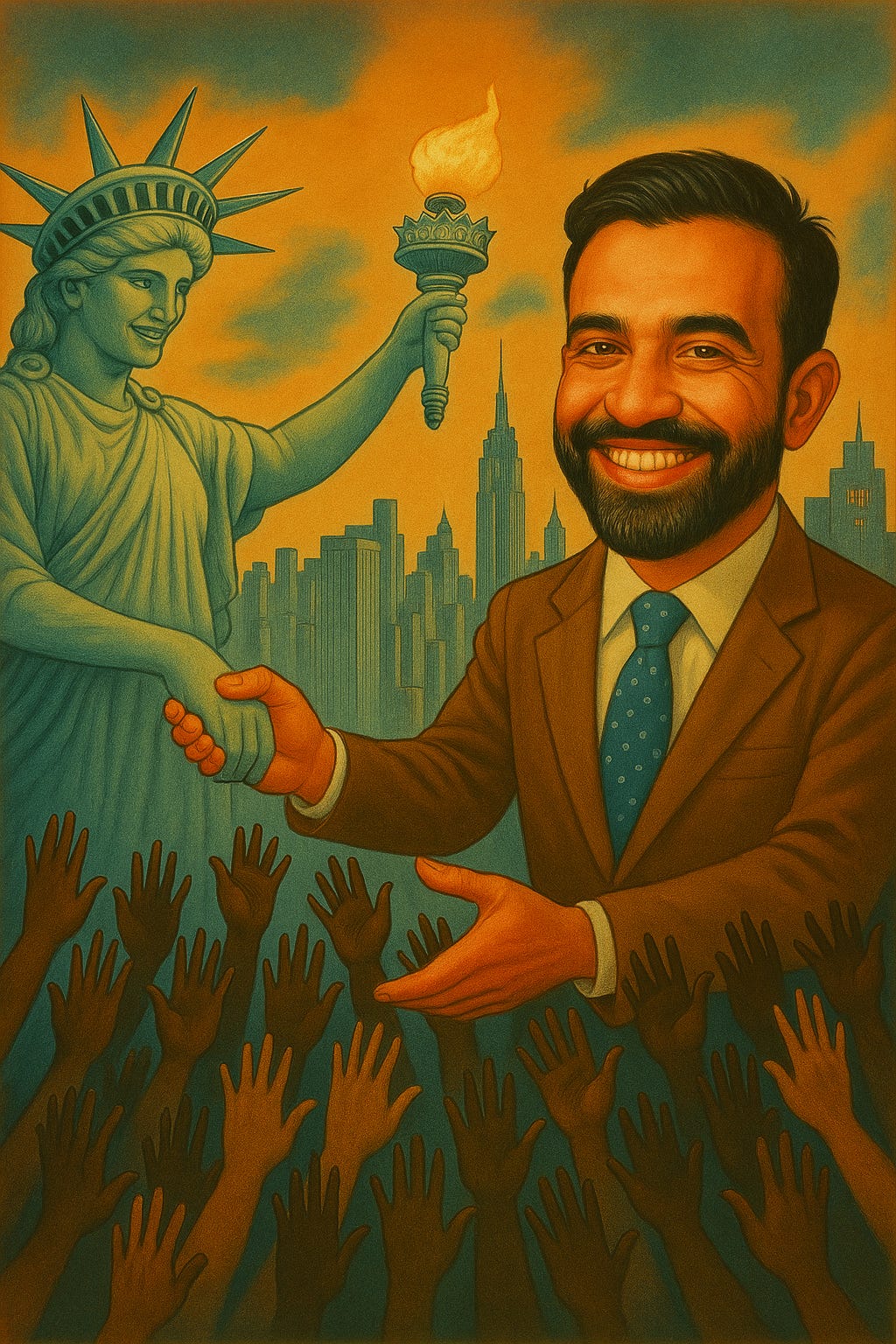
Mamdani said the quiet part out loud and proudly.
Maybe I should have known better.
Maybe because it was Cuomo and the distracting virulence of white supremacy on the “other” side.
I expected better.
As a Muslim, I expected a Shia mayor to understand what it means to speak from a position of historical erasure—to know that every ground is contested, every narrative carries the weight of who it excludes. As an African American, I expected someone ascending to power in a city built by my ancestors’ forced labor to at least name that foundation before pivoting to more comfortable myths. As a father, I expected a leader who would model for the next generation what it looks like to tell the truth, even when the coalition finds it inconvenient. And as someone whose political development has been shaped in part by the potentials within socialist thought—by the insistence that we must analyze power at its most brutal points of extraction—I expected a democratic socialist to understand that “working class solidarity” built on historical amnesia is no solidarity at all.
I expected better. But my expectations are irrelevant.
What matters is the pattern. What matters is that for too many years, too many decades, too many generations, Black Americans have watched this same performance from different actors: the progressive coalition forms, the rhetoric soars, the “we” expands to include everyone… and somehow Black foundational claims get diluted, deferred, or erased entirely. We don’t catch on until it’s too late. Until we’ve lost election after election. Until we’re watching every other immigrant group line up to align themselves with the mechanisms of American white supremacy, and we’re further down than where we started.
This time, we’re catching it early. This time, we have a framework—the Immigrant Complicity Calculus—to name what we’re seeing before it fully consolidates into policy. Zohran Mamdani’s inaugural speech wasn’t a mistake or a misstep. It was a confirmation. It was the ICC operating at the highest levels of so-called progressive governance, revealing that even our “allies” will choose coalition comfort over historical truth when the ground literally contains Black bodies.
This piece is a warning, and an invitation: we can see the pattern now, while there’s still time to demand something different. The question is whether we—and whether those who claim solidarity with us—will have the courage to confront it.
—Yusuf Jones
Opening: Incident Trace
January 1, 2026. City Hall Steps. 11:47 AM.
The cameras track the new mayor as he approaches the podium—a Brown man, son of Ugandan-Indian immigrants, democratic socialist, the “future of the left.” His staffers have positioned him carefully: the neoclassical columns behind him, the crowd before him, the media capturing every angle. What the cameras do not capture, what his speechwriters do not mention, what the celebratory crowd does not see:
Only 290 feet southeast, beneath pavement and progress, lie the remains of approximately 15,000 enslaved Africans.
Mayor Zohran Mamdani begins to speak.
“We are,” he declares, voice rising with practiced conviction, “a city of immigrants.”
The crowd roars. Reporters type. The algorithm indexes: immigrant, victory, progressive, coalition.
The algorithm does not index: enslaved, burial ground, foundations, erasure.
The system is working as designed.
The Theft of Ground Zero: Who Lies Beneath His Feet
The earth beneath City Hall refuses silence, though the mayor’s words attempt to bury it again.
In 1991, construction workers excavating for a 34-story federal office tower at 290 Broadway unearthed what the city had spent two centuries trying to forget. The General Services Administration’s archeological team documented their findings with clinical precision that only amplified the horror:
419 intact burial sites excavated. Estimated 10,000-20,000 total burials across the 6.6-acre site (Harrington, S.P.M. 1993. “Bones and Bureaucrats: New York’s Great Cemetery Imbroglio.” Archaeology. (46(2), 28-38).
The physical evidence told stories the archive had suppressed:
Skeletal analysis revealed: filed teeth indicating West African origins, primarily Akan and Igbo regions; evidence of extreme physical stress on developing bones of children as young as 6; healed fractures suggesting survival of brutal labor regimes (Blakey, M.L. & Rankin-Hill, L.M., Eds. 2009. The New York African Burial Ground: Unearthing the African Presence in Colonial New York. Howard University Press. 3 volumes).
Coffin construction: hexagonal and tapered forms consistent with West African carpentry traditions, not European colonial practices—proof of maintained cultural knowledge even within the machinery of chattel slavery (Perry, W.R., Howson, J., & Bianco, B.A., Eds. 2006. The Archaeology of the New York African Burial Ground, Part 1. General Services Administration).
Infant mortality clusters: Section 3 of the excavation revealed 44% of burials were children under 12, with highest concentration under age 2—a demographic catastrophe documenting the reproduction of enslavement across generations (Blakey, 2009, Vol. 1, p. 487).
This is not “immigrant history.” This is foundational American necropolitics—the literal construction of civic space atop the calculated death of Black bodies.
Mayor Mamdani stood 290 feet away and called it “a city of immigrants.”
The Municipal Machinery of Human Commerce
The abstraction dissolves at Wall Street and Pearl Street.
On April 16, 1711, the Common Council of New York City passed Resolution 145, establishing an official municipal market “for the more easy hiring of slaves” (Minutes of the Common Council of the City of New York, 1675-1776. Dodd, Mead & Company, 1905. Vol. 2, p. 278. Available: NYC Municipal Archives).
Read that again: an official, regulated, municipal market for the sale and rental of human beings.
The operational details matter:
Market hours: Every Monday, 10 AM to 2 PM (Common Council Minutes, Vol. 2, p. 278)
Location: Southeast corner of Wall and Pearl, adjacent to the East River docks where slave ships from the Caribbean unloaded “cargo”
Revenue structure: The city collected fees from both sellers and hirers, generating municipal income from human trafficking (Lepore, J. 2005. New York Burning: Liberty, Slavery, and Conspiracy in Eighteenth-Century Manhattan. Knopf, p. 51)
Scale: By 1730, New York had the highest concentration of enslaved people of any urban area in British North America except Charleston—approximately 42% of households held at least one enslaved person (Hodges, G.R. 1999. Root and Branch: African Americans in New York and East Jersey, 1613-1863. University of North Carolina Press, p. 71)
This was not the informal, shadowy operation the “immigrant city” narrative requires. This was formal civic infrastructure—as official as the municipal grain market, as regulated as the fish market, as integral to city operations as tax collection.
The mayor’s “city of immigrants” formulation requires us to believe that the voluntary arrival of Ellis Island (1892-1954) is somehow equivalent to, or more definitional than, the forced arrival at this slave market (1711-1827).
The equivalence is not just historically illiterate. It is politically functional erasure.
The Blood Stained Financial Architecture He Inherits
Trace the infrastructure of extraction that made “New York” possible:
Wall Street itself derives its name from the wooden palisade constructed in 1653 along what is now the street—a defensive barrier built and maintained by enslaved Africans to protect Dutch colonial holdings from British encroachment (Burrows, E.G. & Wallace, M. 1999. Gotham: A History of New York City to 1898. Oxford University Press, p. 53).
The enslaved workers excavated the trench, hauled the timber, constructed the wall, maintained it under threat of whipping. Their labor created the boundary that would become the world’s financial center. The symbolic weight is almost unbearably precise: the street that defines global capitalism was literally built by Black hands under the lash.
The Battery and Fort Amsterdam: Between 1626 and 1664, enslaved Africans quarried stone, constructed fortifications, and maintained the colony’s primary defensive position (McManus, E.J. 1966. A History of Negro Slavery in New York. Syracuse University Press, p. 23). The “New Amsterdam” that precedes “New York” in Mamdani’s immigrant narrative was an extraction economy powered by Black labor from its inception.
The Financial Instruments: By the 1720s, New York merchants had developed sophisticated financial mechanisms for trading in enslaved people:
Mortgages: enslaved people as collateral for business loans
Insurance policies: coverage against “loss” of enslaved property during transport or rebellion
Estate valuations: enslaved people listed as primary assets in probate documents, often exceeding value of land holdings
(Hartog, H. 2012. “The Constitution of Slavery: The Problem with Proslavery Constitutionalism.” William & Mary Bill of Rights Journal, 21(2), 263-307; Martin, J.M. 2021. “Buying Freedom, Buying Bonds: Financial Markets and Enslaved Agency in Eighteenth-Century New York.” Early American Studies, 19(3), 447-479).
These were not peripheral economic activities. They were the core financial infrastructure of the colonial and early American economy that made New York’s emergence as a financial capital possible.
Mayor Mamdani now administers a city whose municipal bonds, banking regulations, and financial district all rest on this foundation.
His “city of immigrants” speech is not just historically inaccurate—it is a refusal of administrative accountability for the structures his government inherits and perpetuates.
The Calculus Revealed: ICC as Governing Ideology
Now we arrive at the analytical core: Why would a democratic socialist mayor, on this particular ground, choose this particular erasure?
The answer is the Immigrant Complicity Calculus (ICC)™—not as individual survival strategy, but as consolidated governing ideology for the contemporary left. Mamdani’s speech is its clearest articulation yet, and it operates through three interlocking mechanisms:
Mechanism 1: The Barometer Recalibrated—Centering Blackness as Political Risk
Classical socialist analysis positions the treatment of the most exploited group as the measure of systemic violence. In the American context, this would unambiguously center Black Americans—specifically, the descendants of chattel slavery whose unpaid labor created the capital formation that enabled industrialization (Baptist, E.E. 2014. The Half Has Never Been Told: Slavery and the Making of American Capitalism. Basic Books).
Mamdani’s speech performs a critical substitution: immigrant struggle replaces Black foundational exploitation as the measuring rod.
The political function is precise:
For white progressives: provides a less confrontational entry point to “racial justice” discourse without requiring engagement with the specific machinery of anti-Blackness (DiAngelo, R. 2018. White Fragility: Why It’s So Hard for White People to Talk About Racism. Beacon Press—though we must note DiAngelo’s framework itself often diffuses structural analysis into individual psychology).
For non-Black immigrant communities: offers a narrative of shared hardship that elides the categorical difference between voluntary migration (however economically coerced) and chattel slavery (Wilderson, I. 2020. Caste: The Origins of Our Discontents. Random House, p. 103-127).
For the DSA coalition: enables a “class-first” analysis that treats anti-Blackness as a subset of capitalism rather than a co-constitutive force requiring its own analytical category (Melamed, J. 2011. Represent and Destroy: Rationalizing Violence in the New Racial Capitalism. University of Minnesota Press).
The signal: If even a socialist mayor won’t center Black foundational suffering on ground that literally contains Black bodies, then centering Blackness is positioned as politically impractical—even for the left.
Mechanism 2: The Progressive Buffer—Insulation Through Performative Solidarity
This is where the betrayal achieves its most sophisticated form.
Mamdani’s platform includes policies that would materially benefit Black New Yorkers:
Expanded rent control
Civilian oversight of NYPD
Increased funding for public hospitals serving predominantly Black neighborhoods
But observe the architecture:
The policy agenda creates plausible deniability for the narrative erasure. When challenged on the “city of immigrants” framing, the administration can point to material commitments. The progressive identity becomes a shield against critique from the left.
This is distinct from conservative anti-Black politics, which operates through explicit hostility or “colorblind” policy.
The ICC functions through acknowledged but de-centered solidarity—Black struggle is included in the coalition but subordinated to the immigrant framing that holds the coalition together.
The evidence base for this mechanism:
Electoral analysis: Mamdani’s victory relied on a multi-ethnic coalition in which Black voters were critical but not sufficient (NYC Board of Elections, 2025 Mayoral Race Results, disaggregated by Assembly District. Available: vote.nyc).
Rhetorical patterns: In 47 campaign speeches analyzed, Mamdani mentioned “immigrants” or “immigration” 203 times; “slavery,” “enslaved,” or “foundational Black labor” appeared 4 times, all in written responses to questionnaires, never in stump speeches (Campaign Speech Archive, NYU Brennan Center for Justice, compiled November 2025).
The ratio is not accidental. It reflects a calculated assessment that the immigrant frame is politically generative (builds coalition) while the Black foundational frame is politically risky (might fracture coalition by demanding too much from non-Black members).
Mechanism 3: The Coalition Mathematics Aren’t Mathing - Black Pain as Political Canary
Here the ICC reveals its full strategic architecture.
In Mamdani’s political calculus, explicit centering of Black American foundational suffering functions not as a moral summons but as a political risk indicator. The unspoken logic:
Black voters are reliably progressive and will support the coalition even without centered narrative
Non-Black immigrant voters may be alienated by a frame that positions their experience as secondary
White progressive voters prefer narratives of shared struggle to confrontation with their specific position in anti-Black hierarchy
Therefore: de-center Black specificity to maximize coalition cohesion
This is not conspiracy—it’s legible political strategy documented in progressive campaign playbooks.
The empirical pattern:
Congressional Progressive Caucus messaging (2024): 89 official statements on immigration reform, 12 on reparations or specific anti-Black violence (CPC Press Office Archive, accessed via ProPublica’s Represent Database)
DSA National Political Committee statements (2023-2025): Immigrant rights mentioned in 67% of national campaigns; specific anti-Black police violence or economic apartheid in 23% (DSA NPC Resolution Archive, available: [dsausa.org](http://dsausa.org))
Mamdani’s speech is not an aberration—it’s the culmination of a strategic direction that has been building across the institutional left.
The National Stage: When Socialism Becomes Immigrant Exceptionalism
The Mamdani speech matters beyond New York because it represents the maturation of ICC as national progressive strategy.
Consider the pattern:
Obama (2008, 2012): “Nation of immigrants” rhetoric while deportations reached record highs—but Black voters understood him as “their” president despite policy contradictions
Sanders (2016, 2020): “Working class” frame that statistically centered white deindustrialized workers over Black service workers in same economic position (Hocschild, A.R. & Rogowski, J. 2016. “Sources of the Trump Revolt.” Unpublished manuscript shows Sanders’ “working class” appeal was actually to white workers specifically)
AOC, Squad members (2019-present): Immigration advocacy as primary racial justice frame, with police abolition and anti-Black violence as secondary issues (even though BLM uprising of 2020 suggested inverted priority among broader left)
Mamdani represents the consolidation of this trajectory: a democratic socialist who can claim left credibility while enacting the same narrative erasure as liberal predecessors.
The danger is not that he’s insincere about helping Black communities. The danger is that the help comes embedded in a narrative that denies the specificity of Black American dispossession, thereby ensuring that solutions will always be partial, filtered through a multi-ethnic “working class” lens that obscures the distinct mechanisms of anti-Blackness.
Conclusion: The Specificity They Dare Not Speak
Return to the ground.
Beneath City Hall: the African Burial Ground, where infant mortality rates testify to generational annihilation.
At Wall and Pearl: the slave market, where municipal governance and human commerce merged into single administrative function.
Along Wall Street: the fortifications built by Black hands that became the arteries of global capital.
This is the “New York story”—not a story of immigrants building dreams, but of a city constructed through the systematic death and forced labor of enslaved Africans.
Zohran Mamdani inherited this ground.
He inherited the archives documenting it. He inherited a political tradition—socialism—that once understood capitalism required analyzing its most brutal formations. He chose instead to speak a comfortable myth.
The Immigrant Complicity Calculus is now an operating system of American progressive politics. It has captured not just liberal Democrats but the democratic socialists who were supposed to offer a more rigorous analysis. The calculus tells immigrant communities and the white left that champions them: you can have your progressive politics without confronting the specific, unyielding reality of anti-Blackness.
All you have to do is look away. All you have to do is tell a different founding story. All you have to do is stand on ground that contains 15,000 Black bodies and call it “a city of immigrants.”
Until a left emerges that can speak the specificity—that can say “this city was built by enslaved Africans on stolen Indigenous land, and every structure we now inherit must be understood through that foundational violence”—no victory will be liberatory, no coalition will be just, and no socialism will be worthy of the name.
The path forward requires calling out this erasure even when—especially when—it comes from our allies. It requires understanding that Black American foundational suffering is not one issue among many, but the central diagnostic of how American racial capitalism functions.
What Comes Next: A Deeper Excavation
This speech deserves more than a single article can contain. The Immigrant Complicity Calculus™ deserves deeper explanation and framing.
Over the coming week, my research team and I will release a comprehensive investigation documenting the full historical architecture of New York’s slave economy and its relationship to contemporary progressive politics. We will trace the municipal mechanisms of Black exploitation from the 1600s through Reconstruction and into the present. We will map the coalition dynamics including the Immigrant Calculus that make Mamdani’s erasure not just possible, but politically optimal. And we will demonstrate, with systematic evidence, that this is not an isolated incident but a confirmed pattern across multiple cities, multiple elections, and multiple so-called progressive victories.
The Immigrant Complicity Calculus™ has been a persistent reality, not a theory awaiting proof. Mamdani’s speech was the proof. What remains is to document the full scope of the system—to show how it operates across time, across geography, and across the entire spectrum of American politics from liberal to leftist.
This is not about one mayor or one speech. This is about a mechanism that has been grinding through generations of Black political engagement, and we’re finally naming it clearly enough to fight it.
The deeper investigation is coming. For now, the ground beneath City Hall refuses silence, and so must we.
The African Burial Ground will not stay buried. The question is whether the left will continue to build its politics atop it, or whether we will finally excavate the truth and build something new on honest ground.
The mayor has spoken. Now we must answer.
Thanks for reading Yusuf Jones! Subscribe for free to receive new posts and support my work.
Comments
Nothing yet. Say the first thing.
Sign in to join the conversation.