
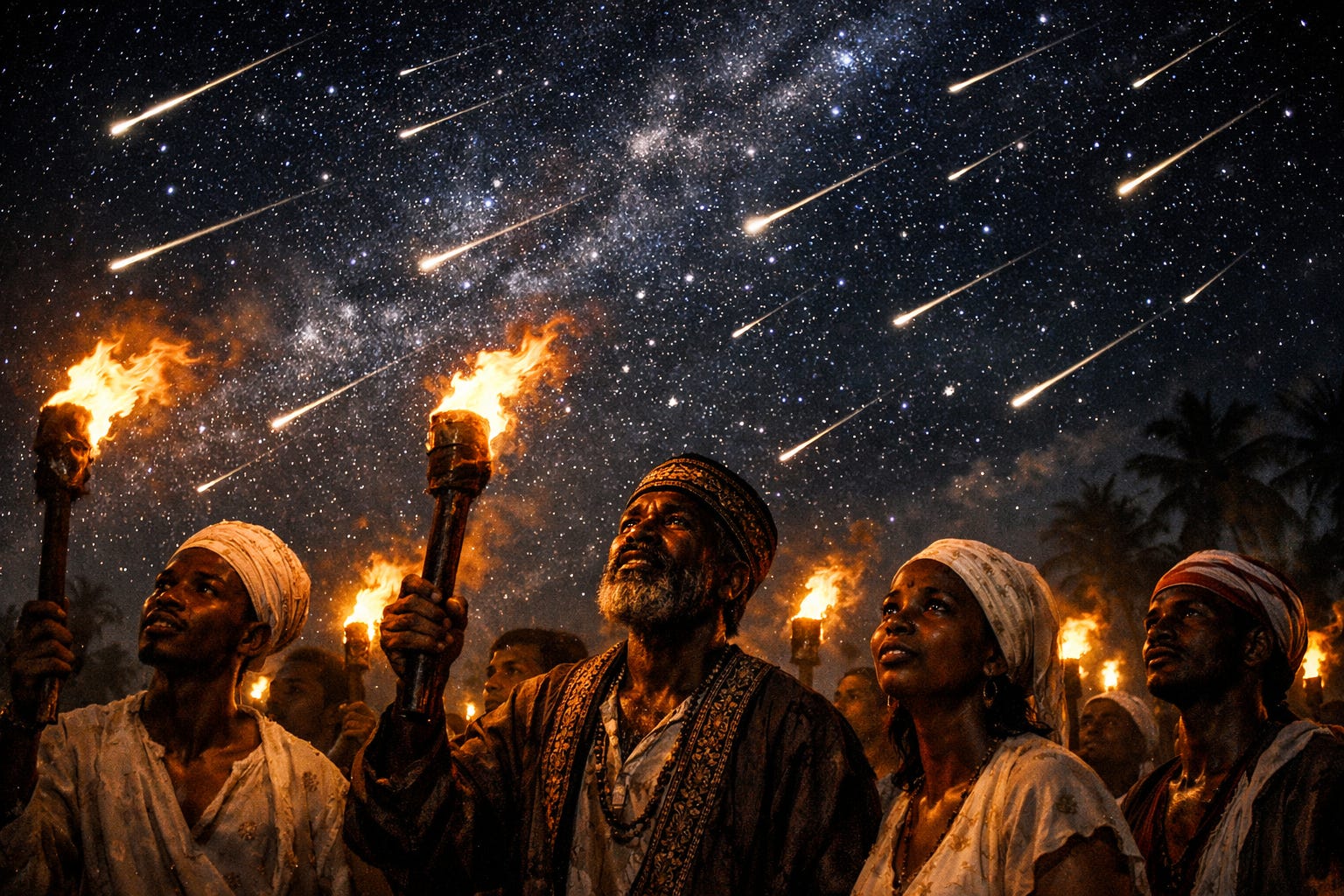
In 1835, in the Brazilian city of Bahia, a young Muslim—enslaved in body but unwavering in faith—joined a revolt led by the elderly scholar and spiritual guide Ahuna. Though the uprising was crushed and the young man killed, his body was found bearing a folio hung around his neck. Written on it was a verse from the Qur’an, a final prayer and declaration:**
“Our Lord, make us Muslims in submission to You, and from our descendants a nation in submission to You.” (Surah Al-Baqarah 2:128
Across oceans and generations, the cry for freedom was never just political—it was ancestral, devotional, and divine.
The Quranic verses of Surah al-Qadr thunder with divine promise: "The Night of Power is better than a thousand months" (97:3). On this night, the heavens rupture, and mercy cascades into a world parched by oppression. Laylat al-Qadr is not merely a moment of celestial grace - it is a cosmic insurrection. Here, the Divine invites humanity to rewrite destinies, shatter shackles, and reclaim the fitrah: the innate dignity etched into every soul. For the enslaved African Muslims of Bahia, known as the Malé, this sacred night became both a spiritual compass and a revolutionary manifesto. Their 1835 revolt - timed to coincide with Laylat al-Qadr - was no mere uprising; it was a declaration that the soul’s surrender to God necessitates rebellion against tyranny.
The Malé were not anonymous rebels. They were Yoruba, Hausa, and Nupe Muslims - blacksmiths, tailors, and scribes - whose hands forged iron and inked Quranic verses in secret. By day, they labored under the lash of Brazilian enslavers; by night, they gathered in clandestine zawiyas, teaching Arabic, reciting Surah ar-Rahman, and plotting liberation. Literacy was their weapon: they drafted proclamations in classical Arabic, invoking the Prophet’s ﷺ triumph at Badr. Among them stood Dandara, a midwife who smuggled messages in herbal pouches, and Malam Bello, a scholar whose tattered Quran doubled as a map of insurgent routes.
Their Ramadan fasts were acts of defiance. While their bodies starved, their souls feasted on the certainty that, as Shaykh Ibrahim Niasse later taught, “The soul which fasts for Allah refuses to be enslaved by anything else.”
For the Malé, hunger was not deprivation - it was purification, a stripping away of colonial lies to reveal the luminous truth: They were Allah’s servants, never man’s property.
Decades later, across the Atlantic in Senegal, Shaykh Ibrahim Niasse (d. 1975) ignited a spiritual revolution. His Faydah Tijaniyya (“Divine Flood”) movement of the Tijani Tariqah declared ma’rifa - direct knowledge of God - a universal right, a Divine endowment, not a privilege for protected classes of elites.
To a Malé survivor’s descendant, his words would have resonated like an ancestral drum: “When the light of ma’rifa enters the heart, the entire world of illusion is shattered.”
Niasse’s teachings bridged the Malé’s struggle and the Quranic ethos of Laylat al-Qadr. He framed fasting as “spiritual warfare” against internalized oppression, urging disciples to “fast from complicity” in injustice. His insistence that “submission to Allah necessitates refusal to submit to any other master” echoed the Malé’s theological revolt.
Ramadan’s rituals are a curriculum for liberation. Fasting dissolves the ego’s chains; Taraweeh prayers synchronize hearts across continents; Laylat al-Qadr reignites the covenant of human dignity. For the Malé, Ramadan was a rehearsal for revolution. Their pre-dawn suhoor meals were whispered strategy sessions; their iftars became communal vows to reclaim agency.
This ethos pulses through marginalized communities today. In Ferguson and Gaza, protesters break fasts with tear gas lingering in the air, embodying Shaykh Niasse’s axiom: “If you fear the tyrant more than Allah, you have not yet begun to know Him.” The Night of Power reminds us that divine mercy flows most fiercely to those who dare to demand justice.
The Malé’s Islam - like Niasse’s - was radical, rooted in Prophet Muhammad’s ﷺ legacy: “Allah does not look at your outward forms, but at your hearts and deeds” (Hadith).
Laylat al-Qadr condemns quietism. It is the night when Bilal’s ﷺ cry of “Ahad!” (The One!) drowns out Pharaoh’s arrogance. To honor it, we must align with Shaykh Niasse’s vision: “True knowledge of Allah dismantles every form of false power.”
The Malé’s outward uprising was crushed. Yet their spiritual and cultural legacy, like Laylat al-Qadr, returns annually, demanding we answer: Will we fast from complacency? Feast on courage? Fast from complicity? Break our fast with truth?
Shaykh Niasse’s light floods onward. In Dakar, Bahia, and Minneapolis, the Night of Power still whispers: Mercy and liberation are twins. To kneel only to Allah is to stand against every empire.
Comments
Nothing yet. Say the first thing.
Sign in to join the conversation.