
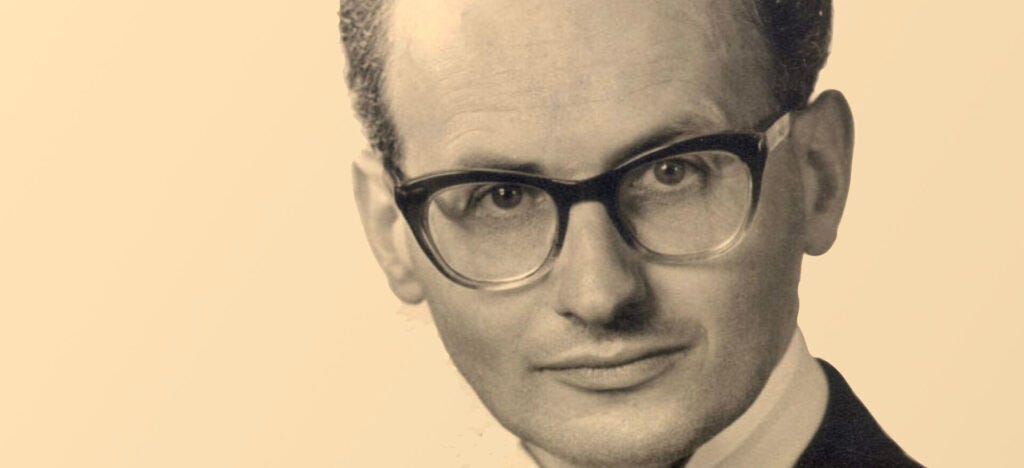
In “Proofs and Refutations“, Imre Laktos1 portrays a Socratic dialogue between a teacher and his students as they prove Euler’s theorem V+F =E+2. The beauty of this essay is that the discussion mirrors the historical development of the subject, whilst also critiquing the formalist school of thought, the modern agenda of meta-mathematics, and how it doesn’t fit the way mathematics is done in practice. Whilst I’m on board with us not knowing how to formalize mathematical practice, I think it is a solvable problem. Moreover, I am a staunch ultra-finist believer in reality being computable, which dovetails with a belief that proofs are truth-preserving. Yet that matters little in the face of such a fantastic exposition on mathematical discovery.2 Moreover, Laktos’ essay wonderfully show how to alternate between proving and disproving a conjecture to derive insights, and how that informs the very conjectures we seek to prove.
In fact, it was so stimulating that after reading it I came up with two other proofs of Euler’s Theorem on the spot, though the core idea is the same as in Laktos’ proof. After that experience, I feel like showing a reader how a proof is generated is a dang good substitute for interacting with a mathematician in real life. Mathematics is one of the few areas where text and images, if read carefully, can transfer most tacit information. We need more essays like this.3
Now, if only we could get professor’s to force students to try and prove theorems within the lecture, dialogue with them and transcribe the process. Just think, when the professor comes to the “scrimp together lecture material and turn it into a textbook” part of their lifecycle, we’d automatically get beautiful expositions. Please excuse me whilst I go cry in a corner over unattainable dreams.4
Despite being an early 20th century genius born in Hungary, he was not a Martian as he wasn't born in quite the right place or quite the right time.
And how weird things were in the days before Hilbert mastered mathematics and brought rigor to the material world. Listen to this wildly misleading quote: "In the 19th century, geometers, besides finding new proofs of the Euler theorem, were engaged in establishing the exceptions which it suffers under certain conditions." From p. 36, foot note 1.
Two other excellent expositions are Genealized Heat Engine by Johnswentworth and Lecture 9 of the Democritus Lectures on QM by Scott Aaronson. Though they’re not as organic as Proofs and Refutations. Another great example of pedagogy is Thermodynamics by Enrico Fermi himself, in what is surely the cleanest exposition of the logical structure of thermodynamics ever written.
Funnily enough, Euler’s papers contain clear descriptions of how he came to the proofs. At least, those I’ve read. Which is, like, 1/10,000th of his material by word count. I’m not kidding. We just finished publishing all his works this century and it took a hundred year long publishing project to do so. For some samples of his works, see the Euler Archive or William Dunham’s excellent book “Euler: The Master of Us All”. Or if you want a taste of his writing for the general public, read his “Letters to a German Princes”, which were one of the first works of popular science.
No posts
Comments
Nothing yet. Say the first thing.
Sign in to join the conversation.