
Generative AI art is supposedly bad, bland, and boring. Haven’t we been here before? Did we not learn not to make these distinctions between high and low culture? At precisely the point when generative AI is becoming truly available to users around the globe, we see a rise of such articulations, yet masses of users don’t seem to be paying heed to them. They are experimenting, learning and adapting. This debate echoes previous moral judgements about the digital camera, the ubiquitousness of cinema, and vernacular image-making practices that today have become prevalent on TikTok and similar apps.
Romanian director Radu Jude—director of the film Do Not Expect Too Much from the End of the World, which truly captures the energy of the past few years—makes a case for vernacular cinema, albeit in a limited and non-idealised sense. The film is about an overworked Romanian woman who drives people around and works for the so-called creative industries. In her free time, she also makes TikTok videos which are derogatory and misogynist as satire. In short, she hates her work, but has to continue working as a wage slave in the chaotic cityscape of Bucharest, and her timepass activity is to be entertainingly vile on TikTok. Her life is contrasted with the previous life of a taxi driver under the Communist regime, when life was slower. The film is not really a nostalgic call for a return to the Communist regime but it describes temporal contrasts exceptionally well, highlighting the contemporary intensification and flexibilization of labour processes. The film captures how lines between one’s working hours and leisure time blur into each other and the frustrations of the working life can somehow only be vented out through masks and vileness—a theme also explored in a very different way in Bad Luck Banging or Loony Porn.
There is nothing unique about this historical moment and its so-called bad art. Art described as bad has always been around: B and C-grade movies, doggerel, teenage angst poetry, cliched love poems, jokes in supposedly bad taste, pornography, mass market dumping ground books sold by the kilo, folk and pop music, suggestive dance and strip shows, ‘kitschy’ sculptures, trinkets and paintings sold by artists trying to make ends meet on the streets and the most paradigmatic of it all—the circus with animal shows, clowns and acrobats. All these are obviously modern examples. A longer genealogy of this would take us back to the carnival and the grotesque. This is what the masses consume(d).
Day-dreaming Indofuturism
It is productive to think of generative AI outputs as a form of wish-fulfillment, acts of daydreaming. Consider the following clips, which imagine a science fictional Indian past through short video snippets. In India, science fiction as a genre of cinema has been grossly underrepresented in cinemas, with a few notable exceptions in recent years. At least in cinema Indofuturism has simply not yet come of age. There is an obvious barrier to making lived-in, sci-fi cinematic worlds: they require huge budgets. The 2021 TV series OK Computer remains a notable exception among a range of other attempts.
To be able to make short clips like exemplifies the possibility of the intersectional synthesis of worlds. The images may very well be limited and informed by previous sci-fi motifs and imagery, but the desire to see oneself in these synthetic hybrids cannot be discounted. One may recoil at the thought of outsourcing our daydreaming to automatons and at the lack of diversity, but to see something fulfilled that previously could not have been does indeed unleash new desires. There is something to be said about the echoes of lost hopes of Nehruvian industrial modernity in the above clips, but that is for another time and place.
One of the first things I did when I encountered DALL-E 2 in early 2023 was to generate cyberpunk images of the city of Kolkata and other images of India which I had studied for so long. This was an obvious thing to try. Growing up in India, a generation of children fantasized playing Grand Theft Auto in the chaotic streets of India, ideally in Mumbai. Watching Japanese cyberpunk, the mind naturally wondered what kind of cyberpunk visions India could produce. What would the sprawling Indian cities look like in future?
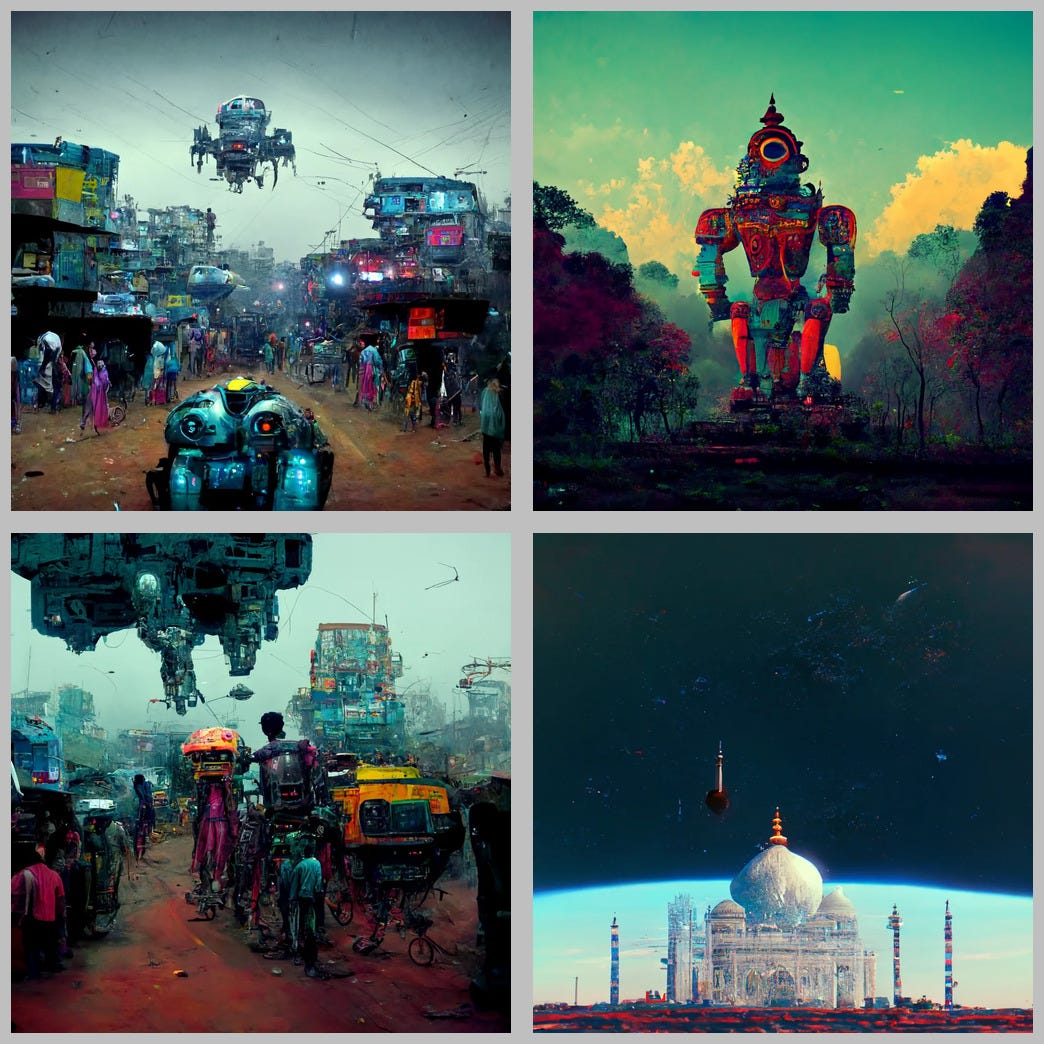
The point is not to debate whether the output generated by generative AI is ‘good’ or ‘bad’. They may become ‘good’ someday. But clearly, certain kinds of users deem it to already be ‘good enough’ to be able to start daydreaming. In 2024, I had a chance to be a test subject for a research wing of a big-tech Silicon Valley corporation. The researchers kept probing us about the realism of pictures—whether the Kolkata in the images, its people, architecture, gender and religious minorities and the likes looked convincing. While the focus on representational bias tends to include diverse people and their backgrounds in AI datasets and patch-up fixes of alignment issues, the users seem to be playing with non-realist images, and dreams.
No shame in this brutal world
Some of these daydreams may be regressive and violent; some may not be. But they are all part of what makes us (more than) humans. Generative AI is also being used to generate offensive images and words. But they have always been around. Desire and dreaming are volatile processes. They are not sanitised. Racist jokes have been around in most inter-ethnic milliues. They have been and still are a part of this world that we inhabit. Cultural work is political and there is political diversity in this world even if we don’t agree with many of them. Such thoughts and practices are part of our shared heritage even if we wish to shy away from them. There is no point in feeling shame and turning away from these shared ways of meaning-making, “even at their most brutal”.
Everyday culture, or folklore, is dirty. It isn’t nice and pretty like in the art galleries and museums. To acknowledge the dirt that we humans associate and live with, can at least then help us recognize the volatile world that we inhabit. We are swimming in the dirt of this earth. So much of the internet is filled with slop, misinformation, disinformation, porn, and hate speech. But is this not the case IRL (or AFK)? Increasingly polluted cities, demands of perpetual working hours, increasing heat waves, eratic weather patterns and conflicts? Why should AI generate only sanitised worlds trained on sanitised data? Any sense of censorship seems to only breed more contempt and suspicion.
As the field of AI ethics has grown in the past few years flooded by capital flow and interest from corporations and states, a new economy of AI ethics has developed which seems to be interested in cleaning up and providing shiny AI in this dirty world.
Do not despair for there is materialism
It is worth going back to a materialist analysis of algorithms and artificial intelligence to situate this moment. Algorithms have been at the heart of the transformation of relations and means of production. Artists, creative and cognitive workers of all sorts working on dead-end gig jobs, or even proper jobs which are more often than not bullshit jobs, are at the risk of devaluation—or, looking at it in another way, a proliferation of new kinds of bullshit data jobs. There are two questions that this moment helps us raise, and they are encapsulated beautifully in the opening paragraph of Matteo Pasquinelli’s The Eye of the Master:
In the twentieth century, few would have ever defined a truck driver as a ‘cognitive worker’, an intellectual. In the early twenty-first, however, the application of artificial intelligence (AI) in self-driving vehicles, among other artefacts, has changed the perception of manual skills such as driving, revealing how the most valuable component of work, in general, has never been manual but has always been cognitive and cooperative as well. Thanks to AI research—we must acknowledge it—truck drivers have reached the pantheon of intelligentsia.
Even though Pasquinelli’s argument hinges on the automation of management and is not applicable to all jobs, the interesting question to ask at this moment might be:
Now that AI has led us to acknowledge that we all are cognitive workers, why indulge in moralizing the value of creative and intellectual work against so-called manual work? How can workers of all sorts appropriate this moment to re-imagine the division of labour and relations and means of production and dream otherwise? Most talk of Big Tech seems to avoid this fundamental concern through regulation talk.
If generative AI’s output can generate mass daydreams and hallucinations that articulate whatever-it-may-be, why are some demanding the return to and preservation of the degrading work of Fiverr gig-hunters generating human-slop like the “10 Hottest Hollywood Celebrities with Blue Eyes”? And, yes, I have indeed written such an article a decade ago and been paid 3 or 4 USD on UpWork for writing it. These mind-numbing jobs are no different than life at an assembly line. A large number of creative workforce engages in such slop jobs across the world. Fiverr’s and Upwork’s recent announcement of integrating AI into the freelance work flow raises interesting questions about the changing nature of these slop jobs and why they exist at all.
Maybe the point is to free up our lives collectively to figure out how we can all daydream and have banal and momentarily profound reveries and also be bored by our very existence in this world and make a lot or some bad art. Workers once fought for the 8-hour work day in the 19th century. And we can probably demand more free time again. This is not at all utopic. Such notions are not even a demand for communism. They are already being lobbied for by a new technocratic left. But they don’t address the fact that labour laws don’t really work for most people in this world. Maybe being allowed to create bad AI slop to daydream is the least we can ask for after years of doing bullshit jobs.
On a different note…
Alongside synthetic and non-realist dreams, there are also more realist Indofuturist articulations of algortihmic folklore. These are projections of fear and anxieties i.e., dreams of loss. Loses are already being dreamt of and prefigured by ordinary folks themselves in the stories they are making up. Ordinary folks are intuitively generating folklore about informalisation, devaluation of skills, and precarisation without the need for those words.
The above clips are emergent cases of algortihmic folklore that directly address the problematic of labour. They are dense vernacular articulations that articulate fears and anxieties of the changing world around them. This is a longer story to unravel in coming time.
Comments
Nothing yet. Say the first thing.
Sign in to join the conversation.