
Another Russian bomb at a European airport. Yes, another one. Had this been done by Al-Qaida, we’d call it terrorism. Instead, it seems hardly to capture attention, probably because pointing the finger publicly at Russia would require actually taking action against Russia.
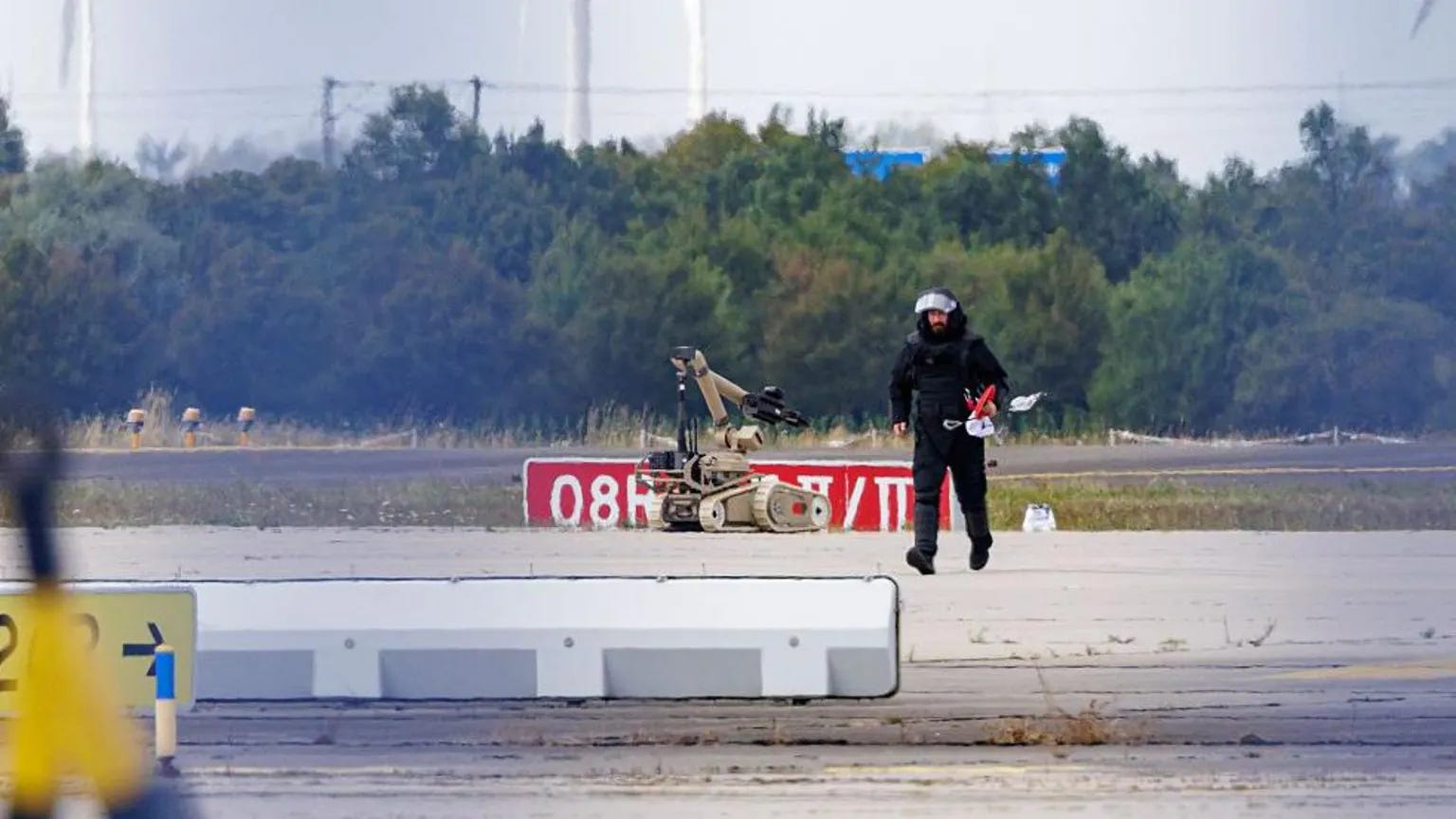
A drone armed with explosives was found at Germany’s Leipzig airport, near two Ukrainian cargo planes—one carrying loads of military ammunition—on Wednesday. The drone was discovered by an airport employee in a “secure cargo flight operations area” near the airport’s southern runway. It had evaded anti-drone technology meant to secure the airport. Unfortunately, NATO has not proven adept at preventing drones from flying over its airports and other sensitive sites.
German media reported the attached bomb was made of PETN and Semtex, about 800 grams of it, more than double the amount of the explosive used by Libyan terrorists to bring down Pan Am flight 103 over Lockerbie, Scotland, in 1988.
By sheer luck, it seems, the bomb attached to the drone did not explode, because the detonator was faulty.
The discovery of the armed drone led the airport to suspend traffic. A DHL cargo plane on approach to Leipzig aborted its landing and took off again, and collided with what is believed to be a second drone. Some German media reports claim that second drone had a camera that was meant to film the attack on the ground. The DHL plane sustained only minor damage.
While many officials called the incident an “escalation” and implied Russia might maybe possibly be involved, few called out Russia specifically. Roderich Kiesewetter, a member of the German parliament’s intelligence committee, was one of the few European officials not to mince words. “I consider the threat to Germany posed by hybrid attacks orchestrated by Russia to be serious. I also believe that the attempted drone attack at Leipzig airport was a targeted hybrid attack—in other words, an attempted act of terrorism—orchestrated by Russia.”
Not Leipzig’s First Russian Rodeo
Leipzig’s airport is known to be a logistics hub for moving aid and weapons to Ukraine. It has been a target of Russia’s shadow war many times already. In July 2024, individuals acting on behalf of Russian military intelligence (GRU) sent a parcel containing explosives hidden inside sex toys through DHL. The bomb went off at the Leipzig airport as the package was being moved to the cargo plane, which had been delayed. Had it gone off on the plane, it likely would have caused serious damage, including possibly downing the plane. Another explosives-laden package sent through DHL had passed through Leipzig airport before exploding in Birmingham, England. Two other explosive parcels were found in Poland before they could go off.
Leipzig airport has also been the target of espionage. Last summer, a staffer for German parliamentarian Maximillian Krah, a member of the Alternative for Germany (AfD) party, was sentenced to four years and nine months in prison in Germany for spying on the airport for China. The case might have involved spying for China, but the intelligence collected was very much connected to Russia’s war in Ukraine. Krah’s staffer had a sub-asset, a Chinese employee of a logistics company that worked at Leipzig airport. She provided him information on arms shipments in and out of the airport. She also provided information on the movement of employees from the German weapons manufacturer Rheinmetall, which makes weapons for Ukraine. She admitted sharing sensitive information and received a suspended sentence. Krah, meanwhile, remains under investigation for spying for both China and Russia.
Not Russia’s First Rodeo, Either
This is not the first time Russia’s intelligence services have acted in extremely dangerous ways inside European countries that do not view themselves as at war with Russia, even though Russia does consider itself at war with them (hence the bomb plots!). In fact, there have been bomb plots in other European countries, too, along with assassination plots and endless attacks on critical infrastructure. Unless our response makes it clear to Russia that further aggression is not a viable option for Russia to achieve its strategic objectives, Russia will continue with similar attacks, to our detriment. Indeed, just this week, US intelligence officials warned that Russia is likely to further test NATO’s resolve in the very near future with even more dramatic attacks or possibly a limited land incursion. We were lucky this time that the bomb didn’t go off. And we were lucky the other times that the bombs went off when they were not on the planes. If we do not respond to this violence with credible deterrence, Russia will try again and eventually will succeed.
This week, a French court upheld that expulsion order. The order would force Federova to wear an ankle bracelet, check in with the police, and have her assets frozen for six months. However, by sheer coincidence I’m sure, Federova was already out of France when the expulsion order was issued. She has vowed not to return to France in order to be expelled from France until the order to expel her from France has gone away. Got it?
Is this considered self-deportation?
Where is Federova? She hasn’t said, but I am guessing we will see her on Russian propaganda channels soon, touting how much she loves being back in Russia and how backwards France is. But that’s just a guess.
A roundup of things you should be reading
Capital One says it closed Trump Organization’s accounts after ani-money-laundering review (The Guardian)
Ceuta Exposes Europe’s Enemies Within (Nathalie Tocci)
The Far Right Is Distorting Ceuta (The Atlantic)
Just Security has launched WHAT JUST HAPPENED? as well as a litigation tracker to help readers keep up with the chaos
Alex Finley is a former officer of the CIA’s Directorate of Operations, where she served in West Africa and Europe. She writes and teaches about terrorism, disinformation / covert influence, and oligarch yachts. Her writing has appeared in Slate, Reductress, Funny or Die, POLITICO, The Center for Public Integrity, and other publications. She has spoken to the BBC, MSNBC, CNN, C-SPAN’s Washington Journal, France24, and numerous other media outlets. She was also invited once to speak at Harvard, which she now tells everyone within the first ten seconds of meeting them. She is the author of the Victor Caro series, satirical novels about the CIA. Before joining the CIA, Alex was a journalist, covering Capitol Hill, the Pentagon, and the Department of Energy. She reported on issues related to national security, intelligence, and homeland security. Did she mention she was invited to speak at Harvard?

Comments
Nothing yet. Say the first thing.
Sign in to join the conversation.