
When words and actions don’t match up.
On July 8, 2026, House Speaker Jill Krowinski sat down for an exit interview with 802 News on WCAX. She was leaving after 14 years in the legislature, six as speaker — not seeking re-election, passing the gavel, reflecting on what she’d built and what she was proud of.
The interview turned, as it often does in this political moment, to the tone of public life. How does Vermont compare to what’s happening nationally?
Krowinski had an answer. She had been at a press conference with Congresswoman Becca Balint a few weeks earlier, she said. Balint had described what she was seeing in Washington: Republicans in Congress had been told not to work with Democrats. “Do not collaborate, do not work across party lines,” Krowinski said, relaying what Balint had described. “And that is so outrageous to me.”
Source: 802 News, WCAX, July 8, 2026 — full transcript on file
Vermont, she said, was different. She described her working relationship with Republican Minority Leader Patty McCoy — a partnership built before either of them was in leadership, when they sat next to each other on the Human Services Committee. She described the motto they’d developed together:
“No surprises — and we work hand in hand to make sure that we are successful on the floor.”
Of McCoy specifically, she said: “We wouldn’t hold back at all — totally open and honest and transparent.”
Source: 802 News, WCAX, July 8, 2026 — transcript confirmed verbatim
The contrast she was drawing — Vermont’s collaborative cross-party culture against Washington’s directed partisanship — is worth holding up against the documented record of how the House Democratic caucus has operated during the years she led it.
Because on the Democratic side of that collaboration, the documented record tells a different story than the one she described.
Patty McCoy has led the House Republican caucus since 2019. In January of that year, Seven Days reporter Taylor Dobbs profiled her as she began the job. McCoy described her approach to leading a super-minority with characteristic directness.
“We never tell anybody how to vote. We never push.”
Source: Seven Days, Taylor Dobbs, January 30, 2019 — sevendaysvt.com
That is the minority leader Krowinski praised in her exit interview. That is the partner in the “no surprises” motto.
The documented record of how the Democratic majority caucus operated alongside that partnership looks different.
In March 2026, House Democrats were weighing a proposal to increase state income taxes by 3% on households earning more than $500,000 a year, with an additional 2% on income over $1 million. The amendment had been scheduled for a floor vote on the evening of March 26.
At about 9:30 p.m., after nearly six hours on the floor, Krowinski unexpectedly postponed action. Vermont Public reporter Peter Hirschfeld obtained the email that explained why. House Majority Whip Karen Dolan, D-Essex Junction, had written to Democratic members:
“There is talk that votes are changing on the proposed amendment. We need a vote count to see where we are at.”
And then:
“The caucus position is to vote NO on this amendment.”
Source: Vermont Public, Peter Hirschfeld, March 27, 2026 — vermontpublic.org/local-news/2026-03-27/house-democrats-revive-tax-the-rich-despite-leadership-misgivings
The following morning, House leaders held a closed-door caucus meeting. Vermont Public reported it was “off limits to media.” Majority Leader Lori Houghton, D-Essex Junction, was direct about what leadership was weighing: “We passed this out of the House last biennium and it went nowhere and we paid for it. There is absolutely a political cost to this, because the message won’t be that we passed taxes on the wealthy. The message from the opposition will be, ‘They raised your taxes.’”
After hours of additional closed-door negotiations, the amendment was pulled from the floor entirely. Sponsors withdrew it in exchange for a committee process later in the session. It was never voted on.
Rep. Monique Priestley of Bradford, one of the amendment’s architects, described what she had heard from constituents: “This is the single-most popular thing that I have received demands from constituents to get passed in this building.”
The Dolan email is a document. The closed-door meeting is reported. The amendment died without a floor vote.
On May 6, 2026, the House took up an amendment to S.325 offered by Rep. Burtt of Cabot — a provision addressing on-farm business exemptions within the land use bill that had broad rural support. The amendment passed 77-66. The Republican minority held 56 seats. With one independent, the non-Democratic vote could reach at most 57. The amendment needed 77. It could not pass without Democratic votes. The 19 Democrats who crossed the caucus line to provide them are listed in the chart below.
Source: House Journal, May 6, 2026, pages 4157–4159
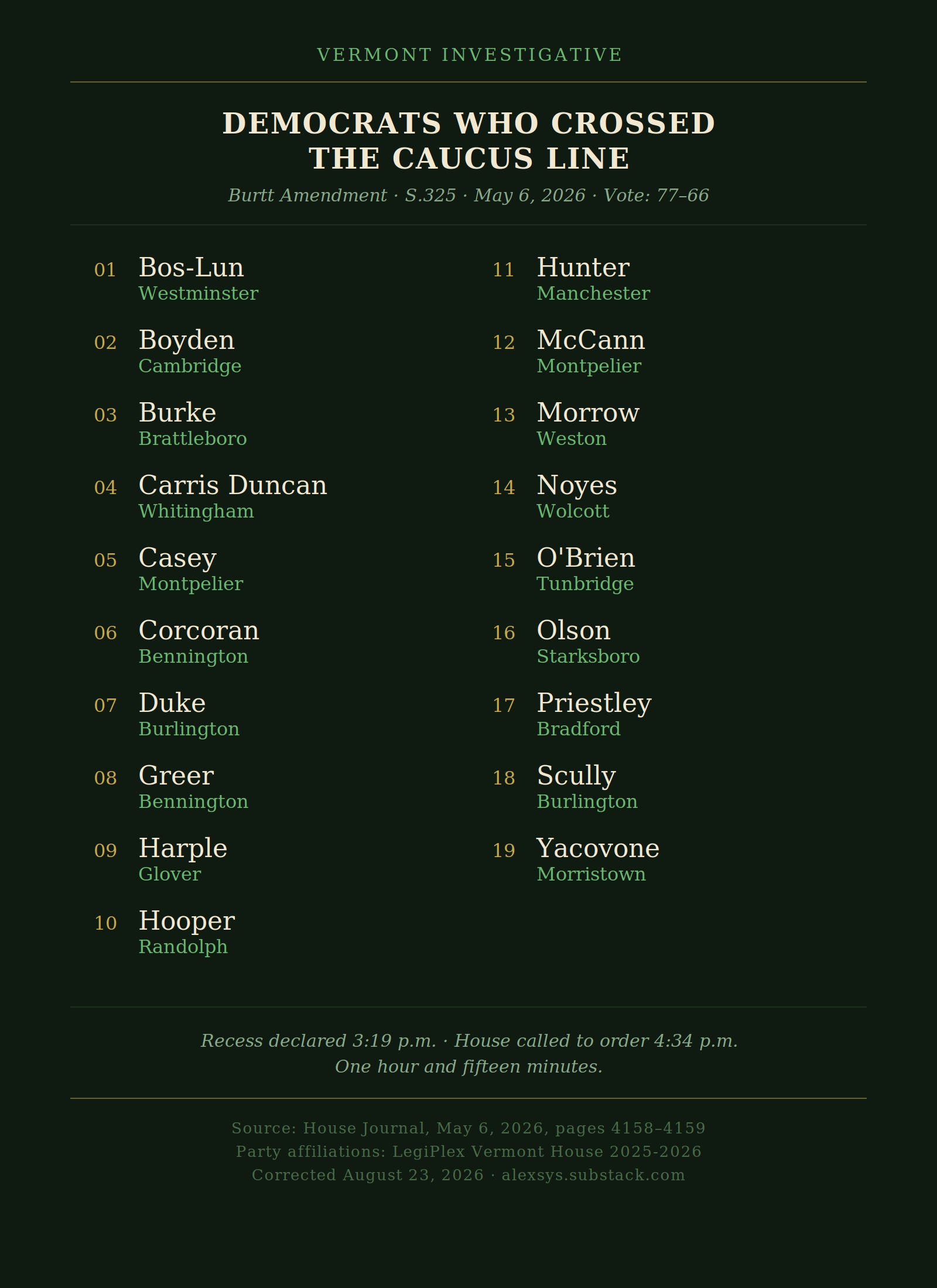
Source: House Journal, May 6, 2026, roll call pages 4158–4159. Party affiliations: LegiPlex Vermont House 2025-2026.
Following the vote, the Speaker declared a recess at 3:19 p.m. — not until a fixed time, but "until the fall of the gavel," an open-ended recess at the Speaker's discretion. The House came back to order at 4:34 p.m. — one hour and fifteen minutes later
Source: House Journal, May 6, 2026, page 4159 — “At three o’clock and nineteen minutes in the afternoon, the Speaker declared a recess until the fall of the gavel. At four o’clock and thirty-four minutes in the afternoon, the Speaker called the House to order.”
What was communicated to members who had crossed the leadership position during that recess is not in the public record. What is in the public record is the sequence: a caucus-line break on a significant vote — one that could not have passed without those crossovers — followed by an open-ended recess of one hour and fifteen minutes.
On December 7, 2024, the House Democratic caucus met to elect its leadership for the coming biennium. The results consolidated power in ways that members themselves noted.
Lori Houghton of Essex Junction was elected majority leader. Karen Dolan of Essex Junction was elected majority whip. Both are from Chittenden County. The Senate Democratic caucus had, the previous month, also shifted leadership toward Chittenden.
Vermont Public had reported the pattern. VTDigger reporter Ethan Weinstein documented what happened at the December 7 caucus meeting: “The changes further consolidate Democratic legislative power in Chittenden County.”
In her acceptance speech as the newly elected majority leader, Houghton acknowledged it directly: “I have heard the concern that leadership power is being concentrated in Chittenden County. I know I need to demonstrate through my actions that my commitment is to the entire state, all 14 counties.”
The documented record of the months that followed offers a reference point. In March 2026, it was Houghton — from Essex Junction, Chittenden County — who told members the caucus position was to vote no on a wealth tax amendment championed by Rep. Priestley of Bradford, in Orange County. It was Dolan — from Essex Junction, Chittenden County — who put it in writing. The amendment that died without a floor vote had been described by its sponsor as the single most popular constituent demand she had received from her district.
Whether that sequence represents a demonstration of commitment to all 14 counties is a question the record leaves open.
Source: VTDigger, Ethan Weinstein, December 7, 2024 — vtdigger.org/2024/12/07/vermont-house-democrats-back-speaker-jill-krowinski-after-defeating-an-outsiders-bid-for-consideration/
At the same meeting, the caucus voted 60-18 to restrict leadership nominations to Democrats only. The vote came on the same day Houghton acknowledged concerns about Chittenden concentration. The rule change specifically blocked independent Rep. Laura Sibilia of Dover — who had mounted a challenge to Krowinski's speakership — from caucus leadership consideration going forward.
The documented mechanics of caucus discipline in Vermont’s House Democratic caucus are not new. They predate Krowinski’s speakership.
In March 2020, Rep. Cynthia Browning, D-Arlington, made a procedural motion requiring an in-person quorum vote on a rule change that would allow the House to vote remotely during the COVID-19 pandemic. The motion came less than a day after Governor Phil Scott had issued a stay-at-home order.
Seventy-six members appeared in person the following day and voted to pass emergency COVID-19 relief legislation. Following the vote, then-Speaker Mitzi Johnson announced she was removing Browning from the House Ways and Means Committee and replacing her with Rep. Emilie Kornheiser.
Vermont Democratic Party spokesperson R. Christopher Di Mezzo called the quorum call a “stunt” that “recklessly endangered the safety of her colleagues.” Browning responded in writing. She did not dispute Johnson’s authority. She disputed the use of it.
“I believe that Speaker Johnson has the power to alter committee assignments as she chooses,” Browning wrote. “In this case she has chosen to remove me from House Ways and Means because I exercised my right as a representative to call for a quorum during a session of the House. While she has the power to do this, I think it is regrettable that she has chosen to do it to punish me for exercising that right.”
She added: “Freedom of speech and the right of independent action, thought, or voting are always under pressure in the House, because the party leadership rewards loyalty above all else.”
Source: Brattleboro Reformer, March 26, 2020 — reformer.com/local-news/browning-out-kornheiser-in-on-ways-and-means/article_72b8ab35-f90a-5e17-afd7-3638d7635061.html. Party spokesperson statement also confirmed in Tax Notes, Aaron Davis, March 31, 2020 — taxnotes.com
That removal happened under Speaker Mitzi Johnson. Krowinski succeeded Johnson in January 2021.
What the Browning case documents is not one leader’s decision. It documents a caucus culture in which breaking from the leadership position on a procedural question carried a committee removal as the consequence — and in which the party apparatus publicly defended that consequence as appropriate — and in which the member herself went on record describing a caucus that rewards loyalty above all else.
Krowinski inherited that culture. The March 2026 Dolan email and the May 2026 recess are the documented evidence of how it operated during her tenure.
Rep. Caleb Elder, D-Starksboro, left the House in 2024 to challenge Democratic Senate incumbents in Addison County. In an interview with VTDigger published August 2, 2024, he described what he had experienced inside the caucus:
“Leadership made it clear the doors were shut for me to participate there.”
He recalled being told, on multiple occasions:
“Jump on board or be thrown off the train.”
Source: VTDigger, Graham Krewinghaus, August 2, 2024 — vtdigger.org/2024/08/02/in-addison-senate-race-a-house-democrat-challenges-two-incumbents/
Elder lost the Senate primary.
In 2014, Democratic state senators Richard Mazza and Richard Sears publicly endorsed Republican Phil Scott in his lieutenant governor’s race, crossing party lines to support Scott over the Progressive/Democratic candidate.
Source: Ballotpedia, Vermont lieutenant gubernatorial election, 2014
No documented disciplinary action followed those endorsements.
The record shows: members who broke with the caucus on floor votes or procedural questions faced documented consequences. Members who crossed the aisle to endorse the opposing party’s candidate for statewide office did not face documented consequences.
What explains that asymmetry is not in the public record. The asymmetry itself is.
In her exit interview, Krowinski described congressional Republicans being told not to work across the aisle as “outrageous.” She held Vermont up as a contrast — a place where cross-party leadership worked collaboratively, openly, without surprises.
That cross-party relationship, as McCoy herself has described it, operates without directives on how members should vote. McCoy said so plainly in 2019: “We never tell anybody how to vote. We never push.”
The documented record of the Democratic caucus during the same period shows a majority whip emailing every Democratic member to communicate the caucus position on how to vote. A floor vote postponed at 9:30 p.m. while a count was taken. A closed-door caucus meeting the next morning, off limits to media. An amendment negotiated off the floor before members could vote on it. A member removed from a powerful committee within 24 hours of a procedural break. A member who described being told to comply or be removed. A 75-minute recess following a vote in which Democratic members crossed the leadership position.
None of those things are secrets. All of them are documented.
The contrast Krowinski drew was between Washington’s directed partisanship and Vermont’s collaborative openness. The record suggests the more precise contrast may be between how the two parties in Vermont’s own House have described their internal operations — and what the documented record shows about one of them.
McCoy said her caucus never tells members how to vote.
The Dolan email is dated March 26, 2026.
Sources
1. 802 News, WCAX, Mark Johnson interview with Speaker Jill Krowinski, July 8, 2026 — wcax.com/2026/07/08/speaker-krowinski-passing-gavel
2. Seven Days, Taylor Dobbs, “House GOP Leader Pattie McCoy Is Outnumbered But Not Discouraged,” January 30, 2019 — sevendaysvt.com
3. Vermont Public, Peter Hirschfeld, “House Democrats Revive Tax-the-Rich Proposal Despite Leadership Misgivings,” March 27, 2026 — vermontpublic.org/local-news/2026-03-27/house-democrats-revive-tax-the-rich-despite-leadership-misgivings
4. House Journal, May 6, 2026, pages 4157–4159 — roll call vote on Burtt amendment to S.325, yeas 77, nays 66; recess declared 3:19 p.m., House called to order 4:34 p.m. — legislature.vermont.gov/Documents/2026/Docs/JOURNAL/hj260506.pdf
5. VTDigger, Ethan Weinstein, “Vermont House Democrats Back Speaker Jill Krowinski After Defeating an Outsider’s Bid for Consideration,” December 7, 2024 — vtdigger.org/2024/12/07/vermont-house-democrats-back-speaker-jill-krowinski-after-defeating-an-outsiders-bid-for-consideration/
6. Brattleboro Reformer, “Browning Out, Kornheiser In on Ways and Means,” March 26, 2020 — reformer.com/local-news/browning-out-kornheiser-in-on-ways-and-means/article_72b8ab35-f90a-5e17-afd7-3638d7635061.html. Browning quotes confirmed verbatim from this article.
6a. Tax Notes, Aaron Davis, “Vermont Lawmaker Loses Tax Committee Seat After In-Person Vote,” March 31, 2020 — taxnotes.com/featured-news/vermont-lawmaker-loses-tax-committee-seat-after-person-vote/2020/03/30/2cbzd. Di Mezzo party spokesperson statement confirmed from this article.
7. VTDigger, Graham Krewinghaus, “In Addison Senate Race, a House Democrat Challenges Two Incumbents,” August 2, 2024 — vtdigger.org/2024/08/02/in-addison-senate-race-a-house-democrat-challenges-two-incumbents/
8. Ballotpedia, Vermont Lieutenant Gubernatorial Election, 2014 — ballotpedia.org/Vermont_lieutenant_gubernatorial_election,_2014
Data tells stories. Patterns show convergence. Curiosity validates both. If this series has been useful to you, consider subscribing or supporting it at ko-fi.com/alexsysthompson.
Comments
Nothing yet. Say the first thing.
Sign in to join the conversation.