
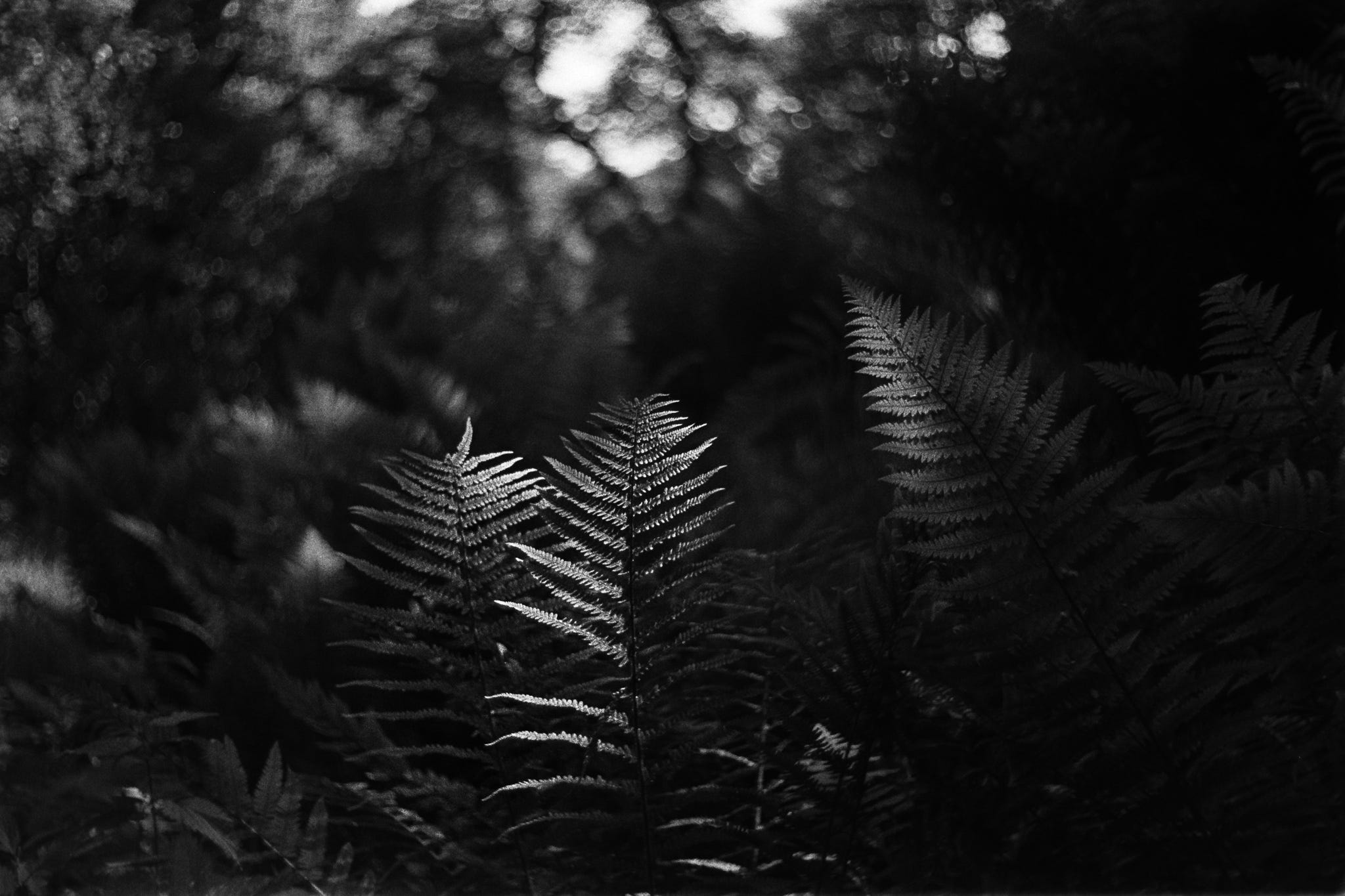
Something about July always feels unreal to me, eerie, as if we’re in a holding pattern outside the year’s true contours. Perhaps it’s a combination of the dimensionless light, the long days, the fact that it never seems to get dark, the warmth, the humidity. Something about the colours in the landscape as well. The soporific greens and muted browns, all held in a tangled web of static textures. Heavy vegetation drooping in the hedgerows, old flowers dry and drained, bracken crowding stiffly over the edges of the footpath through the wood, subdued birdsong in the canopy. The droning of flies. Time drifts from its moorings.
This seems to happen to me every year – this dull, bracken-green, sleepy but somehow terrible thing I call Julyish. For as long as I can remember I’ve felt this way, felt an instinctive aversion to the dead middle of the year. Only in late August do I seem to come to my senses again, as if I find myself waking in some bright forest glade with a cool breeze and the burbling of water close by, the year’s true cadence asserting itself once again.
This July has been as Julyish as they come. That’s not to say it’s been a bad month; a lot of good things have happened. But I have spent much time walking under the old oaks near my new home and I’ve always been sensitive to the whisperings of trees. The oaks feel Julyish, so I do too.
My wife Hannah likes to say that she is a perpetual autumn child, and I suppose we both are. Roll on the crisper mornings and brighter dawns.
I hope you enjoy this issue of Unplugged!
Sidetracked Volume 37.
Like the Wind issue #50. Our bumper 50th edition!
The new book by Andrew Terrill. I’m enthralled by his tale of ‘travelling in one place’ and seeking to know a single mountain intimately over the course of a year.
A couple of other projects, one of which will hopefully include some time behind the lens on the hill soon.
My latest piece for On Landscape magazine (paywall) explores the creative renaissance my photography went through last year, revolving around the fabulous Analogue11 photographic exhibition at Ed Smith’s gallery in Kingussie… but there’s a lot more to it than that.
I wasn’t interested in straightforward nature photography; I wanted the individual emotional response to a moment encountered within that natural setting. I wanted to say something about time, timelessness, mortality and immortality. I was fascinated by layers of reality, whether hidden or hidden, and how we respond to those layers.
Last week I published this case study on the Sidetrackedmag Substack page, going into my editorial process in depth. The feedback so far has been great. My favourite comment has got to be from Felicity Martin: ‘This is the sort of editorial process that has largely been lost in the modern world.’
A major new step for Like the Wind magazine: we’re hosting a corker of an event in London! Organising this has been the focus of much of the team for a while now, and it’s great to see it all come together. Tickets are now on sale.
I’ve been working with the writer Tim Frenneaux on his new Times Long Told project, and am very much looking forward to attending this online event. It’s this Thursday – that’s tomorrow – and tickets are free. I am SO on board with Tim’s approach to storytelling, myth, meaning, and how these stories echo from ancient times into the present day.
Nothing of note to share. It’s been a fallow period for my photography, as summers so often are for me (again, Julyish). I’ve had a couple of rolls of film on the go since before we moved house, but feel the need for a creative reset at some point soon (September usually does the trick, for in our September all hours of life grow beautiful, to quote G.W. Young).
At some point soon I’ll be writing about how I’ve shifted almost entirely from 50mm to 35mm as my focal length of choice. Let me know if you’re particularly keen to read about this!
All the books I mention or recommend on Alpenglow Journal can now be viewed on my bookshop.org page. If you buy a book using one of these links, I’ll receive a small commission.
Hannah bought me a copy of this book, and I was absolutely bewitched by it. There’s little I love more than forests. Mullard takes the reader through the history (and prehistory) of Britain’s trees, exploding quite a few myths in the process. It made me realise that my previous ideas about Britain’s ancient forests were very far from the truth; the primordial wildwood was a much stranger thing than I ever realised. Highly recommended.
A delicious piece of modern Gothic fiction, telling the story of Mary Shelley from her own point of view. I’m only about a third of the way through so far, but I really like how the author brings us into Mary’s head. She’s a fantastically imaginative overthinker who doesn’t quite see the world the same as those around her (yes, I identify with this character).
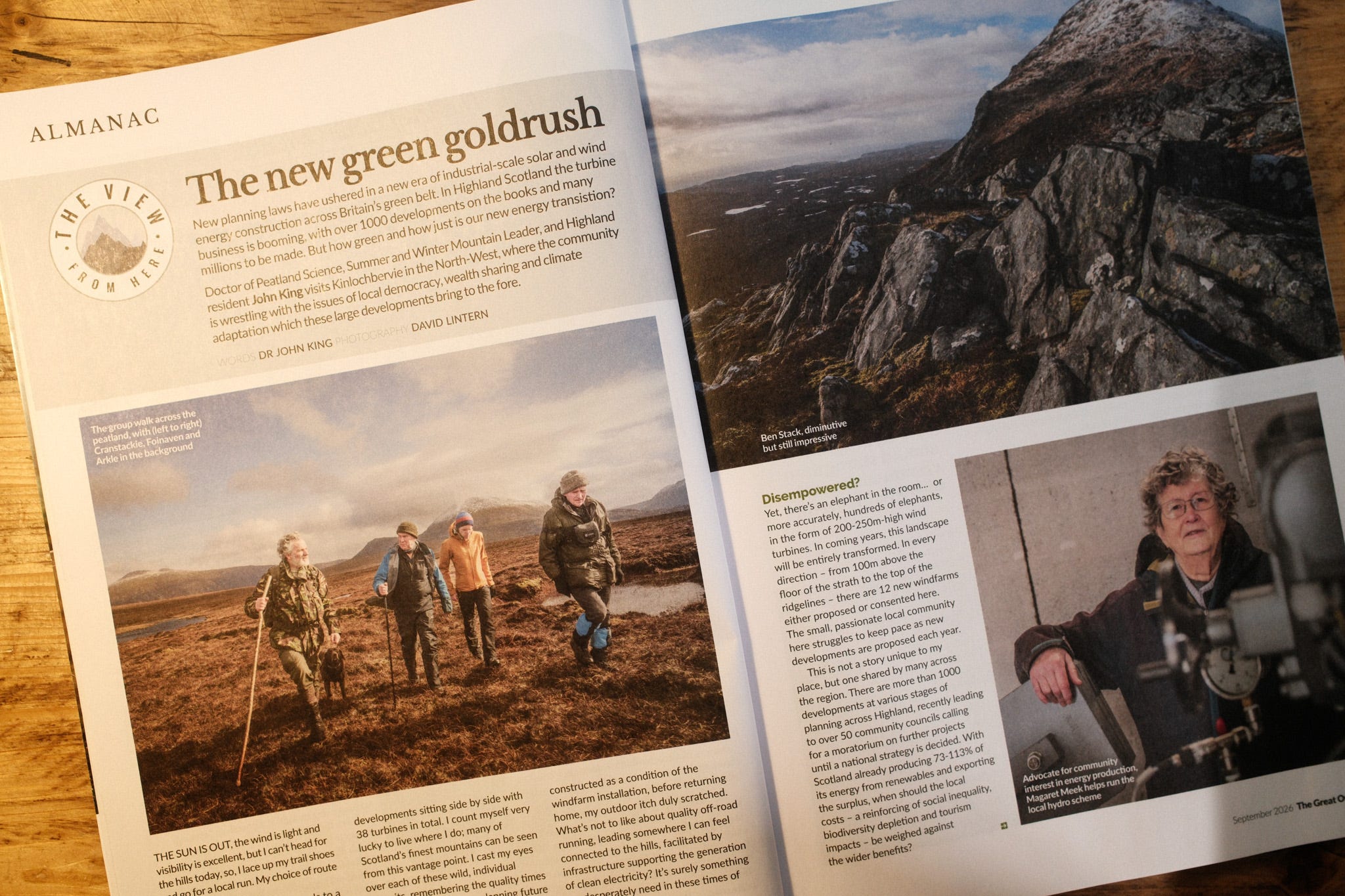
Another cracker of an issue – honestly, if you haven’t picked up TGO for a while, give it a go. The editorial team are killing it right now. Highlights for me this time are the story ‘The new green goldrush’ by John King with images by David Lintern, and ‘Natural instincts’ by Tristan Gooley.
That’s my brother James on the front cover, too!
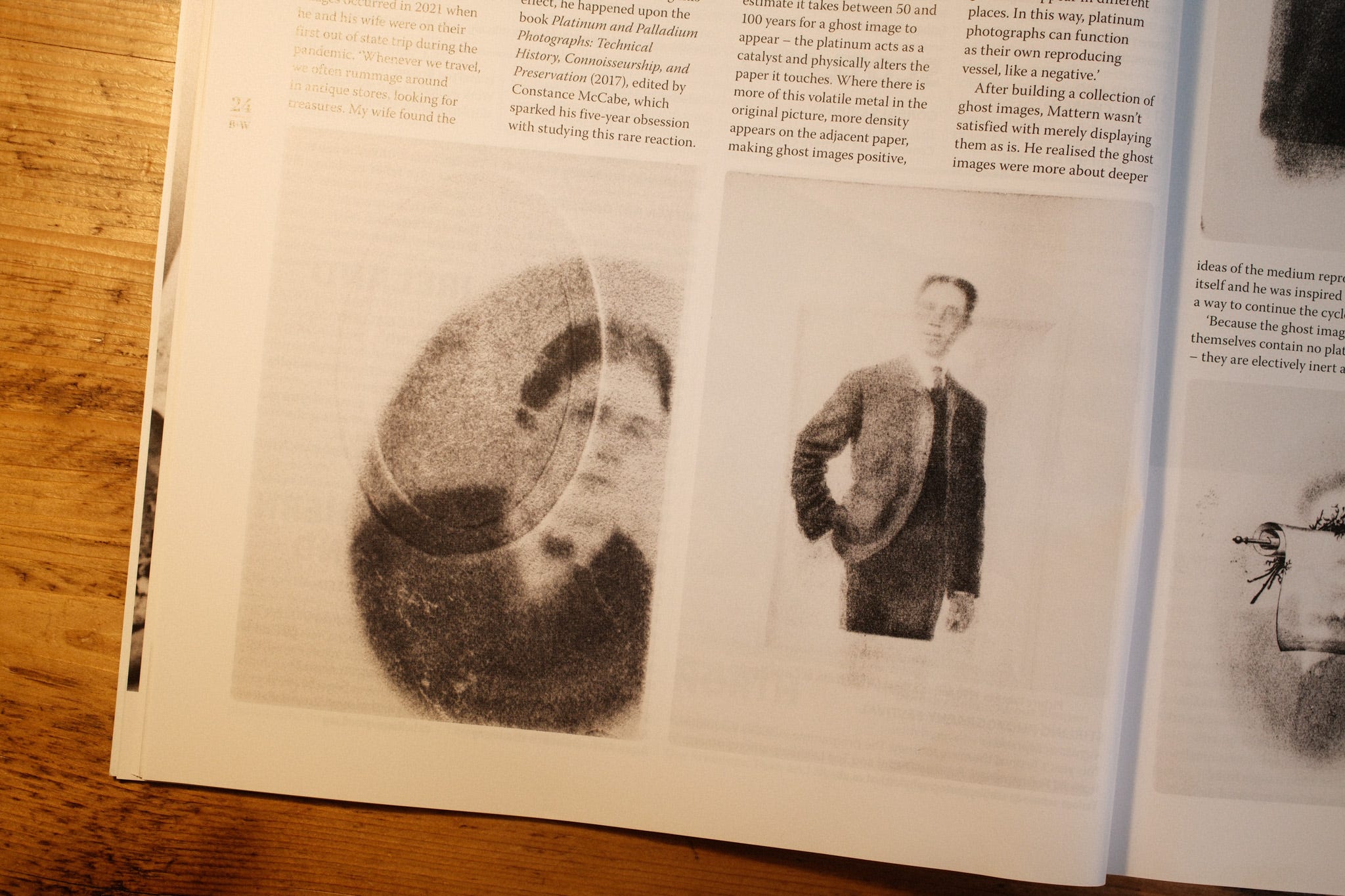
B+W is one of my favourite publications because it manages to teach me something new and wondrous about photography or art every single time. In this issue, I found myself gaping at these amazing ‘ghost images’: traces of old platinum prints found on the backs of newer prints in old frames. Through a special process, Andy Mattern was able to preserve these images. Haunting results!
Caught by the River is consistently one of the best and most interesting web publications I follow, and this piece is marvellous, connecting The Animals of Farthing Wood to the contemporary data centre boom:
Nature is not units of data, but its opposite. It is relationships and delicate systems that take hundreds and thousands of years to become the life support systems we need to flourish. It is individual lives with strivings and wants and thoughts and cultures. It is integral to who we are as humans too, our identities and psyches. It keeps us connected, anchored, and alive.
From Neal Stephenson, a primer on everything you might want to know about handwriting. What we believe in.
This is the closest thing to pure evil I’ve seen for a while. As a student I studied the digital dark age as a theoretical concept, but I never thought I’d live to see big tech quite literally devouring culture. It’s symbolic of all the other things it is devouring less visibly.
We ought to be taking to the streets against this. Instead we eat our lotus flowers and tie ourselves in knots online about how this is progress, or somehow inevitable, or can’t be resisted. We should be calling evil out where we see it – and consuming the entire world in order to feed AI is evil. I’m sorry but if your moral compass doesn’t tell you that then your moral compass is broken.
I haven’t had time to form my own thoughts about Pangram into something coherent yet, but it’s been interesting to see how other writers have reacted in the days since this new feature was introduced to Substack (to bring you quickly up to speed: it’s a universal ‘Is this AI?’ checker built into the site, but it uses AI to do this). The response has been mostly negative, from what I can see, and the most negative responses seem to have come from the people who hate AI the most. Maybe it’s just the view from within my own filter bubble, but people realise that we are now all stuck in a deadly arms race from which nobody and nothing can emerge untarnished.
Hadden Turner writes:
I don’t want to contribute to an online culture which is already overly toxic, confrontational, suspicious, and hostile. The last thing we need are more witch-hunts and mud slinging.
I have given my word to my readers several times before that all of my writing will be 100% AI-free in its conceptualisation, generation, editing, and research. This trust is, or should be, relational — between me as the writer and you the reader. I don’t what this precious trust to be mediated through an AI detection software or dependent upon a 100% AI-free statistic.
I agree with everything here. As I’ve written before, as countless others have written, trust is the only thing that matters online now. Pangram undermines whatever culture of trust we might try to build by imposing a culture of blame, suspicion, and yet more algorithmic optimisation. I can see why Substack introduced this, and I don’t think it’s an entirely bad feature, but on balance I don’t like it and I think it will cause more problems than it solves.
Camera nerdery of the finest order from the ever-excellent 35mmc blog. If you enjoy detailed photos and descriptions of solidly made mid-century photographic hardware, look no further.
This is profoundly beautiful. I know I bang on about AI here, heaven knows there are other subjects to write about, but this is one of the defining cultural fights of our time. The decisions being made now will echo throughout history. I believe that this piece might be one of the most compelling arguments yet for keeping generative AI out of all forms of communication, not just artistic work. It’s a short piece and very much worth a read.
The writing we use, the very substrate of our culture, is the result of a process older than we can comprehend. Who are we to decide that process is finished? That the time of invention and human input is done, and every letter created from now on should be a remix of what came before?
From Anna Welch: moths, gorgeous moths! One lovely but unexpected side effect of our recent move to Blairgowrie is that I’ve discovered our new garden to be home to a variety of moths, and I’m considering ways I might be able to maintain that home for them. Any tips?
Your support enables me to keep publishing Alpenglow Journal. I don’t earn a living from this work, but these words, images and feelings are the most personal I will ever share. It takes a lot of time and effort to put it all together. Please consider becoming a monthly paid subscriber to support me directly – or you can always drop me a one-off tip via Ko-Fi. Thank you.
Images and words © Alex Roddie. No AI has been used in the creation of any work on this page. All Rights Reserved. Please don’t reproduce this material without permission.
Comments
Nothing yet. Say the first thing.
Sign in to join the conversation.