
For those of you who prefer to read on paper (or e-reader) rather than in your Substack or email app, I have converted this essay into an easily printable PDF.

In Alpenglow Journal, much ink is spilled on the subject of an analogue counterculture. Does it really exist, and if so what does it look like? What does it mean?
Here on the web, what passes for reality is constructed from filter bubbles and is insubstantial as cobweb, ephemeral as the dew. Just because my online experience tells me that countercultural forces are building against the digital machine, against its malign influence on the arts – not to mention the whole, you know, human experience – that doesn’t mean this is reflected in meatspace. (That’s objective physical reality, for the non-cyberpunk nerds amongst you.)
In other words, at some point the change you want to see in the world has to happen out there in the world itself. Otherwise it’s not real.
I’ve long held that if there’s hope, it lies in art. While the machine relentlessly grinds meaning into grist for the mill of consumerism, art can save our humanity because art is meaning. I don’t mean just looking at art; I mean participating in its creation. But art fails to thrive in context-collapsed online spaces such as Instagram, where the incentives of the attention economy hold sway and all else withers.
So, if you want to see change taking place out there in the big beautiful world, there are worse places to start than a gallery exhibition.
Although I’d chatted with Ed Smith for years online, it was through mutual friend Davy Wright that we first met in person. As well as being a commercial adventure and sports photographer, Ed is passionate about shooting film, which he often uses for personal projects such as the ongoing Spey Project. He also owns the Kingussie-based photographic gallery Eleven41. (Extra points if you get the reference.)
The prospect of a show at Eleven41 dedicated to analogue photography was first raised earlier this year, and I’m grateful to Ed for putting my name forward.
Matt Sillars, co-founder of the Inverness Darkroom, coordinated the exhibition. All 11 photographers are based in Scotland; many are involved with the Inverness Darkroom community. Of the others, I knew only Hannah Bailey, whose innovative multi-exposure sports photography has previously featured in Sidetracked magazine.
During a briefing call, we discussed possible themes. Given the broad spread of artistic angles between us, we soon realised that it would be restrictive to set a theme – at least an overt one. Instead, Matt said he hoped to be surprised by the work we chose to show, and that visitors would be just as surprised.
One idea many of us liked was the idea of resistance. Hannah Bailey raised the idea that analogue photography is inherently a form of resistance against generative AI, and I backed her up. Although no anti-AI theme is explicitly visible in the final body of work, I don’t think it needs to be. It’s implicit for anyone who’s paying attention.
Anyone shooting with a film camera in 2025 is going against the grain in a very deliberate way, and while we all have our own reasons, resistance to AI came up again and again in conversations on the opening night. In its uncompromising actuality, its singular physical existence, an analogue photographic or artistic artefact is the anti-image of AI-generated fake content. And as the web itself succumbs to platform decay and decouples from human culture, perhaps such an artefact is the anti-image of the entire online world. In that world, meaning and communication and culture are increasingly sidelined, replaced by consumerism, noise, and the listless half-conscious scrolling of feeds designed to enrage and simplify and numb us.
This is why I think Instagram has little to do with photography or culture any more. What does scrolling your Instagram feed have to do with art – with the communication of nuanced human meaning from one soul to another? Not much, I’d argue. Perhaps a photographic exhibition is the anti-image of Instagram. Or Instagram is the dark mirror universe version of an exhibition.
This isn’t to say that all the work in Analogue11 was hardcore analogue using purely traditional darkroom techniques. Far from it. Most of the artists enjoy the benefits of a hybrid workflow, which can include making high-resolution scans of negatives prior to digital processing and printing. This unlocks creative opportunities that would otherwise be impossible. Counterculture should never be about purity, and film photography should never be about gatekeeping. It’s about offering a positive and more nourishing alternative – and celebrating the diverse ways in which we can find that for ourselves.
My wife Hannah and I travelled up to Kingussie the day before the opening night, as Ed generously let us stay in his spare room, and we offered to help him prep the gallery for the show. The exhibition opened on September 19th, 2025.
I brought my prints with me (more about my images in a bit). Ed provided frames and made mounts for the images using his equipment and supplies, then I helped him frame them – a process I found fascinating. Hannah and I then helped Ed (and later Davy) to hang the other images on the gallery walls. I edited and formatted the blurbs for each artist.
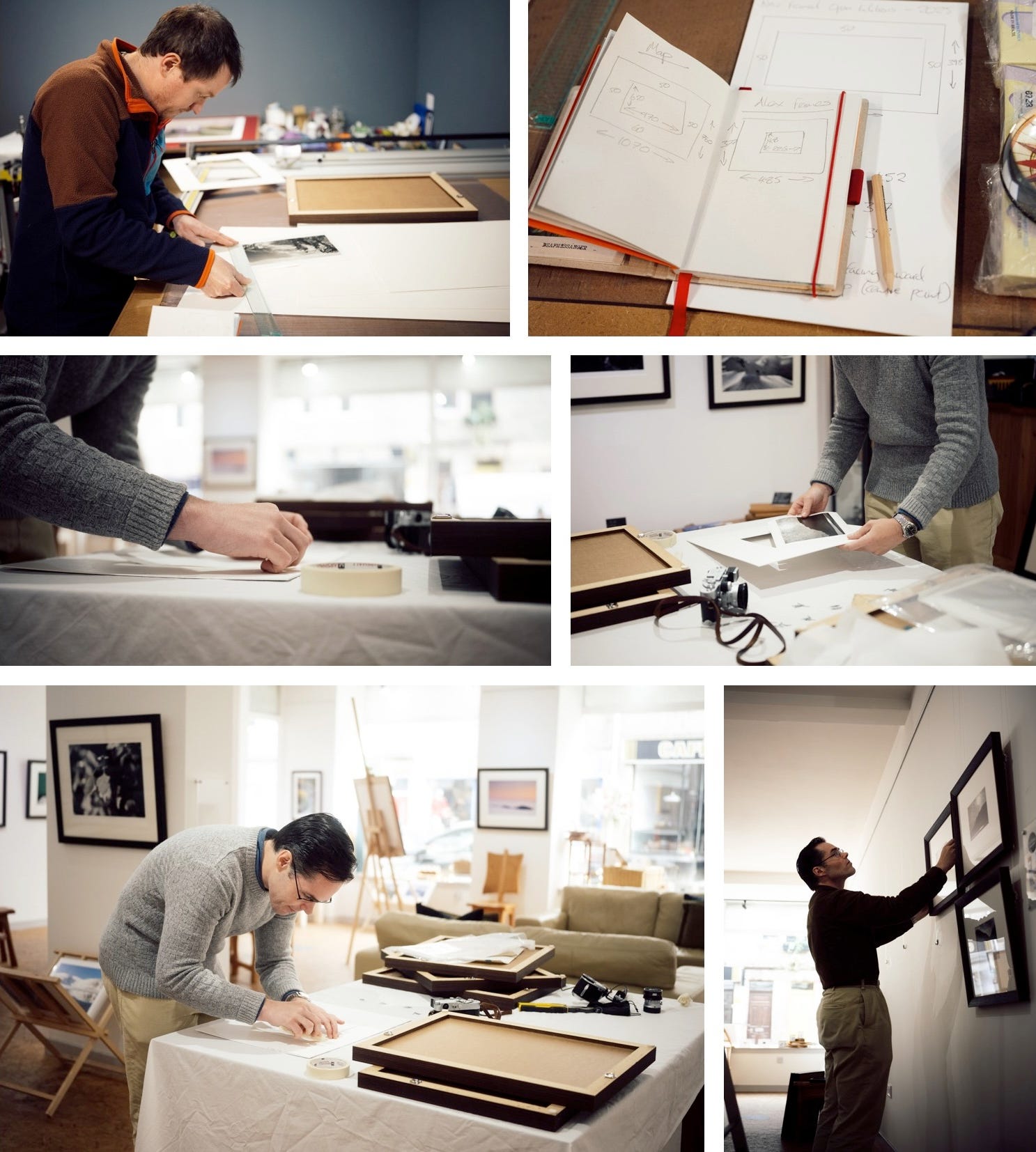
The gallery is spacious with excellent light, and seeing all the images as they are meant to be seen – printed and hung – made quite an impression on me. For the first time I realised that this was real. From the traditional darkroom-printed landscapes of myself and Matt Sillars to the surreal images of Monika Thomson and the remarkably creative mixed pieces by Rachel Fermi and Jannette MacDonald (my favourite of the 11), we’d brought together an eclectic cross-section of analogue photographic art in Scotland. As someone remarked to me during the packed opening night, it proves that film photography is far more than just one thing.
I took some photos of the other exhibits on my film camera, but haven’t processed the film yet, so can’t show you them here! If you can, I’d encourage you to get to the gallery and look at them in person.
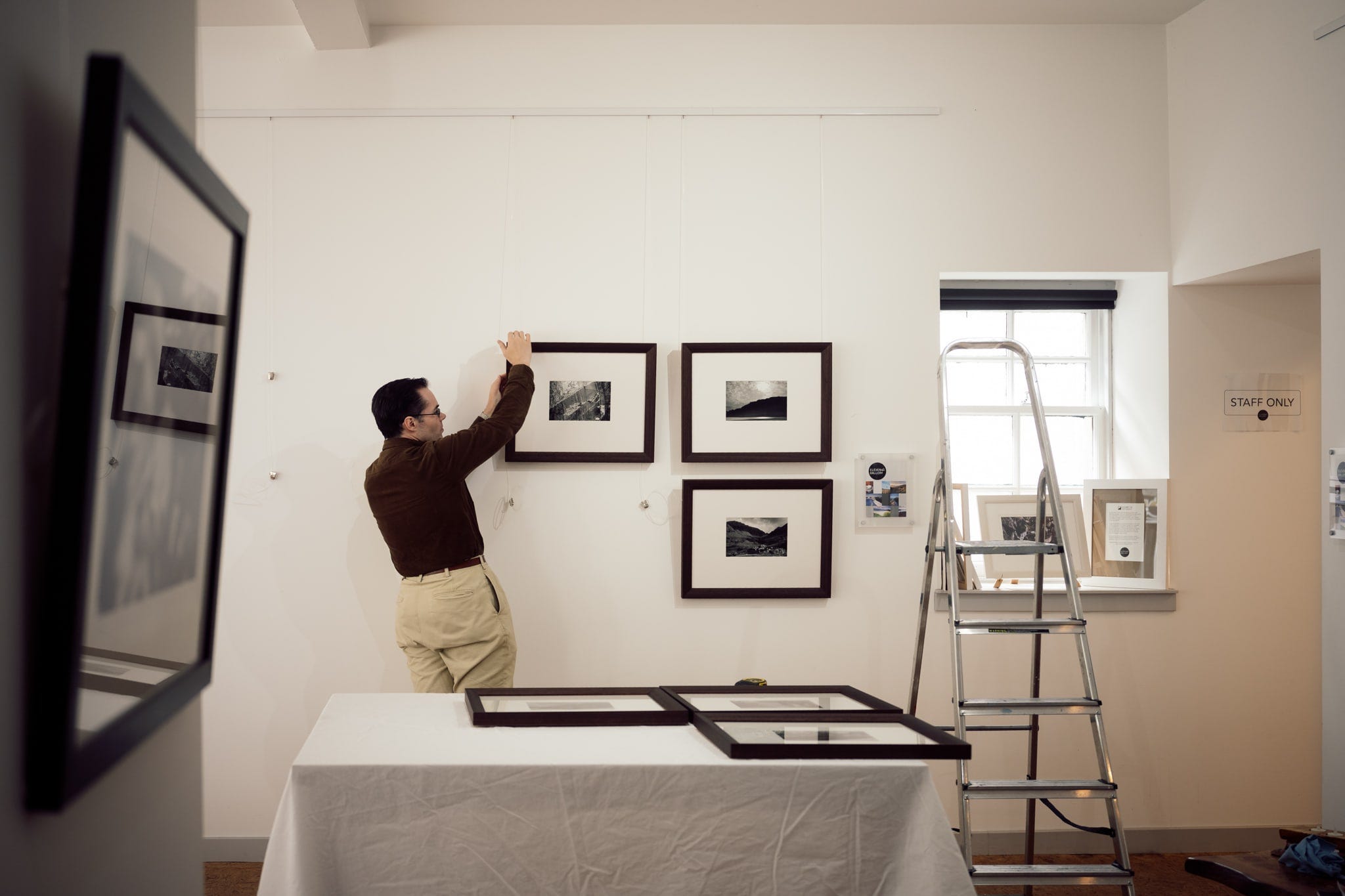
This felt like a defining watershed moment. For such an exhibition to launch in Kingussie, on the edge of outdoor industry heartland – and with the enthusiastic participation of multiple figures so active in outdoors media – felt groundbreaking. And in 2025! For years I’ve been banging on about film making a comeback in the world of adventure, and that maybe this means something. Maybe this is about more than film photography. Now this pivotal shift has been made manifest in the most tangible way I can imagine. Over the next month, as more people see Analogue11, take on its ideas and its physical reality, that message will spread – and it will do so offline as well as online.
Ed’s gallery is a big space, but the crowd that turned up filled it pretty well, which was great to see. In addition to Davy, Ed, and Hannah B, I had conversations with colleagues John Summerton and David Lintern, local literary festival director Nick Walker (who convinced me I must acquaint myself with Spohr’s clarinet concertos), and analogue photographer Tomas who had made the trek from the Stirling area. Tomas also brought me the most amazing and generous gift: an exquisite darkroom print of the Old Man of Storr from his own collection. He wrote up a perceptive piece about the show on his own blog. And I had numerous other conversations with visitors, several of whom showed me pictures of their own analogue work (or collections of film cameras). Hannah, meanwhile, wielded my digital Nikon and took pictures of the event.
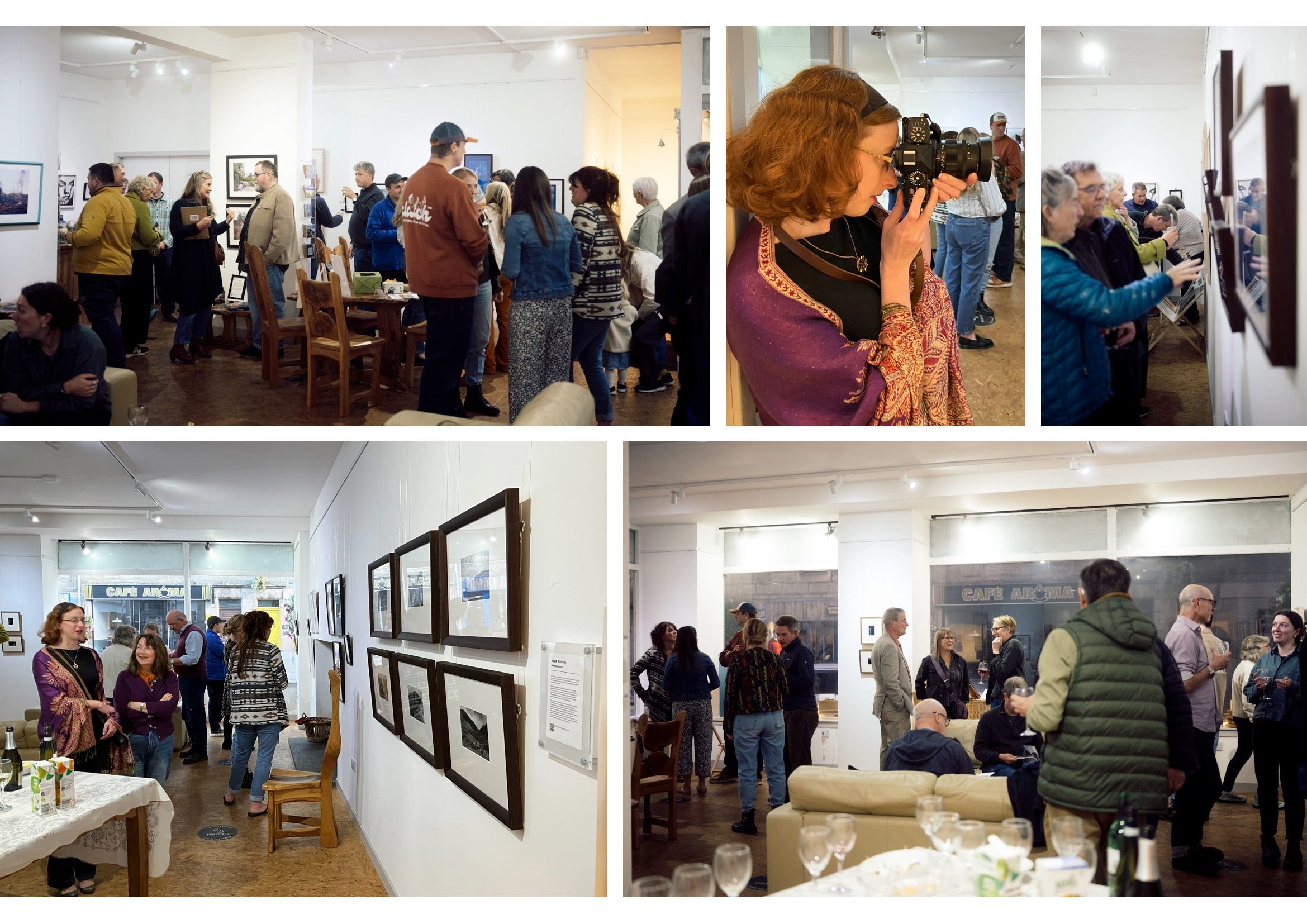
The event gathered donations for Medical Aid for Palestinians, which certainly fits with our unofficial theme of resistance, and raised more than £120 on the opening night thanks to the lovely donations box designed by Hannah. Donations will be accepted throughout the duration of the show.
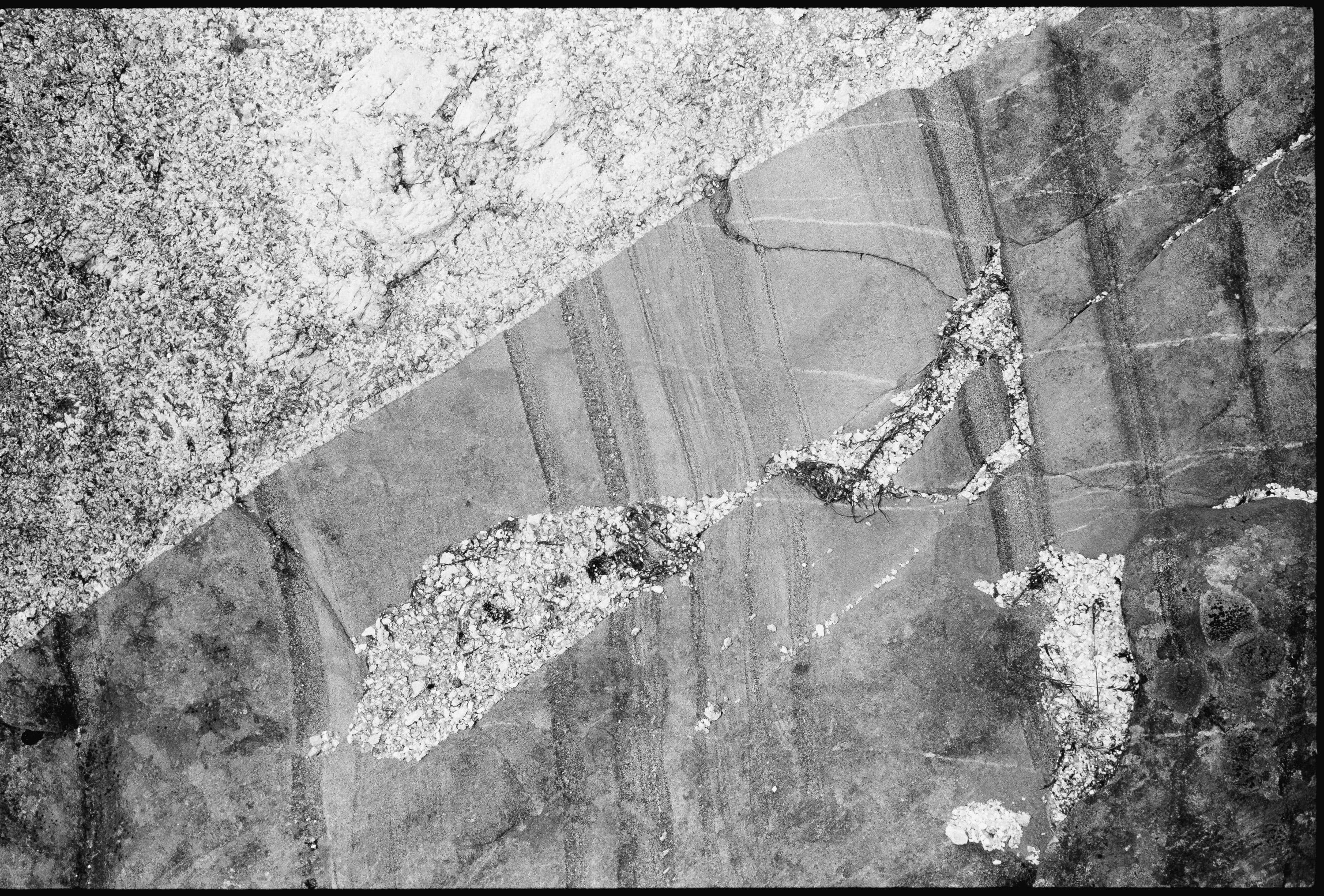
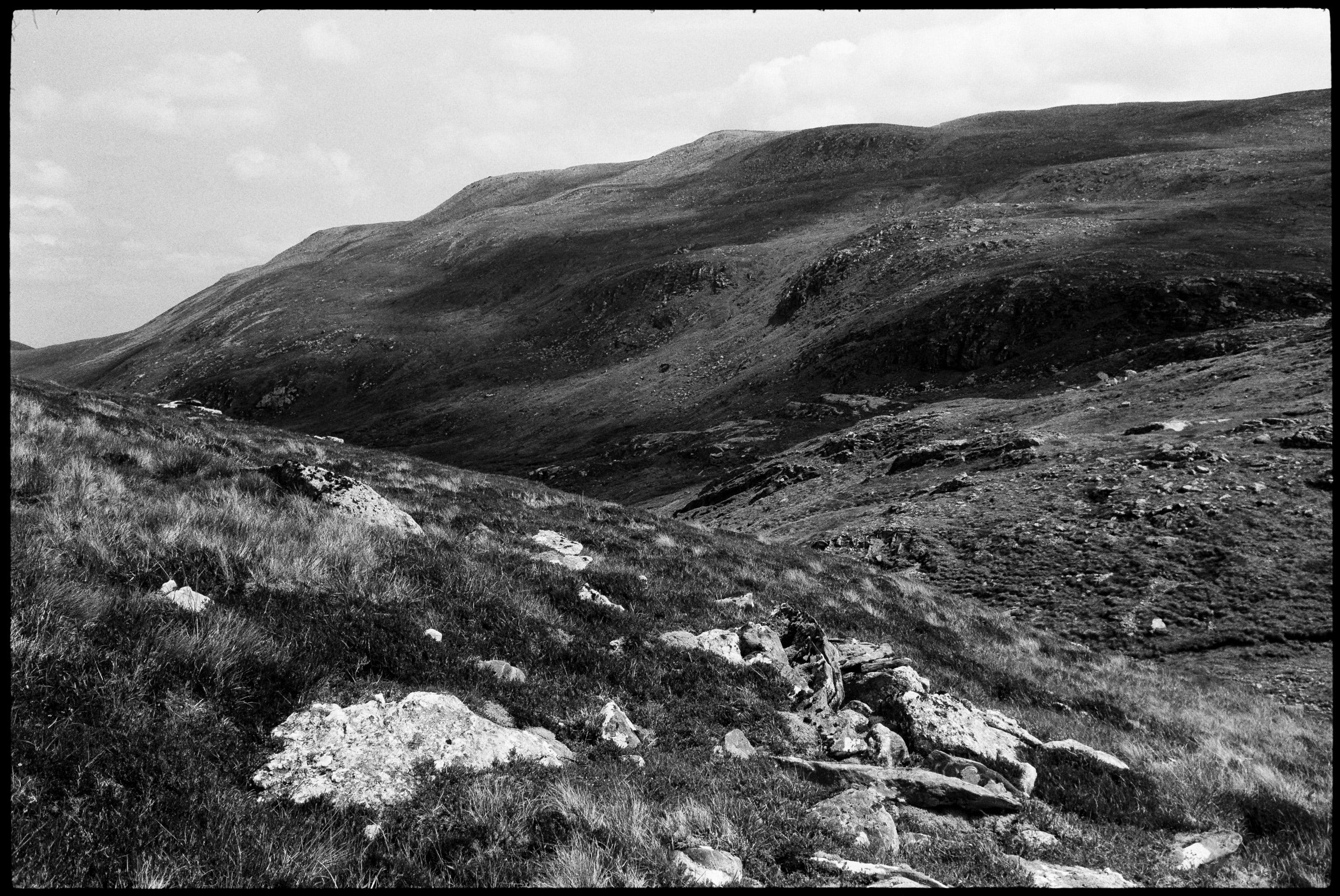
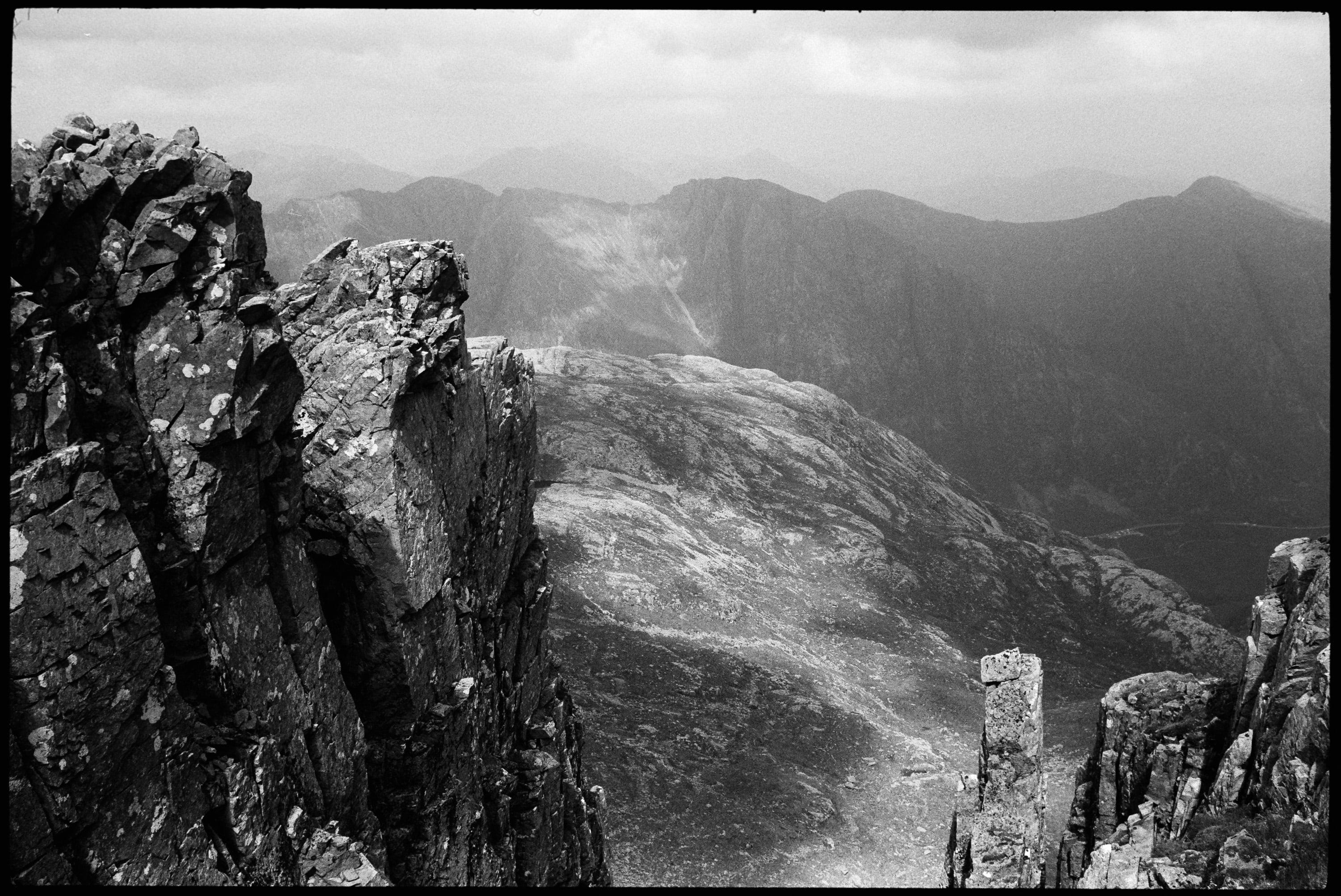
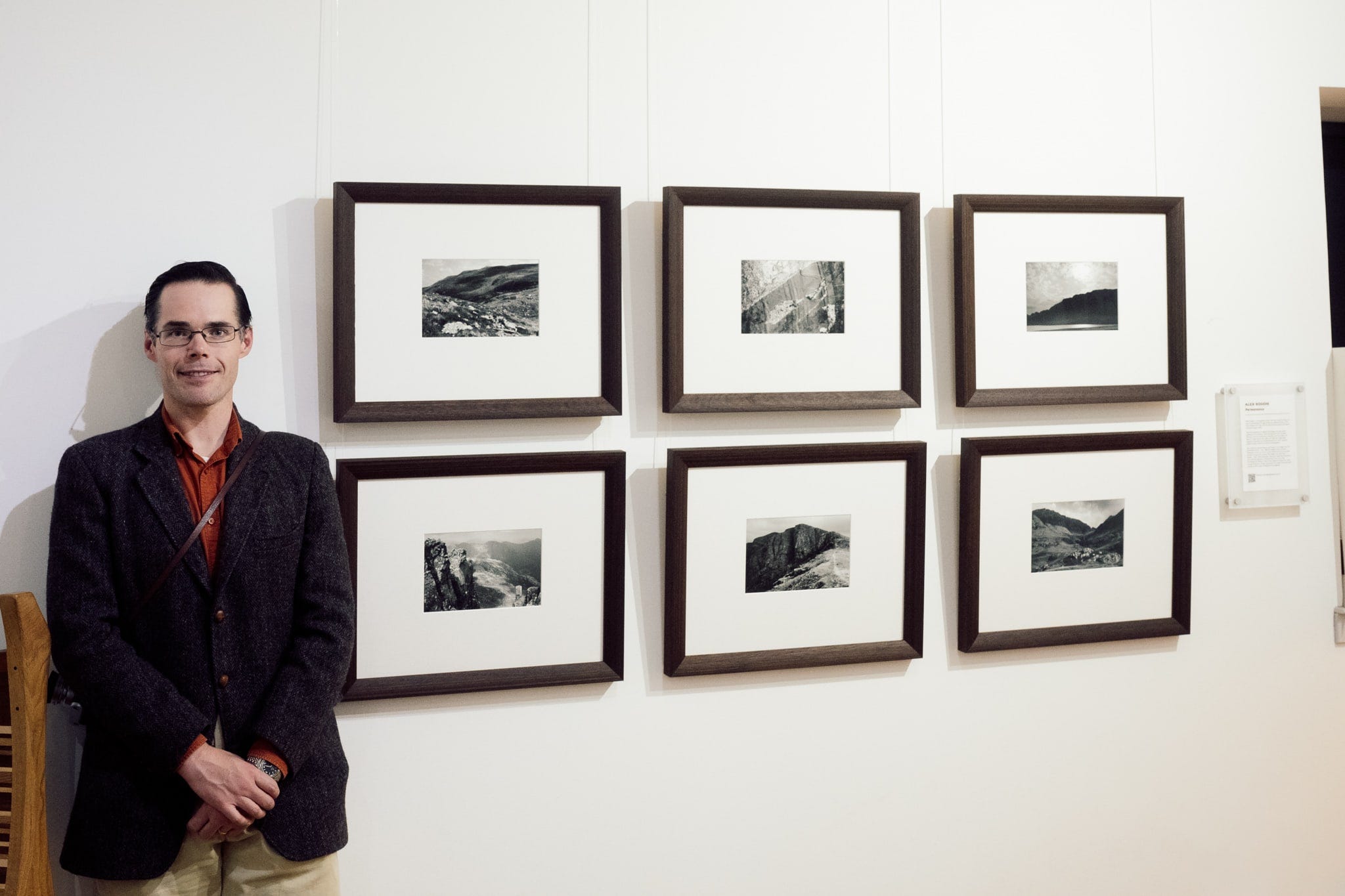
My exhibit, titled Permanence, consists of six traditional black-and-white landscape photographs, darkroom printed from 35mm negatives exposed using my Leica M3 over a two-day period in June 2025.
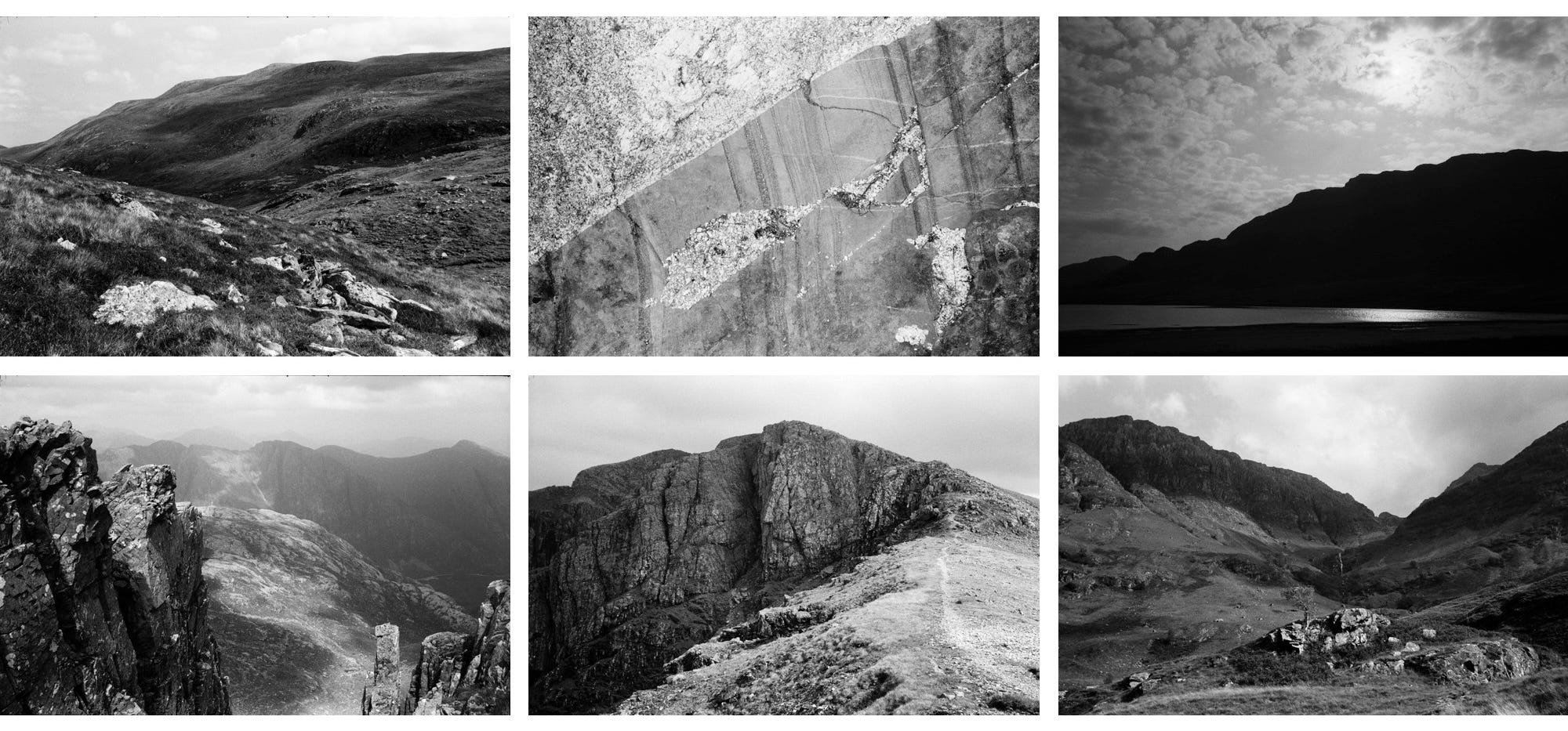
This trip proved to be one of the most creatively productive mountain journeys I’ve done in several years. Day one involved a hillwalk with Davy over the Ardverikie Munros not far from Kingussie. I then made my way to Glen Coe and repeated the challenging scramble of B to F Buttress on the West Face of Aonach Dubh – my first time on this climb in 17 years. It was actually my first climb after first moving to Glen Coe in 2008. After topping out, a few things came together in my head all at once from what I’d been reading and thinking about, and I conceived a narrative arc that would tie together three books I’d been planning for years. Nietzche’s philosophical thought experiment of Eternal Recurrence was involved, as well as a recollection from behind the bar at the Clachaig Inn many years ago.
After returning from that trip, I learnt two facts: that the Earba pumped hydro storage scheme will shortly transform the experience of walking the Ardverikie Munros, and that the Clachaig Inn in Glen Coe, a place I once called home, was up for sale. Both these ideas shook my concept of stability in these places. Permanence is always an illusion; in the mountains, as in life, change is the only constant.
And a week or two later, when scanning the Ilford FP4+ and Kodak Double-X negatives from the trip, a sequence of images leapt out at me.
The more I thought about my theme of illusory permanence, the more layers I saw – both in the individual images and the overall gestalt. One of the reasons I shoot black-and-white film using vintage lenses is because I enjoy the uncanny timelessness of the images, as if they’re removed from the flow of time. Images like this can also be found in the pages of some of my favourite mid-century climbing and mountaineering books, further deepening the illusion. The artefact looks old, but is young; the subject looks eternal, but is mortal. There’s resistance to the online world in that too, where everything is glossy and hyper-optimised for engagement yet also separated from the context of time and space. We feel a dissonance, a surreal phase shift, when looking at a physical artefact that takes on some of these characteristics yet stubbornly refutes others.
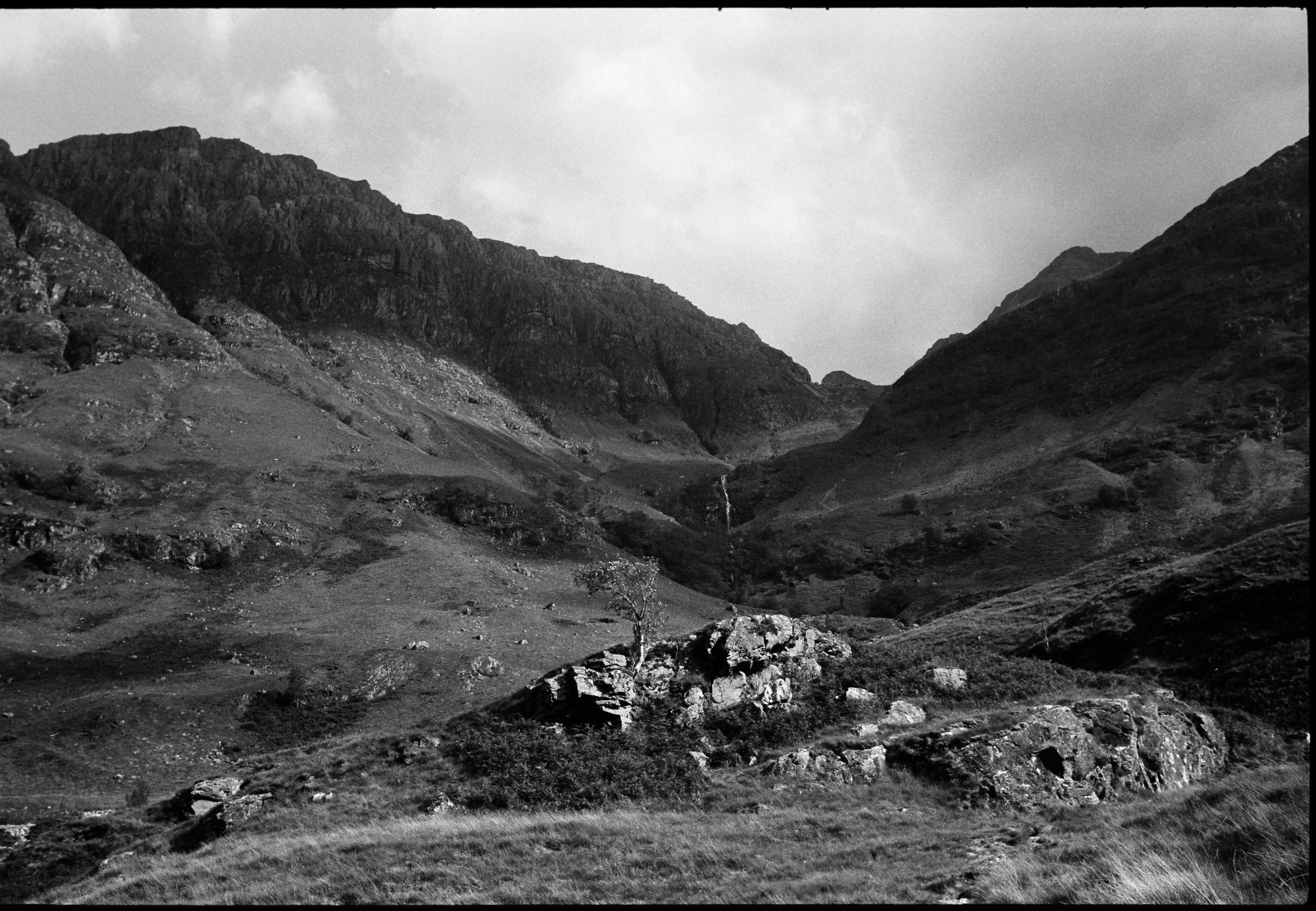
Normally my process is hybrid and involves digital scanning of the negatives, but for this show I decided to go with a 100% analogue workflow. I ended up contacting a darkroom in Cheltenham and having a phone conversation with the printer about my needs. He encouraged me to send him scans of the negatives, edited to my taste, to guide his dodging and burning in the darkroom. A couple of weeks after posting my negatives to him, they returned to me along with my prints – gorgeous work on Ilford Pearl resin-coated photographic paper. It’s worth noting that prints on RC paper are not as archival as fibre-based paper; it’s possible that after 30-40 years some deterioration may start to be visible, depending on how the images are displayed or stored. This was a deliberate artistic choice.
Again, on a long enough timescale, nothing is permanent. But the negatives themselves get as close as anything in this life is ever going to get.
The images can be viewed at Eleven41 gallery until October 17th, 2025, and are for sale – £140 per image framed, or £45 for the print alone (UK only, and prices exclude postage, although you’re welcome to collect from the gallery after the exhibition has concluded). If you’re interested in buying one or more of the images, please get in touch.

If you like what you’ve read, please subscribe to receive updates in your inbox and Substack app. Thanks for your support. And if you’ve enjoyed what you have read, please tell someone else about it!
Images and words © Alex Roddie, Hannah Roddie. No AI has been used in the creation of any work on this page. All Rights Reserved. Please don’t reproduce this material without permission.
Comments
Nothing yet. Say the first thing.
Sign in to join the conversation.